Open Banking for Property Management: Rent Collection Playbook
Lettings and build-to-rent ops teams bleed margin when rent collection depends on cards with interchange, slow bank-transfer reconciliation, or direct debits that fail silently until arrears stack up. Open banking property management gives proptech platforms, agencies, and portfolio operators bank-rail tools — pay by bank, account verification, and recurring bank authorisations — so rent, service charges, and deposit top-ups land with deterministic references and lower variable cost than card-on-file on several flows. This playbook maps six use cases property ops leads can pilot first, how UK recurring schemes fit lettings, and what to validate before you change tenant-facing copy.
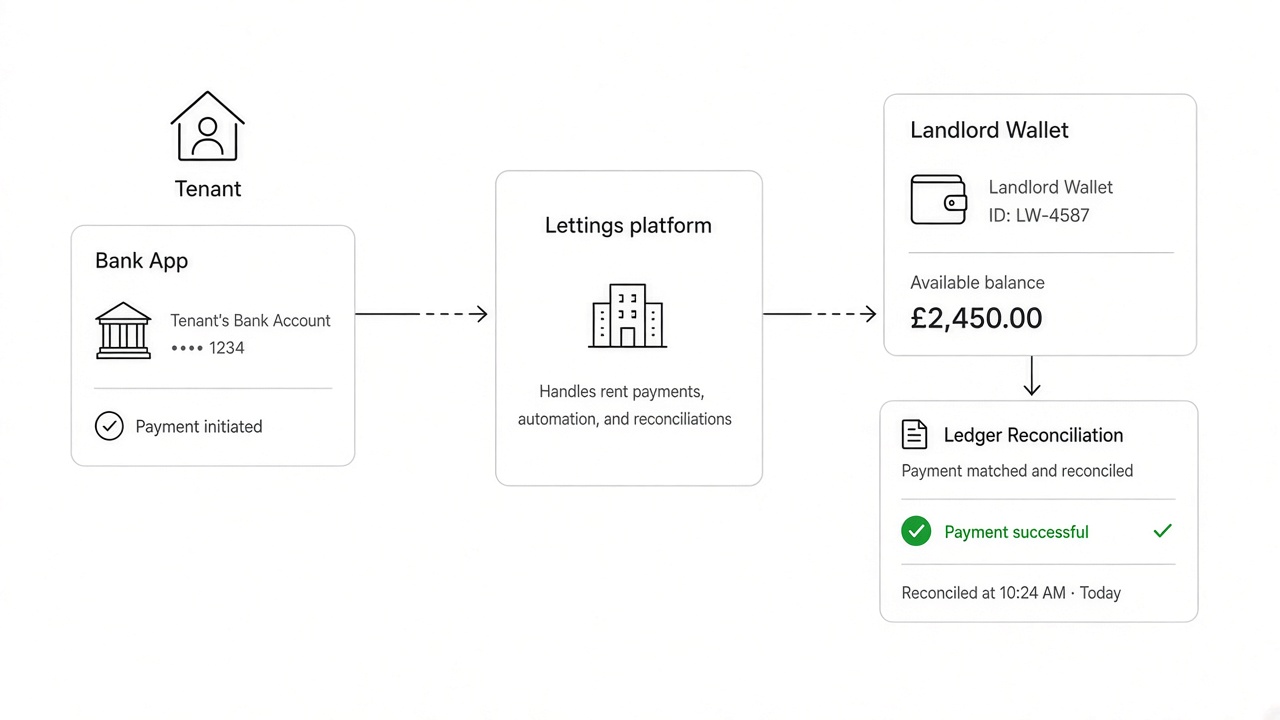
Open banking property management: Using regulated bank APIs — payment initiation, account verification, and recurring bank mandates — so lettings platforms, agencies, and build-to-rent operators collect rent and charges, verify tenant accounts, hold or reconcile deposits, and pay landlords without re-keying IBANs across CRM, accounting, and payment systems. Tenants grant consent in their banking app; funds move account-to-account.
Why are property management teams evaluating open banking?
Property teams evaluate open banking because rent is recurring, amounts change with renewals and service charges, and reconciliation breaks when inbound transfers arrive without tenancy references. A mid-size lettings platform with 15,000 active tenancies can spend six figures annually on card interchange for rent alone — before counting ops time matching anonymous bank transfers to unit IDs.
The pain points differ from generic subscription billing:
- Rent plus service charge — one tenancy may bill base rent, utilities pass-through, and parking; rails must support composite references or split payouts
- Deposit lifecycle — holding, topping up, and returning deposits needs verified IBANs and audit trails, not ad-hoc card charges
- Landlord disbursements — agencies collect from tenants and pay owners on schedules; inbound and outbound bank rails must share reconciliation keys
- Tenant churn at term end — final rent, deposit return, and arrears recovery often happen in the same two-week window
In the UK, regulated lettings and housing operators should map recurring strategy to commercial variable recurring payments (cVRP) and UK Payments Initiative (UKPI) sector rules alongside the FCA's welcome of the UKPI scheme launch. EU portfolios should confirm ASPSP coverage per market and pair bank pay with pay by bank invoice payment patterns for B2B landlord statements.
Open banking does not replace every rail. Standing orders and SEPA Direct Debit remain strong for flat monthly rent at scale. Cards still matter for holding deposits where local law expects card chargeback paths. The win is embedding bank rails in the tenancy journey — verify at move-in, collect each cycle, recover failures, disburse to landlords — rather than treating bank pay as a manual workaround.
How does monthly rent collection work on bank rails?
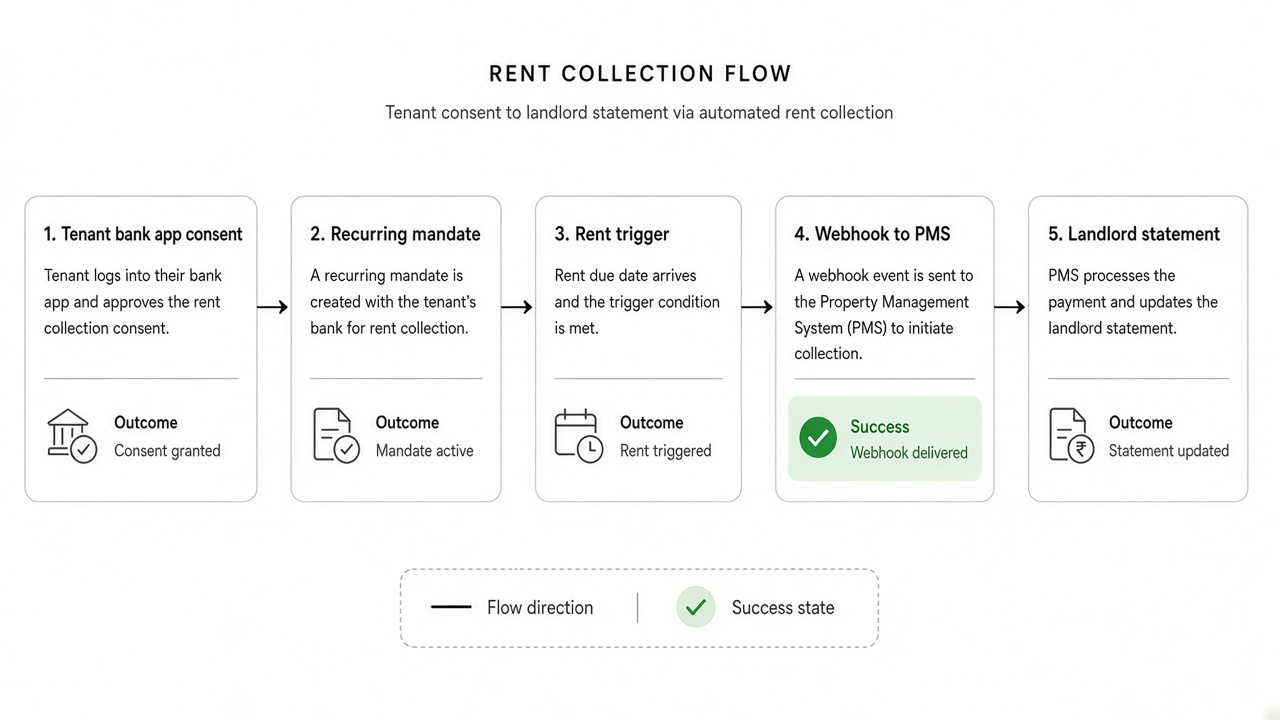
Monthly rent on bank rails starts with one tenant consent in their banking app, then your provider pulls each rent payment within caps the tenant agreed — without sending them back to checkout every month. That pattern matches build-to-rent portals and agency rent accounts where amounts may change at renewal within agreed limits.
A practical tenant journey:
- Tenant signs the tenancy and selects pay by bank or sets up a recurring mandate
- They authenticate with their bank and approve recurring collection with per-payment and monthly caps
- Your platform stores the mandate token — not card numbers
- Each rent period, your property management system triggers collection for rent plus configured service charges
- Webhooks confirm success or failure; tenancy ledgers and landlord statements update in real time
For UK operators, Open Banking Limited describes UKPI as an industry scheme with published transaction and access fees designed to support early adoption. Compare scheme economics alongside provider quotes using open banking pricing models — headline API rates rarely tell the full story when rent volume is high but average unit rent varies by city.
Trade-offs: recurring bank mandates require tenants to bank with an ASPSP that participates in your provider's coverage map. Pilot on one building or agency branch before migrating your full rent book.
What bank rails suit tenant deposits and move-in payments?
Deposits and move-in fees need pay-by-bank checkout or verified account capture so finance can match held funds to tenancy IDs — while recurring rent runs on mandates in parallel. When a tenant moves in, your team cannot afford a checkout flow that drops webhooks under peak season or returns references finance cannot tie to a unit.
| Rail | Best for property use | Main trade-off |
|---|---|---|
| Pay by bank (one-off) | Holding deposit, first month rent, arrears catch-up | Tenant action each time without a mandate |
| UK cVRP (UKPI where eligible) | Variable rent within caps after renewal | Confirm sector eligibility and bank coverage with provider |
| SEPA Direct Debit / Bacs | Flat monthly rent at very large scale | Slower failure notification than instant bank pay on some flows |
| Card on file | Markets where bank redirect is unfamiliar | Interchange, expiry, dispute cost on high volume |
For one-off move-in payments, pay by bank gives instant confirmation and a lower cost per successful payment than many card flows — useful when deposit plus first month exceeds card fee thresholds. Pair checkout with open banking account verification so the IBAN you hold for deposit return matches the tenant name on the tenancy agreement.
Deposit compliance is jurisdiction-specific — this article does not provide legal advice. Ops teams still need deterministic references on every inbound payment so audit and client-money rules are easier to evidence.
How can open banking support landlord payouts and agency reconciliation?
Agencies that collect rent and remit to landlords need the same reconciliation key on inbound tenant payments and outbound owner transfers — open banking webhooks should carry tenancy and landlord IDs finance can script against. Without that, month-end turns into spreadsheet matching between bank statements and your property management system.
Patterns that work for lettings finance:
- Single creditor reference per tenancy — encode unit, tenancy, and period in the payment reference returned on webhooks
- Split logic in your ledger — collect gross rent, allocate management fee, schedule landlord payout via separate bank initiation or batch file
- Verification before first payout — confirm landlord IBAN and name match before you store beneficiary details for recurring disbursement
- VoP on outbound transfers — where verification of payee is available, run name checks before high-value landlord payments
Marketplace-style operators should read open banking for marketplaces for seller payout timing — lettings adds tenancy law and client-money nuance, but the webhook discipline is the same.
How do you reduce failed rent payments and arrears recovery cost?
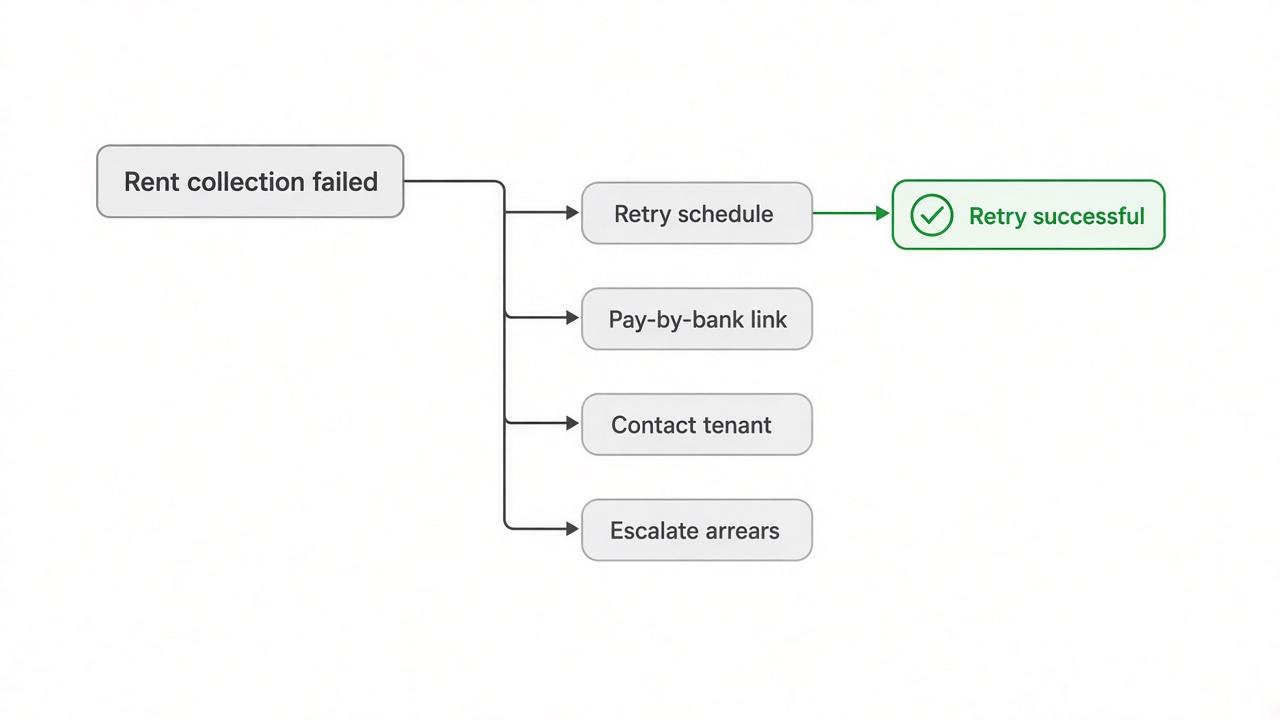
Failed rent often traces to closed accounts, insufficient balance on debit day, or mandates set up with incorrect details — open banking improves recovery with pay-by-bank retry links and automated re-attempt paths before you mark a tenancy in arrears. Property ops teams report that involuntary churn from payment failure rivals active move-outs on long-running portfolios.
Patterns that work:
- Automated retry — configure your bank-payment provider to retry failed collections on a schedule aligned with typical payroll dates in your city
- Smart recovery link — email or SMS with a pay-by-bank deep link for the exact arrears amount, pre-filled with tenancy reference
- Real-time PMS sync — when a collection fails, tenancy status updates immediately so relationship managers see arrears without waiting for batch reconciliation
- Affordability path for plans — where you offer payment plans, open banking affordability checks can support structured arrears agreements without manual statement uploads
For deeper recovery playbooks on bank rails, see open banking recurring dunning — the failure codes and mixed-rail fallback logic apply to rent books as well as subscriptions.
What should lettings teams evaluate in an open banking provider?
Shortlist providers on tenant bank coverage in your cities, recurring consent support for variable rent, webhook fields for tenancy references, and sandbox parity — not API marketing alone. Build-to-rent in London behaves differently from student housing in Berlin; gaps in one national champion bank show up as conversion loss at move-in.
Validation checklist before production:
| Criterion | Why it matters for property |
|---|---|
| Bank coverage per city | Tenants bank locally; gaps block move-in checkout |
| Variable amount / recurring consent | Renewals change rent within caps |
| Creditor reference in webhook | Finance matches thousands of tenancies |
| Deposit vs rent payment types | Some providers treat holding accounts differently |
| Landlord payout initiation | Outbound payments may need separate product scope |
| CRM / PMS integration | Webhooks must map to tenancy IDs your ops team already uses |
Run sandbox tests with your typical rent amounts — student rooms behave differently from prime-city family units on some bank rails. For a neutral comparison framework, see how to choose an open banking provider in the EU. When you are ready to match requirements to live coverage, use the provider-matching form to compare bank coverage, recurring support, and property-system integration against your portfolio markets.
Frequently asked questions
What is open banking for property management?
Open banking for property management uses regulated bank APIs so lettings platforms and agencies collect rent and charges, verify tenant and landlord accounts, reconcile deposits, and disburse to owners with explicit consent in the banking app — instead of relying solely on cards or manual bank transfers without tenancy references.
Can open banking replace cards for rent collection?
Often partially. Bank rails reduce interchange on successful account-to-account rent and improve reconciliation when webhooks carry tenancy IDs. Cards may remain for deposits or markets where tenants refuse bank redirect. Most operators run mixed rails by channel and tenant segment.
How does open banking help with tenant deposit reconciliation?
Pay-by-bank move-in payments and account verification return bank-confirmed IBANs and references tied to tenancy IDs. Finance can match held deposits to units without parsing unstructured transfer descriptions — subject to your provider's reference fields and local deposit rules.
Is open banking suitable for build-to-rent operators?
Yes, when your tenant banks participate in your provider's coverage map and your product supports recurring consent with amount caps for renewals. Build-to-rent teams often pilot one building, measure failure rates and reconciliation time, then expand across the portfolio.
How does rent collection open banking compare to direct debit?
Direct debit and Bacs remain proven at scale for flat monthly rent. Open banking adds faster settlement on many flows, instant failure signals on some rails, and tenant-managed consent in the banking app — useful when rent includes variable service charges. Many agencies run both during migration.
How do I choose an open banking provider for lettings?
Start from tenant and landlord bank coverage in your markets, recurring consent support, webhook reliability, payout initiation if needed, and integration with your property management system. Pilot on one agency branch or building, keep legacy rails live, and validate cap logic and arrears recovery before portfolio-wide rollout.
Lettings and build-to-rent teams that pilot open banking on one rent book — while keeping cards and direct debit live — can measure recovery rates, reconciliation time, and cost per successful rent before changing tenant-facing copy. Document tenancy reference formats and landlord payout rules first; provider fit follows from those operational requirements. When your checklist is ready, compare providers on coverage and integration fit rather than headline pricing alone.
Related articles
- Open Banking for Charities: Donation Collection Playbook
Charity finance and fundraising teams lose donor goodwill when collection friction shows up as failed monthly gifts, manual bank-transfer reconciliation, or ca…
- Open Banking for Telcos: Billing and Collection Playbook
Telecom resellers and managed service providers (MSPs) bleed margin on billing ops long before a network fault hits: manual mandate re-keying after contract si…
- Open Banking for Accounting: 6 Use Cases for Finance Teams
Small businesses and their accountants lose hours every month to the same friction: customers pay invoices by card and eat margin on fees, or they pay by manua…