Open Banking for Telcos: Billing and Collection Playbook
Telecom resellers and managed service providers (MSPs) bleed margin on billing ops long before a network fault hits: manual mandate re-keying after contract signing, failed collections on usage-rated invoices, and finance teams reconciling payments that arrive without deterministic references. Open banking for telcos gives billing and product leads bank-rail tools — pay by bank, account verification, and recurring bank authorisations — embedded in the contract-to-collection path so resellers scale customer bases without scaling back-office headcount. This playbook maps six use cases telco and MSP billing teams can pilot first, plus provider criteria before you commit.
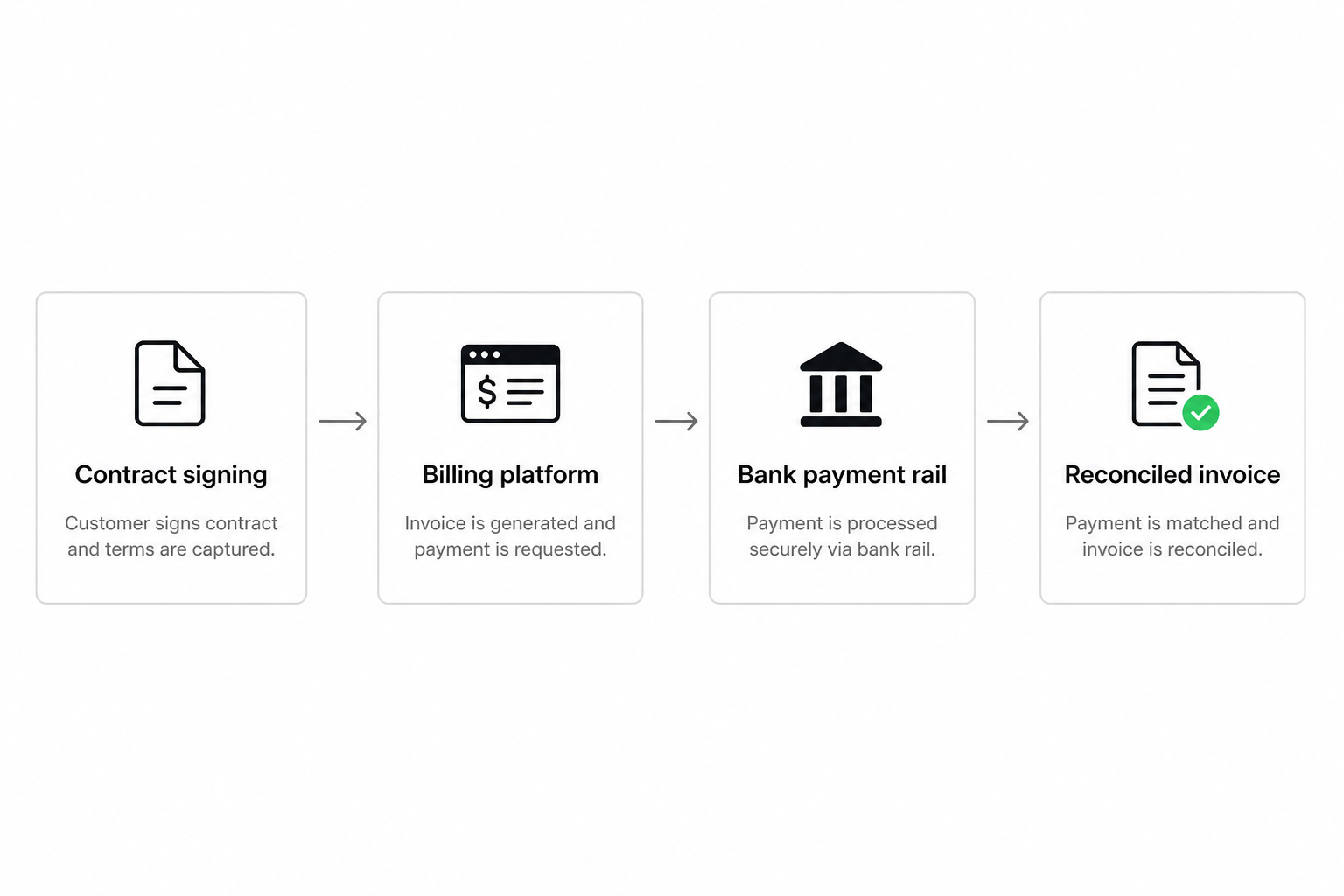
Open banking for telcos: Using regulated bank APIs — payment initiation, account verification, and recurring bank mandates — so telecom operators, resellers, and MSPs collect usage-rated bills, verify customer accounts at signup, and reconcile inbound payments from contract signing through each bill run. Customer consent is granted in their banking app or via a direct debit mandate; funds move account-to-account.
Why are telecom resellers and MSPs adopting open banking?
Telco and MSP billing teams adopt open banking because contract-to-collection friction and failed retries drain ops capacity on every new customer. Resellers often sign hundreds of SME contracts per quarter; each one traditionally required re-entering bank details into a separate payment portal after the billing system already captured them. Usage-rated telecom bills — mobile, VoIP, cloud seats, managed firewall — change every cycle, which makes card-on-file expensive and expiry-driven churn a recurring problem.
The economics differ from consumer utility billing covered in open banking utility payments:
- Reseller model — one billing platform serves many end-customer contracts; mandate setup must happen at contract signature, not in a follow-up email
- Usage-rated cycles — bill runs produce variable totals; rails must accept amount changes within agreed caps
- B2B account mix — SME business accounts dominate; coverage and verification must work on Girokonto-style accounts, not retail-only bank lists
- UK scheme timing — UK Payments Initiative (UKPI) Wave 1 includes telecoms for commercial variable recurring payments (cVRP), per the FCA's welcome of the scheme launch
Open banking does not replace every rail. SEPA Direct Debit and Bacs remain strong for flat recurring amounts. Cards still matter for prepay top-ups and channels where bank redirect is unfamiliar. The win is embedding bank rails inside the billing workflow — mandate at contract, collection at bill run, retry on failure — rather than treating payments as a separate system.
How does contract-to-collection automation work for telcos?
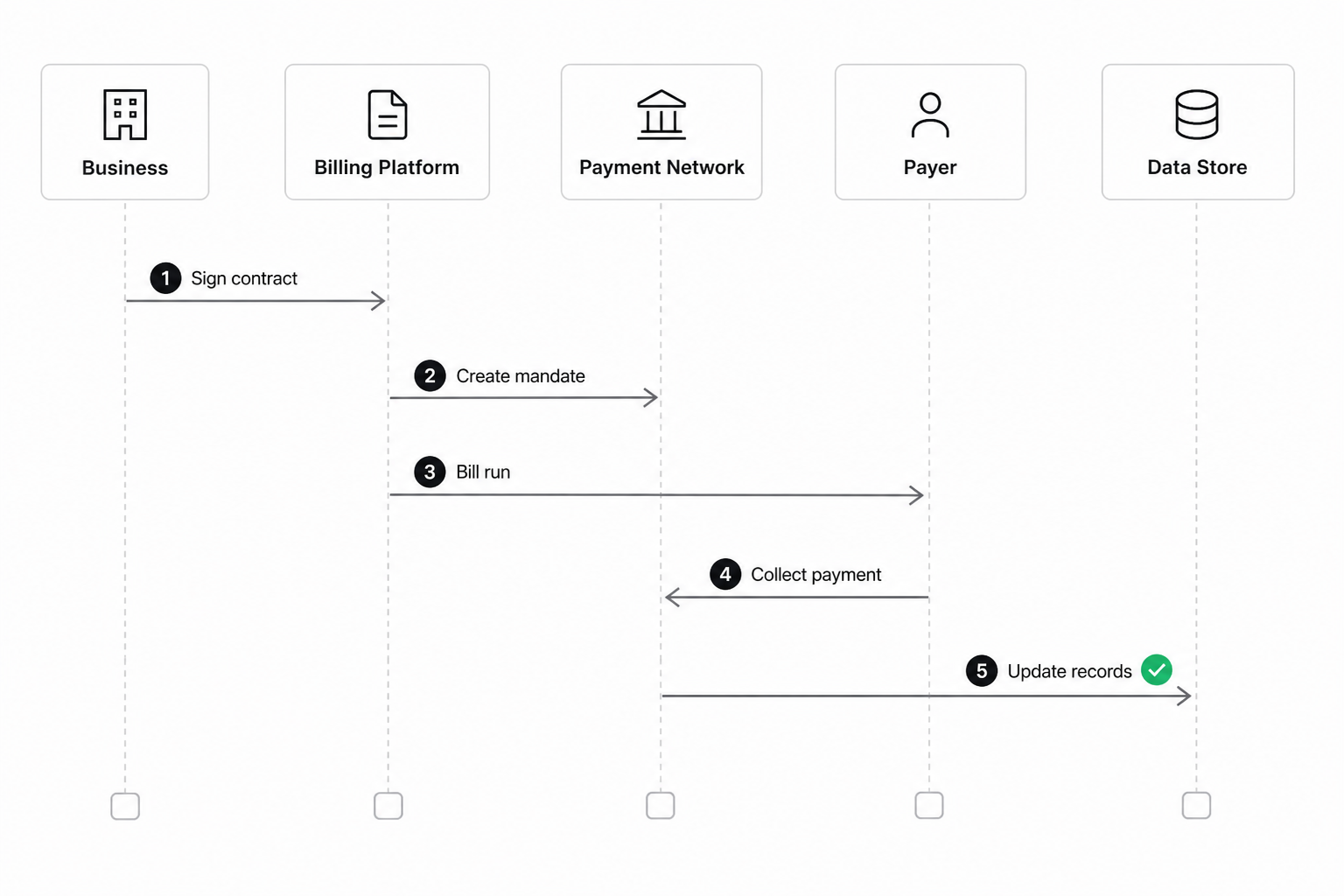
Contract-to-collection automation links electronic contract signing directly to mandate creation and future bill-run collections — removing the re-keying step that causes onboarding drop-off and reconciliation gaps. When a customer signs a telecom or MSP contract, their bank details and payment authorisation should flow into the payment provider in the same session.
A practical flow:
- Customer completes an electronic contract in your billing or CRM platform
- Bank details and direct debit or pay-by-bank consent are captured as part of the signature step
- Your open banking or bank-payment provider creates the customer profile and mandate automatically
- Each bill run triggers collection instructions without staff re-entering data in a separate portal
- Webhooks confirm success or failure; billing records update in real time
In July 2026, GoCardless announced a partnership with anvil — a billing platform for telecom and IT resellers — that embeds this pattern: mandate creation at contract signing, single-action collection after bill runs, and automated retry on failed payments. The architecture lesson applies regardless of vendor: payments belong inside the billing platform, not as a bolt-on portal your ops team logs into separately.
Trade-offs: embedded flows require your billing platform (or middleware) to expose webhooks and idempotent collection APIs. If you run legacy billing with batch file exports, phase contract-to-collection on new customer segments first.
What bank rails suit usage-rated telecom and MSP bills?
Usage-rated telecom bills need rails that tolerate variable amounts within customer-agreed caps — SEPA Direct Debit, Bacs, pay-by-bank for exceptions, and UK cVRP where eligible. A reseller billing mobile, VoIP, and managed IT services together often produces invoices that swing 30–40% month to month as usage shifts.
| Rail | Best for telco/MSP use | Main trade-off |
|---|---|---|
| SEPA Direct Debit / Bacs | Stable base fees plus predictable usage bands | Mandate setup; SDD chargeback windows |
| Pay by bank (one-off) | Catch-up payments, first bill, failed-collection recovery | Customer action each time without a mandate |
| UK cVRP (UKPI Wave 1) | UK telecoms with variable recurring bills | Wave 1 sector eligibility; confirm with provider |
| Card on file | Channels where bank redirect is unfamiliar | Interchange, expiry, dispute cost on high volume |
In the UK, Open Banking Limited describes UKPI as the first commercial open banking payment scheme; Wave 1 sectors explicitly include telecoms alongside regulated utilities and financial services. EU resellers should map recurring strategy to bank on file vs card on file patterns and evaluate providers against recurring transaction criteria — amount caps, consent UX, and webhook granularity matter more than headline API pricing for usage-rated cycles.
For one-off and exception payments, pay by bank gives instant confirmation at lower cost than card on high-value B2B invoices — useful when a reseller sends a usage spike bill mid-contract.
How can open banking reduce failed collections for MSP billing teams?
Failed collections on telecom and MSP invoices often trace to closed accounts, insufficient balance on retry day, or mandates created incorrectly at onboarding — open banking improves recovery with instant pay-by-bank links and automated retry paths. MSP billing teams running monthly bill cycles report that manual credit-control follow-up consumes disproportionate ops time relative to the revenue recovered.
Patterns that work for reseller billing:
- Automated retry — configure your bank-payment provider to retry failed collections on a defined schedule before escalating to credit control
- Smart recovery link — email or SMS with a pay-by-bank deep link for the exact arrears amount, pre-filled with creditor reference
- Real-time billing sync — when a collection fails, billing records update immediately so account managers see outstanding status without waiting for batch reconciliation
- Verified IBAN path — after first successful bank payment, retry future failures against the same verified account where regulations allow
Measure recovery rate and cost per successful collection, not just authorisation rate on the first attempt. A rail that looks cheaper per call but fails more often on certain business banks increases dunning FTE — especially across multi-country reseller portfolios.
How do you verify accounts when onboarding telco and MSP customers?
Account verification at contract signing stops wrong-IBAN mandates, speeds up first bill collection, and reduces fraud on credit notes and refunds. Telecom resellers onboarding SME customers often capture bank details typed from memory; mismatch rates drive failed first collections and ops tickets weeks later.
Open banking verification returns a bank-confirmed account holder name and IBAN match in one consent step. Billing teams use it to:
- Pre-fill mandate setup with a verified account at contract signature
- Block payouts and credit notes to accounts that do not match the named customer
- Shorten credit checks for hardware leasing or managed-service deposits without manual statement uploads
This mirrors income verification with open banking patterns but adds reseller timing: verification at contract signing prevents chasing the wrong account on the first usage-rated bill run.
What should telco billing teams evaluate in an open banking provider?
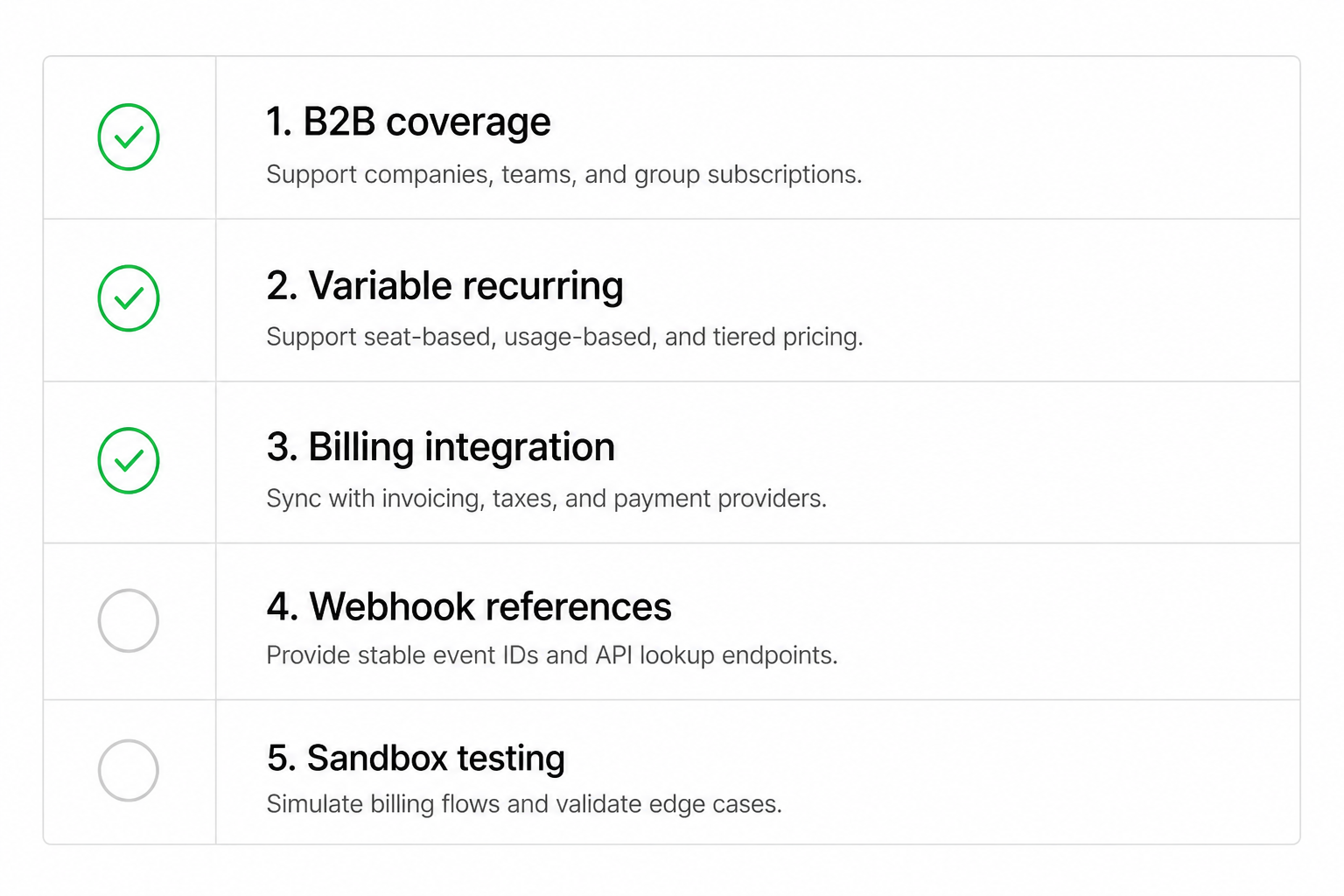
Shortlist providers on B2B bank coverage in your reseller markets, recurring consent support for variable amounts, webhook reliability, and billing-platform integration — not API marketing alone. Telecom reseller programmes span residential, SOHO, and SME accounts across many banks; a gap in one major ASPSP shows up as conversion loss on new contract campaigns.
Validation checklist before production:
| Criterion | Why it matters for telco/MSP billing |
|---|---|
| B2B account coverage per market | Reseller customers bank with national champions; retail-only lists fail |
| Variable amount / recurring consent | Usage-rated bills need rails that accept changing totals within caps |
| Billing platform integration | Contract-to-collection requires webhooks and idempotent collection APIs |
| Creditor reference in webhook | Finance matches thousands of invoice rows; references must be deterministic |
| Sandbox parity | Test usage spikes and failure paths before marketing a new payment method |
Run sandbox tests with your bill-run amount patterns and statement descriptors. For a neutral comparison framework, see how to choose an open banking provider in the EU. When you are ready to match requirements to live coverage, use the provider-matching form to compare bank coverage, recurring support, and billing integration against your reseller markets.
Frequently Asked Questions
What is open banking for telcos?
Open banking for telcos uses regulated bank APIs so telecom operators, resellers, and managed service providers collect usage-rated bills, verify customer accounts at contract signing, and automate recurring collections through account-to-account transfers with customer consent — instead of relying solely on cards or manual bank transfers between separate billing and payment systems.
Can telecom resellers use open banking for variable monthly bills?
Yes. Pay by bank handles one-off and variable amounts when the customer authorises each payment, or when a recurring bank mandate — such as SEPA Direct Debit, Bacs, or UK commercial variable recurring payments where eligible — allows amount changes within agreed limits. Usage-rated mobile, VoIP, and managed IT bills fit this pattern when caps and consent UX are configured correctly.
How does open banking compare to direct debit for telco billing?
Direct debit and Bacs suit stable recurring base fees and predictable usage bands; open banking adds instant confirmation on ad-hoc payments, account verification before mandates are set, and embedded contract-to-collection flows that remove manual re-keying. Most mature reseller stacks combine both — recurring mandate for the normal cycle, pay by bank for exceptions and failed-collection recovery.
Is UKPI relevant for UK telecom and MSP billing?
Yes. UK Payments Initiative Wave 1 includes telecoms among eligible sectors for commercial variable recurring payments, alongside regulated utilities and financial services. UK resellers with variable usage-rated bills should confirm Wave 1 eligibility with their payment provider and track Wave 2 scope for broader retail use cases expected later in 2026.
Can MSPs automate payment collection without a separate payment portal?
Yes, when the billing platform integrates directly with a bank-payment provider. The contract-to-collection pattern creates mandates at electronic contract signing and triggers collections after each bill run inside the same system — removing the step where staff re-enter customer bank details into a separate portal.
What is the difference between open banking for telcos and utilities?
Utilities content focuses on energy, water, and gas suppliers collecting inbound consumer bills. Telco and MSP playbooks target reseller billing platforms, usage-rated telecom services, B2B account mixes, and contract-to-collection automation for managed IT — different ops patterns even when both sectors appear in UKPI Wave 1.
How do I choose an open banking provider for telecom billing?
Evaluate B2B bank coverage in your reseller countries, support for variable recurring amounts, billing-platform integration (webhooks, idempotent APIs), webhook reference fields for reconciliation, and sandbox parity with your bill-run patterns. Run pilot tests on your top customer bank segments before committing production traffic.
Conclusion
Open banking for telcos and MSPs is less about adding another payment method and more about closing the gap between contract signing and reconciled invoice — mandate creation at onboarding, automated collections after usage-rated bill runs, and faster recovery when retries fail. UK resellers can layer UKPI Wave 1 recurring bank rails on top of existing Bacs or SEPA Direct Debit where eligible; EU resellers should verify B2B account coverage and variable-amount consent before marketing bank-pay options to SME customers. Pilot on one customer segment, keep legacy rails live during transition, and validate webhook and reference-field behaviour against your billing platform before you migrate the full reseller book.
Related articles
- Open Banking for Sports Clubs: Membership Fee Playbook
Grassroots treasurers lose evenings to chasing match fees in group chats, re-keying bank details after every new squad signup, and reconciling transfers that a…
- Open Banking for Property Management: Rent Collection Playbook
Lettings and build-to-rent ops teams bleed margin when rent collection depends on cards with interchange, slow bank-transfer reconciliation, or direct debits t…
- Open Banking for Charities: Donation Collection Playbook
Charity finance and fundraising teams lose donor goodwill when collection friction shows up as failed monthly gifts, manual bank-transfer reconciliation, or ca…