Open Banking Dunning: Bank-Rail Failed Payment Recovery
Involuntary churn on bank-rail renewals looks different from card dunning: there is no expired PAN to refresh, but consent can vanish overnight and insufficient funds may surface before you fire a pull. Open banking dunning is the ops playbook billing teams need when UK commercial variable recurring payments (cVRP) or EU SEPA Direct Debit collections fail — mapping provider failure codes to retry tiers, routing customers to mixed-rail fallbacks, and keeping finance reconciliation clean. This guide covers UK and EU patterns, how bank dunning differs from card retry calendars, and what to validate with your payment provider before month-end billing peaks.
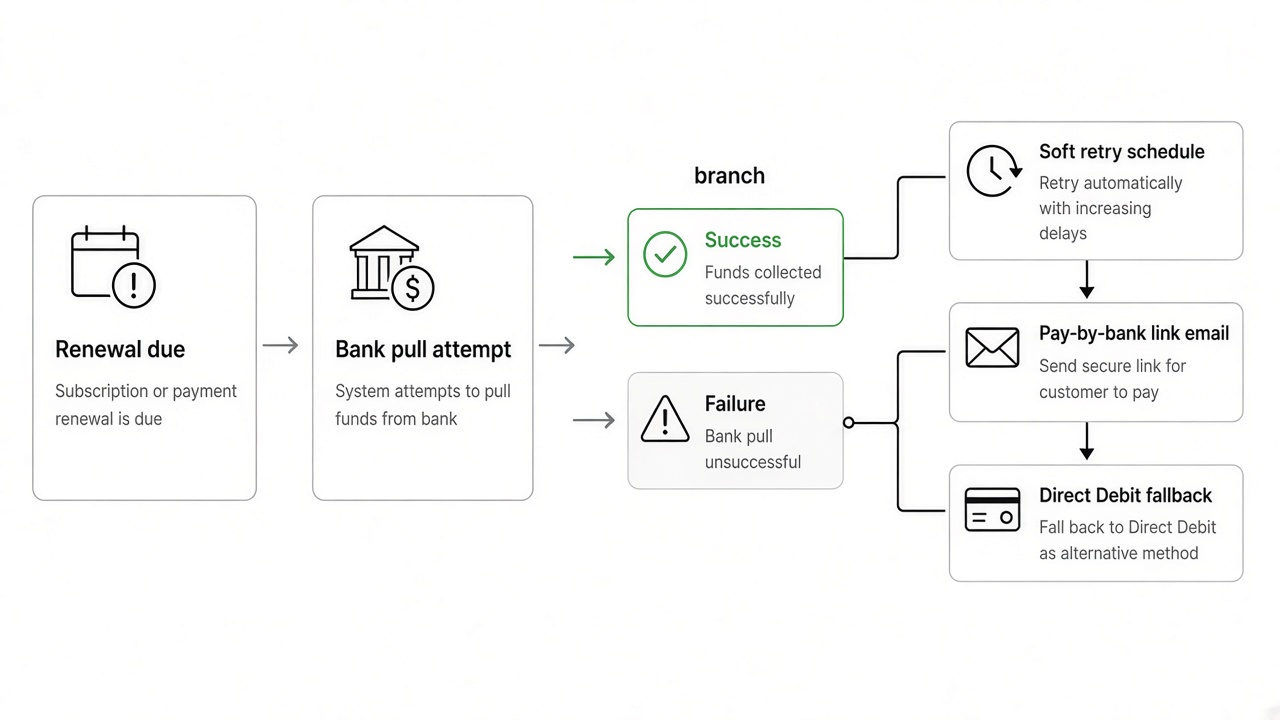
Open banking dunning: The retry, customer communication, and fallback-rail process your billing team runs when a recurring bank pull fails — whether that pull is a UK cVRP consent charge, a SEPA Direct Debit collection, or a mandate-based renewal after account verification.
Why does open banking dunning need its own playbook?
Bank-rail renewals fail for different reasons than cards, on different timelines, and with different recovery paths — so copying card dunning day-for-day usually wastes retries or sends the wrong customer message.
Card-on-file dunning assumes a stable token: retry the same PAN on day 1, 3, and 7 until the issuer approves or you downgrade the account. Open banking renewals depend on consent still being active, funds available at pull time, and bank coverage for your customer's institution. UK cVRP can surface insufficient funds before a doomed payment executes when balance checks run — a win for ops, but only if your billing engine treats pre-decline signals differently from post-settlement Bacs returns.
Teams adopting recurring pay by bank or open banking subscription billing without retuning dunning often see:
- Retries fired too fast after a hard decline, burning provider rate limits
- Customer emails asking for a new card when the subscriber pays from a bank account
- Finance chasing payments that failed three days ago on Direct Debit while cVRP failures were visible immediately
- Involuntary churn logged as "cancelled" because revocation webhooks never reached the CRM
According to Open Banking Limited's VRP overview, variable recurring payments give customers clearer mandate visibility and control in their banking app than many legacy recurring methods — which means recovery starts in the banking channel, not only in your billing portal.
How do UK cVRP failures differ from Direct Debit returns?
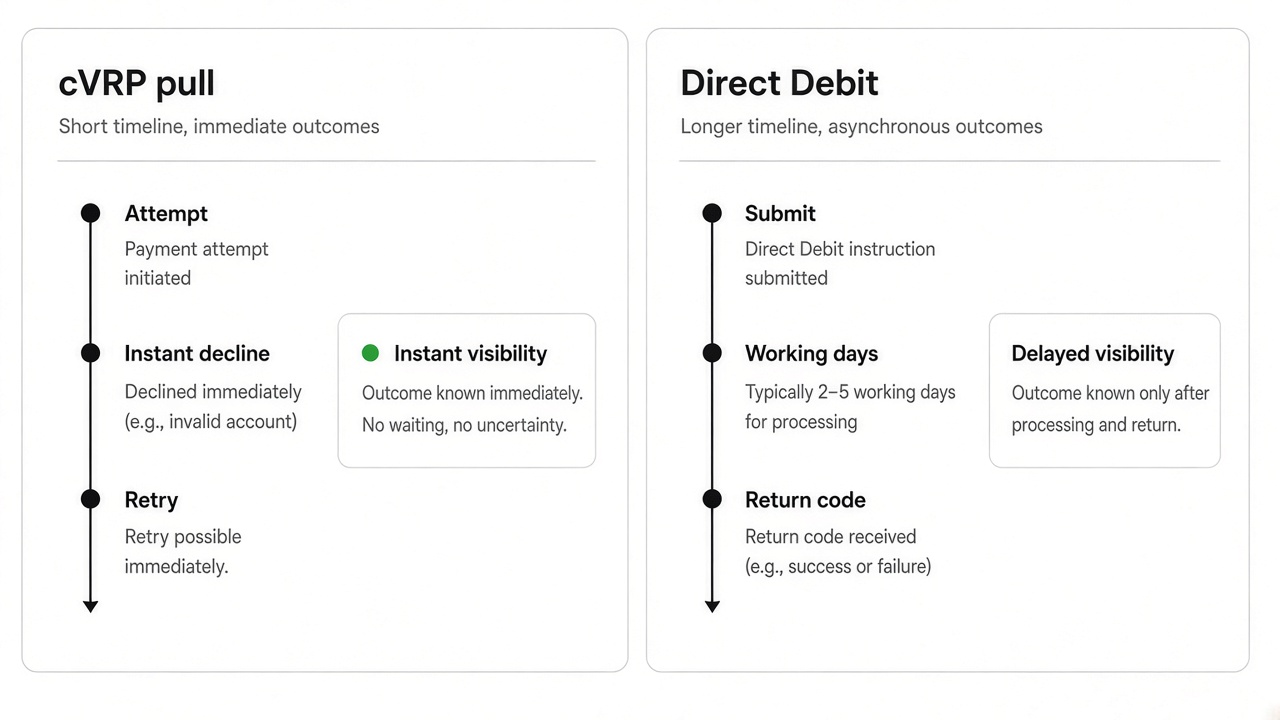
cVRP failures often arrive faster and with clearer pre-decline signals; Direct Debit returns land on Bacs timelines — your dunning calendar should treat them as parallel rails, not one queue.
| Signal | UK cVRP (open banking pull) | UK Direct Debit (Bacs) |
|---|---|---|
| Typical failure visibility | Often at or before pull attempt | Often 2–3+ working days via return reports |
| Customer action | Re-authorise in banking app or add funds | Update mandate or account details |
| Retry spacing | Provider and bank rules; avoid hammering same day | Scheme batch windows |
| Fallback | Route to DD if mandate exists, or pay-by-bank link | cVRP for net-new signups where covered |
Modulr's industry guidance on cVRP and Direct Debit as complementary rails reflects what large UK billers already run: cVRP where bank coverage and sector eligibility allow, Direct Debit for the remainder — with dunning logic segmented by rail. If you only monitor Bacs returns while cVRP failures sit in a separate webhook inbox, collections reports will lie about recovery rates.
For sector eligibility and Wave timing, cross-read commercial variable recurring payments (cVRP) and UKPI Wave 2 recurring payments before you promise bank-primary dunning to customers outside Wave 1 categories.
What failure codes should billing map to retry tiers?
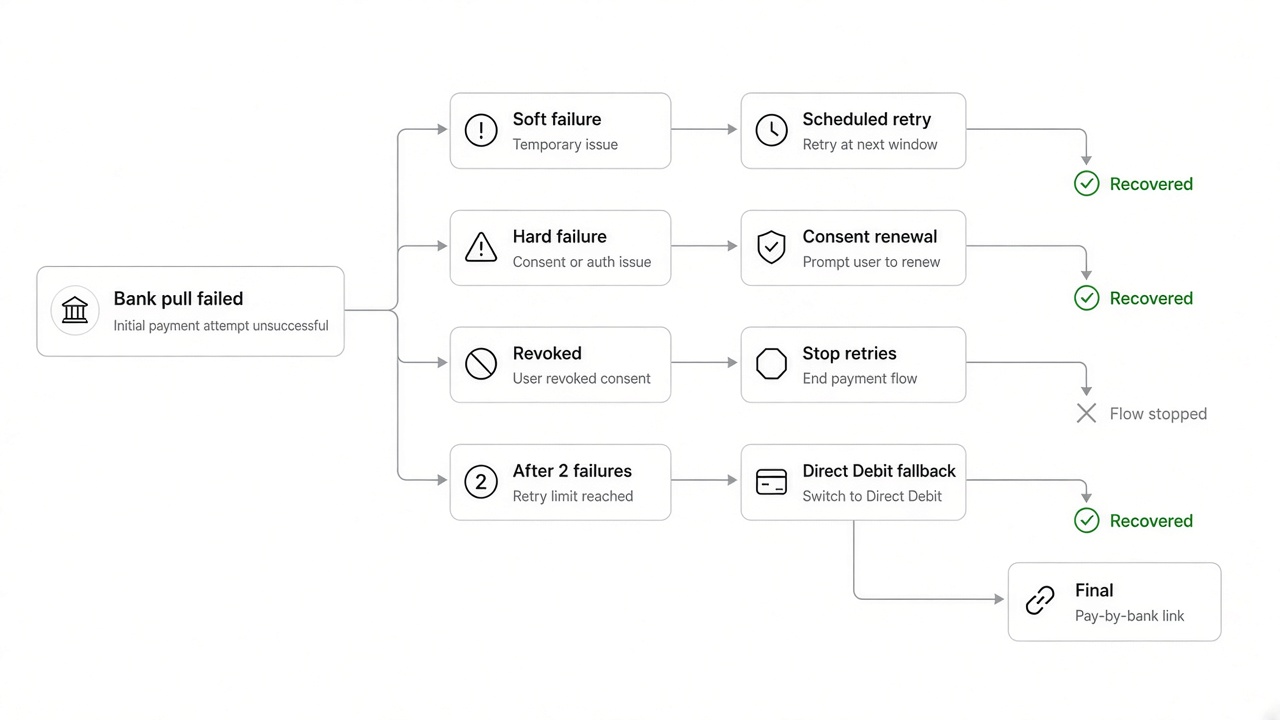
Segment bank failures into soft retries (timing or balance), hard stops (revoked consent or closed account), and coverage gaps (bank or sector not supported) — each tier gets a different retry count, email template, and fallback rail.
A practical three-tier model:
Soft failures — retry on a bank-specific calendar
Insufficient funds, temporary technical errors, and intermittent bank downtime fit here. Space retries longer than card networks often allow — many teams use T+2, T+5, T+10 for bank pulls rather than daily card hammering. If your provider supports balance checks before pull, treat pre-decline "insufficient funds" as soft: the customer may fund the account before the next attempt without re-consenting.
Hard failures — stop auto-retry and change rail or ask for new consent
Revoked consent, expired mandate caps, closed accounts, and authentication failures at setup belong here. Auto-retrying wastes API calls and annoys customers who already cancelled in their banking app. Trigger a consent renewal journey (hosted redirect or embedded flow per your redirect vs embedded setup) or fall back to Direct Debit or card if the customer still has an active legacy mandate.
Coverage and configuration failures — route to ops, not blind retry
Bank not participating, merchant category outside UKPI Wave 1, or amount above consent caps are not dunning problems — they are routing problems. Log them separately from involuntary churn so product teams see enrollment gaps rather than blaming collections copy.
Your PSP should document normalized failure codes in sandbox. Run forced-failure scenarios before production: insufficient funds, consent revoked mid-cycle, amount above cap, and bank timeout.
How should customer emails differ from card dunning?
Bank-rail dunning emails should point customers to their banking app or a pay-by-bank link — never ask for a new card number when the subscription runs on account-to-account rails.
Effective patterns:
- Subject line names the business and amount — "Your £42.00 renewal for [Brand] needs attention"
- Body explains the outcome in plain language — "We couldn't collect from your bank account" not "PIS initiation failed"
- Primary CTA — "Pay now" via hosted pay-by-bank link (pay by bank invoice payment patterns work for dunning recovery)
- Secondary CTA for consent issues — "Update permission in your banking app" with a short screenshot-free instruction list
- No card form on bank-primary dunning unless you operate explicit mixed-rail backup
Charity and donation programmes see the same pattern: open banking for charities notes that failed recurring gifts often trace to balance or mandate issues — recovery copy should invite a one-off pay-by-bank top-up before marking a donor lapsed.
What mixed-rail fallback should finance expect?
Most mature billing stacks run cVRP or open-banking pulls first, Direct Debit or card second — dunning must know which fallback is contractually allowed for each customer record.
A decision flow collections teams can implement:
- First failure on cVRP — soft retry once if balance-related; else email pay-by-bank link
- Second failure — attempt Direct Debit if an active mandate exists on file
- Third failure — offer card-on-file update only if your commercial model allows card backup
- Revoked consent — skip auto-retry; start consent setup from billing portal
Finance needs one reconciliation key per customer invoice across rails — IBAN reference, mandate ID, or provider payment ID — so a failed cVRP attempt and a successful DD collection on retry do not double-count revenue. Webhook payloads should land in the same billing object your ERP reads, not siloed spreadsheets per rail.
The UKPI Wave 1 commercial model assumes cVRP coexists with Direct Debit at scale; your dunning architecture should mirror that hybrid reality rather than betting on a single rail.
How does EU SEPA dunning differ from UK open banking dunning?
Euro-area subscription billing usually runs on SEPA Direct Debit after an initial verification — batch timing and mandate amendment rules replace UK cVRP consent caps, but the same tiered retry logic applies.
EU teams rarely label the workflow "VRP dunning." Instead:
- SDD Core collections batch on scheme calendars — retries align to submission cutoffs, not instant pull loops
- Mandate amendments for variable amounts may need customer notice periods — confirm with your provider before changing dunning to match UK cVRP speed
- Pay-by-bank recovery links work cross-border for one-off catch-up payments when SDD fails
- Revocation flows through mandate cancellation — CRM must listen for mandate status webhooks, not only payment success
Compare stored-method strategy in bank on file vs card on file when you design EU retry tiers alongside UK cVRP pilots.
What should you validate with providers before go-live?
Run sandbox failure drills that mirror month-end volume — webhook delivery, idempotency, and normalized failure codes matter more than marketing claims about "VRP enabled."
| Check | Why it matters for dunning |
|---|---|
| Failure code taxonomy | Maps to your soft/hard/coverage tiers |
| Revocation webhooks | Stops retries when consent dies in banking app |
| Idempotent retry API | Prevents double charges on ops-triggered retries |
| Pay-by-bank link generation | Recovery path when auto-pull exhausts |
| DD fallback orchestration | Single API vs manual rail switch |
| Statement references | Finance matches retries to original invoice |
| Incident status page | Month-end billing peaks need transparency |
Use the provider-matching form to filter on recurring rail support and webhook depth for your billing countries, then pilot one product segment before migrating the full book. For evaluation dimensions beyond dunning, see open banking provider comparison.
Frequently Asked Questions
What is open banking dunning?
Open banking dunning is the process of recovering failed recurring bank collections — retry scheduling, customer communication, and fallback rails — when renewals run on UK cVRP, SEPA Direct Debit, or other mandate-based bank pulls instead of card-on-file. It maps provider failure codes to action tiers so billing ops do not treat bank declines like card retries.
How is open banking dunning different from card dunning?
Card dunning retries the same token on short intervals because failures are often issuer-side or temporary limits. Bank-rail dunning must handle revoked consent, pre-decline balance checks, Bacs return delays on Direct Debit, and recovery via banking-app re-authorisation or pay-by-bank links — not card updater services.
What causes involuntary churn on bank-rail subscriptions?
Insufficient funds, revoked consent or cancelled mandates, closed accounts, sector ineligibility under UKPI rules, and bank coverage gaps — not expired cards. Segmented reporting by rail prevents misattributing cVRP failures to voluntary cancellation.
How many retries should you run on a failed cVRP pull?
Most UK billers use fewer, spaced retries than card dunning — for example T+2, T+5, and T+10 for soft balance failures — then switch to a pay-by-bank link or Direct Debit fallback. Hard failures (revoked consent) should not auto-retry; start a new consent journey instead.
Can you send a pay-by-bank link instead of retrying an automatic pull?
Yes. One-off pay-by-bank links are a standard recovery path when automatic pulls exhaust soft retries — the same infrastructure as pay by bank invoice payment. Finance should reconcile the link payment to the original failed renewal invoice.
Do you need separate dunning rules for cVRP and Direct Debit?
Yes. cVRP failures often surface immediately; Direct Debit returns follow Bacs timelines. Running one dunning queue for both rails double-counts failures or misses early recovery windows. Hybrid billers segment by rail per Modulr's complementary-rail guidance and unified reporting in the billing platform.
How do EU teams handle dunning for SEPA subscription billing?
EU subscription billing typically uses SEPA Direct Debit batches with scheme-specific retry windows and mandate amendment rules. Dunning emails should reference mandate updates or pay-by-bank catch-up links rather than UK cVRP banking-app consent copy — unless you operate UK customers on UKPI rails in parallel.
Conclusion
Open banking dunning is where recurring revenue either holds or leaks after the signup consent looks successful. UK teams running cVRP need retry tiers that respect instant failure signals and hybrid Direct Debit fallbacks; EU teams align SEPA batch calendars and mandate rules with the same soft/hard/coverage segmentation. Retune email copy, webhook routing, and finance reconciliation before you scale bank-primary billing — then measure recovery rate per rail, not blended churn alone.
Related articles
- UKPI Wave 2 Recurring Payments: E-commerce Prep Guide
If you run a UK subscription business — SaaS, streaming, membership clubs, or general e-commerce with renewals — you have watched UKPI Wave 1 launch without yo…
- Wero Bill Payments France: What Orange's Launch Means
If you collect monthly bills in France — mobile plans, utilities, SaaS subscriptions — your customers already pay from banking apps more often than from card f…
- VRP Sweeping: Me-to-Me Open Banking Transfers Explained
Treasury and product teams want idle cash to earn interest, credit balances to shrink on schedule, and overdraft fees to drop — without asking the customer to…