Wero Bill Payments France: What Orange's Launch Means
If you collect monthly bills in France — mobile plans, utilities, SaaS subscriptions — your customers already pay from banking apps more often than from card forms. Wero bill payments add a scheme-native path: customers authorise each bill or recurring pull through the Wero wallet embedded in their bank app, with instant account-to-account settlement instead of card interchange. On 2 September 2026, Orange became the first merchant in France to offer Wero for subscription bill payment, turning a pilot roadmap into a live collection rail that telcos, utilities, and other billers will watch closely.
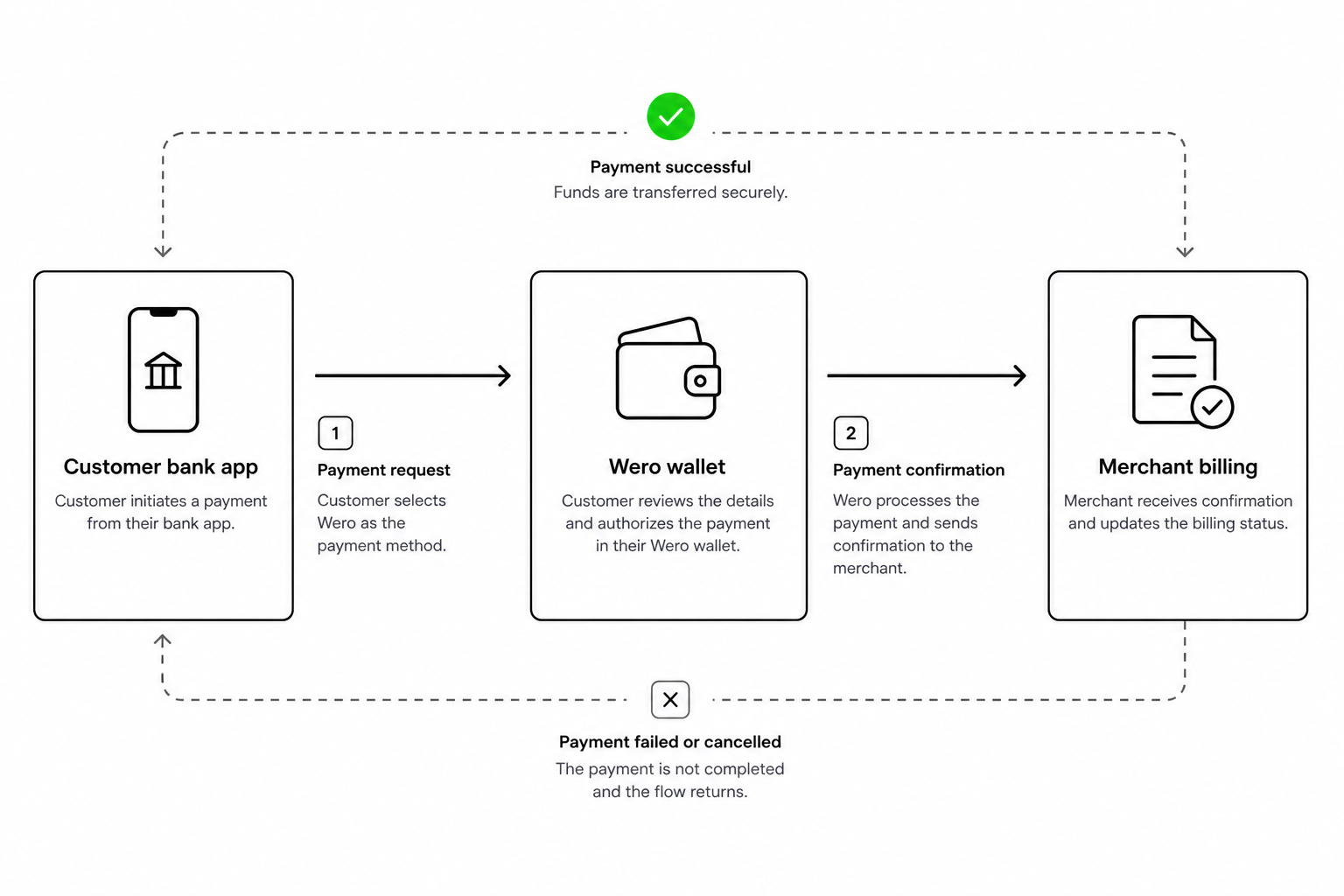
Wero bill payments: Monthly or usage-rated bills collected through the European Payments Initiative's Wero wallet — customers approve payment in their banking app, funds move account-to-account via instant transfer rails, and merchants receive scheme-standard confirmation without card networks. Distinct from open-banking Pay by Bank APIs, Wero bill payments run on the EPI scheme with participating French banks.
What are Wero bill payments?
Wero bill payments let customers settle recurring or one-off bills through the Wero wallet inside their bank app, with instant account-to-account transfer instead of card entry. The European Payments Initiative (EPI) designed Wero first for person-to-person transfers; e-commerce and bill-payment use cases rolled out from 2026 in Germany, Belgium, and France. For billers, the shopper experience resembles iDEAL-style bank checkout — select Wero, approve in the banking app — but settlement runs on SEPA Instant rails through the scheme rather than a merchant's standalone payment initiation contract.
Bill payment differs from one-off e-commerce checkout in three ways billing teams care about:
- Recurring context — the customer already has a relationship with the biller; Wero can support subscription and repeat bill flows as EPI expands merchant features
- Mobile-first behaviour — Orange reported that more than 70% of customers not on direct debit already pay monthly mobile bills through its app (Paiement.fr, March 2026); Wero embeds into that habit loop
- Scheme reporting — transaction IDs and settlement files follow EPI formats, not each bank's legacy card-acquirer layout
Wero bill payments are not open-banking API initiation in the PSD2 sense — merchants integrate through EPI-participating acquirers and PSPs (Orange uses Axepta BNP Paribas). Teams evaluating bank-rail collection should treat Wero as a scheme path alongside Direct Debit, pay-by-bank APIs, and cards.
Why does Orange's launch matter for subscription businesses?
Orange going live with Wero bill payments proves that France's largest telco trusts the scheme for monthly mobile billing — a reference point for any subscription business weighing bank-rail collection. Finextra reported on 2 September 2026 that Orange became the first merchant in France to offer subscription bill payment with Wero, extending a pilot that included e-commerce checkout partners such as Veepee and the École du Ski Français after Groupe BPCE completed the first Wero e-commerce transactions in April 2026.
Why billing leads should note the timing:
| Signal | What it means for your roadmap |
|---|---|
| First bill-payment merchant live | EPI's recurring/bill use case is production-ready in France, not slide-deck |
| Telco at scale | Variable monthly amounts and high mobile-app traffic — harder test than fixed-fee retail |
| Pilot merchant feedback loop | EPI consults launch merchants on dispute handling, reporting formats, and refund paths |
| Bank wallet reach | Wero passed 43.5 million registered users across Belgium, France, and Germany by September 2025 per EPI; French banks including BPCE, Crédit Agricole, and Société Générale embed Wero in retail apps |
Subscription businesses outside telecom — utilities, insurance premiums, SaaS with EU billing entities — gain a live case study for mobile bill pay without card-on-file. That matters where interchange erodes margin on low-ticket recurring amounts or where expiry-driven card churn inflates dunning cost. Cross-read open banking subscription billing for open-banking API patterns; this article covers the Wero scheme path specifically.
How do Wero bill payments differ from Pay by Bank and Direct Debit?
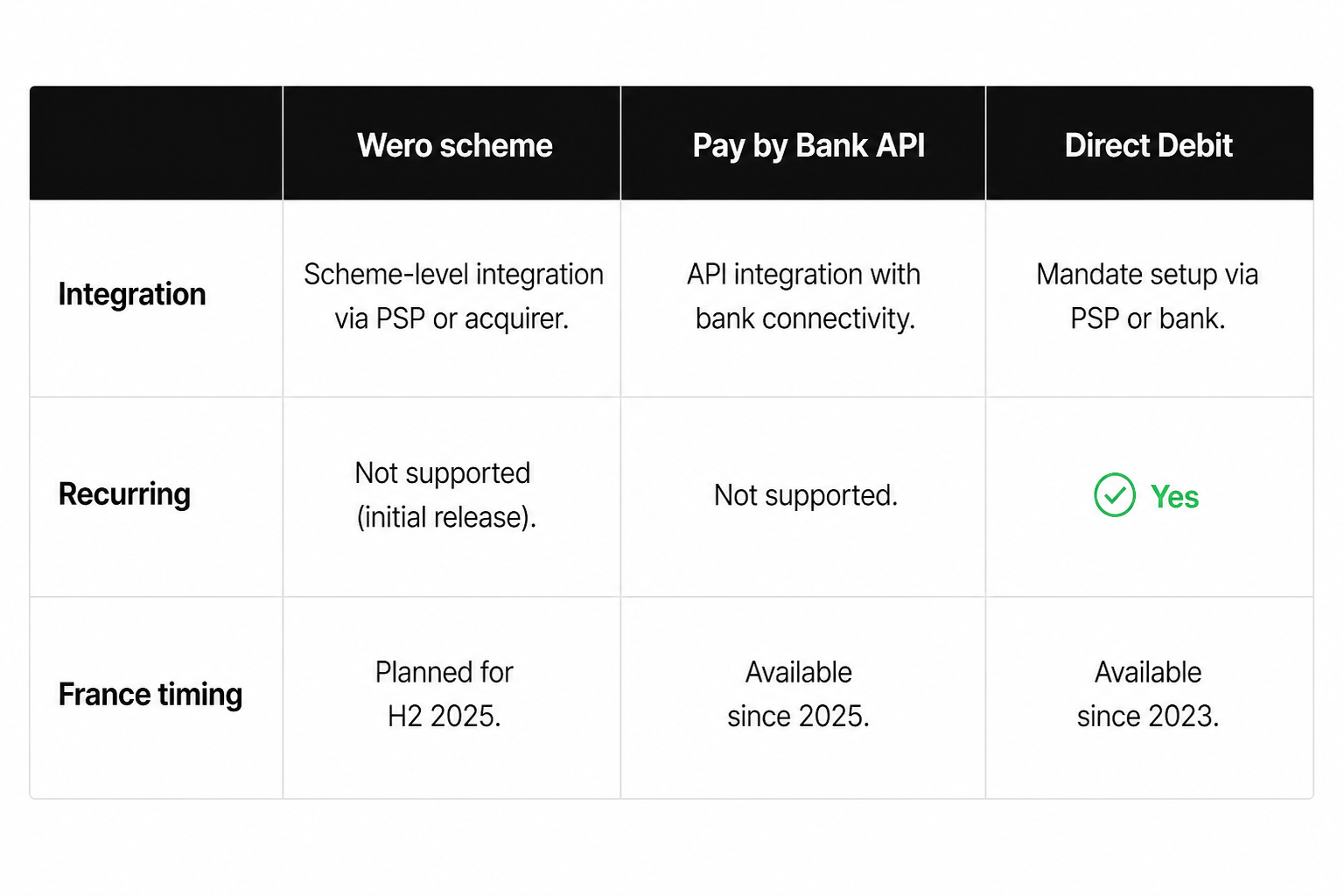
Wero bill payments run on the EPI scheme through participating acquirers; Pay by Bank uses licensed payment initiation APIs; Direct Debit uses mandate-based pulls on SDD or Bacs rails — three integration models with different ops trade-offs.
| Criteria | Wero bill payments | Open-banking Pay by Bank | SEPA Direct Debit / Bacs |
|---|---|---|---|
| Integration | EPI-participating PSP/acquirer | Licensed TPP payment initiation API | Mandate + creditor identifier |
| Customer UX | Wero wallet in bank app | Bank selection → app approval | Mandate setup; silent collection after |
| Recurring | EPI subscription roadmap (expanding 2026+) | VRP / Bank on File where banks support | Core strength for fixed/variable within caps |
| France timing | Live for pilot merchants (Orange bill pay Sep 2026) | Available via multiple TPPs today | Mature; strong for utilities |
| Multi-market | EPI expansion (DE, BE, FR; NL iDEAL migration) | Provider-dependent EU coverage | SEPA geography; UK Bacs separate |
None of these rails eliminates the others. A French utility might keep SDD for customers on mandate, add Wero for mobile-app payers who resist card entry, and use pay by bank APIs for one-off catch-up invoices. Netherlands-heavy portfolios should also read pay by bank Netherlands — iDEAL migrates to Wero on a fixed timeline, so France bill-payment lessons preview NL subscription flows.
The decision is architectural: scheme standardisation vs provider flexibility. Wero gives a single European wallet brand customers may already use for P2P transfers. Pay by Bank gives merchants direct control over initiation, webhooks, and multi-country routing through a TPP — see bank on file vs card on file for recurring API comparisons.
What should billing teams prepare before accepting Wero bill payments?
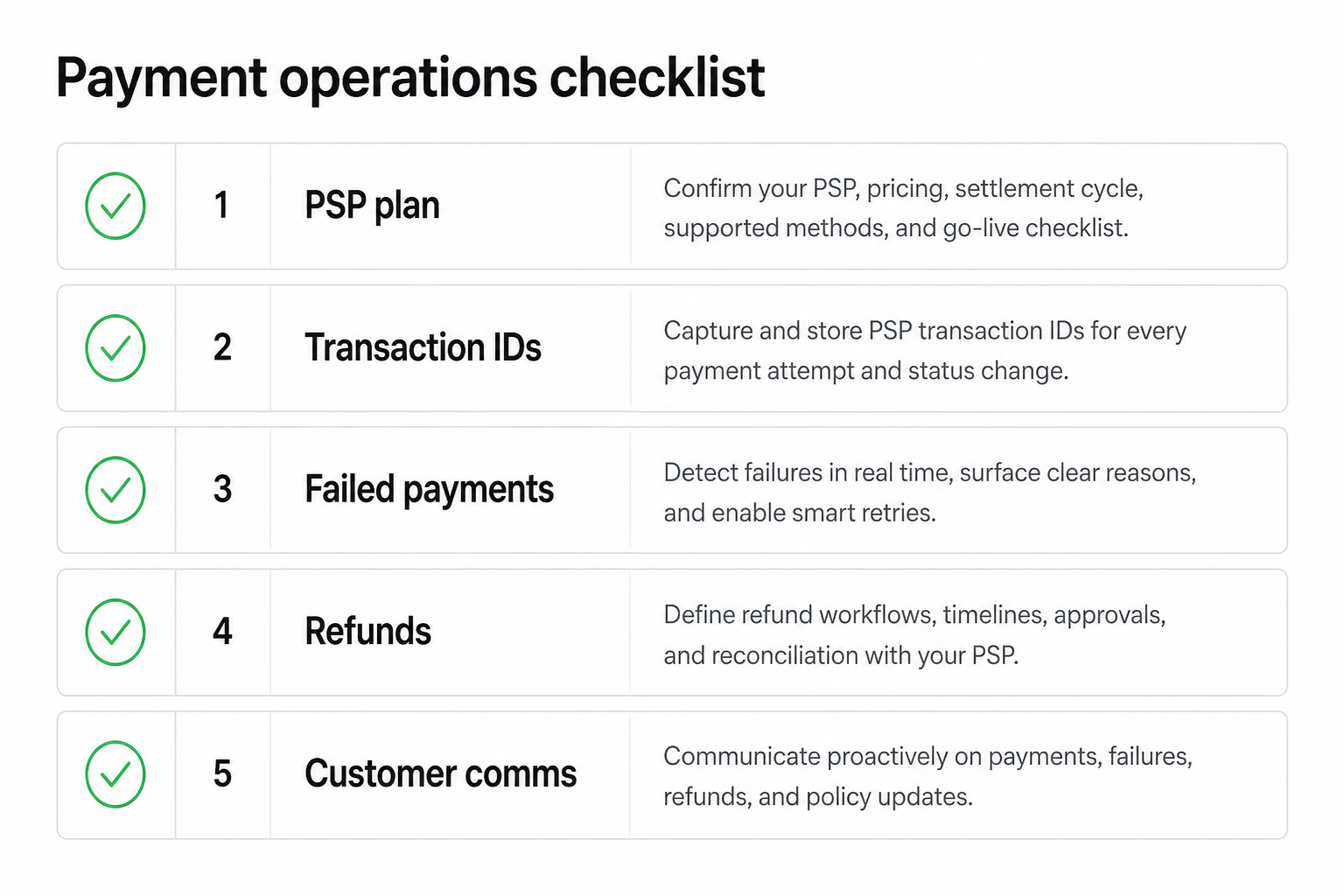
Billing teams should confirm PSP migration dates, map new Wero transaction IDs into reconciliation, test mobile checkout on major French retail banks, and align support scripts before marketing Wero to customers. Orange's pilot work with EPI covered dispute formats, refund journeys, and reporting — the same ops gaps any biller will hit at go-live.
Pre-launch checklist:
- PSP written plan — Which acquirer handles Wero bill pay, and when does your billing platform receive production webhooks?
- Transaction ID mapping — Wero IDs differ from legacy card and virement references; finance must ingest both during mixed-rail periods
- Partial and failed payments — Define retry logic: second Wero attempt, fallback pay-by-bank link, or SDD where mandate exists
- Refund path — Instant A2A refunds need verified beneficiary details; align with pay by bank refunds ops patterns
- Customer comms — Explain Wero in the app where customers already pay bills; do not assume wallet awareness (Orange cited 34% Wero brand recognition among its base in early 2026)
Sandbox testing should mirror real bill amounts — usage-rated mobile, pro-rata upgrades, and failed-collection recovery — not €1 test payments. Telco billing teams can cross-reference open banking for telcos for contract-to-collection patterns that complement Wero wallet checkout.
How do you evaluate providers for Wero vs open-banking recurring?
Shortlist providers on French bank coverage through your PSP, Wero scheme participation, webhook reliability for bill-run reconciliation, and whether one contract covers Wero checkout plus open-banking initiation for multi-market rollouts. Orange selected Axepta BNP Paribas as PSP after a formal tender — most billers will inherit Wero access through an existing acquirer rather than integrating EPI directly.
Validation questions before production:
| Criterion | Why it matters for Wero bill payments |
|---|---|
| EPI / Wero scheme access | Not every TPP offers Wero; confirm bill-payment SKU, not just e-commerce checkout |
| Recurring and variable amounts | Monthly bills swing with usage; caps and consent UX must match your billing model |
| Creditor reference in webhook | Finance matches thousands of invoice rows; references must be deterministic |
| Refund API latency | Instant rails raise customer expectations on credit-note speed |
| Multi-rail reporting | Unified settlement files if you run Wero, SDD, and Pay by Bank in parallel |
France-specific coverage sits in open banking France; for a neutral comparison framework across rails, see how to choose an open banking provider in the EU. When you need live coverage matched to your biller profile, use the provider-matching form to compare Wero scheme access, recurring APIs, and French bank reach without vendor rankings.
Frequently Asked Questions
What are Wero bill payments?
Wero bill payments are monthly or one-off bills collected through the European Payments Initiative's Wero wallet. Customers approve payment in their banking app, funds transfer account-to-account via instant payment rails, and merchants receive scheme-standard confirmation through an EPI-participating payment service provider — without card network fees on each successful payment.
Who was the first merchant to offer Wero bill payments in France?
Orange became the first merchant in France to offer subscription bill payment with Wero, according to Finextra on 2 September 2026. Orange and its Sosh brand let mobile customers pay monthly bills through Wero after piloting Wero e-commerce checkout with other French launch merchants earlier in 2026.
Are Wero bill payments the same as open banking Pay by Bank?
No. Wero bill payments run on the EPI payment scheme through participating acquirers and the Wero wallet embedded in customer bank apps. Pay by Bank uses licensed payment initiation providers and open banking APIs to connect merchants directly to banks. Both use account-to-account transfers with customer consent, but integration models, contracts, and multi-market expansion paths differ.
Can utilities and SaaS companies use Wero for recurring billing?
EPI's roadmap includes subscription and bill-payment features beyond one-off e-commerce checkout. French utilities already collect via SEPA Direct Debit; Wero adds a mobile-wallet path for customers who pay bills through banking apps. SaaS teams with French billing entities should confirm with their PSP whether Wero bill pay is available for their sector and amount patterns before committing.
How does Wero bill payment compare to SEPA Direct Debit for French billers?
SEPA Direct Debit pulls funds on mandate after customer signup — strong for stable recurring amounts and mature dunning workflows. Wero bill payments suit mobile-first customers who prefer approving each bill or recurring pull in a wallet they already use for P2P transfers. Many billers will run both rails: SDD for mandate customers, Wero for app-native payers.
Will Wero bill payments expand beyond France?
Yes. EPI launched Wero e-commerce in Germany and Belgium before France, and the Netherlands begins iDEAL-to-Wero migration from October 2026. Bill-payment features will follow scheme rollout per market. Merchants selling across EU markets should ask providers about unified reporting as Wero bill pay scales country by country.
How should I test Wero bill payments before go-live?
Run sandbox tests with real bill amount patterns — usage spikes, pro-rata charges, and failed-payment recovery — on ING, BNP Paribas, Crédit Agricole, and Société Générale retail accounts where your customers bank. Verify webhook transaction IDs ingest into your ERP, refund flows return funds to verified IBANs, and support scripts explain Wero to customers who only know direct debit today.
Conclusion
Wero bill payments give French billers a scheme-native way to meet customers inside banking apps they already use for monthly bills — with Orange's September 2026 launch proving the recurring use case works at telco scale. The work for billing and product teams sits in PSP integration, reconciliation updates, and an honest comparison against Direct Debit and open-banking Pay by Bank for your amount patterns and markets. Start with your acquirer's Wero bill-payment timeline, test on real French bank accounts, then validate whether one provider covers Wero scheme checkout and API-based recurring for the rest of your EU footprint.
Related articles
- Open Banking Dunning: Bank-Rail Failed Payment Recovery
Involuntary churn on bank-rail renewals looks different from card dunning: there is no expired PAN to refresh, but consent can vanish overnight and insufficien…
- UKPI Wave 2 Recurring Payments: E-commerce Prep Guide
If you run a UK subscription business — SaaS, streaming, membership clubs, or general e-commerce with renewals — you have watched UKPI Wave 1 launch without yo…
- VRP Sweeping: Me-to-Me Open Banking Transfers Explained
Treasury and product teams want idle cash to earn interest, credit balances to shrink on schedule, and overdraft fees to drop — without asking the customer to…