VRP Sweeping: Me-to-Me Open Banking Transfers Explained
Treasury and product teams want idle cash to earn interest, credit balances to shrink on schedule, and overdraft fees to drop — without asking the customer to log in every week. VRP sweeping is the UK open banking pattern that automates those me-to-me moves: the customer approves once in their banking app, and your platform pulls funds between their own accounts within agreed limits. Open Banking Limited refreshed its sweeping Q&As in March 2026 after the CMA clarified which destination accounts qualify, including savings that beat current-account rates and credit-card repayments that compete with overdrafts. This guide explains what VRP sweeping is, how it differs from commercial recurring collections, which use cases pass the CMA definition, and what to validate before you pick a provider.
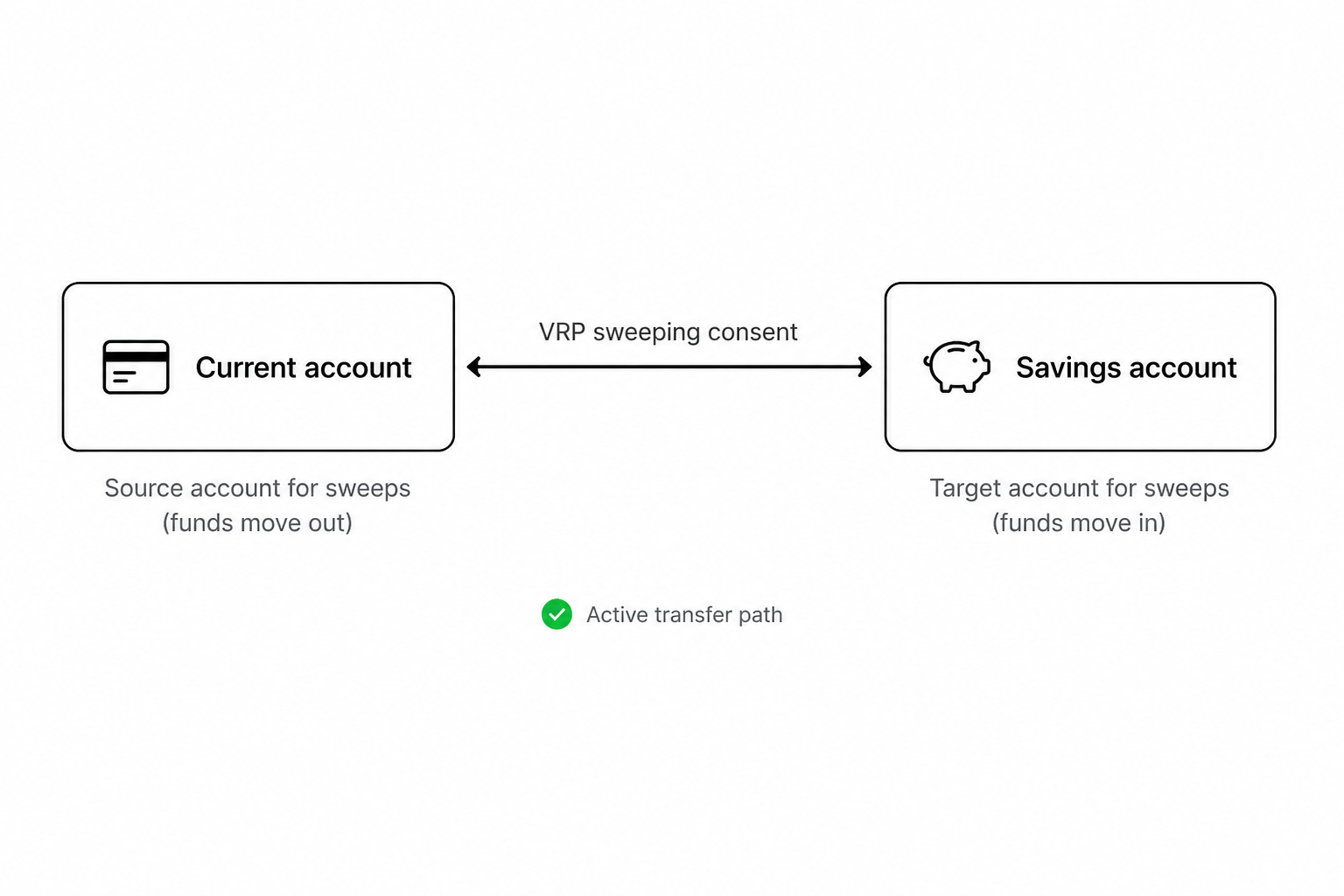
VRP sweeping: Automatic transfers of money between a customer's own accounts — for example from a current account into a higher-interest savings pot or toward a credit-card balance — after a single consent in their banking app. The customer keeps control through per-payment and monthly caps; the move never pays a third-party merchant.
What is VRP sweeping in plain English?
VRP sweeping is open banking's me-to-me recurring transfer: one consent in the banking app, then automated pulls between accounts the same person or business owns, within limits they set.
Unlike paying a supplier or subscription bill, sweeping never sends money to your company as the merchant. Your product orchestrates the journey — round-ups into savings, scheduled credit-card repayments, or cash sweeps that reduce overdraft use — but both accounts belong to the customer. UK mandated banks under the CMA Order must offer sweeping access to licensed payment initiation providers; the service is expected to stay free for sweeping, separate from commercial variable recurring payments that bill businesses under UKPI.
If you are evaluating open banking for collecting from customers, you need commercial variable recurring payments (cVRP) or recurring pay by bank, not sweeping. For the full VRP taxonomy, see variable recurring payments explained.
How is VRP sweeping different from commercial VRP?
Sweeping moves money between a customer's own accounts; commercial VRP pays a business. Mixing the two breaks scheme rules, pricing models, and customer expectations.
| Dimension | VRP sweeping (me-to-me) | Commercial VRP / cVRP |
|---|---|---|
| Money flow | Customer's account → customer's account | Customer's account → your business |
| CMA mandate | Required free access from CMA9 banks | Commercial UKPI scheme with sector rules |
| Typical use | Savings, credit repayments, overdraft alternatives | Utility bills, insurance, charity donations |
| Pricing to bank | Mandated free for sweeping | Fair commercial fees allowed under UKPI |
| Consent caps | Per-payment and monthly limits set by customer | Same cap model, but pays a named creditor |
According to Open Banking Limited's sweeping Q&As (March 2026), individual CMA9 firms and PISPs may also enter commercial arrangements for non-sweeping VRP — for example UKPI collections — but nothing in the sweeping guidance restricts those separate products. Product copy should label flows clearly so customers know whether money stays in their name or pays a merchant.
Teams building both savings automation and merchant billing should route each flow through the correct rail from day one — reconciliation, dispute handling, and open banking pricing models differ sharply between free sweeping and commercial cVRP.
Which VRP sweeping use cases qualify under UK rules?
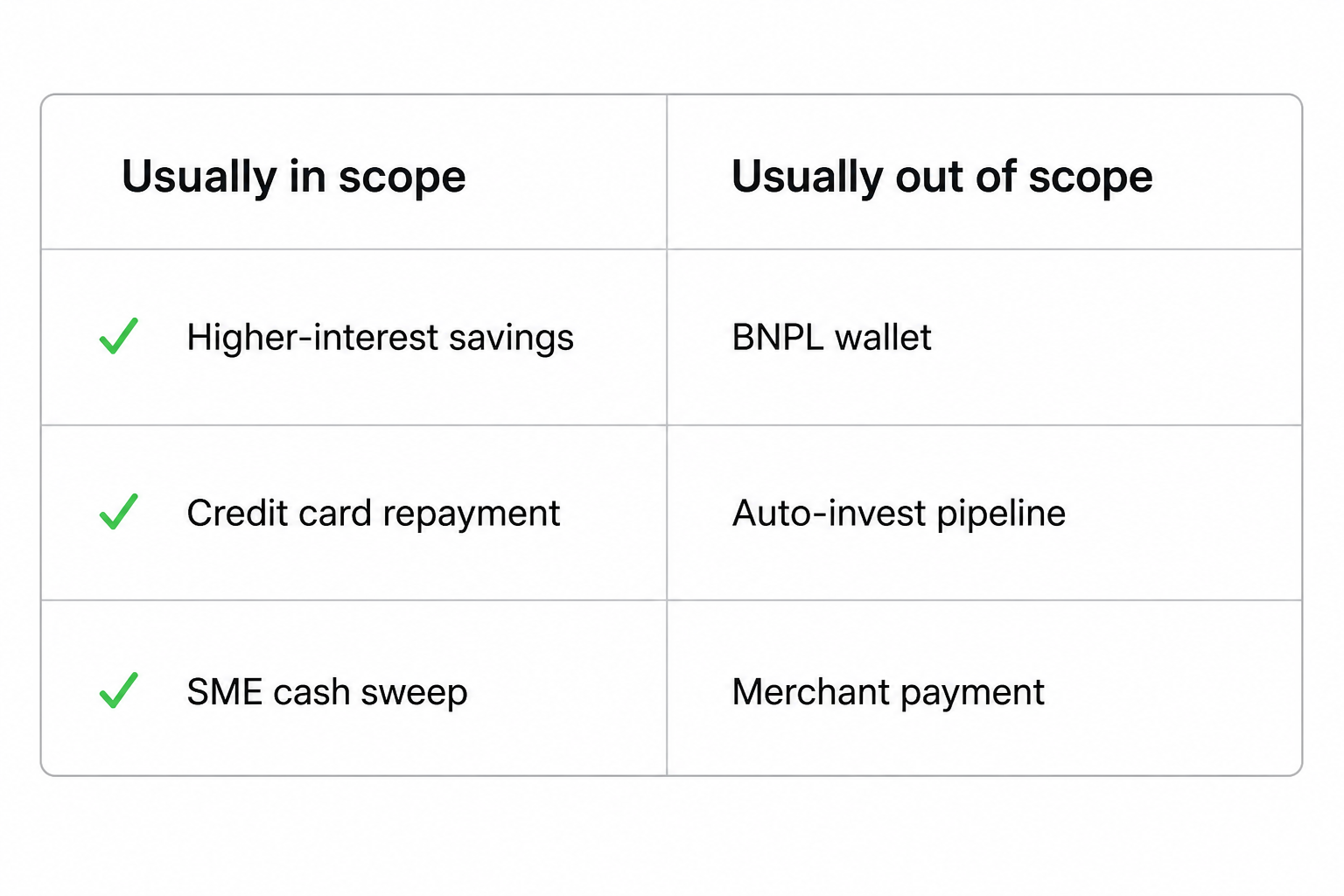
Valid sweeping destinations include higher-interest savings, credit-card repayments, and alternative credit that competes with overdrafts — but BNPL wallets, investment auto-transfers, and merchant collection accounts are usually out of scope.
Open Banking Limited's March 2026 update reflects the CMA's December 2025 letter on alternative credit. These patterns typically pass the definition when both accounts belong to the same person or legal entity:
Savings and cash management
- Higher-interest savings — the destination must pay a better rate than the source current account; instant-access, notice, and fixed-term cash savings can qualify if marketed as savings products in their own right.
- Cash round-ups — spare change from spending can sweep into a savings pot when the destination meets the savings criteria above.
- Treasury-style sweeps for SMEs — moving surplus operating cash into a business savings account overnight, provided both accounts belong to the same legal entity.
Credit and overdraft competition
- Credit-card repayments — explicitly in scope as alternative credit to overdrafts; charge cards that require full monthly payoff are excluded because they lack overdraft-like flexibility.
- Regulated lending repayments — some consumer-credit or business-loan repayments qualify when the product competes with overdraft pricing; payday-style single-purpose credit and fixed-term loans with no overdraft substitute typically do not.
What usually fails the sweeping test
- Buy Now Pay Later wallets — transfers tied to a single e-commerce purchase are not sweeping, even if the BNPL line resembles credit.
- Automatic investment pipelines — if the destination account auto-forwards swept cash into investments on receipt, the account acts as a transfer mechanism into out-of-scope destinations.
- Mortgage collection accounts — OBL notes many collection accounts used for lending are not valid sweeping destinations.
- Paying a merchant — any flow that ultimately pays a business is commercial VRP, not sweeping.
When your use case sits on the edge — for example a savings account that also enables optional manual investment — run it past your provider and the payer's bank early. OBL expects PISPs to populate ultimate-beneficiary data and perform checks that both accounts belong to the same customer.
What changed in the March 2026 sweeping guidance?
The update clarifies savings-rate tests, BNPL exclusions, collection-account rules, and how PISPs should resolve disagreements with banks — without changing the core rule that sweeping is me-to-me and mandated free.
Key clarifications from Open Banking Limited:
- Savings rate test — destination savings must beat the source current-account rate to qualify; PISPs should verify rates before enabling a sweep.
- BNPL exclusion — single-purchase BNPL facilities remain out of scope even when they resemble revolving credit.
- Collection accounts — allowed only when funds ultimately land in an account the same customer owns; mortgage collection accounts are called out as invalid destinations.
- Post-sweep movements — after a valid sweep, customers may manually move money elsewhere; automatic onward transfers triggered by the sweep itself can invalidate the use case.
- Dispute process — if a PISP and CMA9 bank disagree whether a flow is sweeping, OBL expects both parties to minimise consumer harm and follow a defined escalation before access is withdrawn.
These updates sit alongside the broader UK open banking regulatory framework, where statutory commercial VRP access is progressing separately from mandated sweeping.
How do product teams implement VRP sweeping?
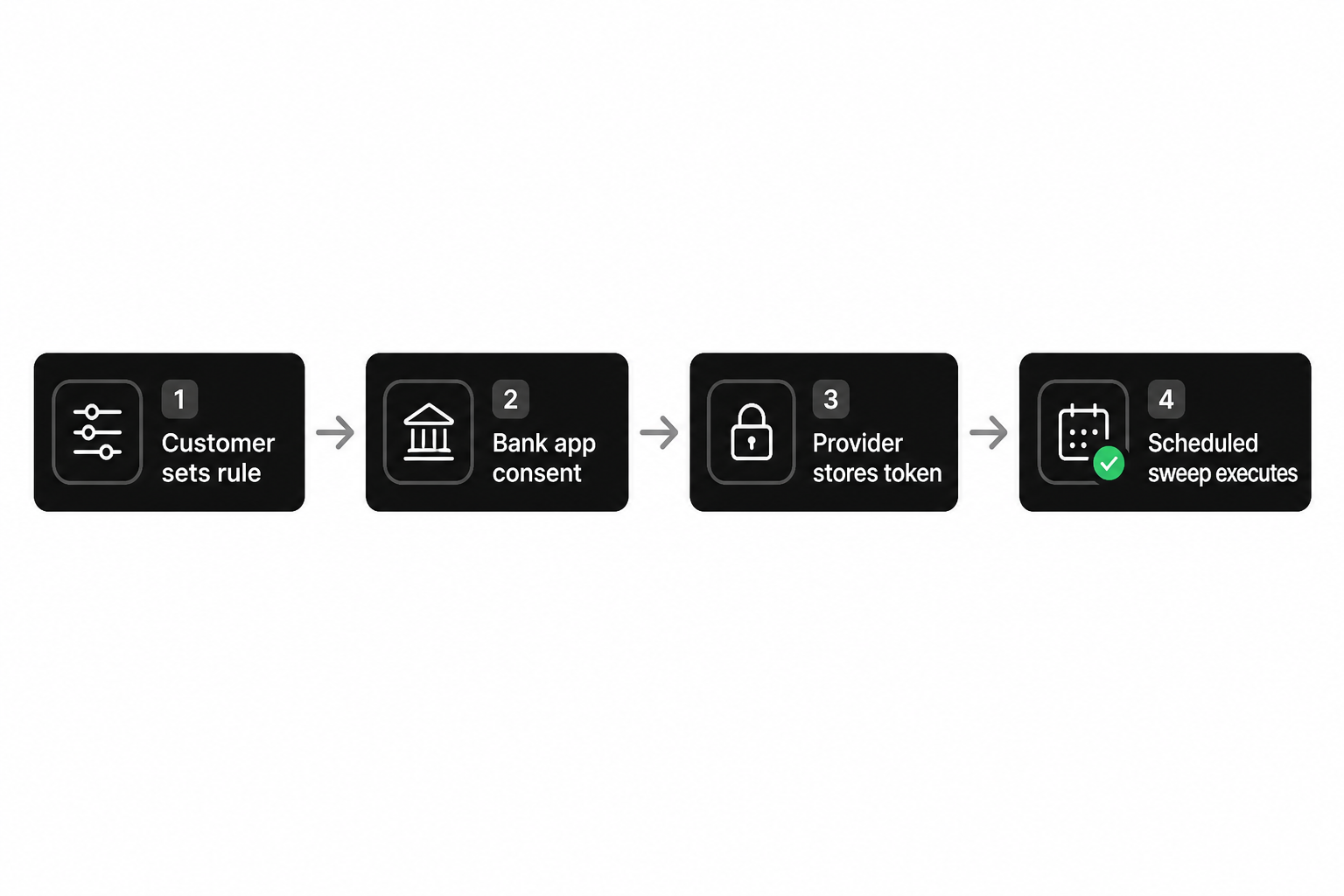
Start with one savings or credit-repayment journey, prove consent conversion and cap logic in sandbox, then scale — sweeping and commercial billing should use separate consent objects and webhook handlers.
Phase 1 — Define the customer outcome
- Pick a single job: e.g. "move £50 to savings every Friday" or "pay my credit-card statement balance when my current account exceeds £500".
- Confirm both accounts can belong to the same customer under OBL's entity-matching rules.
- Document what happens when the source balance is insufficient — fail silently, notify, or retry.
Phase 2 — Consent and limits
- Mirror bank-app UX: show source account, destination account, per-payment cap, monthly cap, and expiry.
- Store consent tokens separately from any bank on file merchant consent you also offer.
- Test revocation — customers can cancel sweeping permission in their banking app without contacting you.
Phase 3 — Provider and bank coverage
- Verify your provider supports sweeping VRP, not just commercial cVRP or one-off pay by bank.
- Ask which CMA9 banks expose sweeping endpoints for your destination account type.
- Run production-shaped tests: rate-change scenarios for savings destinations, partial balances, and cap breaches.
| Checklist item | Question for providers |
|---|---|
| Sweeping vs commercial | Do you support mandated sweeping separately from UKPI cVRP? |
| Destination validation | How do you verify savings rate and same-customer ownership? |
| Cap enforcement | Are per-payment and monthly limits enforced before initiation? |
| Webhooks | Do you emit distinct events for sweeping pulls vs merchant collections? |
| Dispute handling | What is your process when a bank rejects a sweeping classification? |
Use the provider-matching form to compare institution coverage and sweeping support against your target bank list — capabilities vary even among providers that market "VRP enabled".
What are the trade-offs versus standing orders and internal transfers?
Sweeping adds variable amounts and balance-aware logic that standing orders lack, but bank coverage, classification risk, and free-rail economics differ from internal bank-only transfers.
Advantages
- Variable pull amounts within caps — useful for "sweep everything above £1,000" rules standing orders cannot express cleanly.
- Open banking lets fintech apps orchestrate sweeps across banks without owning both accounts.
- Mandated free sweeping access reduces per-transaction cost versus some commercial initiation paths.
Limitations
- Classification disputes can delay launches if your destination account type is novel.
- Savings-rate and same-customer checks add product complexity pure standing orders avoid.
- Sweeping does not replace commercial billing rails — merchant collections still need cVRP or legacy Direct Debit.
Balanced rollout keeps manual transfers or standing orders as fallback while you prove sweeping conversion in one segment.
Frequently Asked Questions
What is VRP sweeping?
VRP sweeping is a UK open banking pattern where a customer authorises automatic transfers between their own accounts — such as from a current account to a savings account or toward a credit-card balance — after one consent in their banking app. Each transfer stays within per-payment and monthly caps the customer set. The money never pays a third-party merchant.
How is VRP sweeping different from commercial VRP?
Sweeping moves money between accounts the same customer owns; commercial variable recurring payments pay a business such as a utility or insurer. UK rules require CMA9 banks to offer sweeping access for free, while commercial cVRP runs under the UKPI scheme with sector eligibility and commercial pricing. Product teams need separate consent flows for each type.
Is VRP sweeping free for customers and providers?
Mandated sweeping access from CMA9 banks is expected to remain free under the CMA Order. That applies to me-to-me transfers that meet the sweeping definition. Commercial VRP that collects merchant bills is a different product with UKPI pricing. Do not assume free sweeping terms cover business collections.
Can VRP sweeping pay into a Buy Now Pay Later account?
Usually no. Open Banking Limited states BNPL transfers tied to a single purchase fall outside the sweeping definition, even when the facility resembles credit. Sweeping into BNPL wallets is unlikely to qualify under CMA guidance.
Can VRP sweeping fund investment accounts automatically?
Not when the destination account automatically forwards swept cash into investments on receipt. That pattern treats the account as a transfer mechanism into out-of-scope destinations. Customers may manually invest after a valid sweep into a qualifying savings account, but automatic investment pipelines triggered by the sweep are excluded.
Which savings accounts qualify as VRP sweeping destinations?
Cash savings products that pay a higher interest rate than the customer's source current account and are marketed as savings in their own right — including instant-access, notice, and fixed-term accounts. Accounts used mainly to hold deposits pending investment do not qualify.
Do I need a different open banking provider for sweeping vs billing?
Many providers offer both sweeping VRP and commercial cVRP, but capabilities differ by bank and account type. Confirm sweeping endpoint support, destination validation logic, and webhook separation before launch. Providers that only support merchant collections cannot substitute for mandated sweeping access.
How do I choose a provider for VRP sweeping?
Compare CMA9 sweeping coverage for your customers' banks, support for your destination account types (savings rate checks, credit-card repayments), cap enforcement, webhook reliability, and dispute escalation when a bank rejects a classification. Run sandbox tests with insufficient balances and cap breaches, then match requirements to live coverage through a structured comparison.
Conclusion
VRP sweeping lets customers automate me-to-me money moves — savings top-ups, credit repayments, and overdraft alternatives — after one banking-app consent. It is not a shortcut for merchant billing; commercial collections still flow through cVRP or legacy rails. The March 2026 Open Banking Limited Q&As add practical guardrails on savings rates, BNPL exclusions, and collection accounts that product teams should bake into onboarding checks. Pilot one use case, keep standing orders as fallback, and validate that your provider truly supports sweeping — not just generic VRP marketing — before you promise automated cash management to customers.
Related articles
- Open Banking Dunning: Bank-Rail Failed Payment Recovery
Involuntary churn on bank-rail renewals looks different from card dunning: there is no expired PAN to refresh, but consent can vanish overnight and insufficien…
- UKPI Wave 2 Recurring Payments: E-commerce Prep Guide
If you run a UK subscription business — SaaS, streaming, membership clubs, or general e-commerce with renewals — you have watched UKPI Wave 1 launch without yo…
- Wero Bill Payments France: What Orange's Launch Means
If you collect monthly bills in France — mobile plans, utilities, SaaS subscriptions — your customers already pay from banking apps more often than from card f…