UKPI Wave 2 Recurring Payments: E-commerce Prep Guide
If you run a UK subscription business — SaaS, streaming, membership clubs, or general e-commerce with renewals — you have watched UKPI Wave 1 launch without your merchant category on the eligibility list. UKPI Wave 2 recurring payments are the industry’s answer: extending commercial variable recurring payments (cVRP) beyond regulated utilities and charities into mainstream retail billing, with a pricing model designed to compete with card-on-file. Wave 2 is expected in the second half of 2026; it is not live for general merchants today. This guide explains what Wave 2 changes for your billing stack, how proposed fees differ from Wave 1, and the technical and provider checks to run now so you are ready when your sector opens.
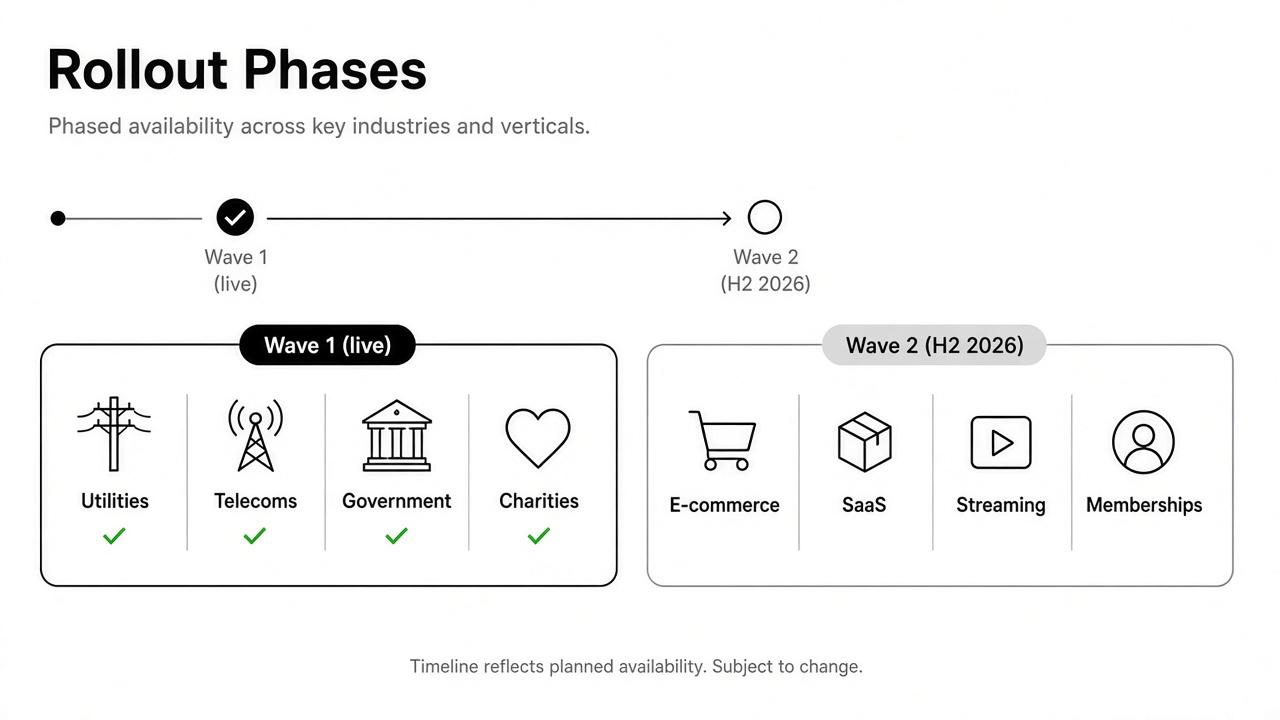
UKPI Wave 2 recurring payments: The second phase of the UK Payments Initiative commercial variable recurring payment scheme — expected to extend bank-rail repeat collections to general e-commerce, SaaS subscriptions, and retail memberships after Wave 1 limited cVRP to regulated sectors from June 2026.
What are UKPI Wave 2 recurring payments?
UKPI Wave 2 recurring payments will let UK merchants outside Wave 1 sectors collect repeat charges from customer bank accounts under a single upfront consent — the same commercial VRP mechanics utilities use today, applied to e-commerce and subscription billing.
The UK Payments Initiative (UKPI) launched Wave 1 on 2 June 2026 as the UK’s first new payment scheme since Faster Payments in 2008. Wave 1 covers lower-risk, regulated categories: energy and utilities, telecoms, financial services, e-money institutions, government bodies, and registered charities. Those billers can already run recurring pay by bank under the shared UKPI rulebook.
Wave 2 targets the merchants Wave 1 excluded — online retailers, SaaS platforms, streaming services, gym memberships, and other card-on-file businesses where interchange and expiry-driven churn hurt margin. Industry expects Wave 2 to go live in the second half of 2026, though the exact date depends on final commercial model approval and bank readiness.
The operational model stays consistent with commercial variable recurring payments (cVRP): the customer approves your business in their banking app with per-payment and monthly caps, you request each renewal within those limits, and successful collections settle on Faster Payments — often same day. What changes in Wave 2 is who may initiate those pulls and how scheme fees are priced for higher-volume retail flows.
Which UK businesses must wait for Wave 2?
General e-commerce, SaaS, BNPL repayments outside regulated finance, travel suppliers, and most B2C subscription merchants cannot run UKPI commercial VRP collections under Wave 1 rules today — they need Wave 2 eligibility.
Modulr’s Wave 1 eligibility guide lists sectors currently in scope versus those waiting:
| Status | Sector examples |
|---|---|
| Wave 1 (live now) | Energy, water, gas utilities; telecoms; regulated lenders and insurers; e-money; central and local government; registered charities |
| Wave 2 (expected H2 2026) | General e-commerce checkout; SaaS and streaming subscriptions; membership clubs; retail BNPL; travel and hospitality; unsecured commercial lending outside regulated categories |
If your billing model matches open banking subscription billing patterns but your UK entity sits outside Wave 1, you should not market bank-rail renewals as production-ready until your PSP confirms Wave 2 sector access. Pilot with one-off pay by bank checkout where supported, keep card-on-file as primary, and use the waiting period to harden consent UX and webhook handling.
Cross-border teams should note: Wave 2 applies to UK domestic cVRP under UKPI. Euro-area subscription billing still follows SEPA Direct Debit and national open-banking paths — see bank on file vs card on file for EU recurring mechanics.
How will Wave 2 pricing differ from Wave 1?
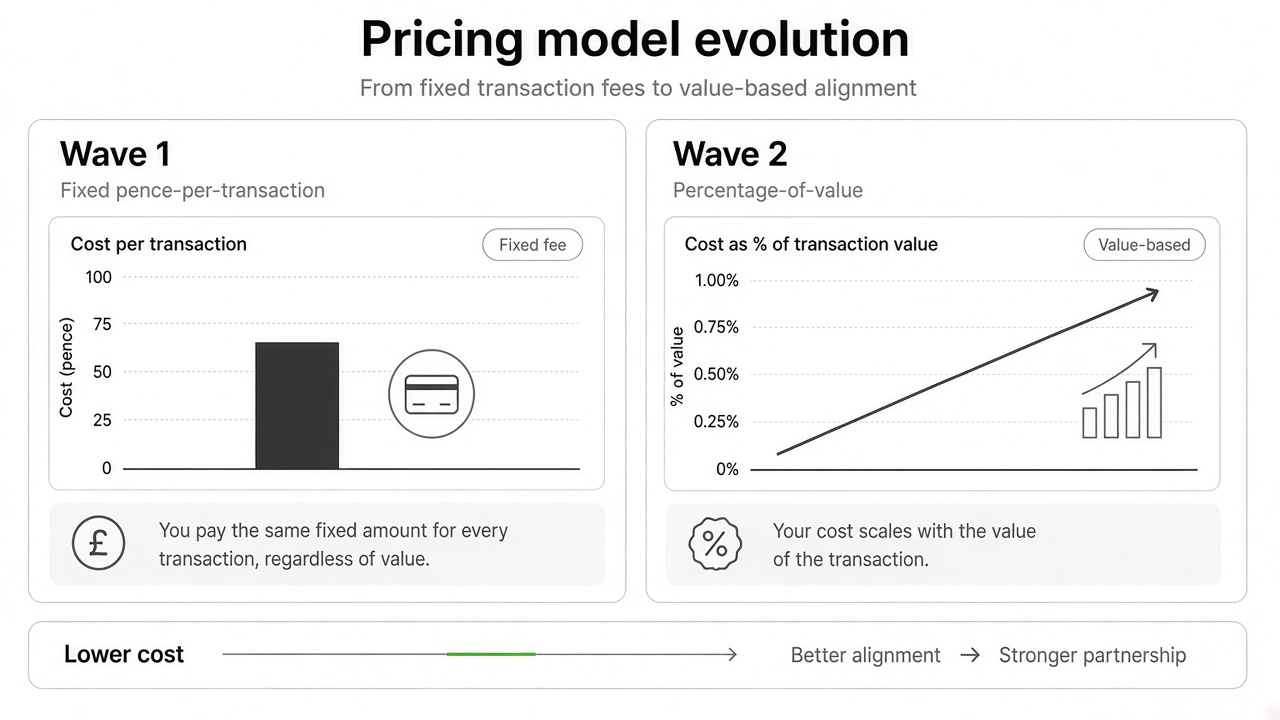
Wave 1 uses fixed pence-per-transaction access and scheme fees; UK Finance’s Wave 2 proposal recommends ad valorem (percentage-of-value) pricing closer to card interchange — a structural shift merchants must model before switching rails.
The FCA and Payment Systems Regulator gave clarity on Wave 1 pricing in January 2026: a 5.5p access fee per successful transaction (PISP to ASPSP) and a 2.5p scheme transaction fee split between bank and provider, plus annual UKPI membership. That fixed-fee design suits utility-scale bills where pence-per-pull economics beat card percentages.
UK Finance’s industry proposal for Wave 2 recommends a multilateral ad valorem fee — a percentage of transaction value paid by payment initiation providers to customer banks — reflecting how e-commerce payment methods are priced today. The paper does not set a final rate; it feeds modelling to UKPI and regulators. Wave 2 may also introduce consumer purchase protection options, with two approaches under consultation.
| Dimension | Wave 1 (live) | Wave 2 (proposed) |
|---|---|---|
| Fee structure | Fixed pence per successful payment | Ad valorem (% of value) under consultation |
| Target sectors | Regulated, lower-risk billers | General e-commerce and subscriptions |
| Competitive frame | vs Direct Debit cost | vs card interchange |
| Purchase protection | Scheme dispute framework | Additional consumer protection options proposed |
Finance teams should build a total-cost model at realistic renewal volumes — not only headline fees but failed-payment handling, dunning ops, and card backup costs. Our open banking pricing models framework applies the same discipline to Wave 2 projections once rates are confirmed.
What should billing teams prepare before Wave 2 launches?
Run a Wave 2 readiness audit on consent UX, webhook infrastructure, mixed-rail dunning, and PSP contracts — the merchants who pilot Wave 1 patterns in sandbox now will switch faster when e-commerce eligibility opens.
Billing and product teams excluded from Wave 1 should treat Q3–Q4 2026 as preparation time, not a waiting room:
- Map your renewal cohort — Identify UK customers on card-on-file where bank-rail economics beat interchange (higher ARPU, lower dispute rates, mobile-first signup).
- Harden consent flows — Wave 2 customers will approve mandates in banking apps; test mobile redirect, cap-setting copy, and revocation handling with your provider’s sandbox.
- Webhook and dunning upgrade — Bank failure codes differ from card declines; align retry tiers, customer email templates, and ERP matching on IBAN references before dual-rail production.
- Contract PSP Wave 2 clauses — Confirm your payment partner has UKPI scheme membership and a written Wave 2 timeline; ask about intelligent routing to Direct Debit when open banking is unavailable (a pattern GoCardless uses in Wave 1).
- Bank coverage planning — UKPI targets roughly 75% current-account coverage at launch; Ozone API’s August 2026 non-CMA9 cVRP product signals smaller banks may join faster, but coverage gaps will persist — plan card fallback until your payer bank list clears threshold.
- Legal and customer comms — Draft plain-language notices explaining bank payments, caps, and cancellation paths; avoid promising Wave 2 dates until your PSP confirms sector eligibility.
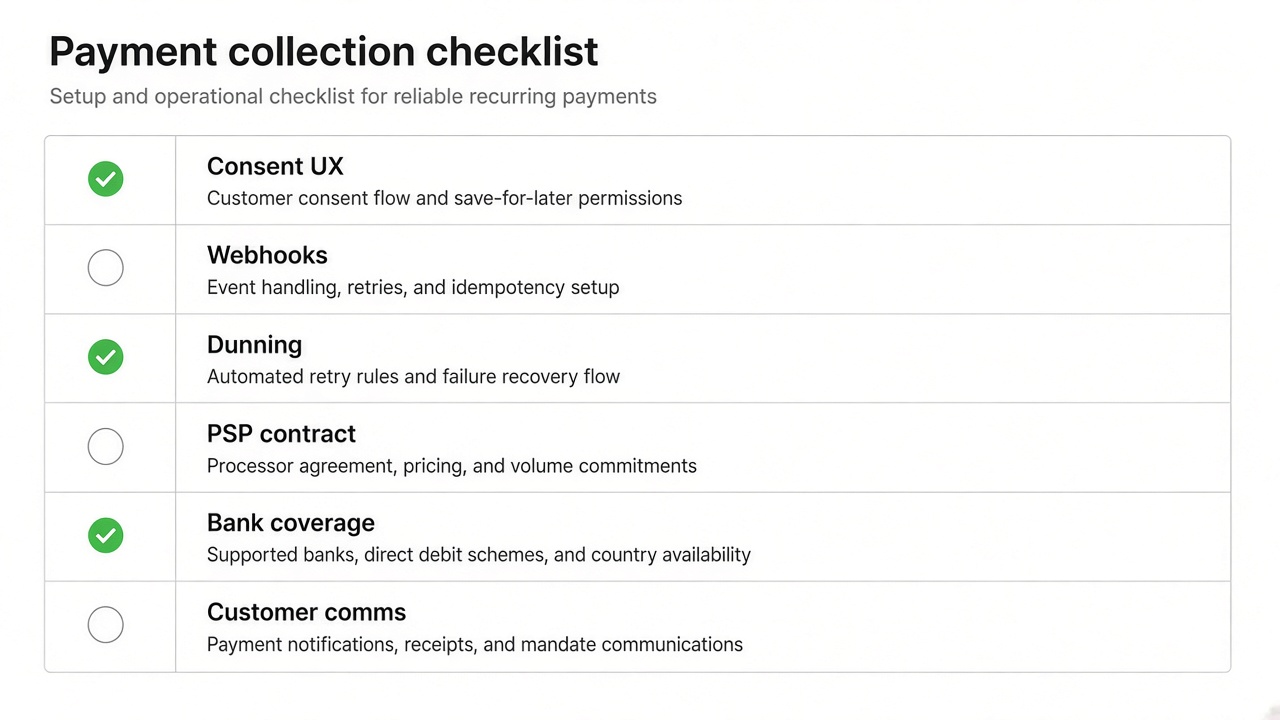
Teams in Wave 1 sectors should already be live or piloting — this checklist still helps if you plan to expand SKUs into Wave 2 retail categories under the same UKPI membership.
How do you evaluate providers for Wave 2 recurring?
Shortlist payment partners on UKPI scheme participation, Wave 2 roadmap commitment, recurring API maturity, bank coverage including non-CMA9 institutions, and unified reporting across card and bank rails.
Provider evaluation for Wave 2 differs from a generic open banking provider comparison because recurring cVRP needs mandate lifecycle APIs, not only one-off initiation:
| Criterion | Why it matters for Wave 2 recurring |
|---|---|
| UKPI founding or participant status | Scheme access and early Wave 2 sector certification |
| Wave 2 written timeline | Avoid providers with no public H2 2026 commitment |
| Variable amount support within caps | Usage-rated SaaS and tiered plans need flexible pulls |
| Balance-check before pull | Reduces blind failures; provider and bank dependent |
| Intelligent routing fallback | Direct Debit or card when bank consent unavailable |
| Webhook granularity | Consent created, used, revoked, failed — for billing engine sync |
| Settlement reporting | Unified files if you run cards, cVRP, and Direct Debit in parallel |
Run sandbox tests with production-shaped amounts — monthly subscription, mid-cycle upgrade, failed collection recovery — not £1 ping payments. Read recurring transactions via open banking for rail-specific criteria, then use the provider-matching form to compare UKPI readiness, Wave 2 roadmap, and live bank coverage for your billing profile.
Frequently Asked Questions
What are UKPI Wave 2 recurring payments?
UKPI Wave 2 recurring payments are the planned second phase of the UK Payments Initiative commercial variable recurring payment scheme. They will extend bank-rail repeat collections — one upfront customer consent, variable pulls within agreed caps, Faster Payments settlement — to general e-commerce, SaaS subscriptions, streaming, and retail memberships after Wave 1 limited cVRP to regulated sectors from June 2026.
When will UKPI Wave 2 recurring payments go live?
Industry expects Wave 2 in the second half of 2026, but no fixed public date is confirmed as of September 2026. Launch depends on final commercial model approval, UKPI operational readiness, and bank participation beyond the CMA9 mandatory group. Merchants should treat H2 2026 as the planning window and confirm dates with their payment service provider.
Can SaaS and e-commerce merchants use UKPI recurring payments today?
No for commercial cVRP under UKPI Wave 1 rules. General e-commerce, SaaS, streaming, and most retail subscriptions sit outside Wave 1 eligibility. Those merchants can use one-off pay by bank where supported and should prepare billing infrastructure for Wave 2. Regulated utilities, telecoms, financial services, government, and charities can use Wave 1 cVRP now.
How will UKPI Wave 2 pricing compare to Wave 1?
Wave 1 uses fixed pence-per-transaction access and scheme fees suited to utility billing. UK Finance’s Wave 2 proposal recommends ad valorem (percentage-of-value) fees paid by payment initiation providers to customer banks — closer to card interchange pricing. Final rates are not set; merchants should model total cost per successful renewal once UKPI publishes confirmed Wave 2 tariffs.
What is the difference between UKPI Wave 2 and SEPA Direct Debit for subscriptions?
UKPI Wave 2 cVRP uses open banking consent in the customer’s banking app with variable pulls within caps and typically same-day Faster Payments settlement. SEPA Direct Debit uses mandate-based pulls with batch timelines and SDD refund windows. UK Wave 2 applies to domestic UK cVRP; EU subscriptions continue on SDD and national open-banking paths unless UKPI-equivalent schemes emerge.
Do UKPI Wave 2 recurring payments replace card-on-file?
Not immediately. Most merchants will run bank-rail renewals alongside cards during transition — bank-primary for enrolled customers, card fallback for coverage gaps or failed consent. Card-on-file remains familiar for low-value one-off purchases. Wave 2 gives subscription businesses a regulated bank alternative where interchange and expiry churn erode margin.
How does bank coverage affect Wave 2 recurring payment adoption?
UKPI targets broad current-account coverage at launch; not every UK bank participates on day one. Non-CMA9 institutions are joining through infrastructure products, but gaps persist. Merchants should monitor payer bank coverage against their customer base, maintain card backup, and track provider routing logic that shifts payers to Direct Debit when open banking is unavailable.
Conclusion
UKPI Wave 2 recurring payments will bring commercial variable recurring collections to the subscription and e-commerce merchants Wave 1 left waiting — with pricing and consumer protection models still being finalised for retail scale. The work worth doing now is operational: consent UX, webhook-driven dunning, PSP contracts with Wave 2 commitments, and realistic total-cost modelling against card-on-file. When your sector opens, the teams already running sandbox renewals and mixed-rail fallbacks will switch faster than those starting from a marketing announcement.
Related articles
- Open Banking Dunning: Bank-Rail Failed Payment Recovery
Involuntary churn on bank-rail renewals looks different from card dunning: there is no expired PAN to refresh, but consent can vanish overnight and insufficien…
- Wero Bill Payments France: What Orange's Launch Means
If you collect monthly bills in France — mobile plans, utilities, SaaS subscriptions — your customers already pay from banking apps more often than from card f…
- VRP Sweeping: Me-to-Me Open Banking Transfers Explained
Treasury and product teams want idle cash to earn interest, credit balances to shrink on schedule, and overdraft fees to drop — without asking the customer to…