Open Banking Pricing Models: Compare Total Cost Before You Sign
Open banking pricing models rarely appear as one clean line item on a contract — and that opacity is where margin leaks hide. EU B2B teams evaluating pay by bank, account verification, or recurring collection need to compare total cost at realistic volumes, not the headline pence-per-successful-call rate on a pricing page. This guide maps the commercial shapes you will see from aggregators and payment providers, explains how UK scheme fees (including the UK Payments Initiative Wave 1 cVRP framework) stack on top, and gives you a 12-month model to run before you shortlist finalists.
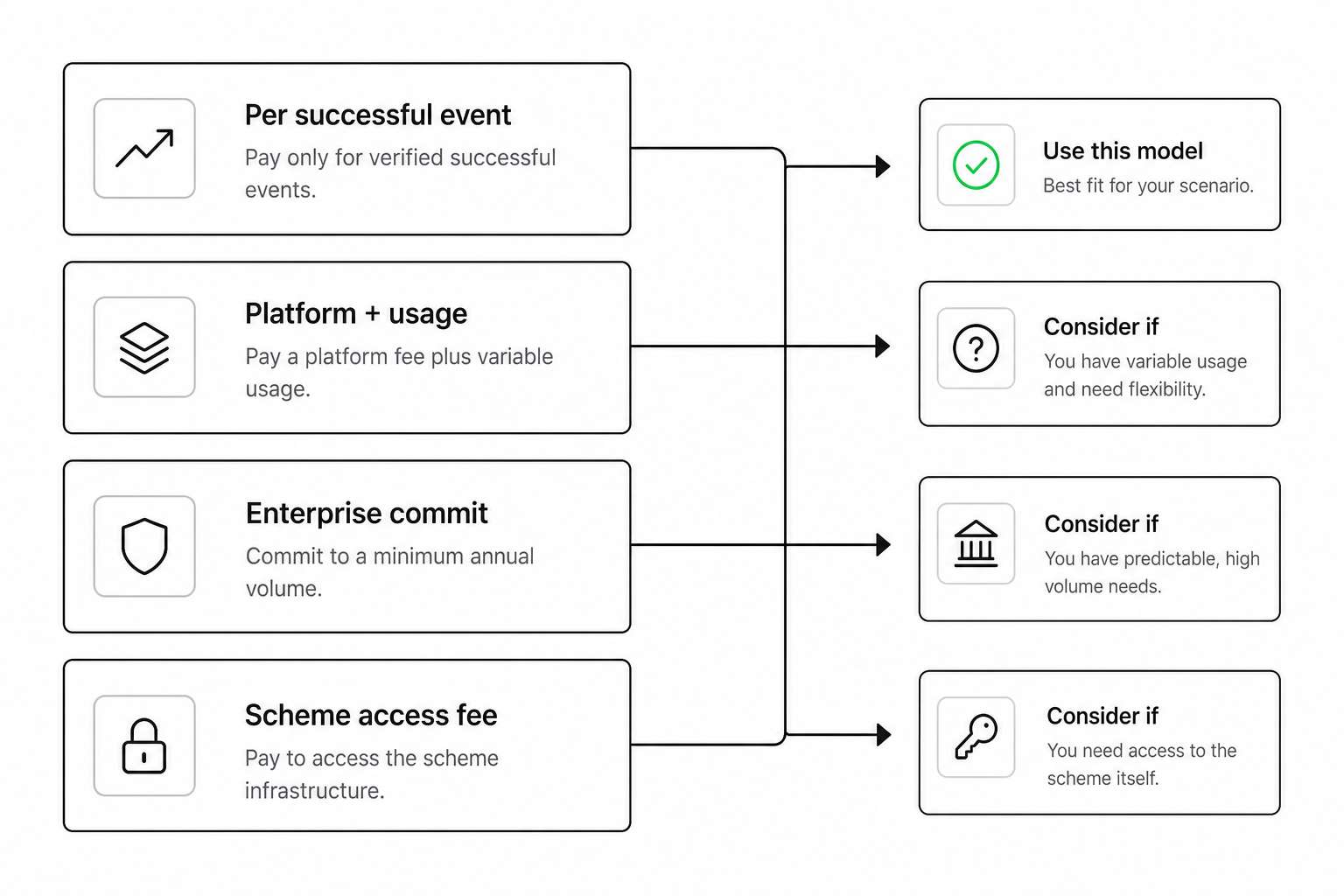
Open banking pricing models: The commercial structures providers use to charge for account-to-account payments, verification, and recurring collection — typically per successful API event, per connected account, platform minimums plus usage tiers, or annual enterprise commits. Scheme-level fees (such as UKPI access fees for commercial variable recurring payments) may sit beneath provider pricing and affect your unit economics even when you buy through an aggregator.
What are the main open banking pricing models you will see?
Most open banking contracts blend two or three models — a platform or minimum fee plus a usage component tied to successful payments or verifications. Pure usage-only deals exist at early stage; large enterprises often negotiate annual commits with tiered overage. The models below are the vocabulary you need before any vendor workshop.
| Model | What you pay for | Typical buyer profile |
|---|---|---|
| Per successful event | Each initiated payment or verification that completes | Checkout, invoice pay, one-off verification |
| Per connected account | Active linked accounts per month | AIS-heavy apps, personal finance, lending refresh |
| Platform + usage | Monthly minimum plus tiered per-call rates | Scale-ups crossing minimums quickly |
| Enterprise flat / commit | Annual contract with committed volume | High-volume PSPs, platforms with predictable flow |
| Revenue share / ad valorem | Percentage of payment value | High-ticket B2B, some marketplace flows |
None of these labels tells you the full story. Failed payments, sandbox-only traffic, re-consent refreshes, and multi-country routing can each bill differently. Always ask which events count as billable and which are included in platform fees.
For how pricing fits into the wider provider selection process, see how to choose an open banking provider in the EU — this article goes deeper on commercials only.
How do per-transaction and per-check fees differ in practice?
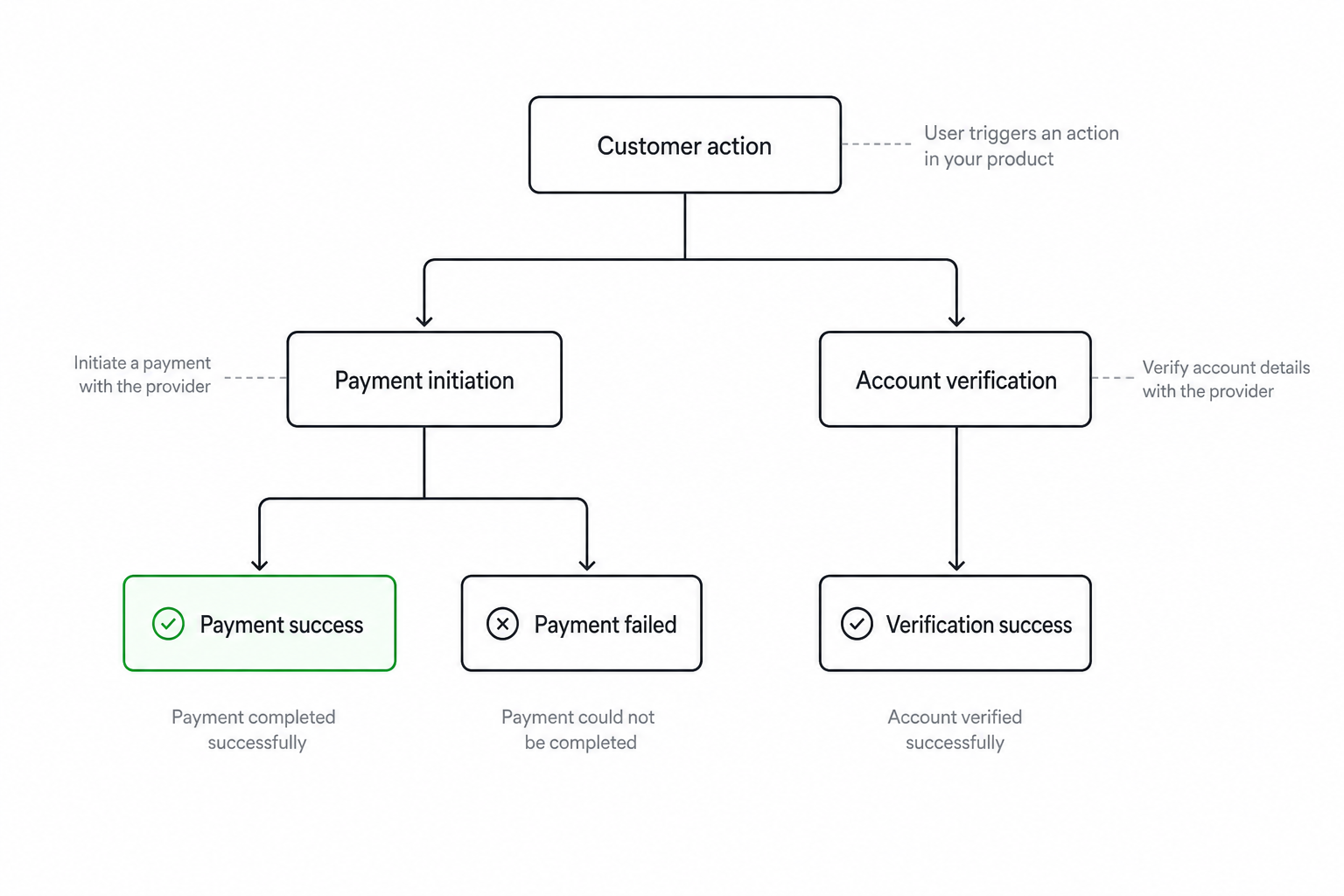
Per-transaction pricing usually means you pay when a payment initiation reaches a final success state — funds moved or irrevocably committed depending on the scheme. Per-check pricing applies to account verification, balance checks, or income/affordability pulls where no money moves. Providers sometimes bundle both under "API calls" but bill at different rates.
Questions that change your model:
- Failed vs successful — Some vendors charge only on success; others bill initiation attempts. A high decline rate (wrong IBAN, insufficient funds, user cancel) can double effective cost if failures are billable.
- Status polling — Rare as a separate line item today, but confirm whether repeated status queries count.
- Verification refresh — Recurring affordability or balance monitoring may re-bill on each refresh cycle, not only the first link.
Run sandbox tests that include at least one failure path before you trust a quoted per-event rate. A provider cheap on success but expensive on retries often loses to a slightly higher success rate with clean webhooks — finance and engineering time matter in the same spreadsheet as API fees.
What scheme-level fees apply to UK recurring open banking?
In the UK, commercial variable recurring payments (cVRP) under the UK Payments Initiative (UKPI) add scheme-level economics on top of whatever your provider quotes. UKPI Wave 1 went live in June 2026 for lower-risk sectors including utilities, charities, financial services, and parts of the public sector. The FCA and PSR confirmed in January 2026 that they would not prioritise a Competition Act investigation into UKPI's centralised access-fee model for Phase 1 — giving the scheme room to launch while a longer-term legislative framework under the Data (Use and Access) Act is expected.
UKPI's initial Wave 1 pricing framework (published July 2026) includes:
- 5.5p access fee — paid by the payment initiation provider to the account-serving bank per successful transaction
- 2.5p scheme transaction fee — paid to UKPI, shared equally between bank and initiation side (1.25p each)
- £5,000 annual membership — for scheme participants (typically absorbed in provider/platform economics, not charged to end merchants directly)
These are fixed pence-per-transaction amounts, not a percentage of payment value — designed to give merchants cost predictability compared with card interchange on variable bills. Your provider may pass through, absorb, or bundle scheme costs into their headline rate; ask explicitly.
Sweeping variable recurring payments (me-to-me transfers) remain mandated free under the CMA order — do not confuse them with commercial cVRP pricing. For the operational difference, see cVRP explained and recurring pay by bank.
Wave 2 expansion into broader e-commerce is expected later in 2026; pricing methodology may evolve when the permanent framework replaces the interim Wave 1 model.
How do you build a 12-month total cost model?
Model total cost of ownership (TCO), not the rate on slide one. A useful 12-month spreadsheet includes:
| Line item | What to estimate |
|---|---|
| Successful payments | Monthly count × provider per-success fee |
| Successful verifications | Monthly count × per-check fee |
| Failed payments | Failure rate × billing rule (if failures bill) |
| Platform / minimum | Monthly minimum whether you hit usage or not |
| Scheme pass-through | UKPI or other scheme fees if itemised |
| Implementation | One-off engineering + compliance review |
| Ops load | Finance reconciliation hours × internal cost |
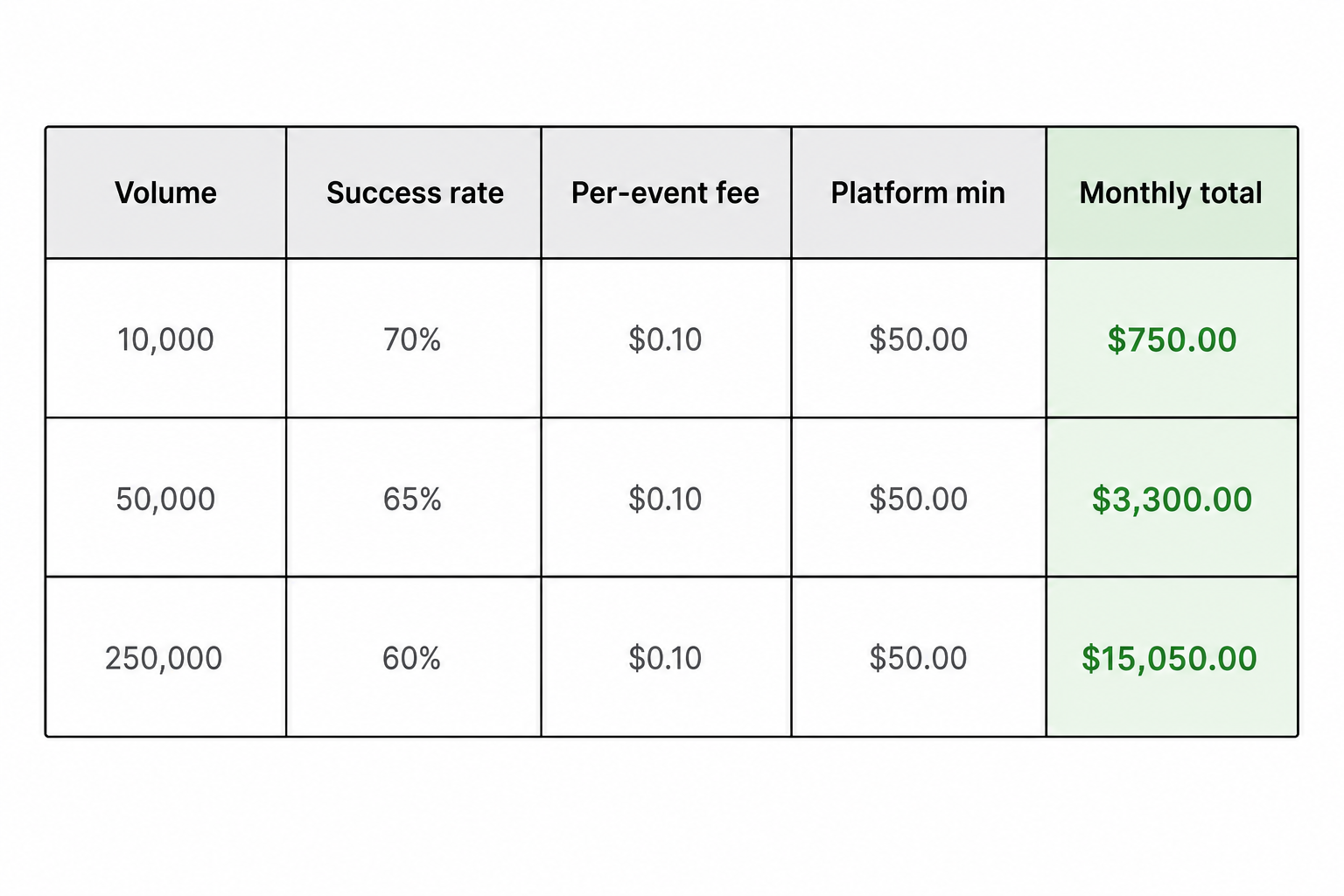
Example sanity check (illustrative, not a market quote): 50,000 successful UK cVRP collections per month at 8p all-in provider fee plus embedded scheme costs implies £4,000/month in variable fees before platform minimums — compare that to card-on-file economics on the same volume and average ticket size.
Include one FTE-equivalent of engineering and finance ops unless you already run a payments platform team. The build vs buy guide shows how partner fees convert fixed compliance and bank-adapter work into variable lines — your TCO model should reflect that trade-off.
Volume tiers matter: enterprise commits often drop per-event rates at 1M+ annual events but raise minimum spend. Early-stage teams sometimes over-buy annual commits before product-market fit; month-to-month or lower minimums may cost more per call but preserve optionality.
What pricing questions belong in your RFP or vendor calls?
Ask the same questions of every finalist so you compare apples to apples. Use this checklist in commercial workshops — after you have already filtered on coverage and sandbox quality via the shortlist checklist.
| Topic | Question |
|---|---|
| Billable event | What exact API state triggers a charge — initiation, success, or settlement? |
| Failures | Are user cancellations, timeouts, and insufficient funds billable? |
| Minimums | Monthly platform fee, annual commit, and what happens below threshold |
| Indexation | CPI or fixed escalation at renewal |
| Scheme fees | UKPI, SEPA, or domestic scheme costs — itemised or bundled |
| Multi-entity | Separate pricing per creditor entity or country |
| Overage | Rate above committed volume |
| Exit | Notice period, data export, wind-down fees |
| Sandbox | Free tier limits; charges for production-like test volume |
Do not negotiate final basis points before engineering validates webhooks and institution coverage. Pricing is the last filter on a short list of two to four vendors, not the first cut across twenty names.
When you are ready to match providers to your volume, markets, and use cases, use the provider-matching form before committing to a six-week RFP — it narrows the set to vendors that already operate your corridor.
Frequently Asked Questions
What are open banking pricing models?
They are the commercial structures providers use to charge for open banking services — commonly per successful payment or verification, per connected account per month, platform fees plus usage tiers, or annual enterprise commits. Scheme-level fees such as UKPI access fees for UK commercial recurring payments may sit beneath provider pricing.
How much does open banking cost per transaction?
There is no single market rate. EU checkout initiation might be quoted from low single-digit cents to higher pence depending on volume, country mix, and contract structure. UK cVRP under UKPI Wave 1 includes published scheme fees (5.5p access plus 2.5p scheme fee per successful transaction) plus whatever margin your provider adds. Always model your own volume and failure rate.
Do open banking providers charge for failed payments?
Some charge only successful events; others bill initiation attempts or charge a lower failure rate. Failed-payment billing can materially change unit economics if your use case has high user drop-off or insufficient-funds rates. Confirm in writing before signing.
How does UKPI pricing affect what merchants pay?
UKPI sets scheme-level fees for Wave 1 cVRP — access fee to the bank, scheme transaction fee, and participant membership. Merchants typically contract with a payment provider or platform that bundles or itemises these costs. The FCA and PSR gave interim regulatory clarity on the access-fee model in January 2026 so the scheme could launch while longer-term legislation is developed.
What is the difference between platform fees and usage fees?
Platform fees (or monthly minimums) are fixed charges for access, support, and baseline infrastructure. Usage fees scale with successful API events or connected accounts. Many contracts combine both — a minimum you pay even in quiet months plus per-event rates above included volume.
Should pricing be the first filter when choosing a provider?
No. Filter first on bank coverage for your use case, product fit (checkout vs recurring vs verification), and sandbox behaviour. Compare pricing only on finalists that pass technical validation — otherwise you optimise for the wrong vendor.
How do open banking fees compare to card acquiring?
Open banking account-to-account flows often carry lower variable cost than card interchange on high-value or recurring B2B payments, but UX and coverage differ. Many businesses run both rails. Compare total cost including fraud, chargebacks (cards), and reconciliation ops, not only the headline fee.
Can pricing change when regulations or schemes update?
Yes. PSD3/PSR implementation in the EU and UK open-banking legislative frameworks may shift access economics over time. Contract indexation, pass-through clauses, and renewal notice periods matter. Fixed multi-year pence rates (as UKPI intends for Wave 1) reduce surprise but may be revisited when Wave 2 or permanent frameworks launch.
Key takeaway
Open banking pricing models look simple until you add failed payments, platform minimums, verification refresh, and scheme pass-through — especially UK cVRP under UKPI. Build a 12-month TCO model at your real volumes, validate billing events in sandbox, and run the RFP checklist on two to four finalists that already cover your banks and use case. Commercial clarity upfront prevents margin surprises after go-live.
Related articles
- Open Banking Credit Bureau Data: How Lenders Merge Both
Open banking credit bureau planning is what credit, BNPL, and embedded-finance teams do when a bureau score alone misses cash-flow reality — but raw transactio…
- Open Banking Vendor Due Diligence: What to Verify Before You Sign
Open banking vendor due diligence is the evidence pass you run after a promising demo and before legal sends the MSA. It turns marketing claims into test resul…
- Mollie GoCardless Acquisition: What Pay by Bank Buyers Should Do Now
If you run recurring billing, invoice collection, or checkout on GoCardless or Mollie, the Mollie GoCardless acquisition completed on 1 September 2026 changes…