Open Banking Multiple Providers: Dual-TSP Setup Guide
Open banking multiple providers is how platform and payments teams keep checkout and verification live when one aggregator hits a bank outage, a country gap, or a contract dispute. Running two or more licensed third-party providers (TTPs) adds routing logic, duplicate reconciliation, and contract overhead — but it cuts single-vendor risk on flows where every failed payment costs margin. This guide explains when a dual-TSP or multi-provider setup beats one contract, how to route traffic without doubling engineering forever, and what to validate before you sign a second agreement.
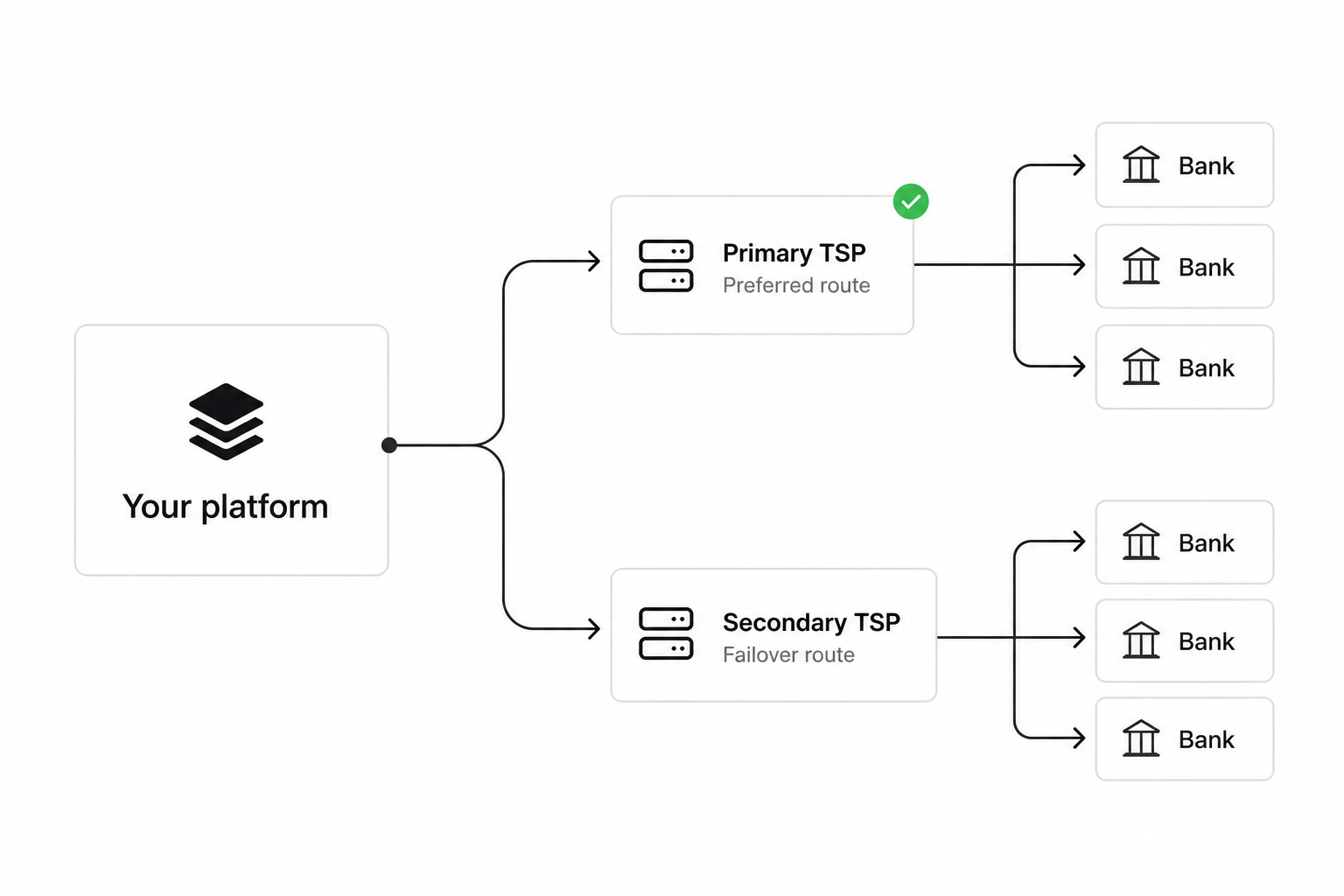
Open banking multiple providers: An architecture where your product connects to more than one licensed open banking provider — routing pay-by-bank, verification, or recurring flows by country, bank, success rate, or failover rules instead of relying on a single integration.
What is an open banking multiple-provider setup?
An open banking multiple-provider setup means your application maintains active integrations with two or more regulated TTPs and decides per request which one initiates a payment or pulls account data. Customers still consent through standard bank redirects; your platform owns the routing layer that picks primary or secondary paths.
This is not the same as comparing aggregators to pick a winner — see open banking aggregator comparison 2026 for that exercise. Multi-provider is an operating model after you have (or are about to have) at least one live contract. Nor is it automatically "building in-house": most teams still buy both providers and add a thin orchestration layer for routing, monitoring, and ledger mapping. The build vs buy open banking decision comes first; multi-provider is often the hybrid pattern that follows when uptime or coverage stops being negotiable.
When should you use more than one open banking provider?
Add a second provider when a single-vendor failure would visibly hurt revenue, onboarding conversion, or payout SLAs — and when the ops cost of dual contracts is smaller than the cost of downtime or manual workarounds.
Typical triggers:
- Geographic split — Provider A covers DE/FR strongly; Provider B is stronger in Nordics or Iberia. One contract cannot serve your actual bank mix.
- Failover and resilience — Card rails have backup acquirers; pay by bank deserves the same for high-volume checkout. Open Banking Limited reported 40.16 million open banking payments in June 2026 across the UK ecosystem — at that scale, even brief ASPSP or TTP incidents affect merchants who bet everything on one path.
- Commercial leverage — A secondary integration gives negotiation room on pricing and roadmap without a risky hard migration.
- Use-case separation — One vendor optimised for payment initiation; another for account verification or recurring mandates — so a PIS outage does not block AIS-led onboarding.
Stay on one provider when volume is low, your mandatory banks sit on one aggregator's list, and your team cannot yet run dual webhook streams and reconciliation IDs. Complexity has a real cost: two sandboxes, two support queues, two settlement reporting formats. Start single-vendor, instrument success rates by bank, and promote a second contract only when data proves the gap.
| Signal | One provider enough | Multi-provider justified |
|---|---|---|
| Bank coverage | Top banks covered on one list | Mandatory institutions split across vendors |
| Volume | Pilot or single corridor | Production traffic where 0.5% fail = material revenue |
| Ops maturity | No dedicated payments SRE | Monitoring, on-call, runbooks in place |
| Regulatory change | Standard PSD2 access | UK cVRP Wave 2 or multi-scheme rollout in H2 2026 |
How do you route payments across multiple providers?
Route on evidence, not hope — start with static rules (country + bank ID), then add dynamic failover when you measure initiation success and latency per institution.
Static routing (v1 multi-provider)
Map each country and ASPSP to a primary TTP using sandbox and pilot data. Example: DE retail → Provider A; NL → Provider B; fallback to secondary only where primary lacks coverage. Keep rules in configuration, not scattered if statements in checkout code.
Dynamic failover (v2)
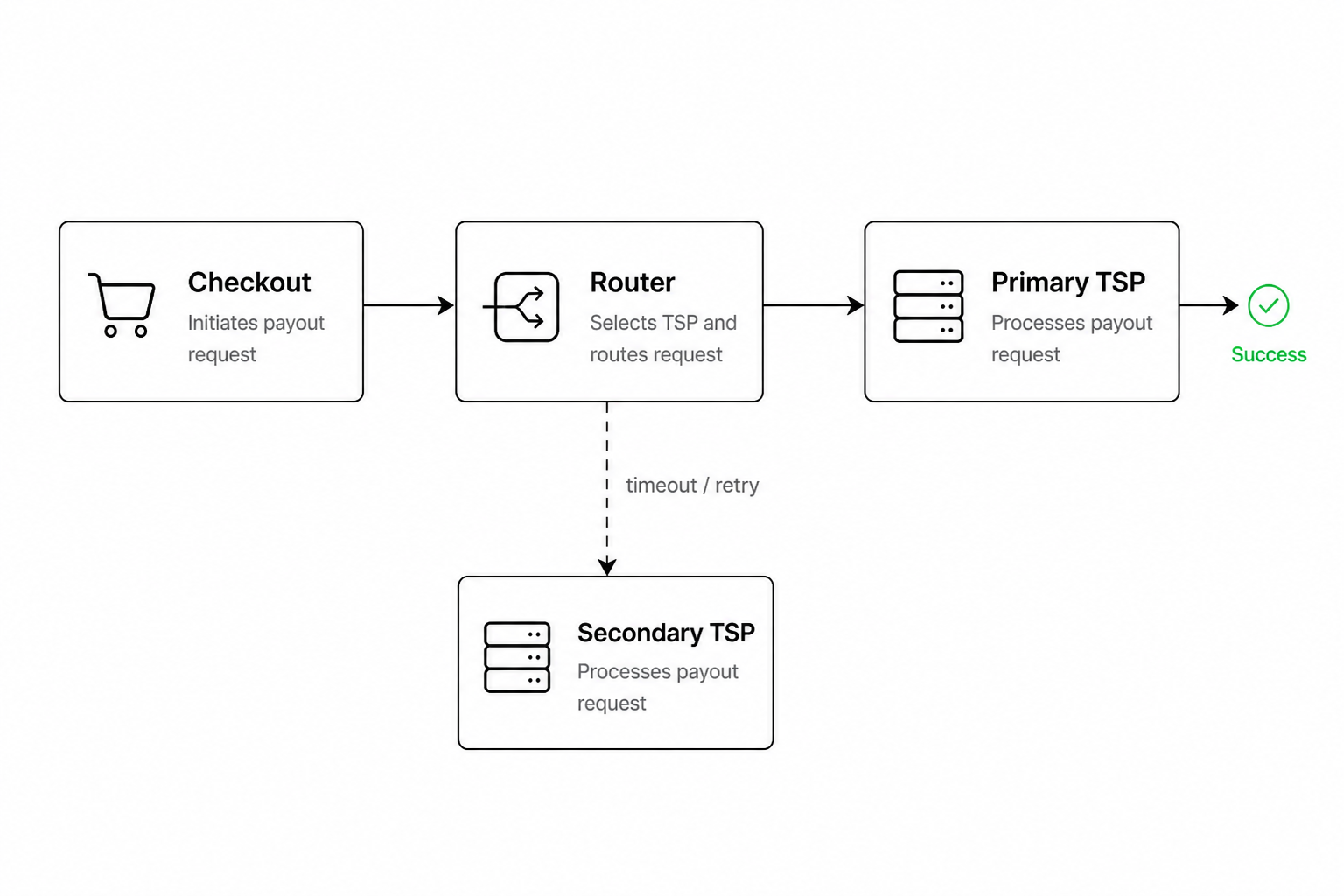
When primary initiation times out or returns a retryable error, attempt secondary on the same customer session — with clear UX limits so users are not sent through endless bank redirects. Cap at one failover per payment; log both attempts with shared merchant reference prefixes so finance can trace duplicates.
Shared identifiers across vendors
Each TTP issues its own payment IDs and webhook payloads. Your ledger needs a canonical internal payment ID mapped to both external references. Reconciliation breaks when teams assume one provider's ID is the source of truth for all rails.
What not to do
Avoid routing by cheapest per-transaction fee alone — a low-cost path with 3% lower success on your top bank destroys unit economics. Avoid silent A/B tests without consent copy review; bank redirect UX must stay consistent with your privacy policy and each TTP's role disclosure.
What does a multi-provider contract and ops model look like?
Dual contracts double the governance surface — you need parallel DPAs, incident contacts, SLA credits, and exit clauses before traffic splits.
Contract checklist
- Non-exclusive terms — Confirm neither contract blocks integrating a competitor for the same use case.
- Bank-level SLAs — Ask for institution-level uptime or success metrics, not only platform-wide averages.
- Webhook SLAs — Late or missing webhooks cause duplicate capture attempts; define maximum delivery delay and replay APIs.
- Exit and portability — Notice periods, data export, and whether customer consents must be re-collected when switching primaries.
Operations
Run separate sandbox regression before each provider's production promotion. Maintain one dashboard that normalises success rate, latency, and webhook lag per bank per provider. On-call runbooks should name which TTP owns which corridor and how to flip routing config without a deploy where possible.
Finance ops must reconcile two settlement reports against one order ledger. Train teams on two dispute paths — chargeback models differ from pay-by-bank, but refund and exception handling still split by vendor support queues.
How do you evaluate providers for a primary-secondary architecture?
Shortlist pairs, not solo winners — test whether your primary and secondary actually cover complementary banks before you commit to dual integration.
Use the framework from open banking provider comparison, but score pairs:
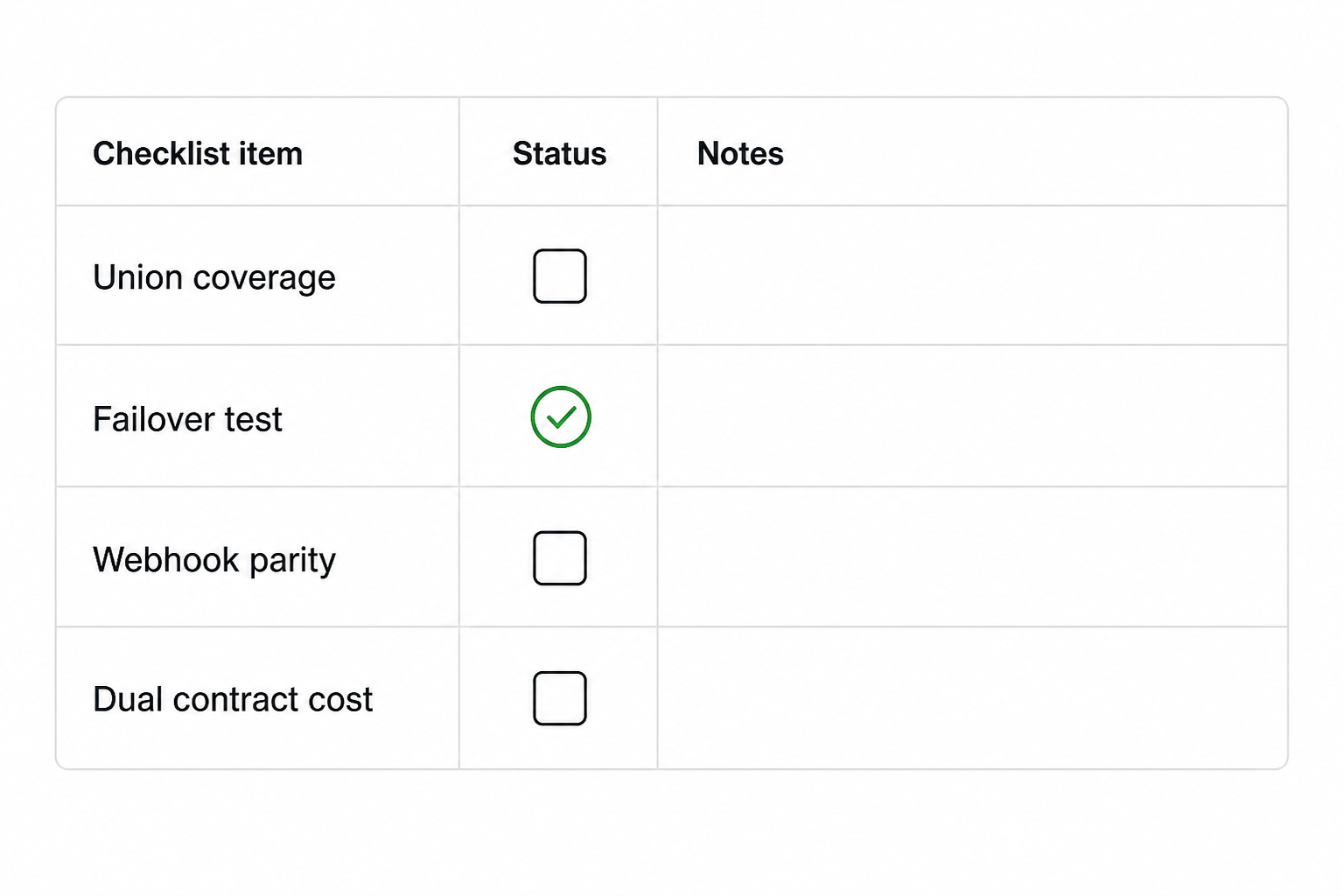
- Union coverage — Combined institution list for PIS and AIS on your mandatory banks; gaps are acceptable only if volume is negligible.
- Failover behaviour — In sandbox, force primary failure and confirm secondary completes without duplicate charges.
- Webhook parity — Same events (authorised, settled, failed) with timestamps finance can align.
- Commercial stack — Total cost including minimums on both contracts; failover traffic may sit on higher tiers.
When you have two finalists that complement each other, use the provider-matching form to confirm fit against your markets, use cases, and volume before legal review on a second agreement.
For a structured vendor pass before dual signing, follow how to shortlist open banking providers — run the same two-week sandbox discipline twice, once per slot in your architecture.
Frequently Asked Questions
What is the difference between open banking multiple providers and open banking orchestration?
Open banking multiple providers means you hold two or more live TTP contracts and route traffic between them. Orchestration is the software layer that implements those routing rules, normalises webhooks, and maps IDs to your ledger. You can orchestrate across multiple providers (common) or across direct bank links plus one aggregator (less common). Orchestration is how multi-provider setups stay maintainable.
When is one open banking provider enough?
One provider is enough when your mandatory banks and countries sit on a single aggregator's coverage list, transaction volume does not justify dual reconciliation, and measured initiation success on top institutions stays within your tolerance without failover. Most v1 products should prove value on one contract before adding a second.
How do you avoid duplicate charges with failover routing?
Use a single canonical payment attempt ID in your backend, idempotent create calls on each TTP, and a hard rule: only one successful initiation per checkout session. If primary returns ambiguous status, query status API or wait for webhook before firing secondary — never parallel-initiate the same amount to the same bank without explicit recovery logic.
Does using multiple open banking providers require two banking licences?
No. Each TTP holds the regulated access; you integrate as a technical client or partner under their licence packaging. Multi-provider increases integration and ops work, not your licensing burden — unless you choose to become a payment institution and build direct ASPSP links yourself.
How do open banking multiple providers affect reconciliation?
You receive separate reporting streams per TTP — different file formats, settlement cycles, and reference fields. Finance needs mapping tables from each provider's payment ID to your order ID. Budget for tooling or middleware early; dual providers without unified reconciliation recreate the manual statement-matching problem open banking was meant to remove.
Can you use different providers for pay by bank and account verification?
Yes — and many teams do when one vendor excels at payment initiation and another at AIS-led verification. Split by use case keeps PIS outages from blocking onboarding. The trade-off is two consent journeys to maintain in UX copy and two webhook pipelines into your user profile store.
How do you choose a primary vs secondary provider?
Primary should own the corridors that carry most volume and the banks with highest conversion in your analytics. Secondary covers long-tail institutions, failover, or regions where primary is weak. Re-evaluate quarterly as providers add banks — primary and secondary roles are not permanent.
Conclusion
Open banking multiple providers trades simplicity for resilience: dual contracts, unified routing, and reconciliation discipline let high-volume EU teams survive bank and TTP incidents without reverting to cards-only checkout. Start single-vendor, measure success by institution, and add a secondary when gaps or downtime costs exceed ops overhead. The right pair covers your bank mix complementarily — not two overlapping logos — and earns its place in architecture reviews alongside your first integration.
Related articles
- Open Banking Credit Bureau Data: How Lenders Merge Both
Open banking credit bureau planning is what credit, BNPL, and embedded-finance teams do when a bureau score alone misses cash-flow reality — but raw transactio…
- Open Banking Vendor Due Diligence: What to Verify Before You Sign
Open banking vendor due diligence is the evidence pass you run after a promising demo and before legal sends the MSA. It turns marketing claims into test resul…
- Mollie GoCardless Acquisition: What Pay by Bank Buyers Should Do Now
If you run recurring billing, invoice collection, or checkout on GoCardless or Mollie, the Mollie GoCardless acquisition completed on 1 September 2026 changes…