Open Banking Redirect vs Embedded: Which Flow Fits Your Product?
Open banking redirect vs embedded is the first UX decision most EU B2B teams face when they add pay by bank — and it shapes conversion, engineering scope, and who owns the consent screen. Redirect sends customers to a hosted page or straight into their banking app; embedded keeps bank selection and consent inside your product. Neither is universally better: redirect ships faster for invoices and payment links, while embedded usually wins when checkout is mobile-heavy and brand trust matters. This guide compares both patterns on outcomes your payments and product leads care about — drop-off, build time, app-to-app handoff, and provider capability — so you pick a mode (or a mix) before sandbox work turns into a production rewrite.
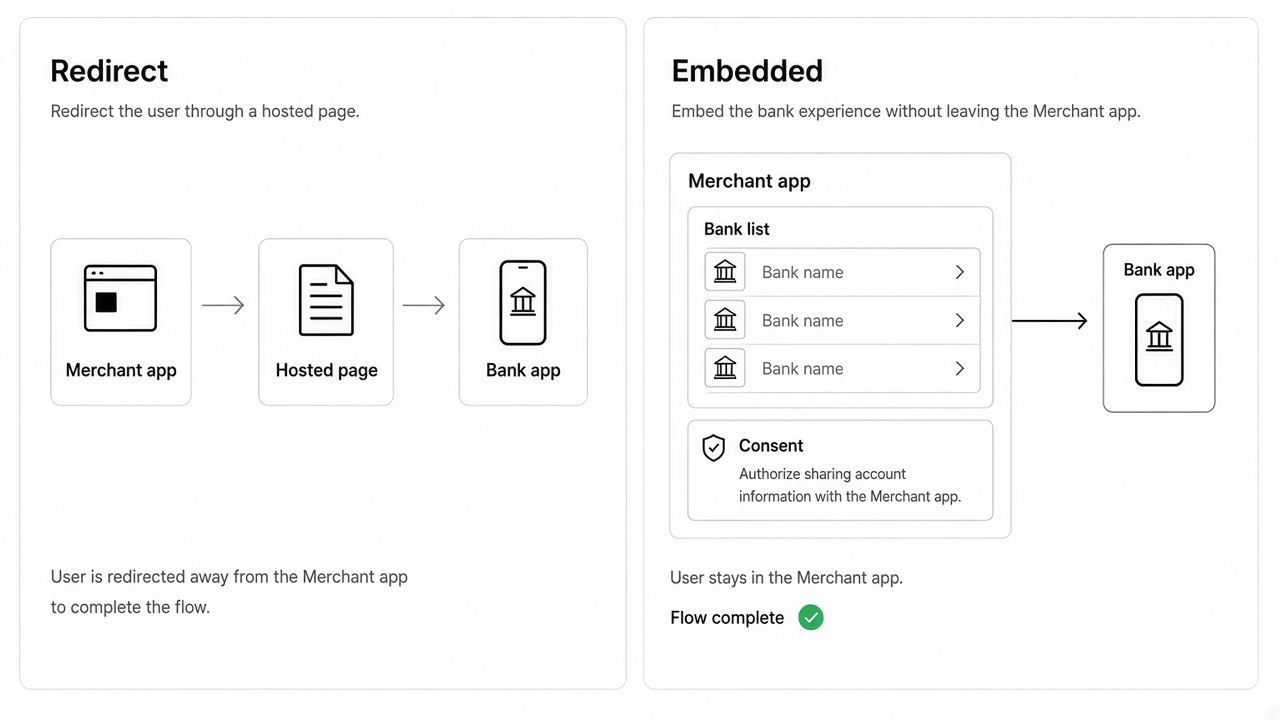
Open banking redirect vs embedded: Two ways customers authorise a bank payment through your product. Redirect hands the user to a provider-hosted page or deep link that opens their banking app. Embedded renders bank selection and consent steps inside your app or website via SDK or iframe, then may still redirect for bank-side strong authentication. Both require customer consent; the difference is where your UX ends and the bank journey begins.
What is the difference between redirect and embedded open banking?
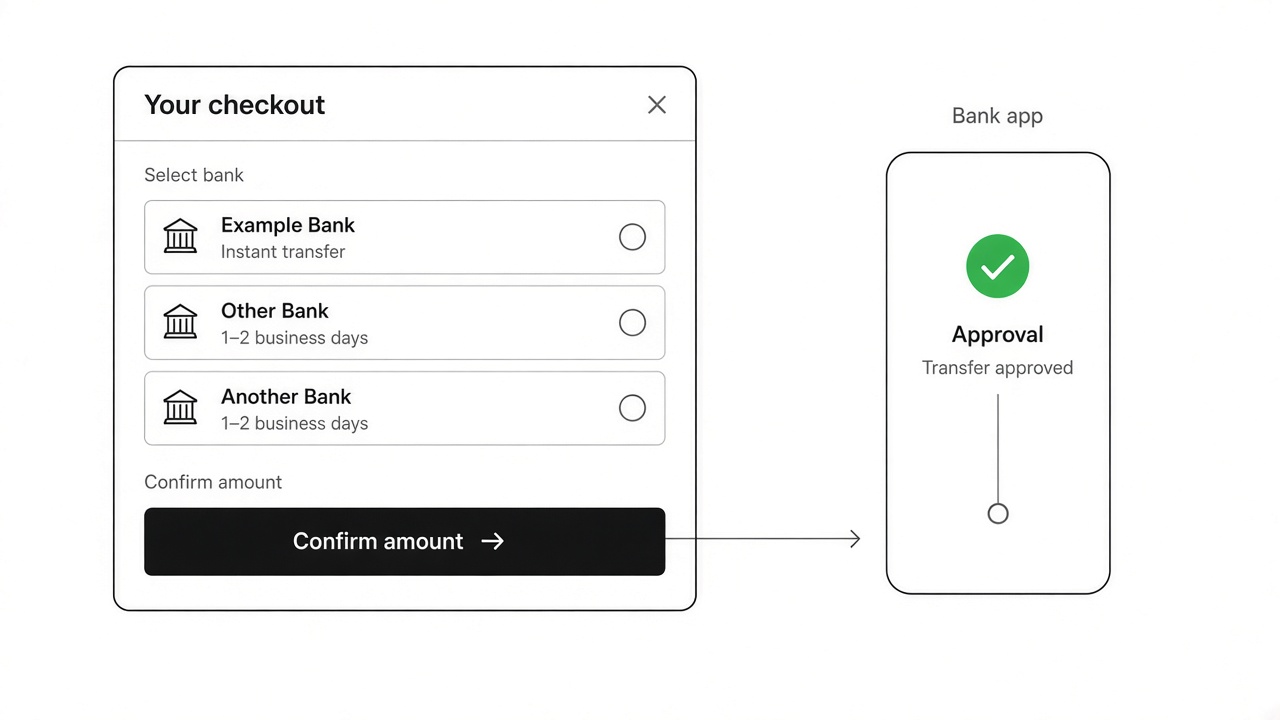
Redirect moves the customer out of your product for bank selection and consent; embedded keeps those steps in your UI until the bank requires app approval. In a redirect flow, your backend creates a payment or data request, returns a URL, and the customer completes authorisation on a hosted page or via an app-to-app deep link. In an embedded flow, your frontend calls provider APIs or loads an SDK so users pick their bank and confirm amounts without leaving your layout — then typically still jump to the banking app for the final approval step required by strong customer authentication.
| Dimension | Redirect | Embedded |
|---|---|---|
| Time to first live payment | Often faster — fewer frontend components | Longer — SDK integration, styling, error states |
| Brand control | Lower on hosted pages | Higher — matches your checkout chrome |
| Mobile conversion | Depends on deep links; desktop can lag | Usually stronger when bank list is in-app |
| Engineering owner | Mostly backend + redirect return URLs | Frontend + backend + webhook handling |
| Invoice / link use cases | Natural fit (email, SMS, PDF) | Harder unless customer is already in your app |
Neither mode removes the bank-app step for most EU payment initiations. The choice is how much of the journey your team owns before that handoff. For the full integration stack behind either pattern, see open banking API integration.
When you know your markets and use case but not which providers support embedded SDKs versus hosted redirect, use the provider-matching form to filter on UX model before sandbox testing.
When should you choose a redirect open banking flow?
Choose redirect when speed to market, payment links, or minimal frontend work matters more than pixel-perfect checkout branding. Redirect is the default for many v1 rollouts because your team can ship pay by bank with backend-only changes plus a return URL handler.
Strong redirect fits:
- Hosted payment links — invoices, dunning emails, or SMS where the customer is not inside your logged-in app (pay by bank invoice payment patterns)
- Low-traffic B2B portals — finance approvers pay occasional bills; UX polish is secondary to correct references and webhooks
- Partner white-label — you hand a URL to a merchant who embeds it as "Pay now" without SDK work
- Proof-of-concept pilots — validate bank coverage and settlement before investing in embedded components
Redirect trade-offs are measurable: customers may drop when they leave your domain, desktop browsers without app-to-app support show longer chains, and you rely on the provider's hosted page for bank list quality. Those are fixable with mobile deep links and good return-url handling — topics covered in pay by bank checkout conversion — but redirect alone will not match embedded conversion on mobile-first retail checkout.
According to Open Banking Limited, UK open banking payment volumes continue to grow through industry-led standards — teams still validate per-bank redirect behaviour in sandbox because hosted pages do not guarantee production success on every institution your customers use.
When should you choose an embedded open banking flow?
Choose embedded when checkout lives inside your app or site, mobile traffic dominates, and drop-off from leaving your UI costs real revenue. Embedded flows let you control bank list ordering (country defaults, top banks first), amount confirmation copy, and error recovery without sending users to a generic hosted skin.
Embedded fits best when:
- E-commerce or SaaS checkout — customer is already authenticated; abandoning your cart for an unfamiliar page hurts completion (open banking for e-commerce)
- Mobile-first products — in-app bank picker plus app-to-app handoff beats long browser redirect chains
- Multi-step onboarding — account verification beside KYC forms; keeping context reduces support tickets
- Agentic or API-led commerce — server creates payment but customer approves through a branded in-app sheet (see agentic payments open banking)
Embedded costs more engineering: SDK versioning, accessibility, loading states, and bank-list caching. You also share responsibility with the provider for consent copy clarity — regulators expect customers to understand what they approve regardless of skin.
Not every provider offers embedded components in every EU market. Treat "embedded available" as a sandbox-tested claim: request institution lists, mobile deep-link behaviour, and failure codes for your top five banks before you commit the frontend sprint.
How does mobile app-to-app change the redirect vs embedded decision?
Mobile app-to-app handoff is required for strong authentication on many flows — embedded vs redirect mainly changes what happens before that jump. On iOS and Android, the best experiences open the customer's banking app directly after they select an institution, then return control through a universal link or custom scheme. Embedded checkout can trigger that handoff from your styled bank list; redirect flows trigger it from a hosted page.
What to test in sandbox for mobile:
| Test | What good looks like |
|---|---|
| Bank list on mobile web | Top domestic banks visible without horizontal scroll |
| Deep link return | Order status updates even if customer never hits your redirect URL |
| App not installed | Clear fallback (continue in mobile browser) |
| Cancel in bank app | Recoverable cart state; no duplicate payment on retry |
Webhook confirmation remains non-negotiable for both modes — customers close tabs after approving in the bank app. If you only mark success on redirect return, embedded and redirect flows will both under-report conversion. Engineering teams should implement the same idempotency and webhook deduplication rules regardless of UX mode.
Can you mix redirect and embedded in one product?
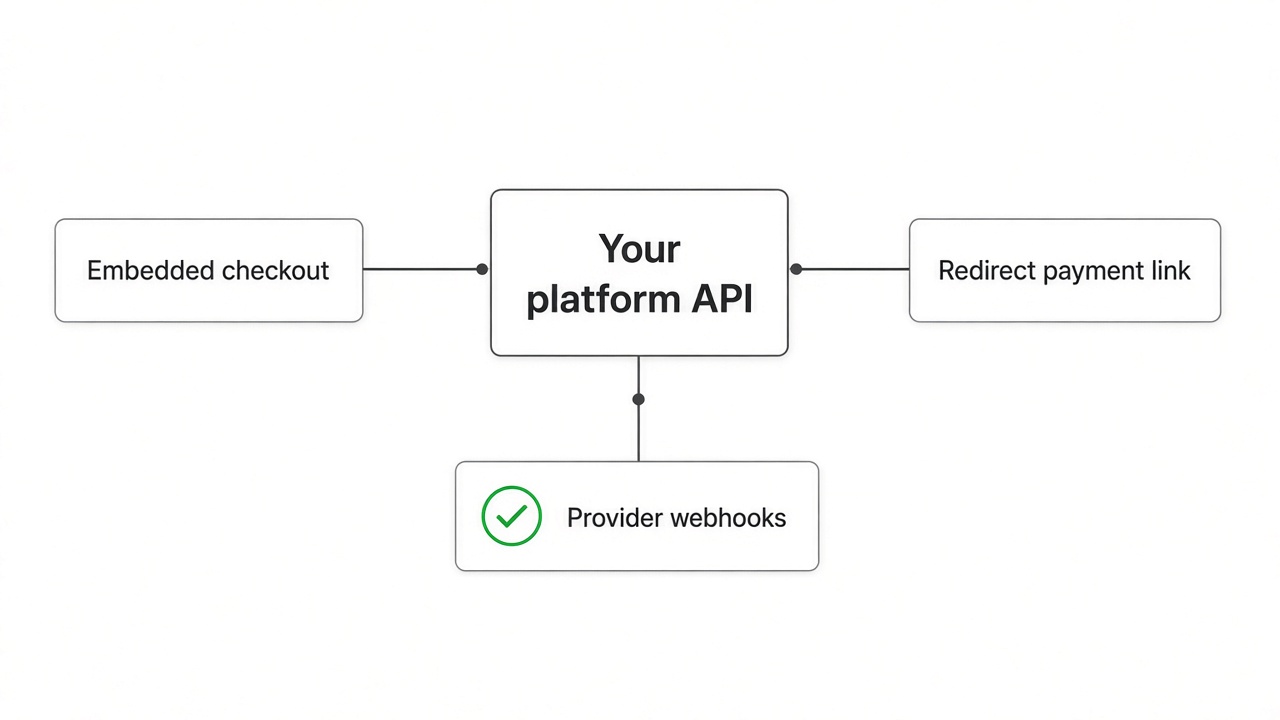
Yes — most mature EU B2B products use embedded checkout for logged-in users and redirect links for outbound invoices or partner channels. Mixed-mode is normal, not a compromise:
- Embedded for authenticated checkout, subscriptions, and in-app top-ups
- Redirect links for invoice emails, payment reminders, and partner portals
- Same provider backend where possible so webhooks, references, and reconciliation rules stay unified
Avoid two providers solely because one offers embedded UI and another offers cheap redirect links — operational cost (two webhook formats, two reconciliation mappings) usually exceeds the UX win. Prefer one provider that supports both patterns in your priority countries, or accept redirect-only for v1 invoice links while embedded checkout ships in Q2.
Document which flows use which mode in runbooks so support knows whether a customer should expect a hosted page or an in-app bank list. Finance should see the same payment reference format across modes.
What should you ask providers before committing to a UX mode?
Validate embedded SDK availability, redirect URL customisation, and per-bank mobile behaviour in sandbox — not on sales slides. A practical RFP or pilot checklist:
| Question | Why it matters |
|---|---|
| Which countries offer embedded SDK vs hosted redirect only? | Avoid rebuilding when you expand |
| Can you white-label hosted redirect pages? | Brand gap mitigation if embedded slips |
| How are bank lists ranked and filtered? | Conversion on embedded checkout |
| What redirect return parameters are guaranteed? | Order matching on success and cancel |
| Are webhooks identical for embedded and redirect creates? | Mixed-mode ops simplicity |
| Sandbox parity for your mandatory banks? | Production surprises are bank-specific |
Cross-read best open banking API providers for developers (2026) for documentation and sandbox depth — this article stays on UX architecture, not vendor rankings. Run the same three to five banks per country for both modes when a provider claims both.
Frequently Asked Questions
What is open banking redirect vs embedded?
Open banking redirect sends customers to a hosted page or banking app link to select their bank and approve payment. Embedded open banking keeps bank selection and consent inside your app or website via SDK or iframe, then usually still opens the banking app for final authorisation. Redirect ships faster; embedded typically converts better on mobile checkout.
Is embedded open banking more secure than redirect?
Both use regulated bank rails and strong customer authentication in the banking app for payment approval. Security differences are mostly implementation hygiene: HTTPS, webhook signature verification, and idempotency keys matter equally. Embedded does not bypass bank-side authentication; it changes where the customer picks their bank.
Which flow has better conversion for pay by bank checkout?
Embedded usually wins on mobile in-app checkout because customers stay in your branded UI until the bank-app handoff. Redirect can match embedded when deep links are tuned and bank lists are accurate — but desktop-only redirect chains often drop more. Measure with webhook-confirmed success, not redirect return alone.
Can I use redirect for invoices and embedded for checkout?
Yes. That mixed pattern is common: redirect payment links for invoice emails and embedded flows for logged-in checkout or subscriptions. Use one provider backend when possible so webhooks and reconciliation stay consistent.
Do all open banking providers support embedded payments?
No. Coverage varies by country and institution. Some providers offer embedded SDKs in the UK and Germany but redirect-only in smaller markets. Always confirm embedded availability for your mandatory banks in sandbox before committing frontend work.
How do webhooks work with redirect and embedded flows?
Webhooks behave the same once a payment is created — the provider notifies your backend of status changes regardless of UX mode. Configure signature verification, idempotent ledger updates, and customer emails on webhook success so orders confirm even when customers never return to your site after bank approval.
Conclusion
Open banking redirect vs embedded is a product and engineering trade-off, not a purity test. Redirect gets invoice links and pilots live quickly; embedded protects conversion when customers already trust your checkout. Mobile app-to-app handoff and webhook-backed confirmation matter for both. Most EU B2B teams end up mixed: embedded where revenue concentrates, redirect where customers arrive from email or partners. Pick your v1 mode from use case and traffic shape, validate mandatory banks in sandbox for that mode, and expand only after webhook reconciliation proves the rail in production.
Related articles
- Open Banking Webhooks: Verification, Idempotency, and Ops
Checkout teams that rely on browser redirects alone still ship orders late, double-fulfil when customers refresh, and argue with finance about which payments a…
- Cross Border Open Banking Integration: EU Multi-Country Data Playbook
Cross border open banking integration is how EU lenders, BNPL operators, and credit platforms pull consented bank data from more than one country without rebui…
- PSD2 Open Banking: Present-Tense EU Framework
If your roadmap includes collecting from bank accounts, verifying IBANs before payouts, or reading transaction history without manual uploads, PSD2 open bankin…