Open Banking for Charities: Donation Collection Playbook
Charity finance and fundraising teams lose donor goodwill when collection friction shows up as failed monthly gifts, manual bank-transfer reconciliation, or card expiry churn on recurring programmes. Open banking for charities gives registered UK charities and EU fundraising operations bank-rail tools — pay by bank, account verification, and recurring bank authorisations — so donations and membership dues land with deterministic references and lower variable cost than card-on-file on several flows. This playbook maps six use cases charity ops teams can pilot first, how UKPI Wave 1 eligibility applies, and what to validate before you switch donor-facing copy.
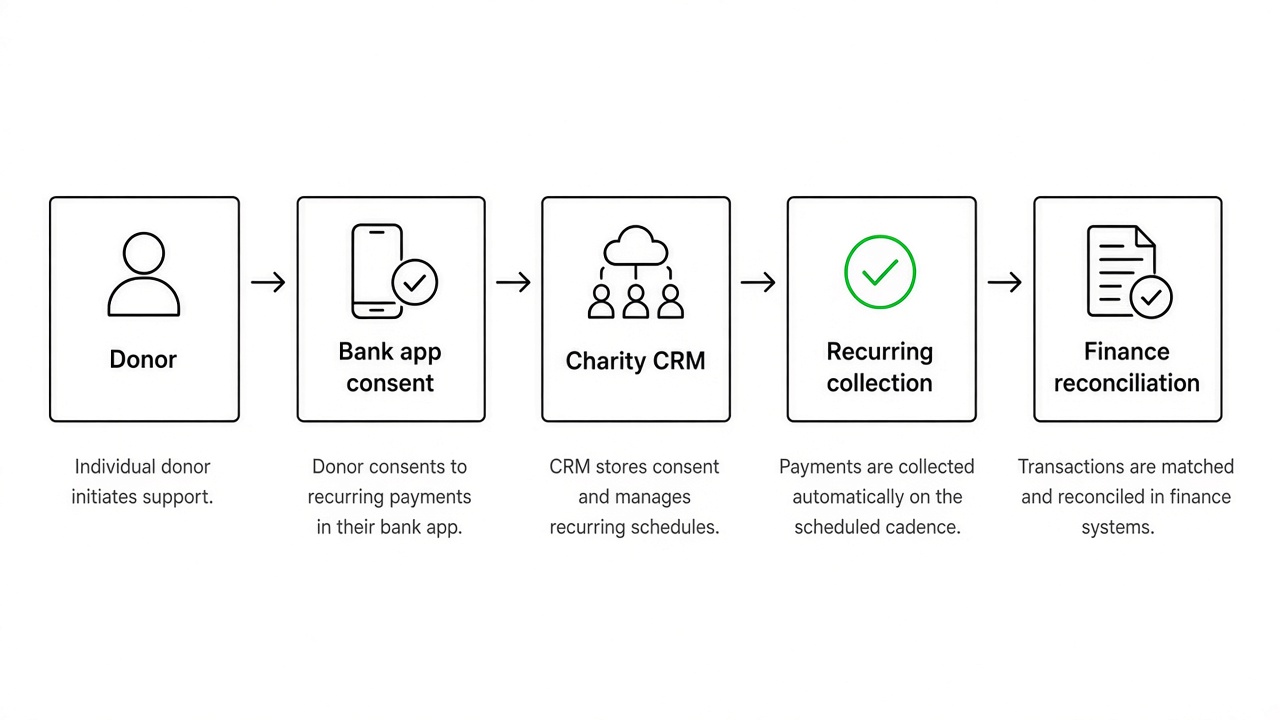
Open banking for charities: Using regulated bank APIs — payment initiation, account verification, and recurring bank mandates — so registered charities collect one-off and repeat donations, verify supporter accounts, and reconcile inbound gifts without re-keying bank details across separate fundraising and finance systems. Supporters grant consent in their banking app; funds move account-to-account.
Why are charity finance teams evaluating open banking?
Charity finance teams evaluate open banking because recurring donation programmes bleed margin on card fees, expiry-driven churn, and manual reconciliation of bank transfers that arrive without campaign references. A mid-size national charity with 40,000 active monthly givers can spend six figures annually on card interchange alone — before counting ops time matching anonymous transfers to CRM records.
The pain points differ from generic subscription billing:
- Variable gift amounts — donors change monthly pledges after campaigns; rails must accept amount changes within agreed caps
- Campaign spikes — emergency appeals produce tenfold volume for two weeks; checkout must stay stable without a separate payment stack
- Donor trust UX — supporters expect to manage giving in their banking app, not re-enter card details on a third-party form every year
- Gift Aid and finance reconciliation — finance needs creditor references that map cleanly to CRM gift IDs, not "transfer from J Smith"
In the UK, registered charities sit inside UK Payments Initiative (UKPI) Wave 1 for commercial variable recurring payments (cVRP), alongside regulated utilities and financial services. The FCA welcomed the UKPI scheme launch in June 2026 as the first new UK payment scheme since Faster Payments. EU charities should map recurring strategy to bank on file vs card on file patterns and confirm ASPSP coverage per market — scheme names differ, but the operational questions (variable amounts, consent UX, webhooks) are the same.
Open banking does not replace every rail. Direct Debit and SEPA Direct Debit remain strong for flat monthly pledges at scale. Cards still matter for one-off web gifts where bank redirect is unfamiliar. The win is embedding bank rails in the donation journey — consent at signup, collection each cycle, recovery on failure — rather than treating bank pay as a separate ops workaround.
How do recurring charity donations work on bank rails?
Recurring charity donations on bank rails start with one supporter consent in their banking app, then your payment provider pulls each gift within caps the donor agreed — without sending them back to checkout every month. That pattern matches what UK fundraisers call recurring giving programmes and what UKPI labels cVRP for eligible registered charities.
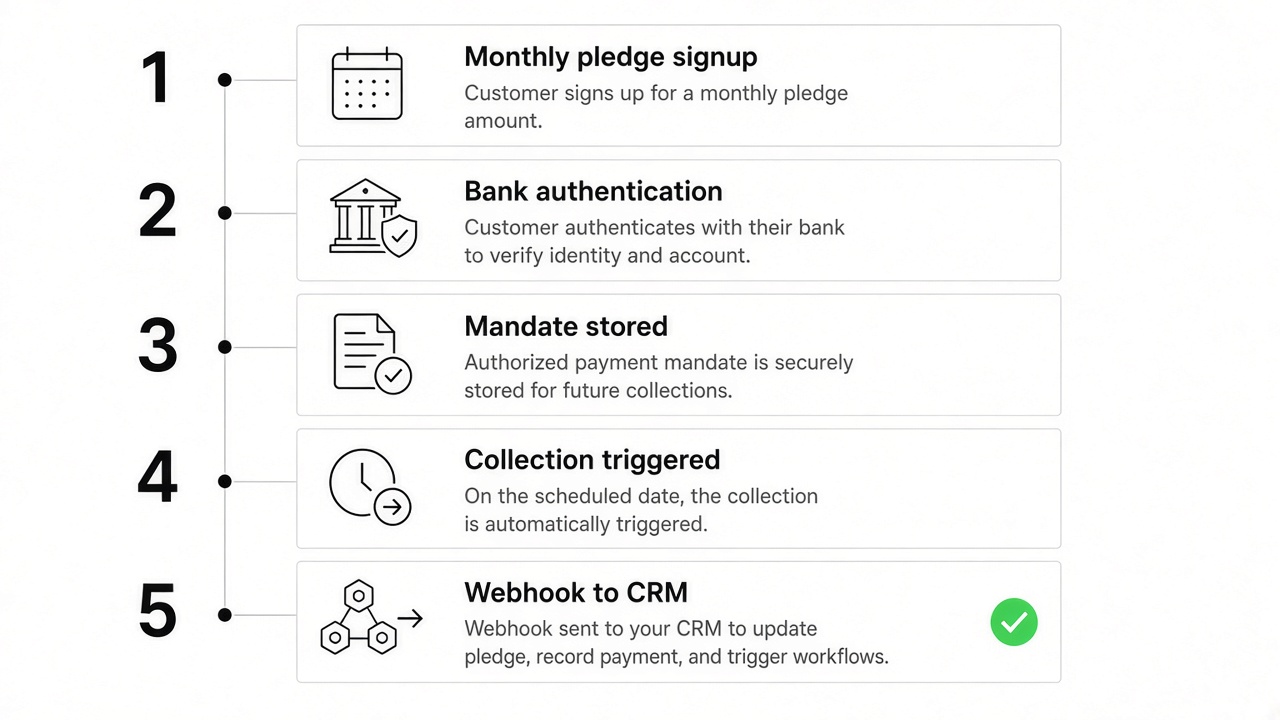
A practical donor journey:
- Supporter selects monthly giving on your website or app
- They authenticate with their bank and approve a recurring mandate with per-payment and monthly caps
- Your provider stores the mandate token — not card numbers
- Each billing cycle, your CRM or fundraising platform triggers a collection for the pledged amount
- Webhooks confirm success or failure; CRM and finance records update in real time
For UK registered charities, Open Banking Limited describes UKPI as an industry scheme with published transaction and access fees designed to support early adoption. Compare scheme economics alongside provider quotes using open banking pricing models — headline API rates rarely tell the full story when donation volume is high but average gift size is modest.
Trade-offs: recurring bank mandates require supporters to bank with an ASPSP that participates in your provider's coverage map. Pilot on one donor segment — for example monthly givers acquired through a single campaign — before migrating your full recurring book.
What bank rails suit one-off appeals and campaign spikes?
One-off appeals and emergency campaigns need pay-by-bank checkout that handles traffic spikes without separate payment infrastructure — while recurring programmes run on mandates in parallel. When a disaster appeal launches, your team cannot afford a checkout provider that throttles API calls or drops webhooks under load.
| Rail | Best for charity use | Main trade-off |
|---|---|---|
| Pay by bank (one-off) | Emergency appeals, event registration, mid-cycle top-ups | Supporter action each time without a mandate |
| UK cVRP (UKPI Wave 1) | Registered UK charities with variable monthly pledges | Wave 1 sector eligibility; confirm with provider |
| SEPA Direct Debit / Bacs | Flat monthly pledges at very large scale | Slower failure notification than instant bank pay on some flows |
| Card on file | Channels where bank redirect is unfamiliar | Interchange, expiry, dispute cost on high volume |
For one-off gifts, pay by bank gives instant confirmation and a lower cost per successful payment than many card flows — useful when average web gift size is high enough that interchange matters. Pair one-off checkout with pay by bank checkout conversion testing: donor-facing copy should explain that they approve payment in their banking app, not on your card form.
Campaign spikes also stress reference discipline. Every successful pay-by-bank gift should return a webhook with a deterministic campaign or gift ID so finance does not manually match thousands of inbound transfers during peak weeks.
How can open banking reduce failed donations and donor churn?
Failed recurring donations often trace to closed accounts, insufficient balance on debit day, or mandates set up with incorrect details — open banking improves recovery with pay-by-bank retry links and automated re-attempt paths before you mark a donor lapsed. Charity CRM teams report that involuntary churn from payment failure rivals active cancellations on long-running monthly programmes.
Patterns that work for fundraising ops:
- Automated retry — configure your bank-payment provider to retry failed collections on a defined schedule aligned with payroll cycles (many donors are paid monthly on the same dates)
- Smart recovery link — email or SMS with a pay-by-bank deep link for the exact arrears amount, pre-filled with gift reference
- Real-time CRM sync — when a collection fails, supporter records update immediately so relationship teams see status without waiting for batch reconciliation
- Verified account path — capture bank-confirmed account details at first successful gift so retries target the same verified IBAN
Measure recovery rate and cost per successful re-gift, not just first-attempt authorisation. A rail that looks cheaper per API call but fails more often on certain retail banks increases donor-services headcount — especially when your supporter base spans many UK and EU ASPSPs.
How does open banking support Gift Aid and finance reconciliation?
Gift Aid and finance reconciliation improve when every inbound gift carries a deterministic reference from initiation through webhook — open banking initiation embeds creditor references that bank transfers rarely include. HMRC Gift Aid claims depend on auditable gift records tied to identifiable supporters; anonymous bank transfers force manual matching that breaks at scale.
Finance teams use open banking to:
- Attach CRM gift IDs to every initiated payment so webhooks reconcile automatically
- Verify supporter bank account names at signup for high-value pledges or legacy giving programmes
- Reduce duplicate gift records when the same donor pays by bank and later "tops up" via a different channel
This is adjacent to income verification with open banking mechanics but tuned to donor onboarding timing: verification at first gift prevents chasing the wrong account on the second monthly collection. Open banking does not replace Gift Aid declaration capture or HMRC submission workflows — it removes the reconciliation gap between "donor paid" and "finance can claim."
What should charity fundraising teams evaluate in an open banking provider?
Shortlist providers on donor-bank coverage in your supporter markets, recurring consent support for variable gift amounts, webhook reliability under campaign load, and CRM or fundraising-platform integration — not API marketing alone. A gap in one major UK retail bank shows up as lost monthly givers the week after you migrate copy.
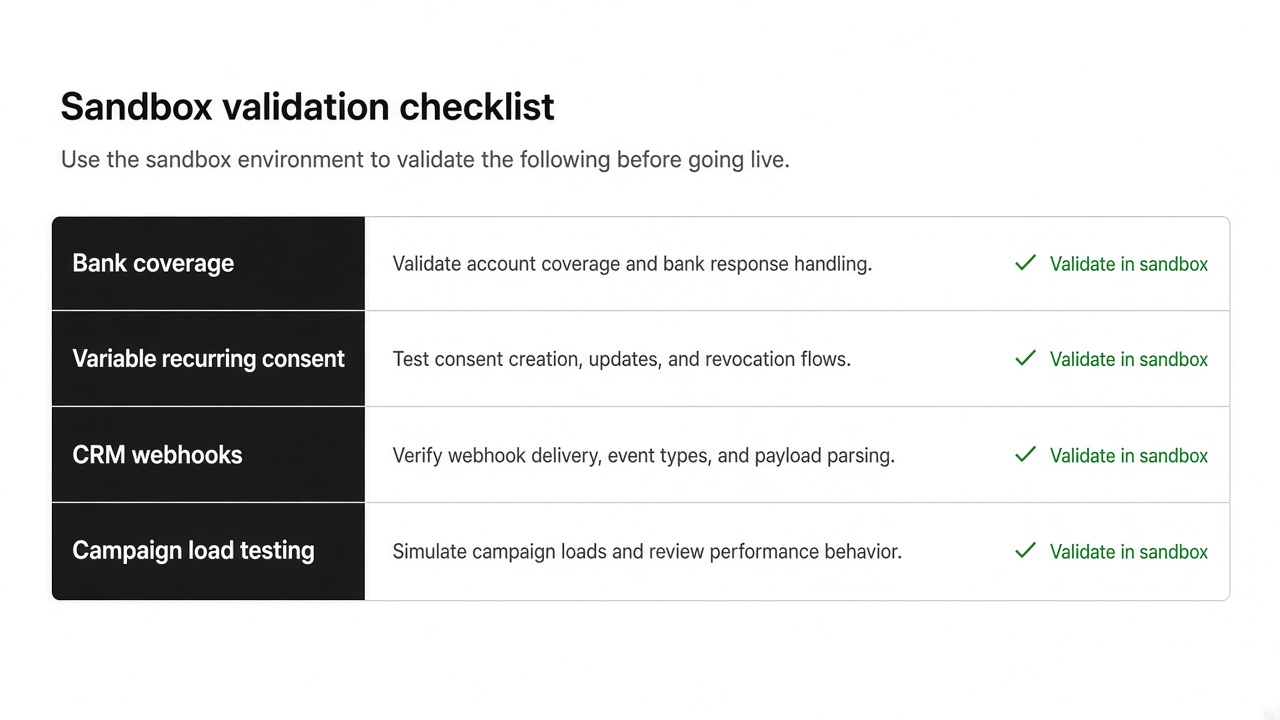
Validation checklist before production:
| Criterion | Why it matters for charity fundraising |
|---|---|
| Retail bank coverage per market | Donors bank with high-street ASPSPs; B2B-only lists fail |
| Variable amount / recurring consent | Monthly pledges change after campaigns; caps must flex |
| CRM / fundraising platform integration | Raiser's Edge, Salesforce, or custom stacks need webhooks and idempotent collection APIs |
| Creditor reference in webhook | Finance matches thousands of gifts; references must be deterministic |
| Sandbox load testing | Emergency appeals spike volume 10×; test before go-live |
Run sandbox tests with your typical gift amounts — £5 monthly pledges behave differently from £100 patron memberships on some bank rails. For a neutral comparison framework, see how to choose an open banking provider in the EU. When you are ready to match requirements to live coverage, use the provider-matching form to compare bank coverage, recurring support, and fundraising integration against your donor markets.
Frequently Asked Questions
What is open banking for charities?
Open banking for charities uses regulated bank APIs so registered charities and fundraising organisations collect one-off and repeat donations, verify supporter accounts, and reconcile gifts with deterministic references — through account-to-account transfers with explicit donor consent in their banking app, instead of relying solely on cards or manual bank transfers.
Can UK charities use cVRP for recurring donations?
Yes, if the organisation is a registered charity and your use case fits UKPI Wave 1 rules. UKPI launched in June 2026 with Wave 1 sectors that include registered charities alongside regulated utilities, telecoms, financial services, and government bodies. Confirm eligibility and live bank coverage with your payment provider before changing donor-facing copy. General retail-style subscriptions wait for UKPI Wave 2.
How does open banking compare to Direct Debit for charity giving?
Direct Debit and Bacs remain proven at scale for flat monthly pledges with predictable amounts. Open banking and cVRP add faster settlement on many flows, instant failure signals on some rails, and donor-managed consent in the banking app — useful when gift amounts vary or when you want to reduce card interchange on recurring programmes. Many charities run both: Direct Debit for legacy programmes, bank pay for new digital acquisition.
Do open banking donations cost less than card payments?
Often on a per-successful-payment basis, because account-to-account transfers avoid card interchange. Total cost depends on your provider's commercial model plus any scheme fees — UKPI publishes transaction and access fees for participating firms. Model your average gift size, monthly volume, and failure rate; a low headline rate with poor bank coverage can increase ops cost through failed collections.
Can open banking help with emergency fundraising appeals?
Yes. Pay-by-bank checkout handles one-off gifts with instant confirmation — suited to disaster appeals and time-limited campaigns. Pair checkout with webhook references tied to campaign IDs so finance reconciles spikes without manual transfer matching. Load-test your provider sandbox before high-profile appeals; campaign traffic can exceed normal monthly volume many times over in days.
How do I choose an open banking provider for a charity?
Start from donor bank coverage in your markets, recurring consent support for variable monthly gifts, CRM integration, webhook reliability, and sandbox parity with production. Pilot on one donor segment, keep legacy rails live during migration, and validate cap logic and failure recovery before you move your full recurring book. Use a structured shortlist process rather than selecting on brand familiarity alone.
Charity fundraising teams that pilot open banking on one recurring segment — while keeping cards and Direct Debit live — can measure recovery rates, reconciliation time, and cost per successful gift before migrating donor-facing copy. UK registered charities with variable monthly programmes should confirm UKPI Wave 1 eligibility now; EU organisations should map the same operational checklist to local bank-pay schemes. When your requirements are documented, compare providers on coverage and integration fit rather than headline pricing alone.
Related articles
- Open Banking for Sports Clubs: Membership Fee Playbook
Grassroots treasurers lose evenings to chasing match fees in group chats, re-keying bank details after every new squad signup, and reconciling transfers that a…
- Open Banking for Property Management: Rent Collection Playbook
Lettings and build-to-rent ops teams bleed margin when rent collection depends on cards with interchange, slow bank-transfer reconciliation, or direct debits t…
- Open Banking for Telcos: Billing and Collection Playbook
Telecom resellers and managed service providers (MSPs) bleed margin on billing ops long before a network fault hits: manual mandate re-keying after contract si…