Open Banking Account Verification: How It Works in 2026
Wrong-IBAN payouts, stalled onboarding, and manual statement reviews drain ops time long before a customer makes their first payment. Open banking account verification lets users prove they control a bank account in the same session where you collect payout or mandate details — you receive a structured match result from their bank instead of waiting days for micro-deposits or parsing uploaded PDFs. This guide explains what the flow delivers, where product teams use it, how it compares to legacy methods, and how it differs from income checks and verification of payee.
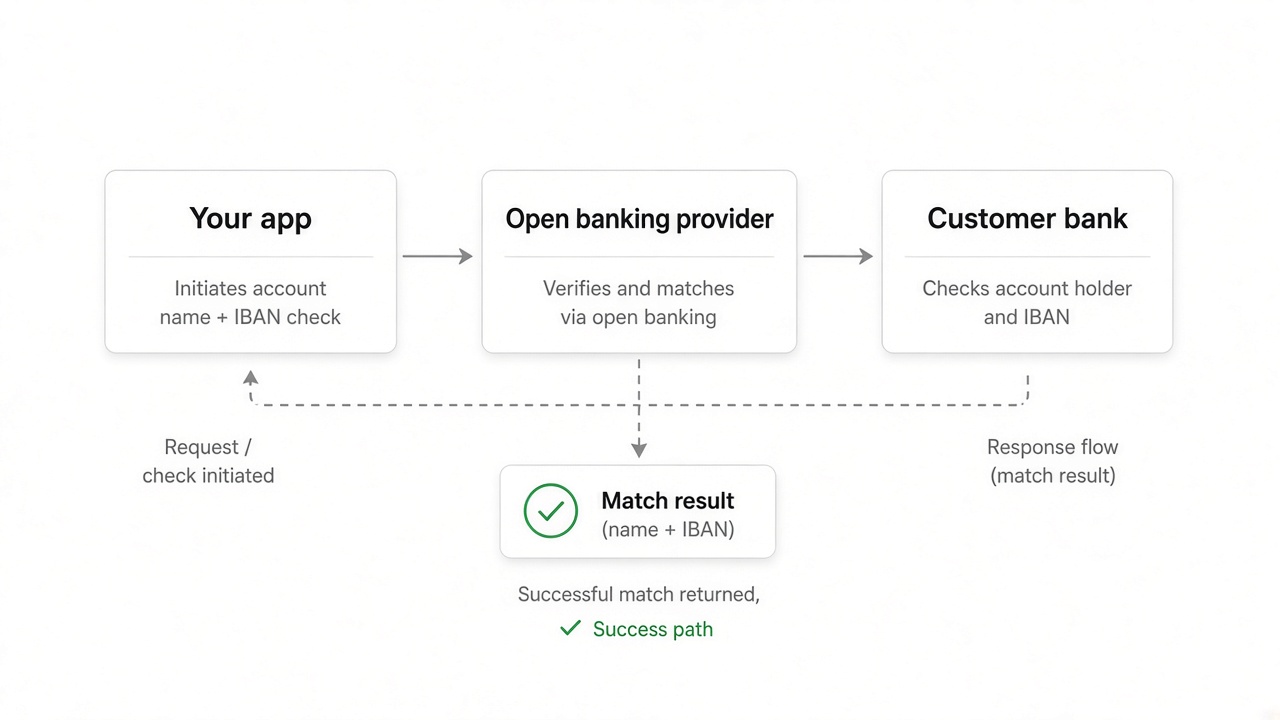
Open banking account verification: Confirming that a bank account exists and belongs to the person or business you expect — by having the customer authenticate in their banking app and consent to share account details through a licensed provider, usually within seconds instead of multi-day manual checks.
What is open banking account verification?
You confirm account ownership in-session — the customer selects their bank, authenticates in the banking app, and your backend receives holder name and account identifiers to compare against what they entered, without you handling bank credentials or waiting for statement uploads.
Most implementations use account information with a narrow consent scope: enough data to verify the account holder, not full transaction history. The user stays in control — they choose the institution, approve access, and can revoke consent under standard EU renewal rules. Your product receives a structured outcome: match, partial match, no match, or unavailable — that risk and onboarding systems can act on immediately.
This is distinct from income verification open banking, which analyses transaction inflows for lending decisions, and from verification of payee, which checks whether an outbound payment reaches the intended recipient at send time. Account verification answers a simpler question first: does this IBAN belong to this person or company before you store it for payouts or mandates?
How does the verification flow work in production?
The user picks their bank, authenticates once, and your system gets a verification result before the onboarding step completes — typically in under a minute for supported institutions.
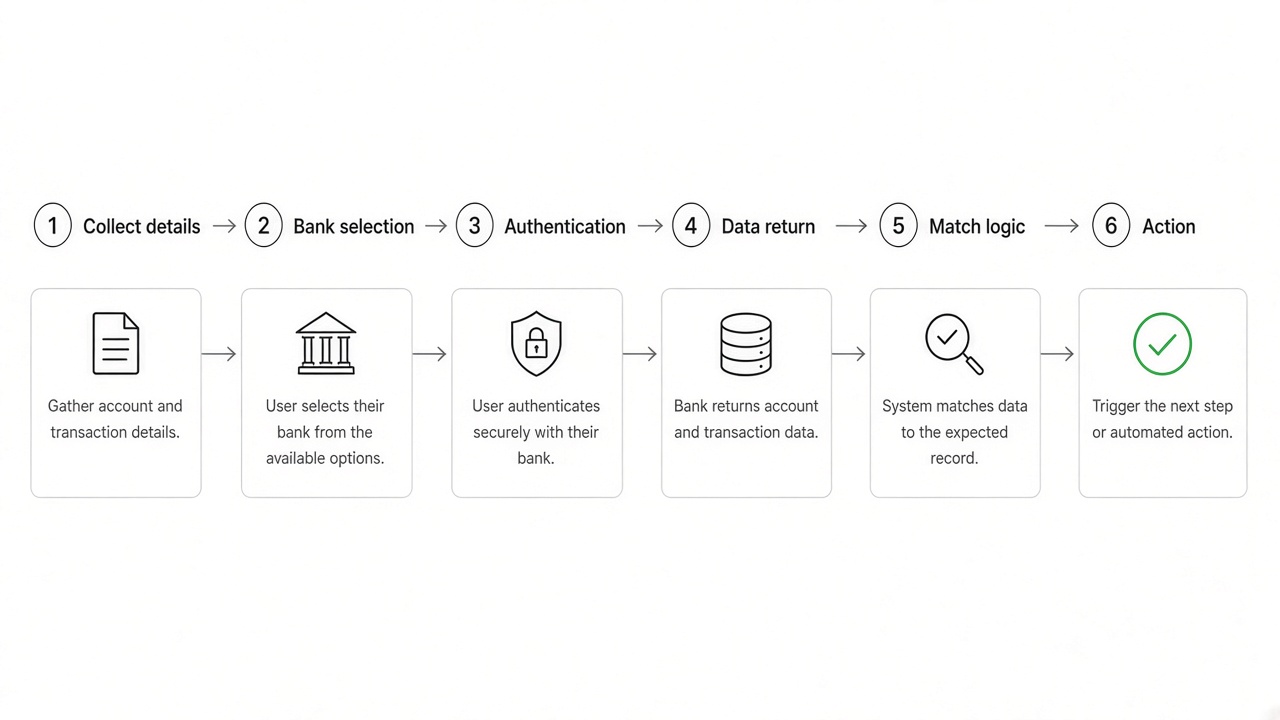
A typical integration path:
- Collect expected details — legal name and IBAN (or sort code and account number in the UK).
- Launch bank selection — redirect or embedded picker from your open banking provider.
- Customer authentication — handled entirely by the bank; you never see login credentials.
- Data return — provider delivers account holder name, masked or full identifiers, and sometimes account type.
- Match logic — your rules or the provider's engine compare returned data to what you collected.
- Downstream action — unlock payout setup, save verified status, or route to manual review.
Engineering work concentrates on UX placement (when to offer verify-with-bank vs manual entry), webhook handling for async banks, and storing verification tokens so you do not re-prompt on every subsequent disbursement. You integrate one licensed partner — you do not wire each EU bank yourself. For API-level evaluation criteria, see instant account verification APIs.
UK Confirmation of Payee vs EU name-and-IBAN checks
In the UK, many users expect Confirmation of Payee (CoP)-style name matching when sending money to a new payee. Open banking verification APIs often integrate CoP or equivalent name-match semantics for UK accounts. In the EU, verification typically relies on holder name and IBAN consistency via consented account data — match quality varies by bank, including joint accounts and truncated legal names.
Multi-market products should validate behaviour on both UK and EU institutions in sandbox before launch, not assume one global match schema.
| Market | Typical check | What to validate in sandbox |
|---|---|---|
| UK | CoP / payee name match | Match codes, business vs personal accounts |
| EU / SEPA | Holder name vs IBAN via account data | Joint accounts, missing name fields |
| Cross-border | Both schemas | Single webhook format or documented per-region payloads |
Where do teams use open banking account verification?
Any flow where storing a bank account creates payout or fraud risk — seller onboarding, contractor payouts, lending disbursement, and mandate setup — benefits from in-session verification instead of delayed manual review.
Common use cases:
- Marketplace and platform payouts — confirm seller accounts before first disbursement; see open banking merchant onboarding for funnel placement.
- Lending disbursement — verify the account that will receive loan funds matches the approved borrower; pairs with open banking for lending workflows.
- Payroll and contractor platforms — reduce wrong-IBAN salary runs without micro-deposit delays.
- Direct debit and mandate setup — validate account before storing payment instructions.
- Wallet and fintech onboarding — verify linked accounts during KYC-heavy signup without asking users to upload statements.
Trade-off: verification confirms ownership at a point in time. If the customer changes bank details later, you need re-verification policy or ongoing monitoring — verification is not a substitute for fraud scoring on every payout.
How does open banking compare to micro-deposits and manual checks?
Open banking verification completes in the same session; micro-deposits and manual statement review typically take one to three business days and still depend on user accuracy.
| Method | Speed | User effort | Fraud resistance | Ops load |
|---|---|---|---|---|
| Open banking verification | Seconds to ~1 min | Bank app authentication | High — data from source bank | Low — structured API result |
| Micro-deposits | 1–3 days | Enter two small amounts | Medium — delays deter some fraud | Medium — match pending deposits |
| Manual statement upload | Hours to days | Find PDF, upload, re-upload if rejected | Low — PDFs can be edited | High — human review queue |
| Free-text IBAN only | Instant | Type IBAN from memory | Low — typos and fraud | High — failed payout cleanup |
Micro-deposits remain valid where open banking coverage is thin or regulations require them, but for EU markets with strong bank API coverage, verification via consent usually wins on conversion and ops cost. Yapily's Validate product and Tink's Account Check both position open banking as replacing slow legacy methods for digital onboarding — the pattern is consistent across providers even when implementation details differ.
How is account verification different from income verification and verification of payee?
Account verification confirms who owns an account; income verification analyses what flows through it; verification of payee checks an outbound payment before it leaves.
| Check type | Question answered | Typical timing | Primary use |
|---|---|---|---|
| Account verification | Does this IBAN belong to this person or company? | Onboarding, payout setup | Platforms, PSPs, lenders |
| Income verification | Can we evidence salary or regular inflows? | Credit underwriting | Lenders, BNPL, rental |
| Verification of payee | Is this outbound payment going to the right name? | Before each transfer | Payers, treasury, apps |
Teams often need more than one: verify the disbursement account at onboarding, run income checks for credit decisions, and apply VoP on outbound treasury transfers. Each requires different consent scopes and provider capabilities — confirm your partner supports the checks you need before signing.
What should you evaluate in a verification provider?
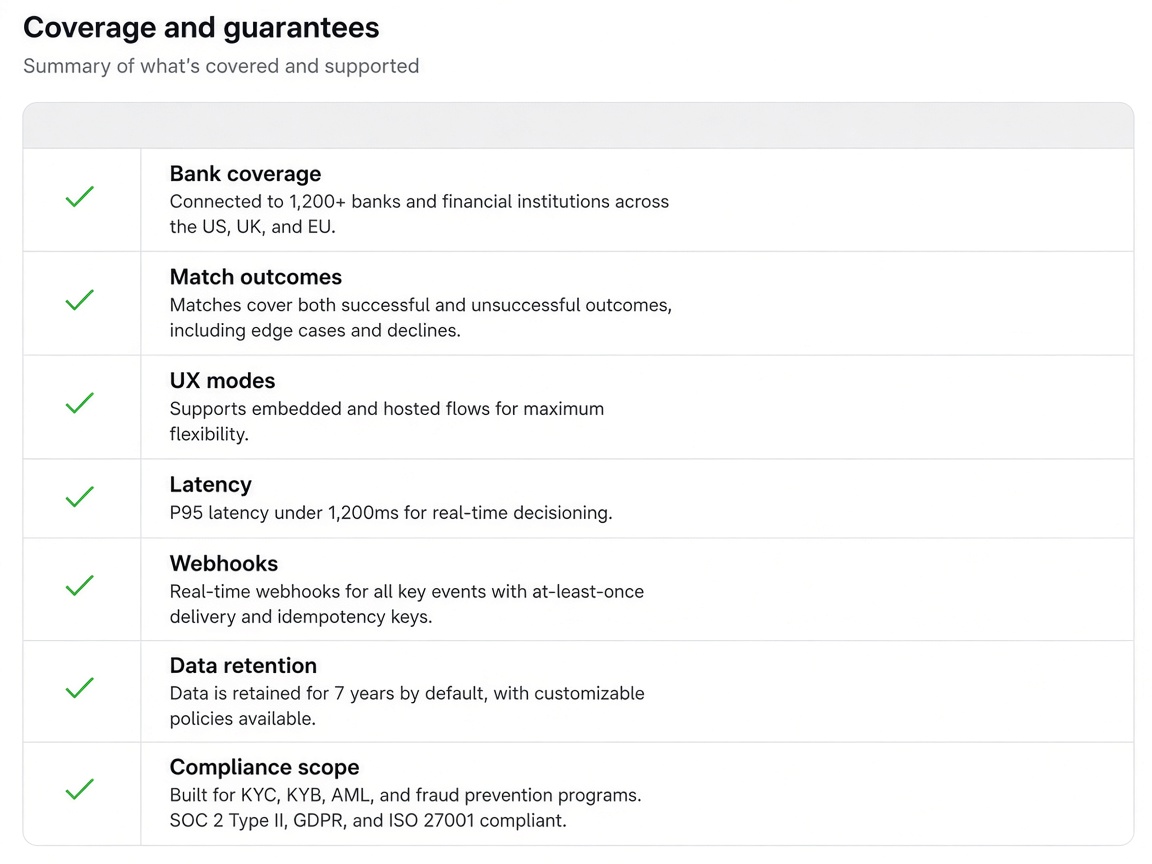
Coverage on your target banks, match semantics you can automate, and latency that does not block conversion — not feature-list length on a marketing page.
Evaluation checklist:
- Bank coverage — per-country lists for consumer, business, and corporate accounts you onboard.
- Match outcomes — exact, fuzzy, partial, unavailable; documented handling for each.
- UX modes — redirect, embedded, or API-only; mobile app-to-app behaviour.
- Latency — p95 after consent for your top five banks per market.
- Webhooks — async completion for slow institutions.
- Data retention — whether you store a verification token or must re-check each payout.
- Compliance scope — verification supplements KYC; it does not replace identity document checks or AML screening.
When you have sandbox results for your bank list but need to compare providers on coverage and match quality, use the provider-matching form to filter on verification capabilities before legal review — or start from how to choose an open banking provider in the EU for the wider evaluation framework.
Frequently Asked Questions
What is open banking account verification?
Open banking account verification confirms that a bank account exists and belongs to the expected person or business by having the customer authenticate in their banking app and consent to share account details through a licensed provider. Your system compares returned holder name and account identifiers to what you collected, usually within seconds.
How long does open banking account verification take?
For supported banks, verification typically completes in under a minute after the customer approves access in their banking app. Some institutions respond asynchronously; production integrations should handle webhooks and timeouts without blocking the entire onboarding funnel.
Is open banking account verification the same as KYC?
No. Account verification confirms bank account ownership and details. KYC (Know Your Customer) includes identity document checks, sanctions screening, and broader AML requirements. Verification reduces wrong-IBAN risk and speeds payout setup but does not replace regulated identity verification.
How is account verification different from verification of payee?
Account verification confirms ownership when you first store a beneficiary's bank details — usually at onboarding or payout setup. Verification of payee checks whether an outbound payment matches the intended recipient name at payment time. Many UK platforms use both because they address different failure modes.
Can open banking verify business bank accounts?
Yes, where your provider supports business and corporate account types and the bank returns holder name data for those accounts. Match quality varies — validate your target business banks in sandbox before launch, not only consumer retail accounts.
Do I need a banking licence to offer account verification?
No. You integrate a licensed open banking provider (TPP) that connects to banks under customer consent. You do not need your own banking licence unless you hold customer funds or perform regulated payment services beyond what your provider covers.
Conclusion
Open banking account verification replaces slow micro-deposits and manual statement review with in-session bank consent — fewer wrong-IBAN payouts, faster onboarding, and structured match results your risk engine can automate. It complements, rather than replaces, income verification for lending and verification of payee for outbound transfers. Validate match semantics and coverage on your target banks in sandbox, then compare providers on the criteria that matter for your markets and account types.
Related articles
- Open Banking Merchant Onboarding: Verify Accounts Faster
Every merchant you approve without verifying their payout account is a future support ticket — misdirected transfers, delayed first settlement, and sellers who…
- Verification of Payee Open Banking: Stop Wrong Payouts Before They Leave
Wrong IBANs, invoice fraud, and authorised push payment scams cost finance teams hours of recovery work — and sometimes the money never comes back. Verificatio…
- Open Banking Affordability Check: How EU Teams Map Obligations
Self-declared budgets and uploaded bank statements still miss the repayments, rent, and buy-now-pay-later instalments that actually leave a customer's account…