Open Banking Merchant Onboarding: Verify Accounts Faster
Every merchant you approve without verifying their payout account is a future support ticket — misdirected transfers, delayed first settlement, and sellers who churn before they earn. Open banking merchant onboarding embeds bank account verification in the same session where a PSP, marketplace, or platform collects KYC details, so finance confirms name-and-IBAN match before the first disbursement instead of after a failed payout. This guide explains where verification fits in the funnel, how the flow works in production, what breaks conversion, and how to evaluate providers without ranking vendors.
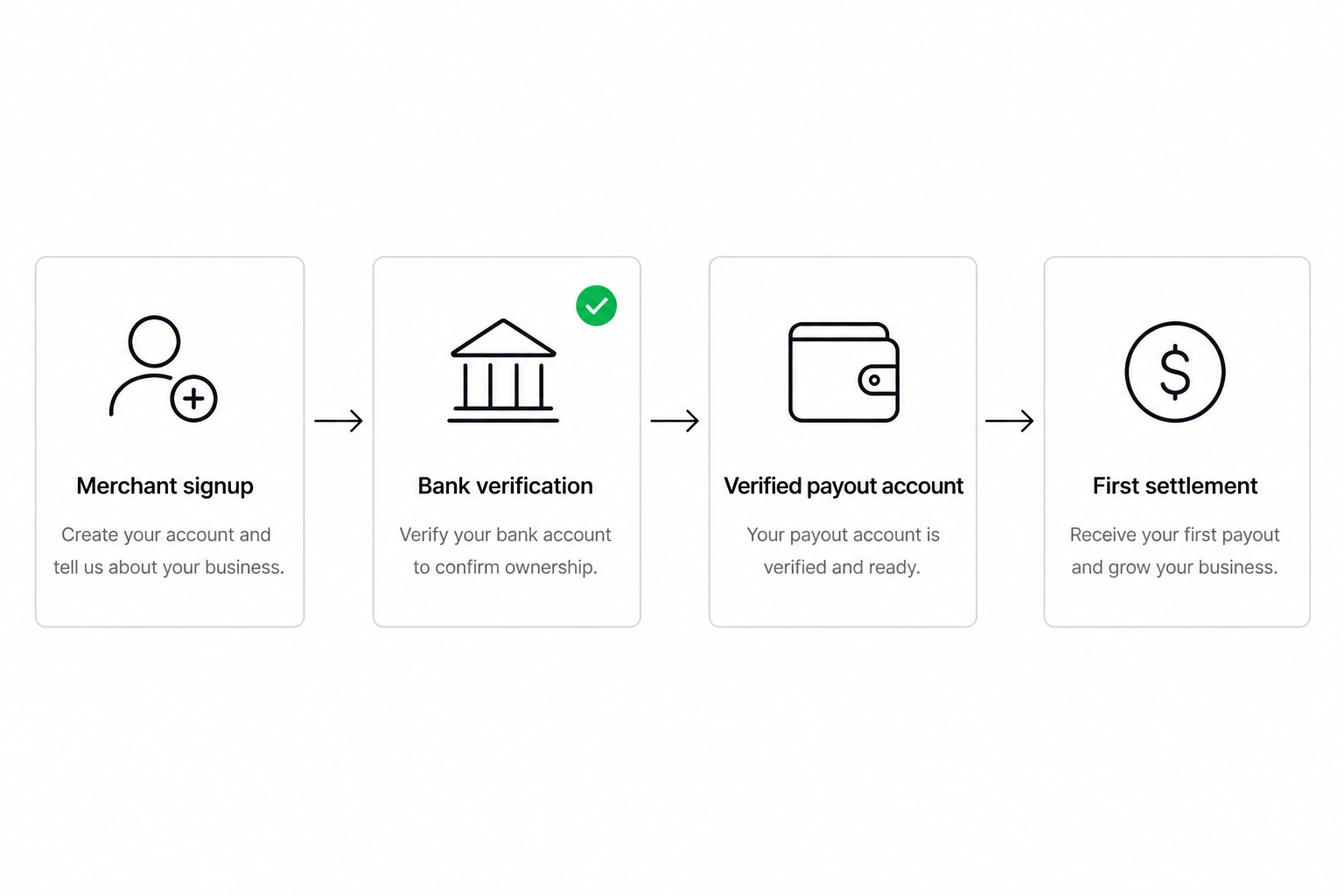
Open banking merchant onboarding: Using customer-consented bank account verification during merchant or seller signup — typically via a licensed open banking provider — so platforms confirm payout details, reduce wrong-IBAN transfers, and move approved merchants to first transaction faster than manual statement review or micro-deposit tests.
What does open banking merchant onboarding deliver?
You get verified payout rails before money moves — fewer failed disbursements, shorter time-to-first-settlement, and onboarding funnels that do not stall on "upload a bank statement" steps.
Teams running PSP sub-merchant programmes, marketplaces, and vertical platforms usually want four outcomes:
- Fewer wrong-IBAN payouts — name-and-account match before you store disbursement details
- Shorter onboarding cycles — in-session verification instead of two-day micro-deposit loops
- Lower ops load — structured match results instead of manual PDF review
- Better conversion — mobile-native bank authentication instead of typing IBANs from memory
Open banking delivers these through a licensed provider that connects to the merchant's bank after they authenticate in the banking app. You receive a structured verification result — match, partial match, no match, or unavailable — that your risk engine can gate payouts on. The merchant stays in control: they choose the bank, approve access, and can revoke consent under standard EU renewal rules.
This is verification-first onboarding, not checkout collection. If you also need buyer pay-by-bank at checkout, plan AIS verification and PIS initiation as separate integration scopes — see AIS vs PIS in open banking for how the rails differ.
How does bank verification work in the merchant onboarding flow?
The merchant selects their bank, authenticates in the banking app, and your backend receives a verification result before you mark onboarding complete — usually within seconds for supported institutions.
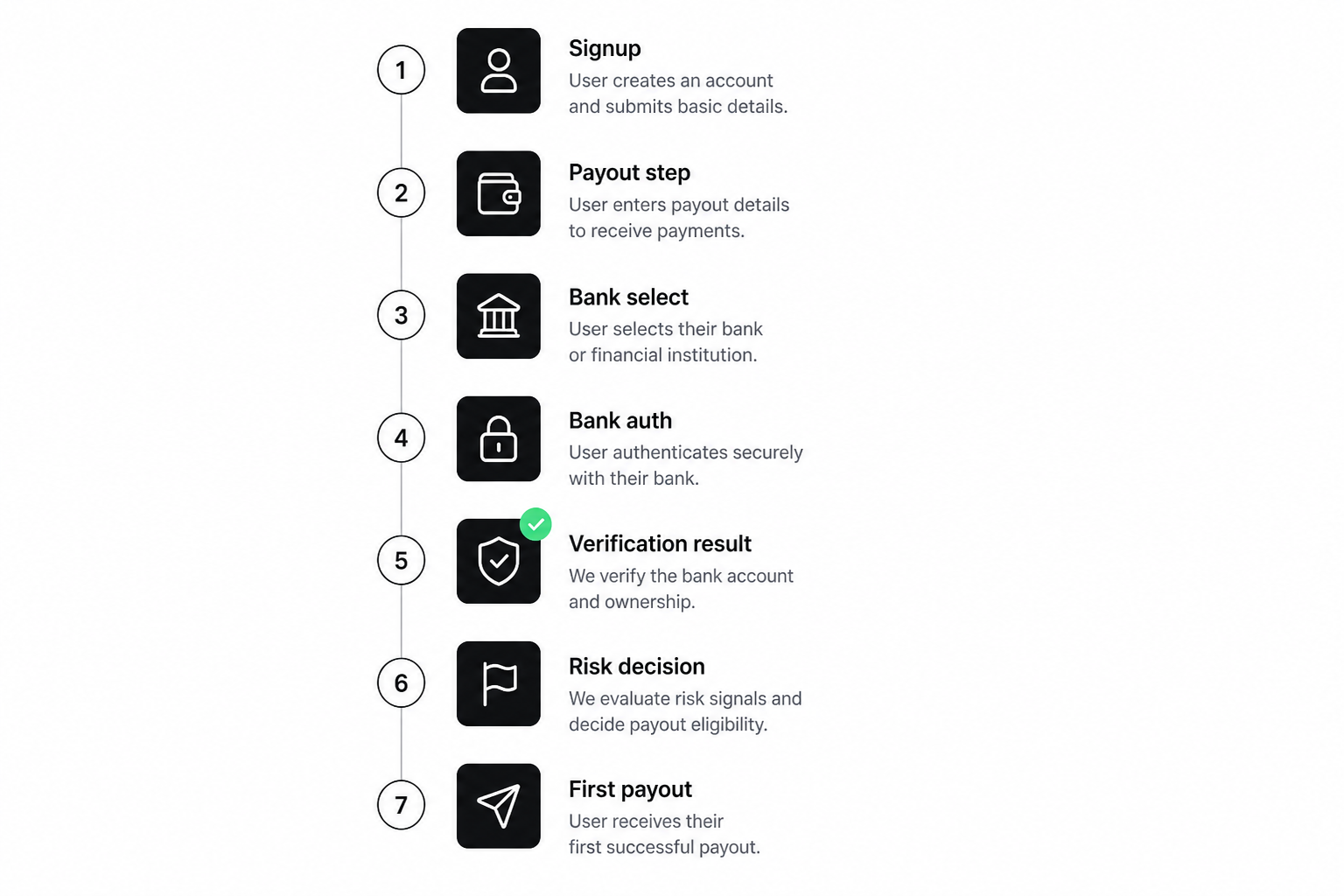
A typical production path:
- Merchant starts signup — business details, tax ID, and contact information as your policy requires.
- Payout account step — instead of free-text IBAN entry alone, offer "verify with bank" alongside manual entry if regulations allow.
- Bank selection — merchant picks their institution from your provider's coverage list.
- Authentication — they approve in mobile or web banking (strong customer authentication).
- Verification result — provider returns account holder name, IBAN, and match status.
- Risk decision — auto-approve, request manual review, or block based on your rules.
- First payout — disburse only when verification status is pass or policy exception approved.
Engineering work concentrates on UX placement, webhook handling for async banks, and storing verification tokens so you do not re-prompt on every subsequent payout. You integrate one licensed partner — you do not wire each EU bank yourself. For API-level evaluation criteria, see instant account verification APIs.
UK Confirmation of Payee vs EU name checks
In the UK, verification of payee open banking schemes add a payer-side name check before outbound transfers. Merchant onboarding verification is the beneficiary-side mirror: confirm the seller's account belongs to them before you store payout instructions. UK platforms often combine both — VoP on disbursement and open banking verification at onboarding — because they solve different failure modes.
In the EU, name availability and match semantics vary by bank. Your acceptance criteria should define fuzzy-match rules, what to do when the bank returns IBAN but not holder name, and when manual review is mandatory — not assume UK-grade CoP everywhere.
Where should you place verification in the onboarding funnel?
Verify as early as payout details are collected, but after identity steps that justify asking for bank access — too early feels invasive; too late means wrong accounts enter your ledger.
| Funnel position | When it fits | Trade-off |
|---|---|---|
| After business identity | PSP and marketplace flows with staged KYC | Balanced — merchant understands why bank access is needed |
| Before first live transaction | Low-friction signup first, verify before go-live | Risk window if manual IBAN entry allowed earlier |
| At payout-method change | Mature platforms with re-verification policy | Catches account swaps after initial approval |
| Combined with affordability (lending) | Embedded finance or merchant cash-advance products | Heavier consent copy; pair with open banking affordability check patterns |
Marketplace teams often verify sellers before first disbursement even when buyers can checkout earlier — open banking for marketplaces covers buyer-side collection separately. PSP programmes frequently require verification before sub-merchant goes live because chargeback and scheme rules attach to the facilitator.
Drop-offs spike when verification feels disconnected from value. Show merchants why verification unlocks faster settlement — not only compliance language. One line that first payout ships within 24 hours after verified account approval outperforms abstract "regulatory requirement" copy in A/B tests run by payment facilitators.
How do you evaluate providers for merchant onboarding verification?
Score coverage on the banks your merchants actually use, match semantics on business accounts, and webhook reliability — not headline institution counts.
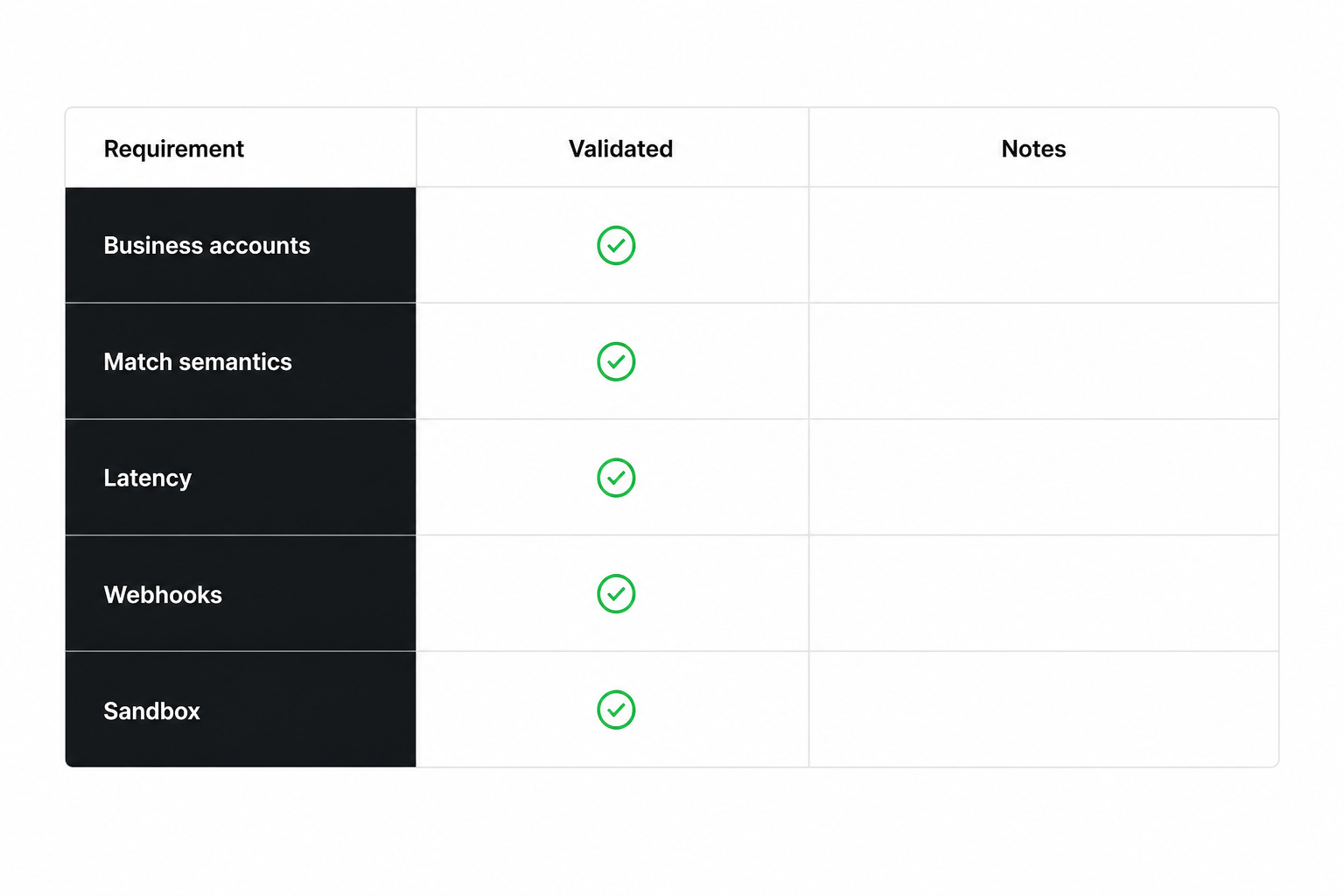
Use this checklist before you wire verification into production onboarding:
| Criterion | What to validate |
|---|---|
| Business account support | Many merchants pay out from business, not retail, accounts |
| Match semantics | Exact, fuzzy, partial, unavailable — and how your policy maps each |
| Latency | p95 under a few seconds after consent on top five banks per market |
| Re-verification | Token lifetime and whether account changes trigger re-check |
| Webhooks | Async completion when banks slow; replay and idempotency |
| Sandbox fidelity | Same banks and fields as production for your pilot countries |
| Data residency | EU hosting and DPA terms for merchant PII adjacent to verification |
Run sandbox tests on business accounts in DE, FR, NL, and UK if those are core corridors — retail-only sandboxes miss the IBAN types marketplaces see in production. When two providers cover complementary banks, a dual setup may beat forcing one contract — see open banking multiple providers for routing patterns.
When you have a shortlist that passes sandbox gates, use the provider-matching form to confirm fit against your merchant countries, account types, and onboarding volume before legal review.
Follow how to shortlist open banking providers for the two-week sandbox discipline — apply the same tests to verification-only scope before you expand to payment initiation.
What breaks merchant onboarding conversion — and how do you fix it?
Most drop-offs are UX and coverage problems, not merchant unwillingness to verify.
Common failure modes:
- Unsupported bank — merchant's institution missing from picker; offer manual fallback with delayed payout hold
- Business vs retail mismatch — verification API returns retail account when merchant selected business profile
- Timeout after consent — user completes bank auth but your app never receives webhook; show "verification pending" with email follow-up
- Name mismatch on legitimate businesses — trading name differs from account holder; route to manual review with document upload, not hard decline
- Mobile redirect breaks — deep link fails on in-app browsers; test iOS Safari, Android Chrome, and embedded WebViews
Open Banking Limited reported one billion open banking payments and 100 billion API calls across the UK ecosystem by July 2026 — at that scale, even small per-bank verification gaps affect thousands of merchants monthly. Instrument verification success rate per bank and per device; promote banks with low match availability to manual path automatically.
Reduce friction with progressive onboarding: collect minimum viable business data, verify bank, then request enhanced KYC for higher limits. Pair verification with clear status screens — "verified", "pending review", "action required" — so merchants do not abandon during async waits.
Frequently Asked Questions
What is open banking merchant onboarding?
Open banking merchant onboarding is the process of verifying a merchant's or seller's bank account during signup using regulated open banking APIs — usually through a licensed provider — so platforms confirm payout details before first disbursement. It replaces or supplements manual statement uploads and micro-deposit tests with in-session bank authentication.
How is merchant onboarding verification different from instant account verification APIs?
Merchant onboarding verification focuses on when and how verification fits the seller signup funnel, risk gating, and drop-off reduction across PSPs and marketplaces. Instant account verification APIs are the underlying product capability — covered in provider comparison guides. Onboarding is the operational playbook; APIs are the integration surface.
Do marketplaces need open banking verification if they already use KYC providers?
KYC confirms identity documents; open banking verification confirms the payout account belongs to that identity. Many platforms run both — document KYC for compliance and bank verification for disbursement accuracy. Skipping bank verification leaves wrong-IBAN payouts and seller disputes that KYC alone does not prevent.
Can open banking merchant onboarding work for business accounts?
Yes, when your provider supports business account coverage in your target countries. Business account name formats, joint accounts, and missing holder-name fields vary by bank — validate in sandbox on real merchant bank mixes, not only retail test accounts.
Does merchant onboarding verification replace Confirmation of Payee in the UK?
No. VoP checks the payee name at payment time; onboarding verification confirms the beneficiary account during signup. UK platforms often use both — verification when storing payout details and VoP on outbound transfers — because they catch errors at different stages.
How long does open banking verification take during merchant signup?
For supported banks, verification often completes in seconds after the merchant authenticates in the banking app. Some institutions return results asynchronously via webhook — design your funnel for pending states rather than blocking the entire signup on synchronous response.
What should PSPs ask open banking providers before onboarding verification goes live?
Ask for business-account coverage in your merchant countries, match semantics documentation, webhook SLAs, re-verification rules, sandbox parity with production banks, and evidence of verification success rates on institutions your merchants use most — not only platform-wide averages.
Conclusion
Open banking merchant onboarding turns payout verification from a post-failure cleanup step into a front-of-funnel control — fewer wrong-IBAN transfers, faster path to first settlement, and onboarding flows that mobile-native merchants will finish. Place verification where payout details are collected, instrument per-bank success, and treat business-account coverage as a hard gate in sandbox testing. When your shortlist passes those checks, match providers to your merchant mix before you scale signup volume.
Related articles
- Open Banking Credit Invisible: Underwriting Thin Files in the EU
Stable employment and a bank account still fail bureau checks when someone has never borrowed, moved countries recently, or recovered from a single missed paym…
- Open Banking Account Verification: How It Works in 2026
Wrong-IBAN payouts, stalled onboarding, and manual statement reviews drain ops time long before a customer makes their first payment. Open banking account veri…
- Verification of Payee Open Banking: Stop Wrong Payouts Before They Leave
Wrong IBANs, invoice fraud, and authorised push payment scams cost finance teams hours of recovery work — and sometimes the money never comes back. Verificatio…