Pay by Bank UK Card Fees: Rail Mix When Interchange Is in Court
When UK card interchange returns to the headlines, finance teams ask the same operational question: does pay by bank UK card fees math change enough this quarter to justify another checkout rail? Proposed class actions against Visa and Mastercard put multilateral interchange fees (MIFs) back in board packs — but court timelines and settlement outcomes rarely match sprint planning. This guide separates what litigation might mean for your P&L from what you can control today: dual-rail checkout, UK Payments Initiative (UKPI) fee shapes, and provider contracts that price account-to-account payments predictably.
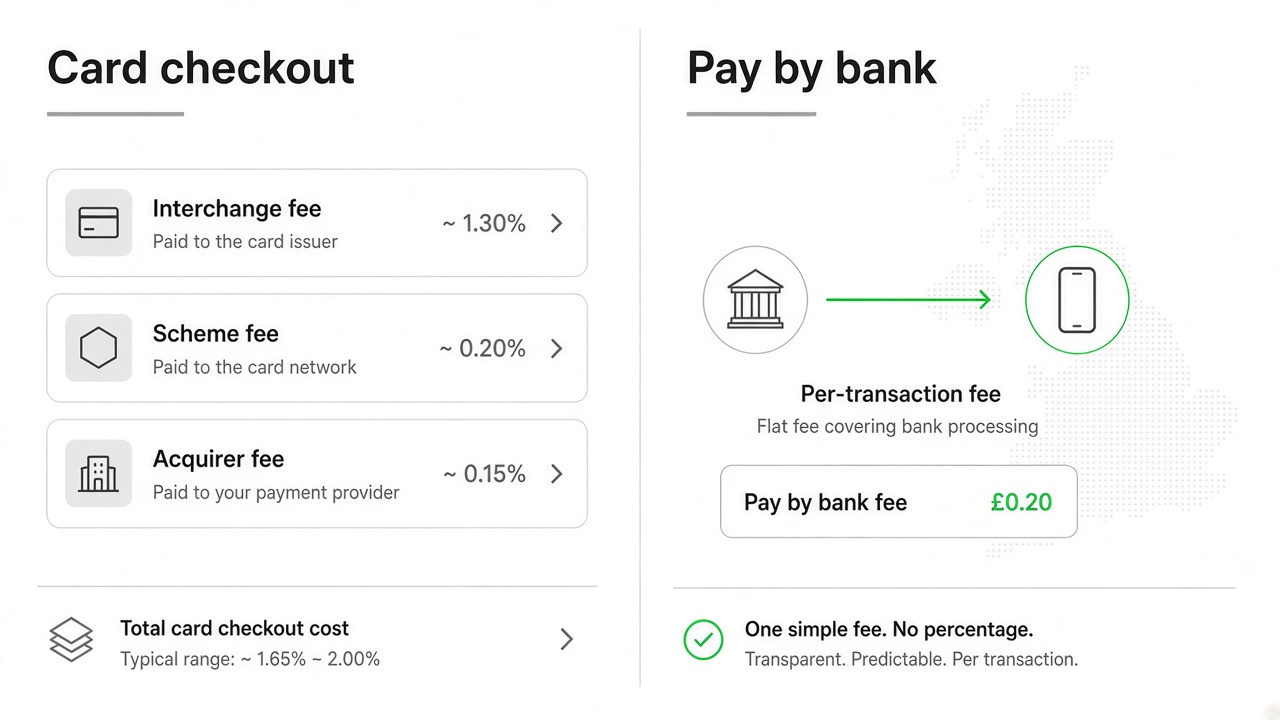
Pay by bank UK card fees: The total cost merchants carry when customers pay by card (including interchange passed through acquirers) compared with fees for UK account-to-account checkout via licensed payment initiation — often fixed pence per successful payment under UKPI Wave 1 rather than ad valorem interchange on card volume.
For generic checkout trade-offs, see pay by bank vs card for checkout. For UKPI tariff detail, see open banking pricing models.
What changed in UK card fee litigation in October 2026?
Two proposed UK class actions were filed at the Competition Appeal Tribunal (CAT) against Visa and Mastercard, targeting consumer card multilateral interchange fees on UK transactions from October 2020 through October 2026. Finextra reported on 27 October 2026 that law firms Harcus Parker and Hausfeld filed the claims, alleging MIFs restricted competition and left businesses paying more on every card tap. The story notes an earlier CAT finding in June 2025 that commercial and consumer card MIFs materially prevented, restricted and distorted competition — with Visa and Mastercard signalling intent to appeal.
That news cycle matters to payments leads because it reframes card fees as a contested line item, not a fixed cost of doing business. It does not automatically lower tomorrow’s acquirer invoice or fund a pay-by-bank project. Recovery timelines, opt-in rules for large merchants, and scheme responses will unfold over years — similar to earlier UK interchange battles Finextra also references, including a Mastercard consumer settlement pathway reported in 2025.
Operational takeaway: treat litigation as a risk and narrative trigger to re-run your rail-mix model, not as a budget line you can accrue today.
How do pay by bank fees differ from UK card interchange in practice?
Card interchange scales with transaction value and scheme rules; many UK pay-by-bank flows under UKPI Wave 1 use fixed pence-per-successful-payment access charges rather than a percentage of GMV. That difference shows up most on high-ticket B2B baskets, subscriptions, and utilities — the same segments where card MIF pressure already hurts margin.
| Cost dimension | Typical UK card checkout | Pay by bank (UKPI-influenced) |
|---|---|---|
| Variable fee shape | Interchange + scheme + acquirer markup (often % of value) | Often fixed pence per successful initiation (Wave 1) |
| Who sets headline price | Schemes, acquirer contract | Customer banks via UKPI access fees; your TSP contract on top |
| Dispute economics | Chargeback regimes | Different bank-rail dispute profile — not “no disputes” |
| Customer UX | Card on file, wallets | Bank-app authorisation — coverage and device matter |
| Future pricing | Litigation may shift long-run MIFs | Wave 2 proposals include ad valorem elements — model before switching primary rail |
Wave 2 recurring discussions (see UKPI Wave 2 recurring payments) mean pay by bank UK card fees comparisons are not static. A merchant optimising for 2026 interchange headlines still needs a 2027 scenario where bank-rail pricing may move closer to card-like ad valorem frames for some sectors.
When should UK merchants expand pay by bank alongside cards?
Add or scale pay by bank when your margin map shows interchange-heavy flows, customers already pay by bank transfer manually, and you can absorb bank-app conversion trade-offs — not because a headline lawsuit guarantees refunds. Litigation creates executive air cover; engineering and support still own rollout.
Strong fit signals:
- High average order value where interchange is a visible percent-of-revenue line (marketplace checkout patterns).
- B2B invoices where payers tolerate a short redirect for large amounts (pay by bank invoice payment).
- Recurring UK cohorts eligible under UKPI sector rules — pair with recurring pay by bank planning.
- Concentration on consumer credit where MIF debates focus — still keep debit-capable card paths for customers who refuse bank auth.
Weak fit signals:
- Low-ticket impulse checkout where card one-tap wins unless you have proof bank pay converts in your vertical.
- Markets with thin bank coverage for your payer base — fee savings do not matter if authentication fails.
- Teams with no webhook ops — bank rails need the same incident discipline as cards (pay by bank bank outage).
Run a four-week pilot on one segment with explicit KPIs: success rate by bank, support tickets, finance reconciliation hours, and effective fee per successful order including failures and manual work — not provider list price alone.
What should finance model when comparing pay by bank UK card fees?
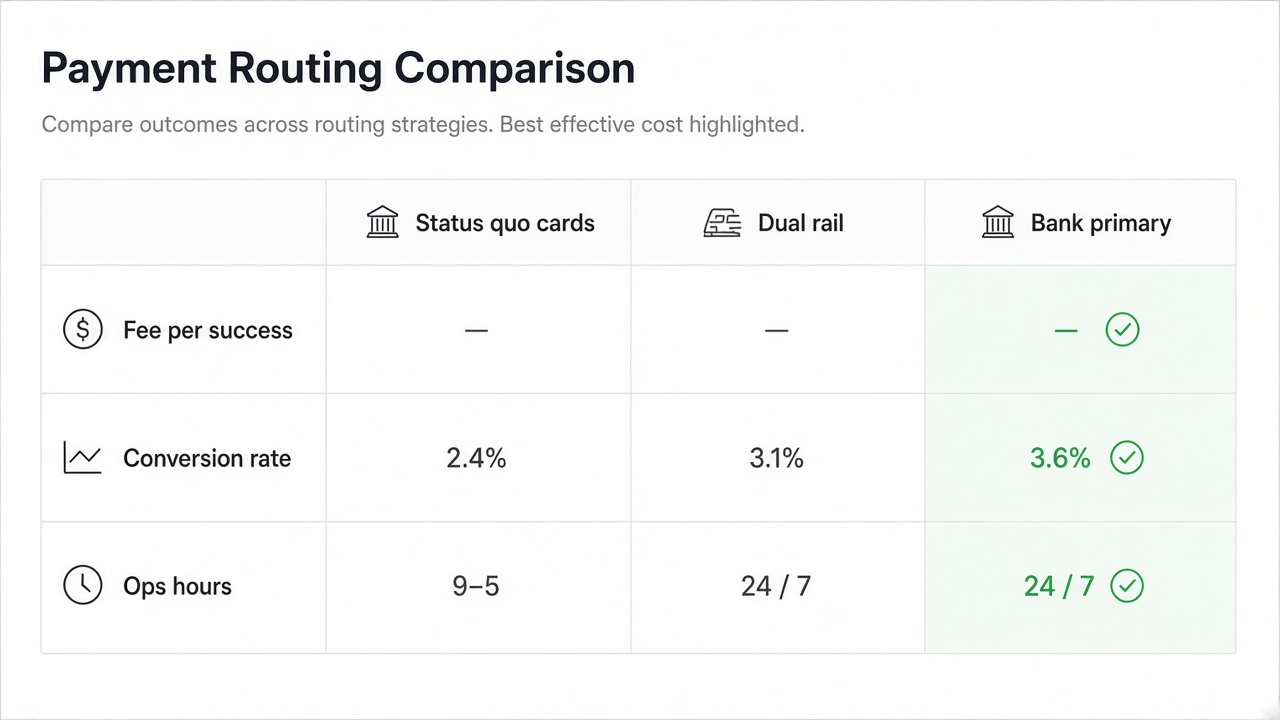
Build three scenarios — status quo card, blended dual-rail, and bank-primary for eligible flows — each with failed-payment cost and ops time, then stress-test Wave 2 ad valorem assumptions before you renegotiate acquirer deals based on litigation hope.
Scenario inputs
- Effective interchange — use acquirer statements, not scheme press quotes. Segment debit vs credit if your mix skews credit during consumer promotions.
- Pay-by-bank provider fee — per-success, monthly minimums, and chargeback/support passthrough.
- UKPI access pass-through — ask whether your TSP absorbs or itemises Wave 1 pence fees; confirm Wave 2 sensitivity if you sell subscriptions (open banking subscription billing).
- Conversion delta — a 2% drop on bank pay at high margin may erase fee savings; measure in A/B, not assumptions.
- Legal recovery — exclude from base case; optional upside line with finance counsel, not in engineering ROI.
Reporting cadence
Monthly rail-mix dashboard: GMV by rail, success rate, fee per success, support contacts per 1,000 attempts. When CAT headlines spike, leadership will ask for one slide — having the dashboard ready beats rebuilding spreadsheets under pressure.
Which provider questions matter for UK card-fee pressure?
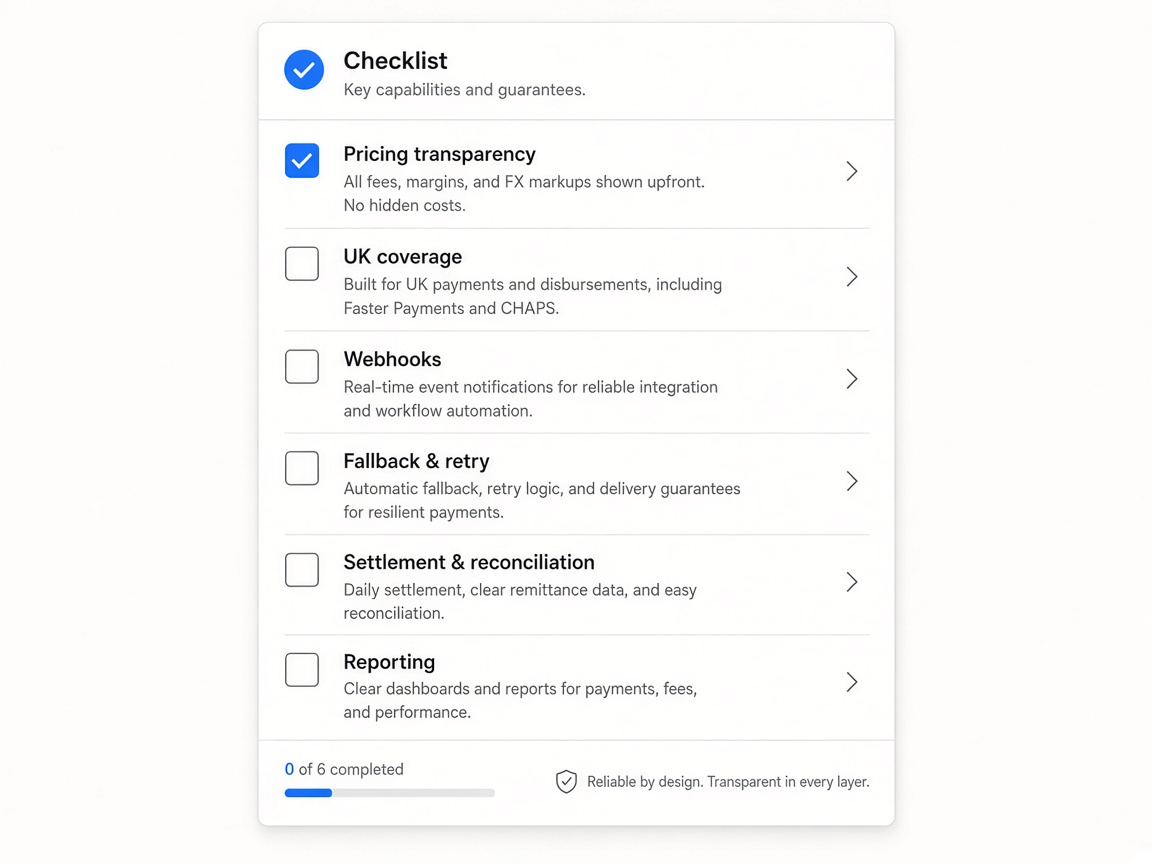
Shortlist TSPs on transparent all-in pricing, UK bank coverage for your payer concentration, webhook reliability, and contract paths if Wave 2 pricing shifts — not on promises that litigation will “kill cards”. Your provider cannot control CAT outcomes; they can control implementation quality.
| Criterion | Why it matters under fee pressure |
|---|---|
| All-in fee quote | Separates TSP margin from UKPI pass-through |
| Sector eligibility | UKPI Wave rules still gate some merchant categories |
| Debit vs credit displacement | Track whether bank pay cannibalises lower-cost debit or high-MIF credit |
| Fallback routing | Card path stays live when bank auth fails |
| Settlement reporting | Finance matches rail-mix savings to GL lines |
| Sandbox MIF stress test | Model Wave 2 ad valorem before you commit primary rail |
Use the provider-matching form with your top five payer banks, monthly card fee statement totals, and target sectors — or start from open banking provider comparison.
Frequently Asked Questions
What are pay by bank UK card fees in plain language?
They are the combined cost picture for UK merchants comparing card acceptance (including interchange passed through your acquirer) with account-to-account checkout fees charged by your payment initiation provider and UKPI access rules. The comparison is about effective cost per successful order, not a single published tariff.
Does the October 2026 Visa and Mastercard CAT news lower my interchange bill immediately?
No. Proposed class actions and prior tribunal findings do not change acquirer pricing overnight. Finextra’s 27 October 2026 report describes filings and alleges past overcharge — recovery, appeals, and opt-in rules unfold on legal timelines. Plan operational savings from rail mix you control.
Is pay by bank always cheaper than cards in the UK?
Not always. Low-ticket consumer flows may convert better on cards; failed bank attempts and support load add hidden cost. High-value B2B and many recurring utilities often show better bank-rail economics under Wave 1 fixed pence models — validate with your own data.
How does UKPI Wave 2 affect pay by bank UK card fees comparisons?
Wave 2 proposals include ad valorem (percentage-of-value) access fees for some use cases, which narrows the structural gap versus interchange on certain flows. Merchants evaluating bank-primary strategies should read UKPI Wave 2 recurring payments before locking multi-year pricing assumptions.
Should we remove cards if we win a future interchange case?
Keep dual rails unless you have extraordinary conversion parity on bank pay. Customers expect card fallback; partial bank outages and authentication drop-off still happen. Litigation outcomes will not uniformally remove cards from UK checkout.
Can open banking providers guarantee savings versus MIFs?
Licensed providers quote their fees and coverage; they do not set Visa or Mastercard interchange and cannot guarantee tribunal outcomes. Compare proposals on all-in per-success cost, implementation effort, and reconciliation — route vendor hype to measurable pilots.
Where does this sit versus general pay by bank guidance?
Start at the pay by bank hub for product basics, then pay by bank vs card for UX trade-offs. This article adds UK October 2026 litigation context to your fee spreadsheet — not legal advice on joining claims.
What to do this week
Pay by bank UK card fees planning starts with an honest rail-mix dashboard, not a press release. Refresh October 2026 CAT filing context with finance and legal, pilot bank pay on one high-MIF segment, and keep cards tested as fallback. When providers pitch “interchange killer” narratives, ask for sandbox success rates on your actual payer banks and an all-in fee table that survives Wave 2 sensitivity — then match options neutrally through the provider-matching form.
Related articles
- Pay by Bank Bank Outage: Checkout When Bank Apps Fail
When a payer's bank app stops loading, pay by bank bank outage handling decides whether you lose one transaction or an hour of checkout revenue. Bank-side inci…
- TrueLayer Pay by Bank Funding: What the $27M Round Means for Buyers
If you are shortlisting pay-by-bank providers for EU checkout, the TrueLayer Pay by Bank funding round on 8 October 2026 is a signal about where capital is flo…
- Mollie Pay by Bank: What the 2026 Relaunch Means for Checkout Teams
Payments and product teams watching the Mollie–GoCardless combination now have a concrete checkout reference: Mollie Pay by Bank relaunched on 2 October 2026 a…