Pay by Bank Bank Outage: Checkout When Bank Apps Fail
When a payer's bank app stops loading, pay by bank bank outage handling decides whether you lose one transaction or an hour of checkout revenue. Bank-side incidents — cloud provider failures, API maintenance, or digital channel overload — hit the same authentication screens your customers need to approve a payment. Merchants that only planned for card-acquirer outages discover bank rails have their own failure modes. This guide explains what to show shoppers when institutions go dark, how to keep webhook logic honest during ambiguous states, and which provider capabilities to validate before the next incident.
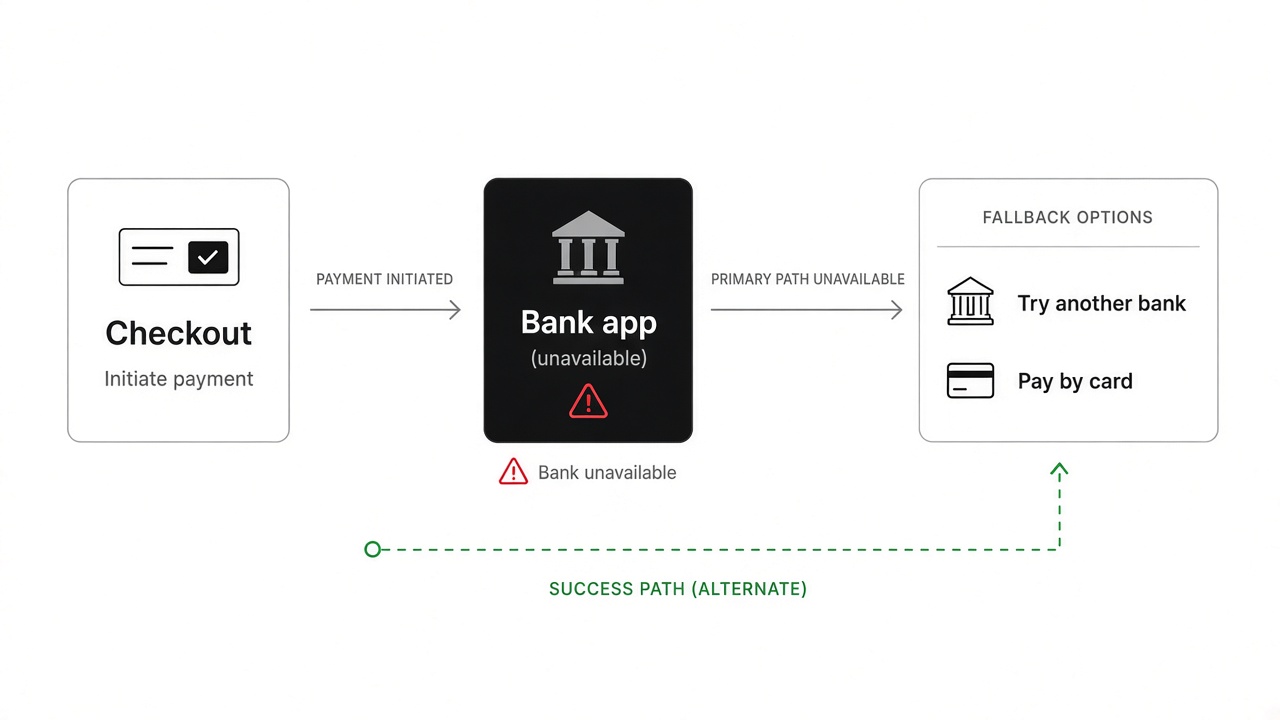
Pay by bank bank outage: A period when a customer's bank (or its open-banking API) cannot complete authentication or payment initiation — so pay-by-bank checkout fails even though your website and payment provider are healthy. Merchants reduce loss with clear customer messaging, alternate banks or rails, and ops playbooks that treat "unknown" webhook states as first-class incidents.
For acquirer-side failures (when cards stop authorising), see pay by bank payment resilience. For routing traffic across two licensed providers when one bank or aggregator blips, see open banking multiple providers.
What happens to pay by bank checkout when a bank goes offline?
The customer cannot reach the strong-authentication step, so the payment never reaches a confirmed success state — your checkout shows an error or spins until timeout. Your merchant stack may still be up; the break is usually on the payer institution's digital channel or the API path between your provider and that bank.
Typical customer-visible symptoms:
- Banking app returns "service unavailable" or never loads after bank selection
- Redirect flow stalls on a blank interstitial page
- App-to-app handoff fails to open the payer's bank on mobile
- Payment status stays
pendingin your admin while the shopper assumes money left their account
On 20 October 2026, a major cloud infrastructure failure reportedly disrupted digital services at several UK banks including HSBC, Revolut, Lloyds, and Bank of Scotland, as Finextra reported. Pay-by-bank checkouts that routed payers through those institutions would have failed for the duration — unrelated to your card acquirer or ecommerce platform uptime.
The business takeaway: bank outage risk is institution-specific. A merchant with 40% of payers on one high-street bank feels a national incident as a conversion cliff; diversifying bank selection and fallback rails limits concentration.
How is a bank outage different from a card acquirer outage?
Card outages usually block every card payment on the affected acquirer; bank outages block pay-by-bank for customers of the affected institutions while other banks may work normally. Dual-rail resilience means more than "add pay by bank next to cards" — it means handling partial failures on each rail.
| Failure type | Who is affected | Typical merchant response |
|---|---|---|
| Acquirer / card platform | All card checkout on that stack | Surface pay by bank, wallets, or backup acquirer (payment resilience patterns) |
| Single ASPSP / bank app | Pay-by-bank users of that bank only | Offer another bank, card, or invoice link; do not blame "open banking" globally |
| Your payment provider | All bank rails through that TSP | Failover to second provider if contracted (multiple providers) |
| Your storefront | Everything | Status page; pause ads — outside open-banking scope |
Finance and support should tag incidents by layer in postmortems. Mislabelling a bank outage as "open banking down" sends engineering on the wrong hunt and produces vague customer comms.
What should customers see during a pay by bank bank outage?
Tell them the bank channel is temporarily unavailable, offer an immediate alternative way to pay, and never leave a pending state unexplained for more than a few minutes. Copy should name the outcome ("We couldn't reach your bank") rather than error codes customers did not cause.
Checkout UX patterns that work
- Specific failure message — "Barclays online banking isn't responding" beats "Payment failed" when your provider returns institution metadata.
- Try another bank — keep bank list live; grey out institutions your provider flags as degraded if status feeds exist.
- Promote card or invoice link — for B2B, fall back to pay by bank invoice payment sent by email when realtime checkout fails.
- Preserve basket — session persistence so customers do not re-enter shipping data after switching rails.
- Honest pending state — if status is unknown, show "We're confirming with your bank" with a support link instead of infinite spinners.
Conversion teams should rehearse these paths in sandbox "bank unavailable" simulations — the same discipline as pay by bank checkout conversion A/B tests, but for failure branches.
Support macros
Give agents three scripts: (a) bank-side outage confirmed, (b) unknown pending, (c) customer insists money left the account. Script (c) should reference how to trace payment ID and expected settlement timing without promising instant confirmation during incidents.
How should webhooks and ops handle ambiguous payment states?
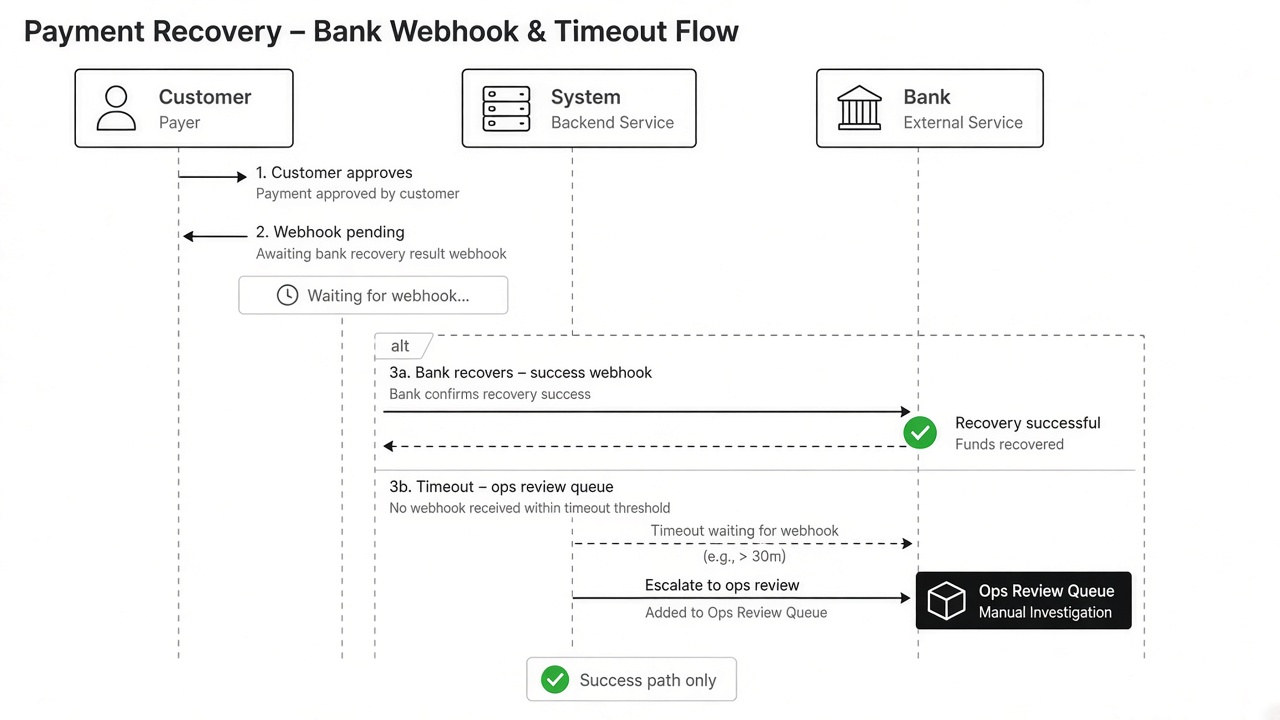
Treat pending and unknown longer than your SLA as incident traffic — auto-reconcile with provider status APIs before telling the customer payment failed or succeeded. Bank outages create duplicate attempts, orphaned authorisations, and webhook delays.
Engineering checklist
- Idempotent create — duplicate clicks during slow bank responses must not double-charge; see open banking webhooks patterns for idempotency keys.
- Timeout policy — after N minutes pending, move checkout to "needs review" rather than auto-cancel if your provider may still settle.
- Provider status subscription — some aggregators publish institution-level degradation; wire alerts to Slack/PagerDuty separately from your own uptime monitors.
- Reconciliation job — nightly sweep comparing checkout attempts to settled payments catches late successes after outages.
- Manual override tool — ops must mark orders paid when provider confirms settlement delayed by incident.
During widespread incidents, webhook volume spikes and ordering inverts. Queue consumers should backoff and dedupe — not drop events as duplicates because timestamps cluster.
Which provider capabilities reduce bank-outage pain?
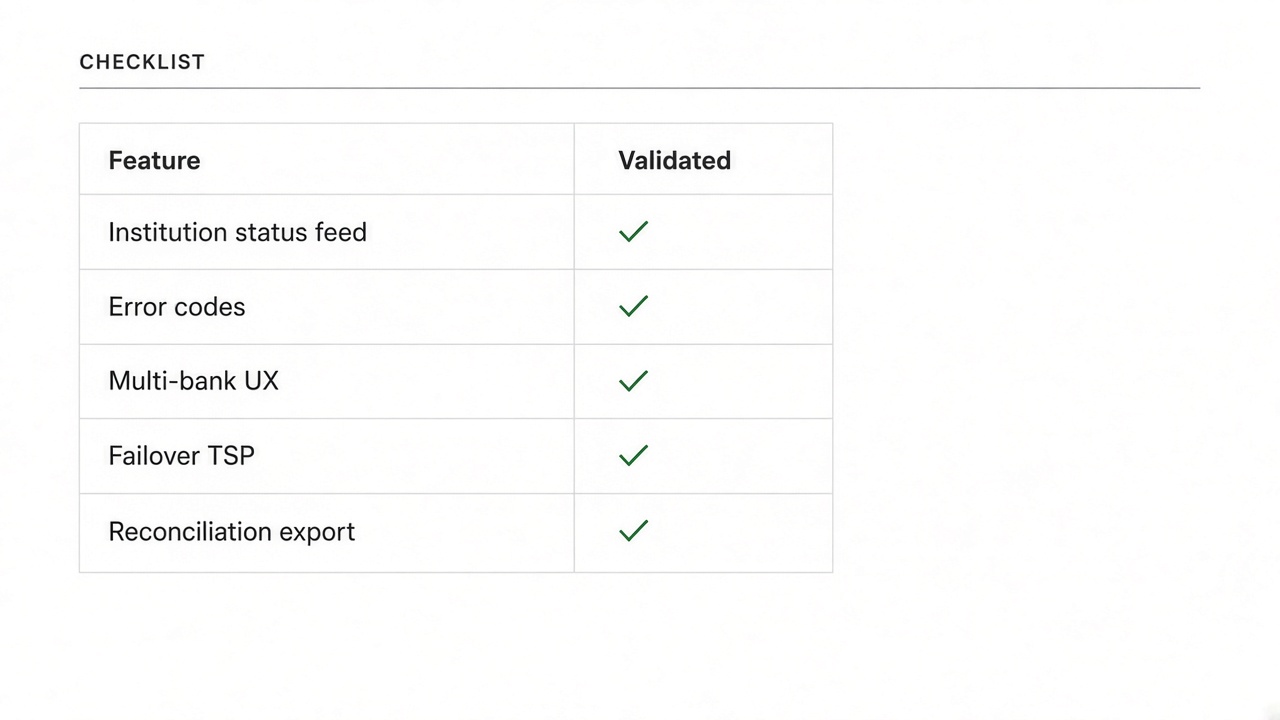
Institution-level status visibility, multi-bank routing, granular error codes, and a second TSP failover path matter more than shaving one second off happy-path latency. Shortlist providers with incident history transparency, not only sandbox demos on healthy banks.
| Criterion | Question for providers |
|---|---|
| Institution status | Do you expose degraded/down flags per bank in API or dashboard? |
| Error granularity | Can we distinguish user abort vs bank timeout vs maintenance? |
| Routing | If Bank A fails, can we prompt Bank B without restarting checkout session? |
| Failover TSP | Contractual second provider with automated or manual traffic shift? |
| Support SLA | Incident comms channel during ASPSP-wide events? |
| Reporting | Export failed attempts by bank for concentration analysis? |
Run a table-top exercise with your provider: simulate one major UK bank offline for two hours — walk through customer copy, webhook backlog, and finance reconciliation. Gaps you find in the room cost less than gaps found on a peak sales day.
When you need neutral comparison of incident tooling and bank coverage for your markets, use the provider-matching form with your top five payer banks and peak traffic windows — or start from open banking provider comparison.
How do you reduce concentration before the next outage?
Measure failed pay-by-bank attempts by bank ID for thirty days — if one institution accounts for an outsized share of attempts and failures, adjust marketing, bank ordering, or provider routing before the next headline incident. Outages are predictable in frequency, unpredictable in timing.
Practical risk reducers:
- Bank list ordering — default sort by historical success rate, not alphabet (conversion guidance).
- Geographic mix — EU expansion spreads reliance across national clearing patterns.
- Second provider — not every merchant needs dual TSPs on day one; high GMV checkout often does.
- Card rail kept honest — maintain a tested card path even when pay by bank is primary; partial bank outages are exactly when cards earn their fee.
Document an incident severity scale (S1 single bank, S2 regional, S3 provider-wide) with comms owners for product, support, and finance. Link the runbook from your internal wiki — regulators do not require it, but your CFO will ask why revenue dipped hour-by-hour.
Frequently Asked Questions
What is a pay by bank bank outage?
A pay by bank bank outage is when a customer's bank or its open-banking interface cannot complete payment authentication or initiation, so checkout fails even though the merchant site and payment provider are operational. The customer typically sees a bank app error or endless pending state rather than a declined card message.
Is open banking "down" when one bank has an outage?
No. Open banking is a network of bank APIs; one institution's digital channel failure does not stop payments for customers banking elsewhere. Merchants should message institution-specific problems and offer another bank or payment method instead of closing all pay-by-bank options.
How is this different from pay by bank payment resilience?
Payment resilience articles focus on surviving acquirer or card-platform failures by routing to bank pay. Bank outage playbooks focus on failures at the payer's bank while cards may still work. Mature checkout teams plan for both layers.
Should we automatically switch customers to card when a bank fails?
Yes when card is enabled and the customer already trusts it — after a clear message that the bank channel failed. Forcing card without explanation erodes trust in pay by bank; hiding card forever leaves revenue on the table during partial outages.
What should we do if webhooks stay pending during a bank incident?
Do not assume failure or success until the provider confirms settlement or times out per your documented SLA. Move the order to manual review, prevent duplicate payment attempts with idempotency keys, and reconcile once institution status returns to normal.
Can we prevent bank outages entirely?
No merchant controls bank infrastructure. You can reduce impact with multi-bank UX, second providers, concentration monitoring, and rehearsed customer messaging. Provider due diligence on status transparency helps — see open banking vendor due diligence.
How do we test bank outage behaviour before production?
Use sandbox scenarios that simulate institution timeouts and ambiguous pending states. Verify checkout copy, webhook consumers, and support macros — not only the happy path where authentication succeeds in seconds.
Conclusion
Pay by bank bank outage planning is checkout continuity when payer banks — not your acquirer — are the broken link. The October 2026 cloud disruption affecting several UK banks was a reminder that digital banking shares the same infrastructure risks as any other online service. Merchants who name the failure clearly, keep alternate rails visible, and treat pending webhooks as ops work protect revenue and support capacity. Validate institution status tooling with providers before the next headline, and measure which banks your customers actually use so concentration does not surprise you mid-incident.
Related articles
- TrueLayer Pay by Bank Funding: What the $27M Round Means for Buyers
If you are shortlisting pay-by-bank providers for EU checkout, the TrueLayer Pay by Bank funding round on 8 October 2026 is a signal about where capital is flo…
- Mollie Pay by Bank: What the 2026 Relaunch Means for Checkout Teams
Payments and product teams watching the Mollie–GoCardless combination now have a concrete checkout reference: Mollie Pay by Bank relaunched on 2 October 2026 a…
- Pay by Bank Payment Links: Hosted Checkout Without Card Fields
Payments teams add pay by bank payment links when customers are not inside a logged-in checkout — dunning emails, SMS reminders, in-store QR codes, or partner…