Mollie Pay by Bank: What the 2026 Relaunch Means for Checkout Teams
Payments and product teams watching the Mollie–GoCardless combination now have a concrete checkout reference: Mollie Pay by Bank relaunched on 2 October 2026 as the first major product built on GoCardless open banking technology inside Mollie’s merchant stack. For Dutch merchants the rail is live today; wider European rollout is planned through 2027. Whether you already run Mollie for cards and local methods or you are comparing pay-by-bank stacks after the acquisition, this guide translates the announcement into operational questions — checkout steps, recurring upsell paths, geography, and what to validate in sandbox before you shift traffic.
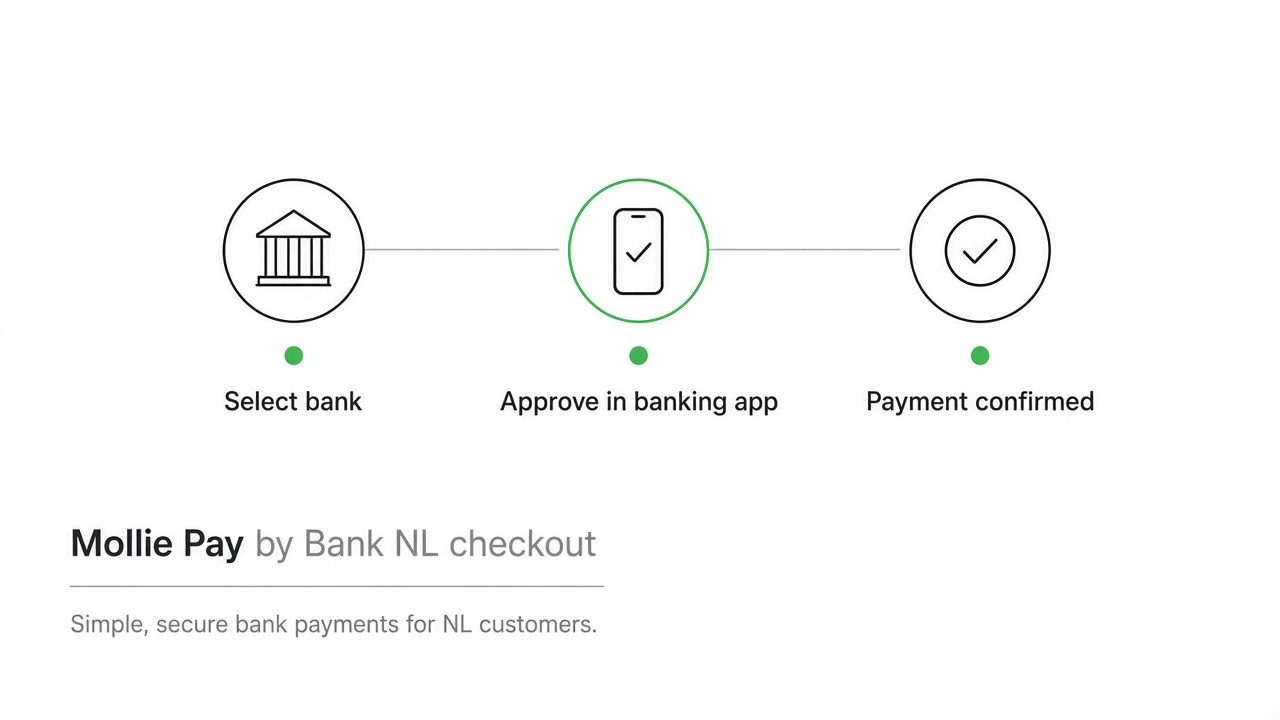
Mollie Pay by Bank: Mollie’s renewed bank-account checkout, built on GoCardless open banking connectivity, designed for fewer redirect steps, one-off and recurring payments from one foundation, with initial availability in the Netherlands and European expansion planned through 2027 (Mollie announcement).
For acquisition timelines and contract continuity, see Mollie GoCardless acquisition: buyer actions. For Dutch market context beyond a single PSP, read pay by bank in the Netherlands.
What did Mollie change in the Pay by Bank relaunch?
Mollie Pay by Bank is a merchant-embedded checkout rail that uses GoCardless’s open banking connections so customers pay from their existing Dutch bank apps with a shorter step count than many legacy open banking flows.
According to the 2 October 2026 Mollie press release:
- The product combines GoCardless pan-European open banking connectivity (direct connections to 2,500+ banks, per Mollie) with Mollie’s hosted checkout experience.
- Mollie states the payment can complete in three steps, compared with five typical of other open banking checkout patterns — fewer hops before bank approval.
- One technical foundation supports one-off payments, recurring payments, and invoicing.
- Features marketed include guaranteed payments, instant confirmation, and transparent pricing.
- IBAN capture at payment time is positioned as a bridge to Direct Debit and recurring revenue, not only single checkout sessions.
Mollie frames the relaunch as the first major proof point after acquiring GoCardless — product integration, not just portfolio branding. Finextra syndicated the same release on 6 October 2026 (Finextra press article).
Who is Mollie Pay by Bank for right now?
Dutch merchants and platforms already on Mollie — or evaluating a unified cards-plus-bank stack in the Netherlands — are the immediate audience; EU teams outside NL should treat the relaunch as a roadmap signal until expansion lands.
| Audience | Near-term fit |
|---|---|
| NL e-commerce on Mollie | Can enable Pay by Bank without a separate GoCardless contract |
| NL SaaS and subscriptions | IBAN capture + recurring story aligns with bank-rail retention |
| EU merchants outside NL | Wait for 2027 expansion or keep incumbent pay-by-bank provider |
| Teams mid-RFP | Compare step count, webhooks, and recurring path vs standalone TSPs |
Geography matters: Mollie states Pay by Bank is available from launch day for businesses and consumers in the Netherlands, with expansion to the rest of Europe planned throughout 2027. CEO Koen Köppen’s quoted rationale is to prove the model at scale in the Netherlands first before rolling broader (Mollie announcement).
If your checkout mix spans multiple EU countries today, pair this post with open banking UK vs EU market differences only where cross-border buyer education helps — Mollie’s first wave is NL-specific.
How does the Mollie Pay by Bank checkout flow work for payers?
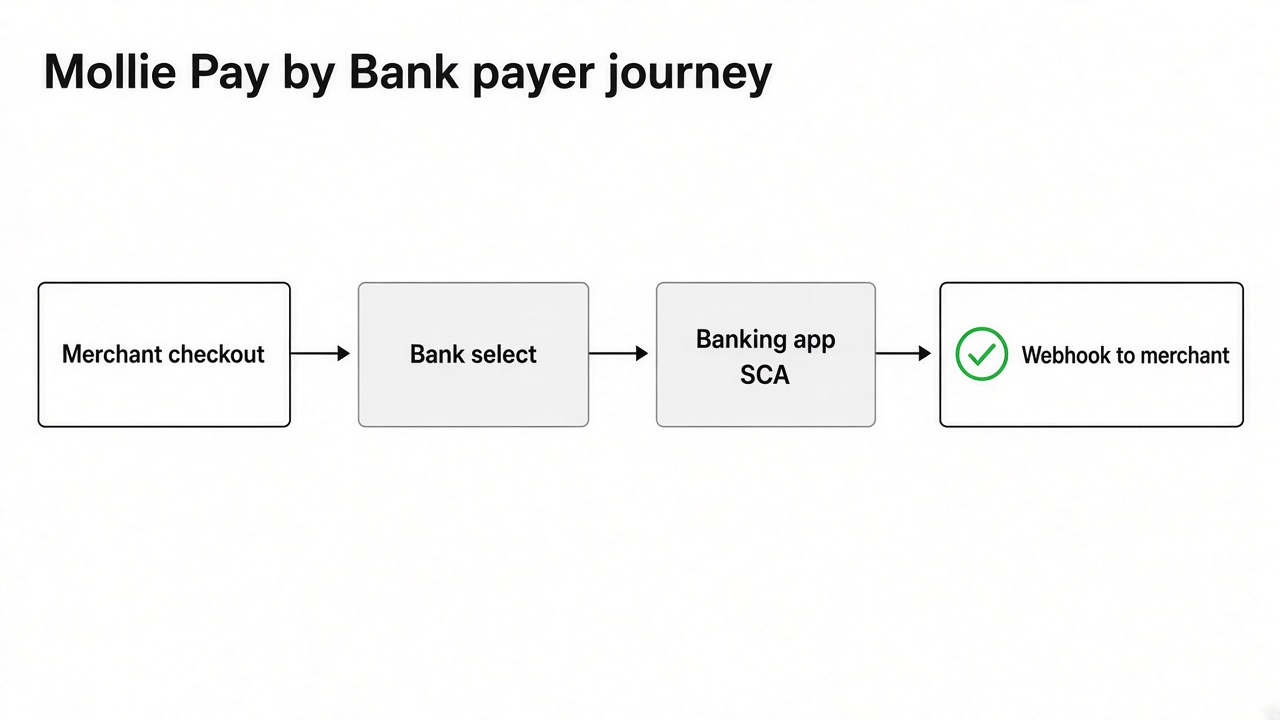
The payer stays inside the merchant’s Mollie checkout, selects a Dutch bank, authenticates in the banking app, and returns with confirmation — Mollie’s pitch is that direct ownership of the GoCardless connection removes extra hops that cause drop-off.
Operational sequence you should validate in sandbox (exact screens vary by bank):
- Method selection — Pay by Bank appears alongside cards and local methods in Mollie checkout.
- Bank choice — Payer picks an institution Mollie connects to via GoCardless open banking rails.
- Strong customer authentication — Approval happens in the bank channel, not on a long chain of intermediary pages.
- Confirmation — Mollie markets instant confirmation; finance should still map webhook events to ledger rules.
- Optional recurring path — IBAN captured securely at payment can feed Direct Debit or recurring setups without re-collecting account details.
Apply the same conversion discipline as pay by bank checkout conversion: show fees, settlement expectations, and support paths before redirect. A three-step claim only helps revenue if your analytics prove bank-selection and approval rates beat your previous open banking integration.
What should finance and product verify before shifting traffic?
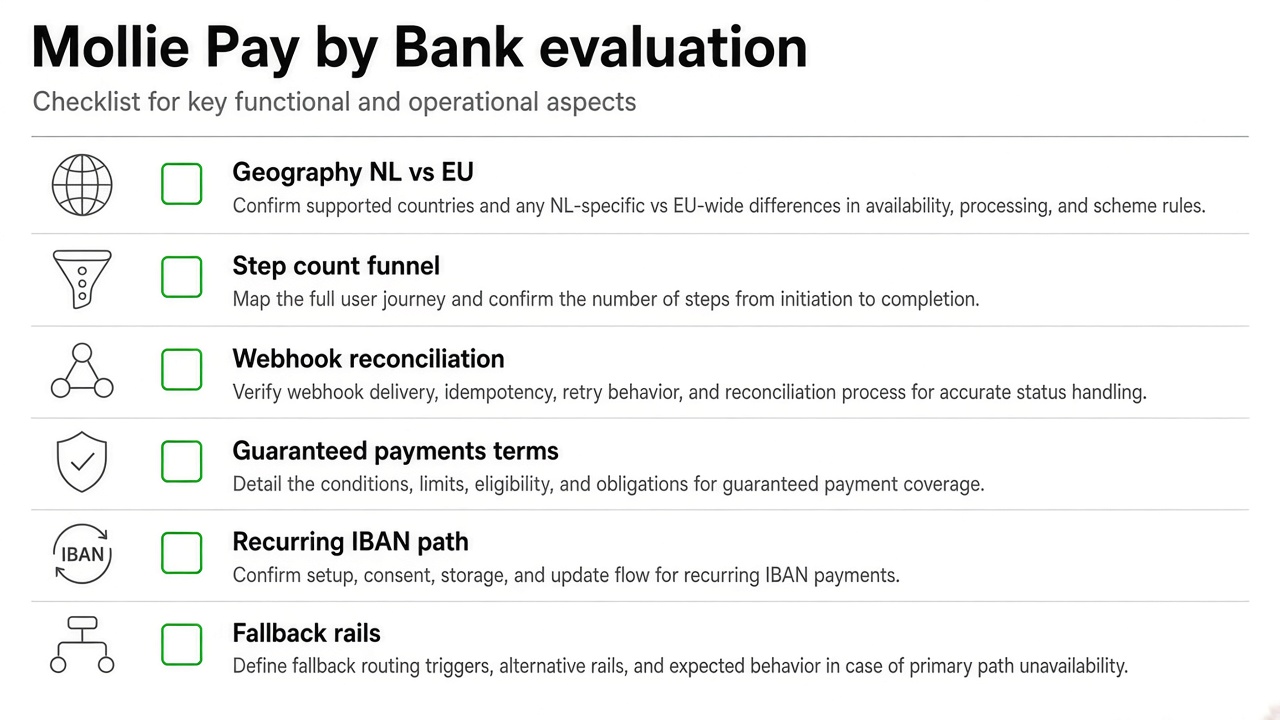
Treat marketing claims — guaranteed payments, instant confirmation, transparent pricing — as hypotheses until your sandbox and pilot traffic produce webhook traces and settlement reports you can reconcile.
Claims to test
| Mollie statement | What to measure |
|---|---|
| Three-step checkout | Funnel events: method click → bank selected → webhook accepted |
| Guaranteed payments | Definition in contract: failure scenarios, liability, retry rules |
| Instant confirmation | Time from webhook to cash in Mollie balance vs bank settlement |
| Transparent pricing | Effective cost per successful payment vs cards and iDEAL/Wero |
| IBAN → recurring | Consent copy, SEPA Direct Debit compliance, churn on re-presentment |
Integration and ops
- Webhook schema — Align order, invoice, and subscription IDs before go-live.
- Refund path — Bank rails still need refund APIs; see pay by bank refunds.
- Fallback rail — Keep cards or alternative A2A methods until approval rates stabilise per bank.
- Support playbooks — Payer abandons in bank app, insufficient funds, maintenance windows.
Teams that already documented baselines during the Mollie GoCardless acquisition should add a post-relaunch row: NL Pay by Bank approval rate, average steps observed, and recurring attach rate from IBAN capture.
How does Mollie Pay by Bank relate to recurring and invoicing?
Mollie positions one foundation for one-off checkout, recurring collections, and invoicing — the commercial upside is fewer integrations, but recurring success still depends on mandate quality and dunning ops.
GoCardless built its reputation on bank payments and Direct Debit across many countries (GoCardless–Mollie combination announcement). The relaunch explicitly ties IBAN capture at payment to a direct route to recurring revenue through Direct Debit. That matters for:
- Subscription businesses evaluating bank-rail retention vs card-on-file
- Invoice-led B2B combining hosted pay with structured references — compare pay by bank invoice payment
- Dunning after failed cycles — link to open banking recurring dunning for recovery patterns
Do not assume “one foundation” removes consent and retry policy work. Run a pilot cohort on voluntary bank pay before migrating entire subscription bases.
When should you compare alternative pay-by-bank providers?
Stay on Mollie Pay by Bank when you are NL-first, want one vendor for cards and bank pay, and pilot data beats your old funnel — run a structured comparison when you need multi-country coverage today, specialised VRP/cVRP, or stronger negotiation position after consolidation.
Triggers to widen the shortlist:
- Non-NL EU checkout is majority of GMV before 2027 expansion
- UK cVRP or sweeping is on the roadmap — see VRP sweeping and cVRP spokes
- Hybrid TSP strategy — you prefer GoCardless direct plus a second initiator for redundancy (open banking multiple providers)
- Concentration risk after Mollie owns both your card stack and bank rail
Use the provider-matching form to map coverage, recurring capabilities, and sandbox evidence to your corridors — or start from how to choose an open banking provider in the EU.
Frequently Asked Questions
What is Mollie Pay by Bank?
Mollie Pay by Bank is Mollie’s renewed account-to-account checkout method, launched in October 2026 on GoCardless open banking technology. It lets consumers pay from their bank account within Mollie checkout, with Mollie marketing a three-step flow, instant confirmation, and support for one-off, recurring, and invoice payments from one foundation.
Is Mollie Pay by Bank available outside the Netherlands?
At launch, Mollie states Pay by Bank is available for businesses and consumers in the Netherlands. The company plans expansion to the rest of Europe throughout 2027. Merchants outside NL should confirm roadmap dates with Mollie before committing checkout UX changes.
How is Mollie Pay by Bank different from the GoCardless acquisition announcement?
The September 2026 acquisition explained ownership, contracts, and multi-rail strategy. The October 2026 Pay by Bank relaunch is a shipped product integration — checkout behaviour, step count, IBAN capture, and NL availability — not the deal mechanics alone.
Does Mollie Pay by Bank replace iDEAL or Wero in the Netherlands?
Mollie Pay by Bank is an additional bank-payment path inside Mollie checkout, not a scheme replacement. Dutch shoppers may still expect iDEAL/Wero alongside other methods. Merchants should A/B test method ordering and approval rates rather than forcing a single rail.
Can Mollie Pay by Bank support recurring subscriptions?
Mollie positions IBAN capture at payment as a path to Direct Debit and recurring revenue on the same technical foundation. Operational success still requires mandate consent, retry logic, and dunning — the same bank-rail ops discipline as recurring pay by bank.
What does “guaranteed payments” mean for Mollie Pay by Bank?
Mollie markets guaranteed payments as part of the relaunch. Finance and legal should obtain the contractual definition — which failure modes are covered, who bears loss, and how retries work — before treating the label as risk elimination.
Should existing GoCardless merchants migrate to Mollie Pay by Bank automatically?
Not without a integration review. GoCardless continues as “GoCardless, a Mollie company.” Existing GoCardless API integrations may differ from Mollie-native Pay by Bank. Compare webhooks, pricing, and geography against your current GoCardless setup before migrating traffic.
Closing notes
Mollie Pay by Bank is the first visible checkout output of the GoCardless combination — shorter-step NL bank pay, recurring hooks via IBAN capture, and a 2027 EU expansion promise. Treat the three-step narrative as a hypothesis to measure, not a guarantee. Pilot in the Netherlands, document webhook-to-ledger timing, and keep fallback rails until approval data supports a broader rollout.
Related articles
- Pay by Bank Payment Links: Hosted Checkout Without Card Fields
Payments teams add pay by bank payment links when customers are not inside a logged-in checkout — dunning emails, SMS reminders, in-store QR codes, or partner…
- Pay by Bank Chargebacks: What Merchants Need to Know
High-dispute checkout categories — digital goods, subscriptions, travel, and cross-border e-commerce — bleed margin on card chargeback fees, representment ops,…
- Pay by Bank Refunds: How EU Merchants Handle Returns
Merchants add pay by bank at checkout for lower fees and strong payer authentication — then discover returns season works differently. Pay by bank refunds send…