Open Banking UK vs EU: What B2B Teams Need to Know
Your product roadmap probably mentions "Europe" as one market — but open banking UK vs EU is not a single integration. UK and EU buyers use different bank apps, recurring payment schemes, and consent patterns. Launching both without a clear comparison leads to duplicate engineering, mismatched provider contracts, and conversion gaps that show up only in production metrics.
This guide compares what changes when you move from UK-only to EU-only or dual-market open banking: bank coverage models, pay-by-bank and recurring rails, customer consent UX, and the provider questions that determine whether one contract covers both regions or you maintain parallel stacks.
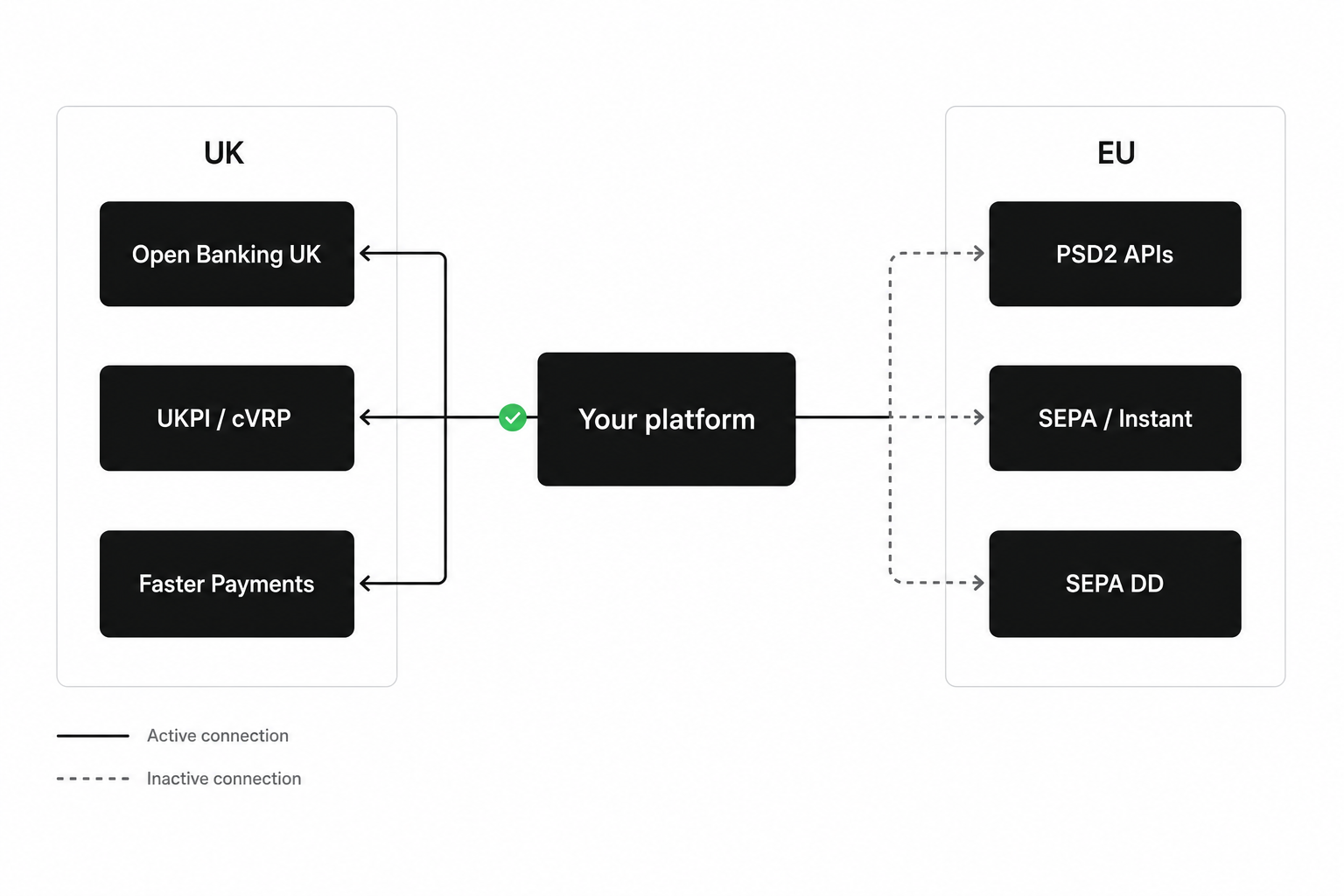
Open banking UK vs EU: Two related but separate bank-connectivity environments. UK open banking runs on industry standards managed by Open Banking Limited and newer scheme rails like UKPI for commercial recurring payments. EU open banking sits on PSD2-implemented APIs across member states, with SEPA and instant payment networks underneath. Your business can verify accounts, collect payments, and read transaction data in both — but coverage, consent UX, and recurring mechanics differ enough that "one Europe" rarely means one integration path.
Why does the UK vs EU split matter for your rollout?
You avoid rebuilding the same feature twice when you treat UK and EU as parallel markets with shared product goals but different bank rails underneath. A provider slide that says "2,000+ banks across Europe" often hides the fact that UK connectivity, consent copy, and recurring schemes do not automatically transfer to France, Germany, or Poland.
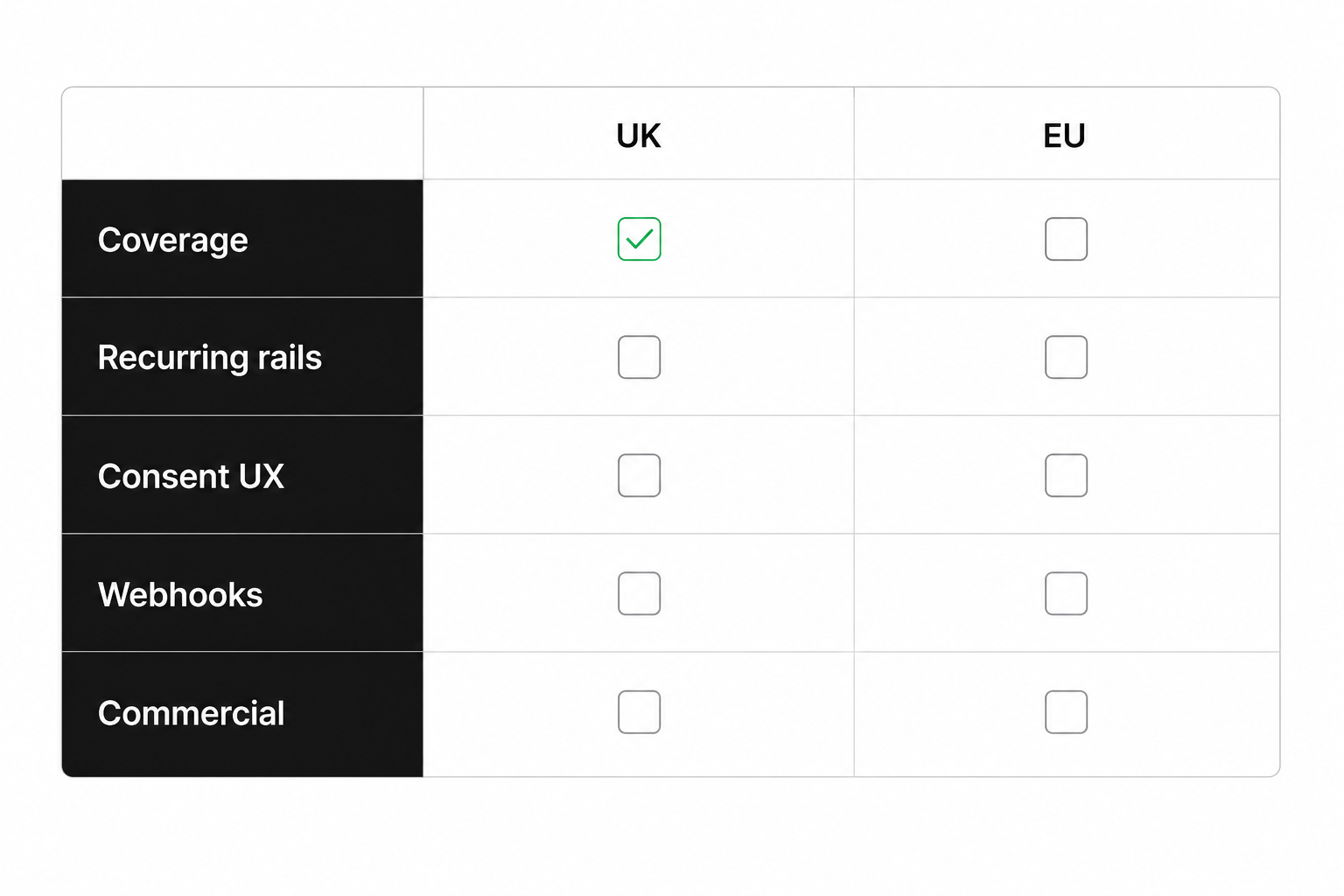
The practical split shows up in three places:
- Coverage validation — winning the banks your UK customers use does not guarantee the ASPSPs your EU borrowers or payers need
- Recurring collection — UK commercial variable recurring payments (cVRP) under UKPI follow different rules than EU variable recurring payment pilots and SEPA Direct Debit
- Contract scope — some providers bundle UK and EU under one API; others require separate commercial terms, sandboxes, and incident channels
If you sell into both regions, sequence the market that drives revenue first, then extend with a provider that documents dual-market parity — not assumptions from a marketing map.
How does bank coverage differ between UK and EU?
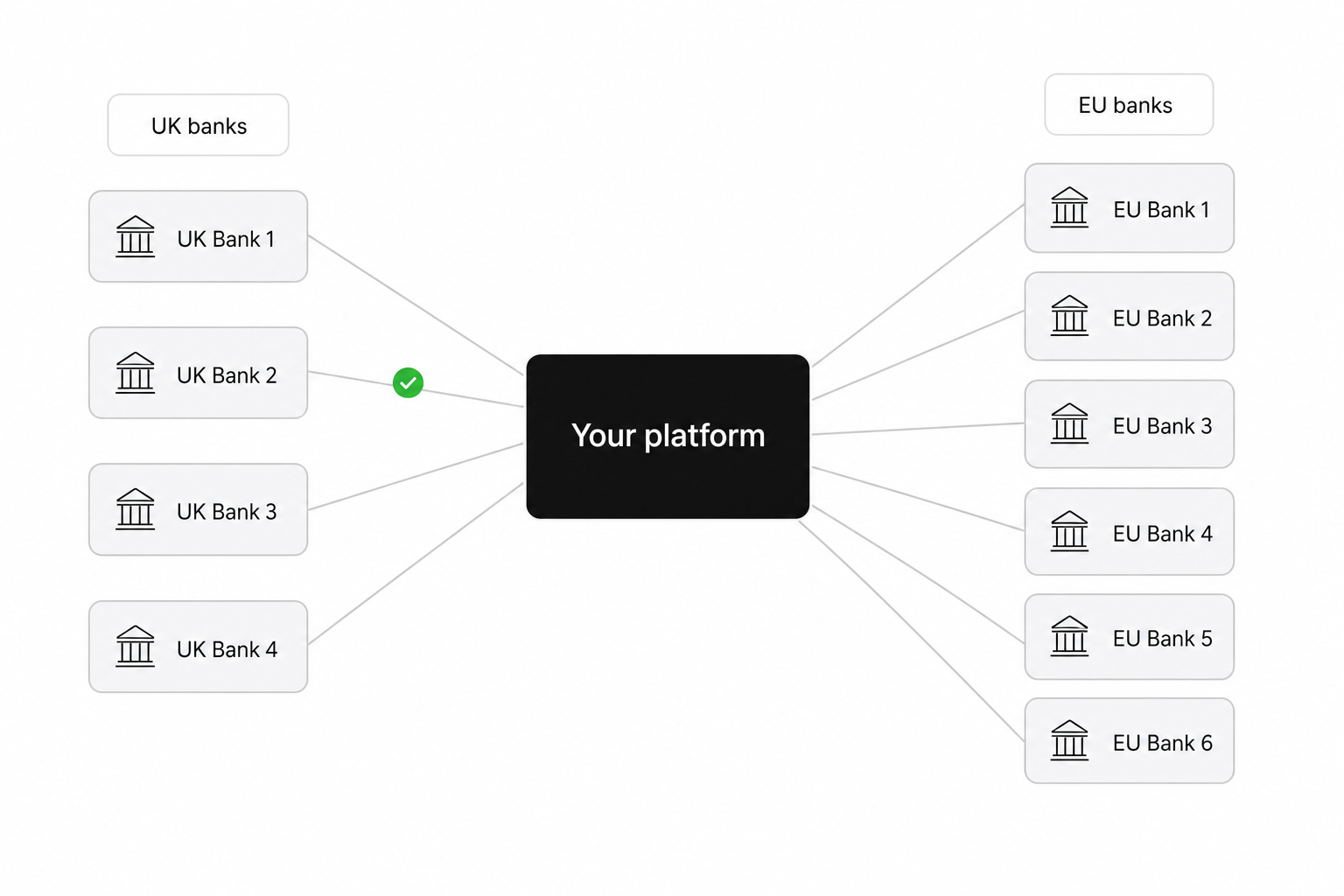
UK open banking concentrated early adoption around a smaller set of high-volume retail banks, with standards maintained by Open Banking Limited. EU coverage is fragmented across member states — Germany's bank landscape differs from France, Italy, or the Nordics even under the same PSD2 framework.
For B2B buyers, coverage means more than a country checkbox:
| Dimension | UK | EU |
|---|---|---|
| Bank concentration | Few institutions drive most consumer volume | Varies sharply by member state |
| Business accounts | Corporate Girokonto-style complexity lower than DE | Germany, Nordics, Benelux need explicit business-account tests |
| API standardisation | UK Open Banking Standard v4.x | PSD2 interfaces vary by ASPSP; quality differs bank to bank |
| Instant settlement | Faster Payments for eligible flows | SEPA Instant adoption uneven; standard SEPA timing still common |
| Provider marketing | "UK coverage" often means named high-street banks | "EU coverage" needs per-country acceptance tests |
Run sandbox tests with real accounts at the top ten banks your users actually hold — not generic percentage claims. If Germany matters, read open banking in Germany as a separate acceptance pass. If Nordics are on your roadmap, treat open banking providers in the Nordics as another layer on top of a generic EU contract.
What changes for pay by bank and recurring payments?
Pay by bank works in both regions — customers authorise in their banking app, you get confirmation, reconciliation improves — but the recurring story diverged in 2026.
UK recurring rails now include commercial variable recurring payments under the UK Payments Initiative, live since June 2026. cVRP lets businesses collect variable repeat amounts after one bank-app approval, with Faster Payments settlement and balance checks before collection. Wave 1 covers utilities, insurance, and regulated sectors; broader e-commerce is expected later in 2026. See cVRP explained for the operational detail.
EU recurring rails still centre on SEPA Direct Debit for many billers, with variable recurring payment pilots and bank-led schemes varying by country. SEPA Instant is expanding for one-off and some recurring flows, but you cannot assume UKPI-style scheme uniformity across member states.
| Recurring need | UK typical path | EU typical path |
|---|---|---|
| Fixed monthly subscription | cVRP (Wave 1 sectors) or Direct Debit | SEPA DD mandate after first authenticated payment |
| Variable usage billing | cVRP within customer caps | SEPA DD with amendments, or pay-by-bank each cycle |
| One-click repeat checkout | Bank on file / VRP consent | Emerging; often card on file still dominates retail |
| Settlement speed | Faster Payments (seconds to same day) | SEPA Instant where supported; else 1–2 business days |
For subscription and billing teams, open banking subscription billing covers the ops view. For checkout-first products, start with pay by bank and compare card economics in pay by bank vs cards at checkout.
How does consent UX differ for customers?
Customers approve access in their banking app in both regions, but the journey details affect conversion more than compliance slides suggest.
UK flows often benefit from mature mobile banking deep links and a smaller set of banks to optimise. EU flows multiply redirect patterns, language requirements, and bank-app versions across member states. A consent screen that converts in London may underperform in Milan if you reuse UK copy and timing.
Practical differences to test before launch:
- Language and localisation — EU markets need native consent copy per country, not English-only fallbacks
- Desktop vs mobile — UK mobile-first patterns work; some EU corporate payers still complete flows on desktop banking portals
- Re-authentication cadence — EU AIS access typically requires periodic re-consent; plan renewal UX in lending and verification products
- Corporate authorisation — B2B payers with dual signatories need explicit tests; consumer-optimised flows fail silently on business accounts
Measure drop-off per bank and per device, not per country average. The how to choose an open banking provider checklist applies to UK selection too — add UK-specific bank lists and incident history to your RFP.
What should you ask providers about dual-market contracts?
One API contract covering UK and EU is possible with some aggregators, but "single integration" rarely means identical behaviour. Ask for evidence, not slide claims.
Coverage and product parity
- Which UK ASPSPs cover 80% of your target users? Name them.
- Which EU member states are production-ready vs beta? List go-live dates.
- Does pay by bank, account verification, and AIS work on business accounts in both regions?
- Are sandboxes representative of production behaviour per bank?
Recurring and settlement
- UK: cVRP / UKPI participation status, Wave 1 sector eligibility, balance-check support
- EU: SEPA DD mandate flows, VRP availability by country, SEPA Instant fallback behaviour
- Webhook events for success, failure, and consent revocation — same schema in UK and EU?
Operations and commercial
- Separate incident channels and SLAs for UK vs EU, or unified?
- Pricing: per-success initiation, monthly minimums, cross-border settlement fees
- Data residency and subprocessors for UK and EU enterprise procurement
- Exit terms if you split providers after a failed dual-market pilot
Use the open banking provider comparison framework to score answers. Regulatory timelines — including PSD3/PSR — sit in PSD3 open banking; treat that as background for EU roadmap planning, not day-one launch blockers. When you are ready to compare providers against your UK and EU requirements, use the provider-matching form to filter on markets, use cases, and recurring rail support before deep technical review.
How should you sequence a UK and EU rollout?
Most B2B teams succeed by shipping one region completely before cloning patterns — not by launching both on the same sprint.
A practical sequence:
- Pick the revenue market — where do paying customers or borrowers already concentrate?
- Scope one use case — pay by bank checkout, account verification, or recurring collection; not all three at once
- Run a 10-bank sandbox — real accounts at institutions your users hold
- Measure production conversion — per bank, per device, for four weeks minimum
- Extend to the second region — re-test consent UX and recurring rails; do not assume code reuse without validation
- Unify reconciliation — map UK Faster Payments and EU SEPA references into one finance feed early
If you are still deciding build vs buy, build vs buy open banking frames the fork before you commit engineering across two regulatory environments.
Frequently Asked Questions
What is the difference between open banking in the UK and the EU?
UK open banking is an industry-led standard environment managed by Open Banking Limited, with newer scheme rails like UKPI for commercial recurring payments. EU open banking implements PSD2 across member states, with bank API quality and coverage varying by country. Both let regulated providers initiate payments and access consented account data, but bank lists, consent UX, and recurring schemes differ enough that most B2B teams treat them as parallel integrations.
Can one open banking provider cover both the UK and EU?
Many aggregators offer both regions under one API contract, but product parity is not guaranteed. Coverage depth, recurring rail support (UKPI cVRP vs EU SEPA Direct Debit), sandbox quality, and incident response often differ by region. Validate with sandbox tests at your top customer banks in each market before signing a dual-market deal.
Is UK open banking the same as PSD2?
No. PSD2 is the EU directive that created open banking across member states. The UK implemented PSD2 before Brexit and now maintains its own open banking standards and schemes — including UKPI for commercial variable recurring payments from June 2026. The concepts overlap (consent, bank APIs, payment initiation), but standards, regulators, and recurring rails diverge.
Which market is easier to launch first — UK or EU?
UK often has faster iteration for pay-by-bank checkout because of concentrated bank coverage and mature mobile flows. EU launches need per-country testing, especially for Germany, France, and the Nordics. Choose the market where your revenue and user concentration already exist — not where integration looks simpler on a provider slide.
How does recurring billing differ between UK and EU open banking?
UK businesses can use commercial variable recurring payments under UKPI from June 2026, with Faster Payments settlement and sector-based rollout waves. EU billers typically rely on SEPA Direct Debit for recurring collection, with variable recurring payment availability varying by country. Subscription products should map their billing model to the rails available in each region before choosing a provider.
Do I need separate legal agreements for UK and EU open banking?
You integrate through a licensed payment provider rather than holding banking licences yourself in most cases. Your provider holds the regulatory relationships, but your customer-facing consent copy, privacy notices, and data processing terms must reflect each region's requirements. Enterprise procurement often asks for separate UK and EU data residency and subprocessor documentation even under one vendor contract.
How does PSD3 affect UK vs EU planning?
PSD3 and the Payment Services Regulation apply to EU member states once published in the Official Journal — expected in 2026 with application roughly 18–21 months later. The UK follows its own legislative path. EU teams should track PSD3 for API quality and access rules; UK teams should track UKPI Wave 2 and open finance developments. Neither blocks a near-term launch if you scope one use case and validate coverage today.
Conclusion
Open banking UK vs EU is a deployment question, not a geography trivia exercise. Coverage, recurring rails, consent UX, and provider contracts all diverge enough that "Europe" on a roadmap should mean explicit UK and EU acceptance tests, separate sandbox validation, and a rollout sequence tied to where your revenue already lives.
Start with one region and one use case, measure conversion per bank, then extend — using neutral provider evaluation rather than assuming one API covers both markets identically.
Related articles
- Open Banking in Italy: Coverage and Provider Fit
Italy is where many EU payment roadmaps add Southern Europe — large retail banks, strong mobile banking, and heavy use of bank transfers for B2B invoices — yet…
- European Network for Payments: What ENP Means for Merchants
Cross-border checkout still fragments when every country ships its own bank-app wallet — Spanish shoppers live in Bizum, Nordics in Vipps MobilePay, and Wero k…
- Open Banking in Spain: Coverage and Provider Fit
Spain combines one of Europe's strongest account-to-account payment cultures with an open banking stack that looks nothing like the UK's single-standard model.…