Pay by Bank Chargebacks: What Merchants Need to Know
High-dispute checkout categories — digital goods, subscriptions, travel, and cross-border e-commerce — bleed margin on card chargeback fees, representment ops, and acquirer monitoring thresholds. Pay by bank chargebacks behave differently: once a customer authorises an account-to-account payment in their banking app, there is no card-scheme chargeback right to invoke later. That changes your dispute playbook, support training, and which SKUs deserve a bank rail — but it does not eliminate every customer complaint or fraud risk. This guide explains how pay by bank disputes differ from card chargebacks, what recourse paths remain, and how to evaluate providers before you shift high-dispute traffic.
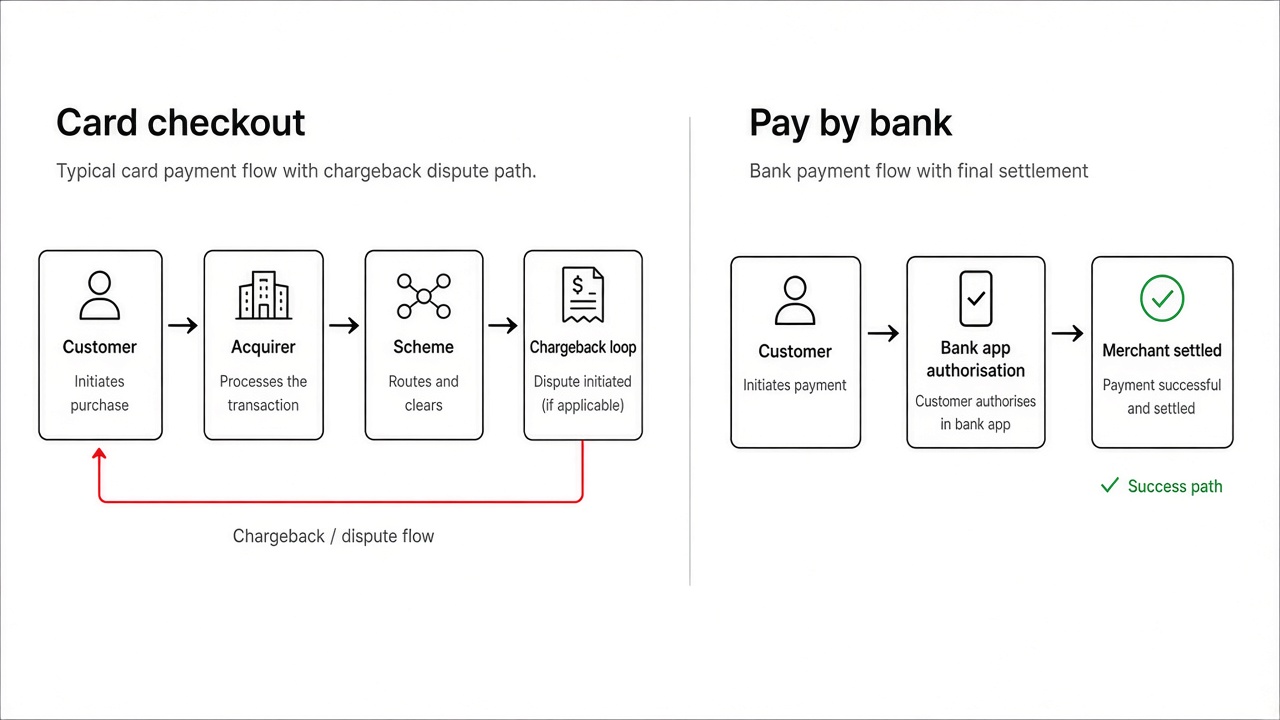
Pay by bank chargebacks: Card-style chargebacks — where an issuer reverses a transaction through a card scheme weeks after checkout — do not apply to customer-authorised bank push payments. Customers can still request refunds, raise bank complaints, or fall victim to authorised push payment fraud; the operational pattern is different from scheme reason codes and acquirer representment.
For how pay by bank works at checkout, start with pay by bank explained. For return mechanics after a sale, see pay by bank refunds. For fees, settlement, and when bank rails beat cards overall, see pay by bank vs cards at checkout.
Do pay by bank payments have chargebacks?
No — not in the card-scheme sense. Pay by bank moves money account-to-account after the customer approves the amount and payee name inside their banking app. That authorised push payment does not travel through Visa, Mastercard, or domestic card schemes, so there is no issuer chargeback right to reverse the transaction through reason codes weeks later.
What you get instead:
- Up-front authentication — the customer confirms payer, amount, and merchant details at the bank before funds move
- Immediate confirmation — your provider webhook reports success or failure; no pending authorisation window like cards
- Merchant-initiated refunds — returns are outbound credit transfers you control, not automatic scheme reversals
According to Open Banking Limited, open banking payments in the UK passed one billion cumulative transactions by mid-2026. As more checkout volume shifts to bank rails, finance and support teams that only know card dispute workflows need a separate playbook — not a copy-paste of chargeback reason codes.
How are pay by bank disputes different from card chargebacks?
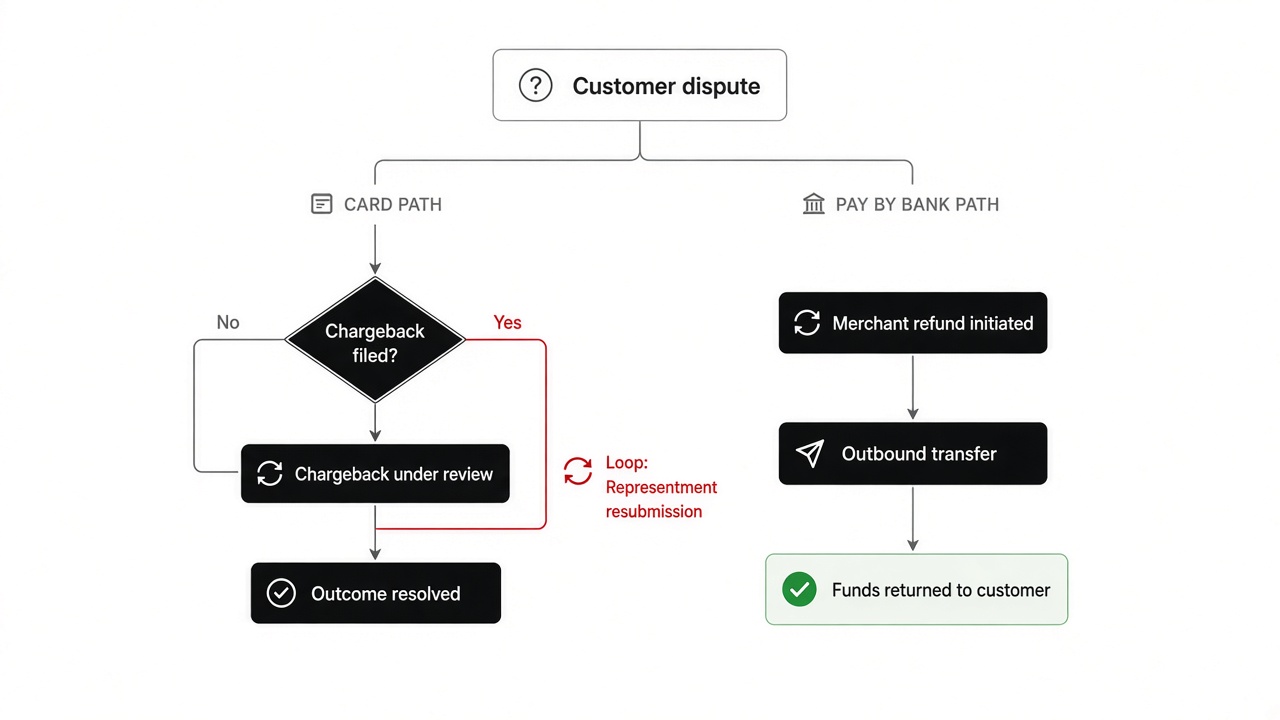
Card chargebacks are scheme-managed reversals; pay by bank disputes are merchant- or bank-managed resolution paths. The cost structure, timing, and ops load diverge sharply.
| Dimension | Card chargeback | Pay by bank dispute |
|---|---|---|
| Trigger | Cardholder disputes via issuer | Customer contacts merchant or bank directly |
| Timing | Often 30–120 days post-checkout | Refunds initiated when you approve a return |
| Fees | Scheme fees per dispute regardless of outcome | No scheme dispute fee — outbound refund transfer cost only |
| Ops load | Representment, evidence uploads, ratio monitoring | Refund API, IBAN verification, support copy |
| Automatic reversal | Issuer can claw back funds without merchant consent | Funds stay unless you initiate refund or bank intervenes |
| Friendly fraud pattern | "I don't recognise this charge" after delivery | Less common when payee name matches brand in bank app |
Chargeback fraud vs authorised push payment fraud
Open banking closes a specific fraud category: stolen card credentials used at checkout without the cardholder's knowledge. Because every pay by bank payment requires strong customer authentication in the banking app, the dispute volume driven by weak checkout authentication and compromised card data drops on bank-rail share.
Authorised push payment (APP) fraud is a separate risk. A customer tricked into approving a payment themselves — social engineering, fake invoices, impersonation — is not solved by removing card chargebacks. APP fraud requires its own detection, payer education, and sometimes confirmation-of-payee checks. Treat it as a distinct ops category rather than assuming bank rails eliminate fraud.
For IBAN verification before outbound refunds — a related but different ops concern — see verification of payee open banking.
Which checkout categories benefit most from removing card chargebacks?
Categories with elevated card dispute rates and domestic bank-app adoption see the largest ops and cost benefit when you shift eligible traffic to pay by bank. The win is fewer scheme fees and representment cycles — not zero customer complaints.
High-fit segments:
- Digital goods and software keys — instant delivery plus high friendly-fraud chargeback rates on cards
- Subscription and membership billing — recurring disputes from "cancelled but charged" claims; pair with recurring pay by bank where mandates exist
- Travel and events — service disputes after date changes; bank rails change the dispute path, not cancellation policy
- Cross-border EU e-commerce — chargeback currency friction and scheme fees on international cards
- Marketplaces with buyer protection expectations — combine bank checkout with clear refund SLAs; see open banking for marketplaces
Lower-fit segments:
- Global audiences expecting card chargeback habits — US and some APAC buyers may resist bank redirect
- Low basket values where card UX wins — dispute savings may not justify conversion testing cost
- Categories with heavy APP fraud exposure — invoice scams and B2B payer impersonation need controls beyond rail choice
Route by SKU and market, not globally. A merchant running 30% bank pay on domestic mobile traffic still keeps cards for international segments — the dispute benefit accrues on the bank-rail share only.
What dispute paths remain after you remove card chargebacks?
Customers retain refund rights, bank complaint channels, and consumer protection law — you lose automatic scheme reversal, not all recourse. Support and legal teams should document these paths before scaling bank checkout.
Merchant-initiated refunds
The primary path: customer requests return, you approve, provider sends outbound credit transfer to payer IBAN. This is faster and more predictable than card representment when your refund ops are wired correctly. Detailed mechanics are in pay by bank refunds.
Bank complaint and ombudsman routes
If a customer believes a payment was unauthorised or a merchant acted unfairly, they may complain to their bank under PSD2 payment services rules. That is not a chargeback — timelines, evidence, and outcomes differ. Document your checkout consent copy and order confirmations.
Consumer protection and sector rules
Travel, telecom, and digital content regulations may grant cancellation rights independent of payment rail. Switching to pay by bank does not remove those obligations — it only changes how money returns.
Internal dispute ops you still need
- Clear refund policy published before checkout
- Support macros that explain bank-rail timing honestly
- Fraud review for APP patterns on high-value B2B invoices
- Reconciliation that ties webhook payment IDs to order lines for evidence
What should you ask providers before routing high-dispute traffic to bank rails?
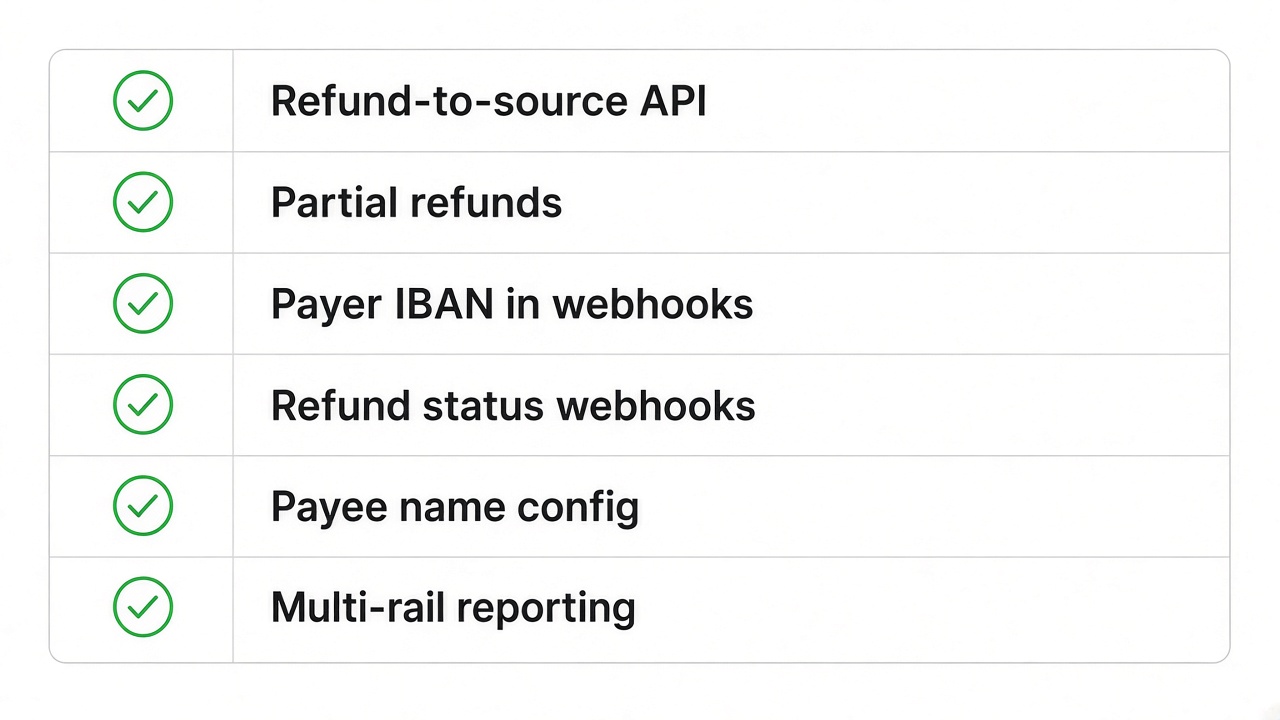
Validate refund APIs, payer data retention, and dispute reporting before you promise chargeback elimination to finance stakeholders. Coverage maps alone do not prove ops readiness.
| Criterion | Why it matters for dispute ops |
|---|---|
| Refund-to-source API | Automatic return to payer IBAN captured at checkout |
| Partial refund support | Essential for marketplace and travel partial cancellations |
| Payer IBAN in webhooks | Evidence and refund routing without re-asking customer |
| Outbound payment status webhooks | Close support tickets on terminal refund states |
| Payee name configuration | Reduces "unrecognised merchant" complaints at the bank |
| Multi-rail reporting | Separate card chargeback ratio from bank-rail dispute volume |
Run a pilot on one high-dispute SKU with measurable card chargeback rate today. Compare all-in cost: scheme dispute fees plus ops hours versus bank refund cost plus conversion impact. Link coverage gaps to how to choose an open banking provider when your funnel shows bank drop-off rather than dispute volume.
Frequently Asked Questions
Do pay by bank payments have chargebacks?
No, not in the card-scheme sense. Pay by bank uses customer-authorised push payments through banking apps, so there is no Visa or Mastercard chargeback right to reverse the transaction after checkout. Customers can still request refunds or raise complaints through their bank, but the automatic scheme reversal mechanism does not apply.
What is the difference between pay by bank chargebacks and card chargebacks?
Card chargebacks let an issuer reverse a transaction through card scheme rules, often weeks later, with per-dispute fees and representment workflows. Pay by bank payments settle as account-to-account transfers after customer authentication in the banking app — disputes route through merchant refunds or bank complaint processes instead of scheme reason codes.
Can open banking eliminate chargebacks for merchants?
Open banking removes card chargeback exposure on the bank-rail share of checkout because authorised push payments are not card transactions. It does not eliminate customer complaints, refund obligations, APP fraud, or regulatory cancellation rights. Merchants still need refund ops, support training, and fraud controls.
Does pay by bank stop payment fraud?
Pay by bank reduces fraud tied to stolen card credentials and weak checkout authentication because every payment uses strong customer authentication at the bank. Authorised push payment fraud — where a customer is deceived into approving a payment — remains a separate risk requiring payer education, confirmation-of-payee checks, and manual review on high-value flows.
How do refunds work if there are no pay by bank chargebacks?
Merchants initiate refunds as outbound credit transfers to the customer's bank account, usually the IBAN that funded the original payment. Providers with refund-to-source APIs automate this path. Refund timing and IBAN verification differ from card reversals — plan support copy and webhook-driven status updates accordingly.
Should high-dispute merchants replace cards with pay by bank?
Most merchants run both rails: pay by bank on domestic, mobile-heavy segments with elevated card chargeback rates; cards for international buyers and categories where bank conversion underperforms. Shift traffic incrementally by SKU and market, measuring dispute cost savings against conversion and refund ops load.
Conclusion
Pay by bank chargebacks are not a hidden feature — they reflect a structural difference in how account-to-account payments settle. Authorised bank push payments remove card-scheme chargeback rights, which cuts scheme fees and representment ops on the bank-rail share of checkout. Customers still expect refunds, banks still handle complaints, and APP fraud still needs its own controls. Teams that document dispute paths, wire refund APIs before scaling traffic, and pilot on high-dispute SKUs capture the ops benefit without pretending bank rails erase every payment risk.
Related articles
- Pay by Bank Refunds: How EU Merchants Handle Returns
Merchants add pay by bank at checkout for lower fees and strong payer authentication — then discover returns season works differently. Pay by bank refunds send…
- Pay by Bank for Marketplaces: Checkout Cost and Conversion
Marketplace payments teams add pay by bank marketplace checkout when card interchange on high-AOV baskets, chargeback exposure, and B2B buyer preferences make…
- Pay by Bank Invoice Payment: B2B Collection Without Card Fees
Finance teams add pay by bank invoice payment when card fees on large B2B invoices, slow manual transfers, and reconciliation gaps cost more than a short bank-…