Pay by Bank for Marketplaces: Checkout Cost and Conversion
Marketplace payments teams add pay by bank marketplace checkout when card interchange on high-AOV baskets, chargeback exposure, and B2B buyer preferences make bank rails worth a redirect. Buyers authorise payment in their banking app; you get confirmation and structured references finance can match to orders — without treating marketplace checkout like a single-retailer card flow. This guide covers when Pay by Bank belongs at marketplace cart, how conversion differs from pure e-commerce, rollout order with card fallback, and what to validate with providers before you promise the method EU-wide.
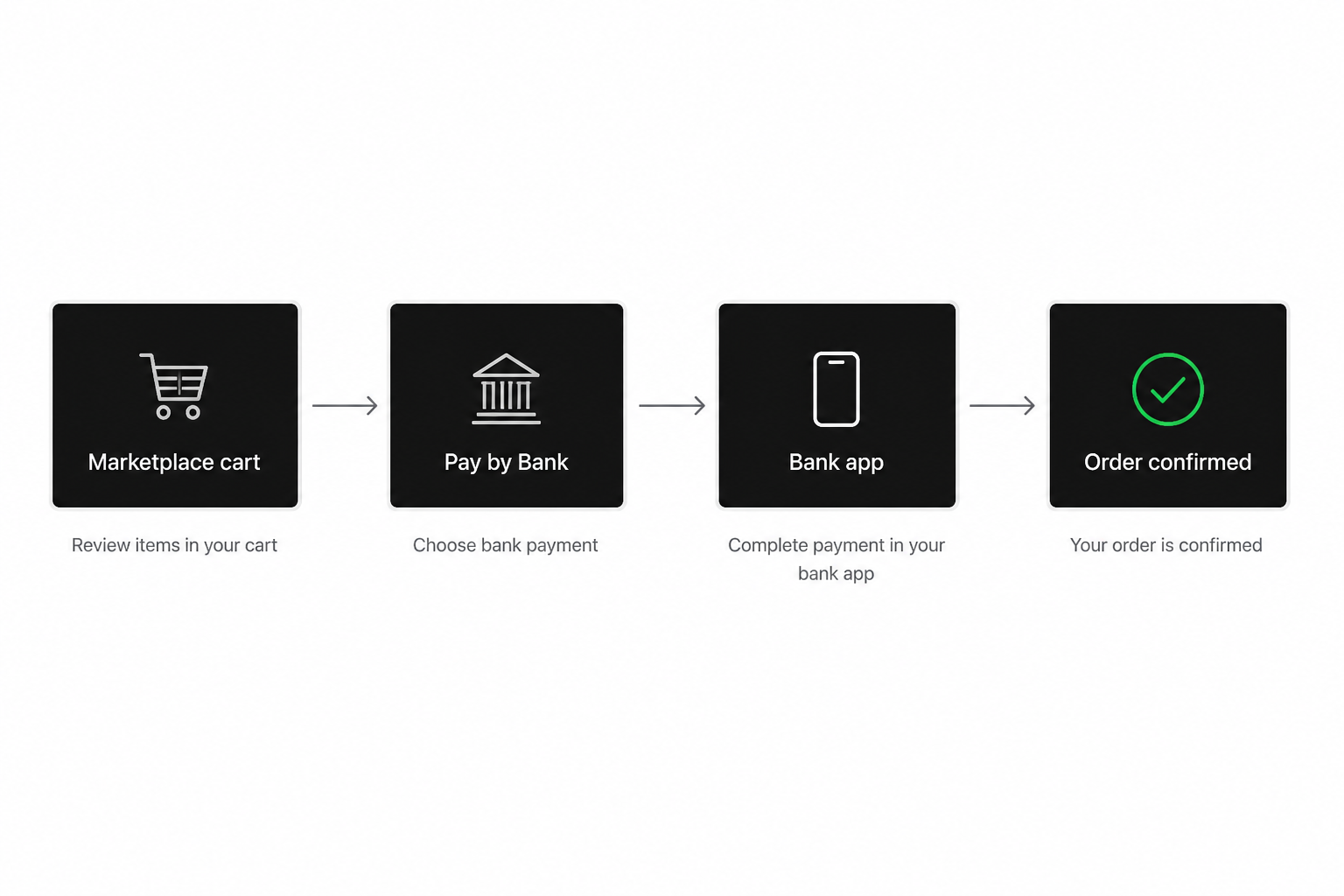
Pay by bank marketplace checkout: A buyer payment method on two-sided platforms where the customer pays for an order by authorising an account-to-account transfer in their banking app — typically at cart or hosted checkout — instead of entering card details, while the platform still handles seller settlement separately.
For the full marketplace programme — seller verification, payouts, fees, and refunds — see open banking for marketplaces. For the rail explained without marketplace context, start with pay by bank.
When should marketplaces offer pay by bank at checkout?
Offer Pay by Bank at marketplace checkout when average order value is high enough that card economics hurt, your buyers are finance-led or B2B, and bank-app payment initiation works in your core countries — always with card or wallet fallback on the same cart.
Strong fits include:
- High-AOV categories — furniture, industrial parts, luxury, vehicles, and B2B procurement where interchange on cards compresses take rate
- Marketplaces with business buyers — purchasers who already pay suppliers by bank transfer and expect structured references
- UK and EU markets with mature open banking — where institution lists cover your top buyer banks; Open Banking Limited reported more than one billion cumulative open banking payments by July 2026, with monthly one-off payment volumes continuing to climb
- Platforms testing lower dispute exposure — bank rails carry different dispute economics than card chargebacks; product and legal teams should align copy before marketing the benefit
Deprioritise or pilot-only when:
- Buyers are impulse consumer shoppers expecting card rewards — conversion may lag unless you segment by category
- Mobile checkout dominates but bank deep links fail on key Android browsers — measure device-level drop-off before global rollout
- You cannot keep card fallback live — forcing bank-only checkout on mixed GMV categories usually hurts conversion more than it saves fees
UK marketplace teams should track UKPI Wave 2 scope for broader e-commerce sectors; Wave 1 under the UK Payments Initiative focused on utilities, financial services, and parts of the public sector, with wider retail checkout expected in later waves per HM Treasury's open banking roadmap — details in our UK open banking regulatory framework explainer.
How does pay by bank marketplace checkout work for buyers?
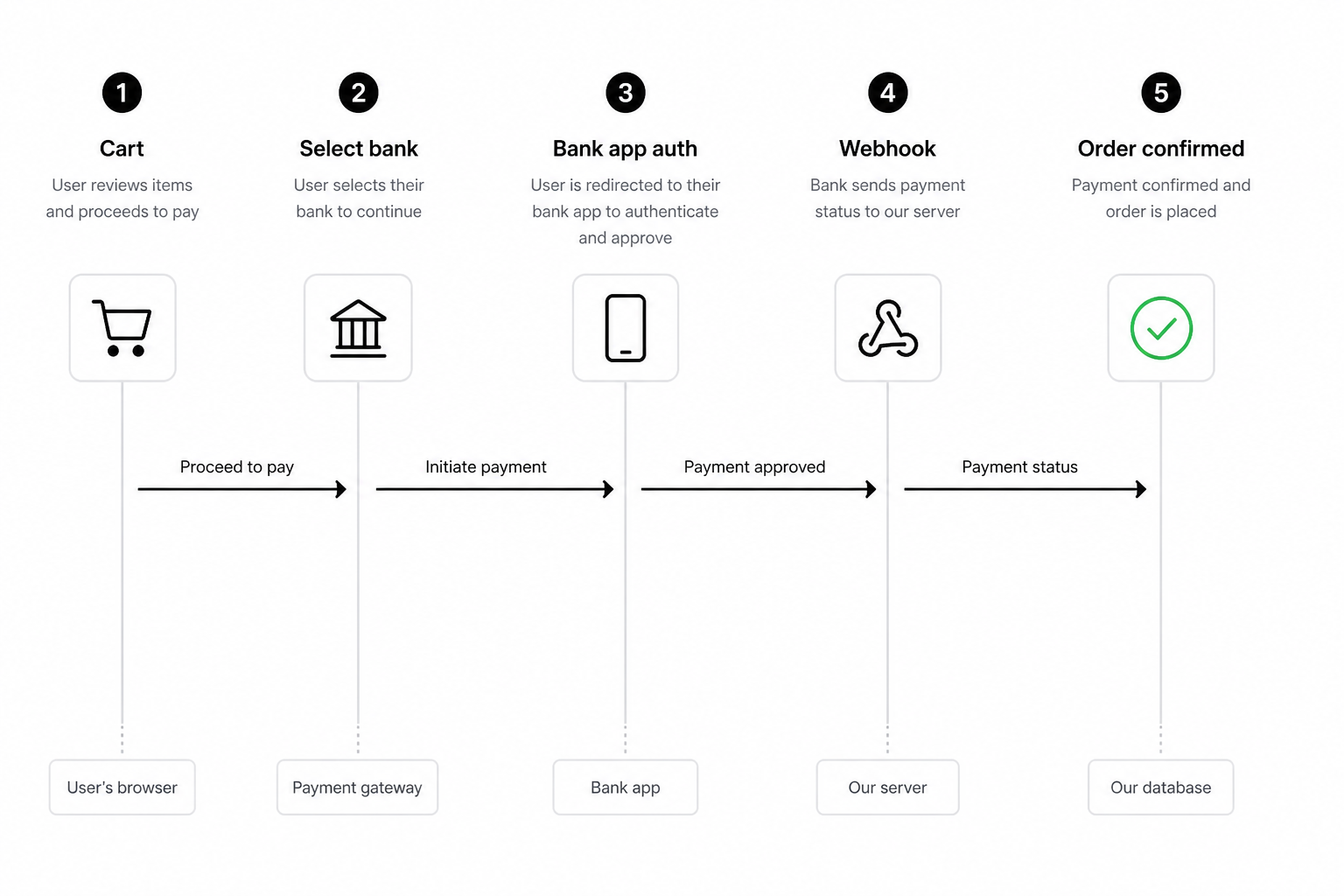
The buyer selects Pay by Bank at cart, chooses their bank, authenticates in the mobile or online banking app, confirms amount and payee, and returns to your confirmation page while your platform receives payment status via API.
Typical sequence:
- Cart total locked — shipping, taxes, and platform fees visible; Pay by Bank sits beside card and wallet options.
- Bank selection — country-filtered list; domestic banks first for EU buyers paying in EUR or GBP.
- Authentication in bank channel — strong customer authentication happens in the banking app, not on your domain.
- Status webhook — accepted, pending, failed, or cancelled; order state updates without relying on browser return alone.
- Buyer confirmation — receipt email references order ID; support scripts explain bank-timeline settlement if funds are not instant.
This differs from manual bank transfer instructions because amount and payee are pre-filled — buyers cannot easily underpay or omit references. It differs from card on file because there is no card number; repeat buyers may still prefer cards for loyalty unless you add recurring pay by bank for subscriptions on the same platform.
Why is marketplace checkout conversion different from pure retail?
Two-sided platforms must optimise buyer checkout without breaking seller payout assumptions — so Pay by Bank pilots need category and country segmentation, not a single global toggle.
Conversion drivers that differ from single-merchant e-commerce:
| Factor | Marketplace implication |
|---|---|
| Trust in the platform brand | Buyers weigh platform reputation before leaving card for bank redirect — social proof and buyer protection copy matter |
| Mixed seller baskets | Multi-seller carts complicate payee naming on the bank screen; providers vary in how they display marketplace legal entity |
| B2B vs consumer mix | B2B segments often convert better on bank rails; consumer fashion may need card-first ordering |
| Mobile share | Deep links to banking apps drive completion; desktop QR flows help in some EU markets |
| Refund expectations | Buyers accustomed to "refund to card" need clear policy when checkout was bank-initiated |
Run A/B tests by category × country × device rather than platform-wide switches. Patterns that lift completion on single-retailer checkout — covered in pay by bank checkout conversion — still apply, but marketplace cohorts split faster.
Pay by bank vs cards at marketplace checkout
Cards win on habit and rewards for low-ticket consumer baskets; pay by bank wins when variable card cost, chargeback exposure, or B2B buyer preference dominates the economics on larger marketplace orders.
| Criterion | Pay by Bank at marketplace cart | Card at marketplace cart |
|---|---|---|
| Variable cost | Often lower per successful payment on high values | Interchange scales with ticket size |
| Buyer habit | Stronger with B2B and bank-native markets | Default for consumer impulse |
| Chargeback / dispute | Bank dispute paths differ from card chargebacks | Familiar buyer protection via card networks |
| Settlement visibility | Structured references via initiation | Batch card settlement with opaque descriptors |
| Implementation | Redirect + webhooks; card fallback required | Existing PSP stack |
Compare fee and dispute assumptions with finance before marketing Pay by Bank as "always cheaper" — partial captures, multi-currency baskets, and FX can change the answer. Deeper card-versus-bank framing lives in pay by bank vs cards at checkout.
Which provider criteria matter for marketplace checkout only?
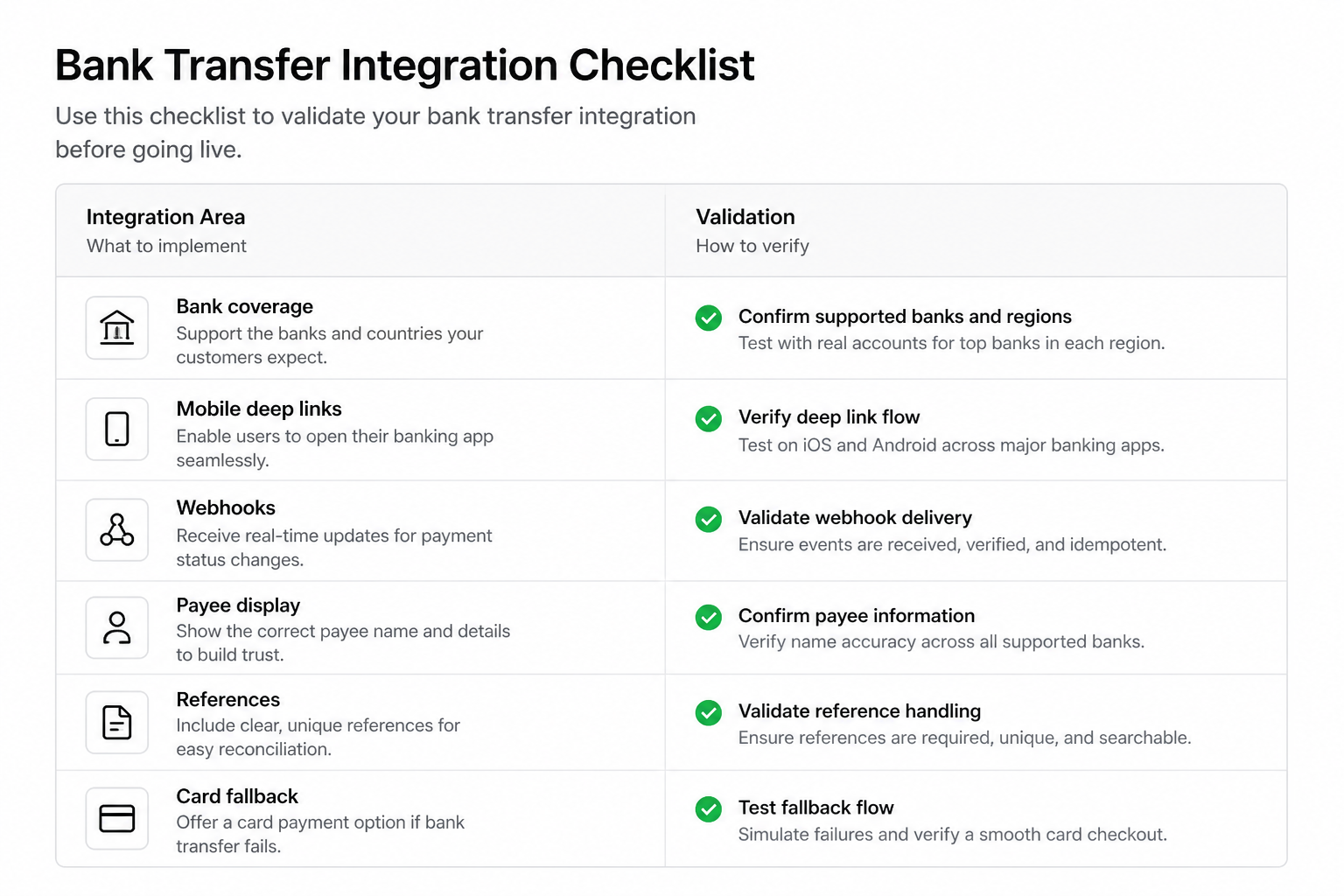
Shortlist providers on buyer-bank coverage in your active countries, mobile deep-link quality, webhook reliability, marketplace payee display, and honest sandbox parity — buyer checkout strength does not guarantee seller payout capability elsewhere on the platform.
| Criterion | Checkout-specific question |
|---|---|
| Institution list | Do your top 20 buyer banks support payment initiation in each pilot country? |
| Mobile UX | iOS/Android deep links tested on devices your analytics show? |
| Webhooks | Final status without browser return? Idempotent events for high QPS sales? |
| Payee naming | How does the bank screen show your marketplace legal entity for multi-seller orders? |
| References | Order ID and buyer-visible descriptor passed end-to-end? |
| Fallback | Same session if payer cancels in bank app? |
Validate in sandbox with production-shaped cart totals and multi-seller metadata. When you need both checkout and seller disbursement on one contract, cross-read provider evaluation in open banking for marketplaces — this article stays on the buyer cart decision.
Share your buyer countries, GMV bands, and category mix via the provider-matching form to compare live coverage, or start from how to choose an open banking provider in the EU for general RFP dimensions.
How should marketplaces roll out pay by bank checkout?
Sequence seller-side readiness separately: pilot Pay by Bank on one high-AOV category and country with card fallback, measure segment conversion for four to eight weeks, then expand categories only where economics and completion rates clear your threshold.
Practical rollout order:
- Pick a pilot segment — one country, one category, B2B or high-AOV consumer where card fees hurt most.
- Keep card and wallet live — never force bank-only on mixed GMV.
- Instrument drop-off — bank list load, redirect return, webhook latency, and support tickets tagged by payment method.
- Align finance — reconciliation rules for bank-settled orders before marketing to sellers.
- Expand or stop — scale to adjacent categories when conversion and unit economics beat card-only baseline; link seller payout programmes only after treasury signs off.
Platforms also running open banking for e-commerce merchant flows can reuse checkout UX learnings — marketplace branding and multi-seller legal display remain the delta.
Frequently Asked Questions
What is pay by bank marketplace checkout?
Pay by bank marketplace checkout is a buyer payment option on two-sided platforms where the customer authorises an account-to-account payment in their banking app at cart or hosted checkout instead of using a card. The marketplace receives payment confirmation via API while seller settlement and fees are handled in separate treasury flows.
How is pay by bank marketplace checkout different from open banking for marketplaces?
Open banking for marketplaces covers the full two-sided programme — buyer checkout, seller verification, payouts, refunds, and fee reconciliation. Pay by bank marketplace checkout focuses only on the buyer cart moment: when to offer bank payment, conversion patterns, and provider criteria for that step.
Should marketplaces remove cards when adding pay by bank?
No. Keep card and wallet methods on the same checkout for mixed GMV. Pay by Bank works best as a segmented option for high-AOV, B2B, or bank-friendly markets while cards cover impulse and low-ticket consumer baskets.
Does pay by bank marketplace checkout work in the UK and EU?
Yes, where licensed providers connect to buyer banks that support payment initiation. UK adoption has accelerated under industry schemes including UKPI; EU coverage varies by country and institution. Pilot in your top buyer markets before EU-wide promises.
Can pay by bank reduce marketplace chargebacks?
Bank-initiated payments follow different dispute paths than card chargebacks. Some platforms see lower dispute volume on bank rails, but buyer protection copy and refund processes must match the method — consult legal before marketing chargeback reduction.
Do buyers need a new account to pay by bank on a marketplace?
No new marketplace account is required beyond normal signup. Buyers need a bank account with a participating institution and complete authentication in their existing banking app during checkout.
How do I choose a provider for marketplace pay by bank checkout?
Prioritise buyer-bank coverage in pilot countries, mobile deep-link quality, webhook reliability, payee display for your legal entity, and sandbox tests with real cart shapes. Use the provider-matching form to compare options against your countries and categories.
Conclusion
Pay by bank marketplace checkout is a buyer-side lever — lower variable cost and bank-native UX on the right segments, with card fallback everywhere else. Teams that win pilot by category and country, measure conversion honestly, and separate checkout provider criteria from seller payout programmes avoid the common trap of optimising cart rails while disbursement still runs on a different stack. Your GMV mix and buyer geography determine whether Pay by Bank belongs at cart this quarter or after the next UKPI wave; either way, treat it as a measured product decision, not a platform-wide toggle.
Related articles
- Pay by Bank Chargebacks: What Merchants Need to Know
High-dispute checkout categories — digital goods, subscriptions, travel, and cross-border e-commerce — bleed margin on card chargeback fees, representment ops,…
- Pay by Bank Refunds: How EU Merchants Handle Returns
Merchants add pay by bank at checkout for lower fees and strong payer authentication — then discover returns season works differently. Pay by bank refunds send…
- Pay by Bank Invoice Payment: B2B Collection Without Card Fees
Finance teams add pay by bank invoice payment when card fees on large B2B invoices, slow manual transfers, and reconciliation gaps cost more than a short bank-…