Open Banking Webhooks: Verification, Idempotency, and Ops
Checkout teams that rely on browser redirects alone still ship orders late, double-fulfil when customers refresh, and argue with finance about which payments actually settled. Open banking webhooks are the server-to-server events that tell your backend when a payer finished in the banking app — so fulfilment, dunning, and reconciliation run on confirmed rail status, not on hope that the customer returns to your site. This guide covers what to implement before production: verification, deduplication, terminal states, and the sandbox failures most integrations miss.
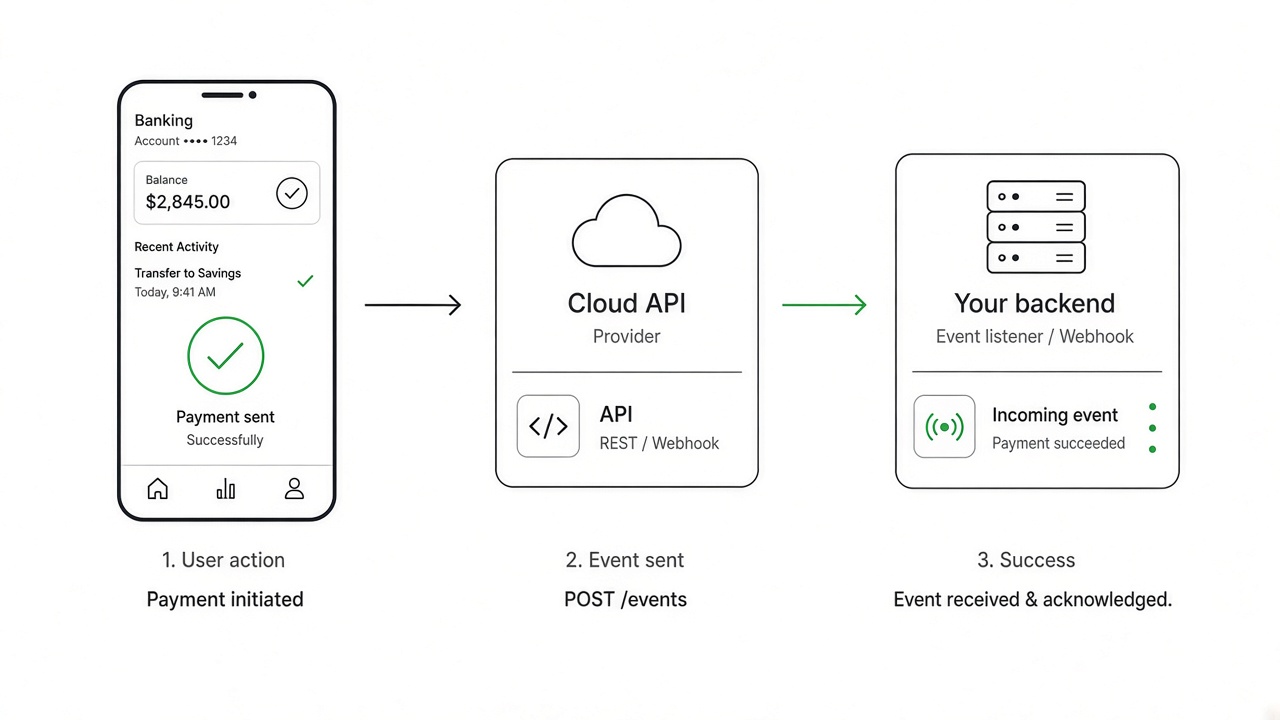
Open banking webhooks: HTTPS callbacks from your regulated open banking provider to your servers when a payment, mandate, or data consent changes state — for example authorised, settled, failed, or revoked — so your ledger and customer communications update without polling or trusting the payer’s return redirect.
Why do open banking webhooks matter for B2B payment ops?
Webhooks matter because bank authorisation is asynchronous — your API call starts the journey, but settlement and failure signals arrive later on a channel you control. A parent may approve a club fee in a mobile banking app two minutes after closing your checkout tab; a B2B payer may complete SCA on a desktop bank site while your redirect URL never loads on a corporate proxy.
If you only mark orders paid when the browser hits your success page, you systematically under-count successful payments and over-build manual reconciliation. Industry adoption data from Open Banking Limited shows sustained growth in API-driven payment volume in the UK — EU deployments face the same async pattern per bank, even when standards differ by market.
Webhook-first fulfilment also fixes reporting: conversion metrics for pay by bank checkout should use webhook-confirmed success as the denominator, not redirect alone. Payments and engineering should agree on that definition before you scale traffic.
How should you verify and trust webhook payloads?
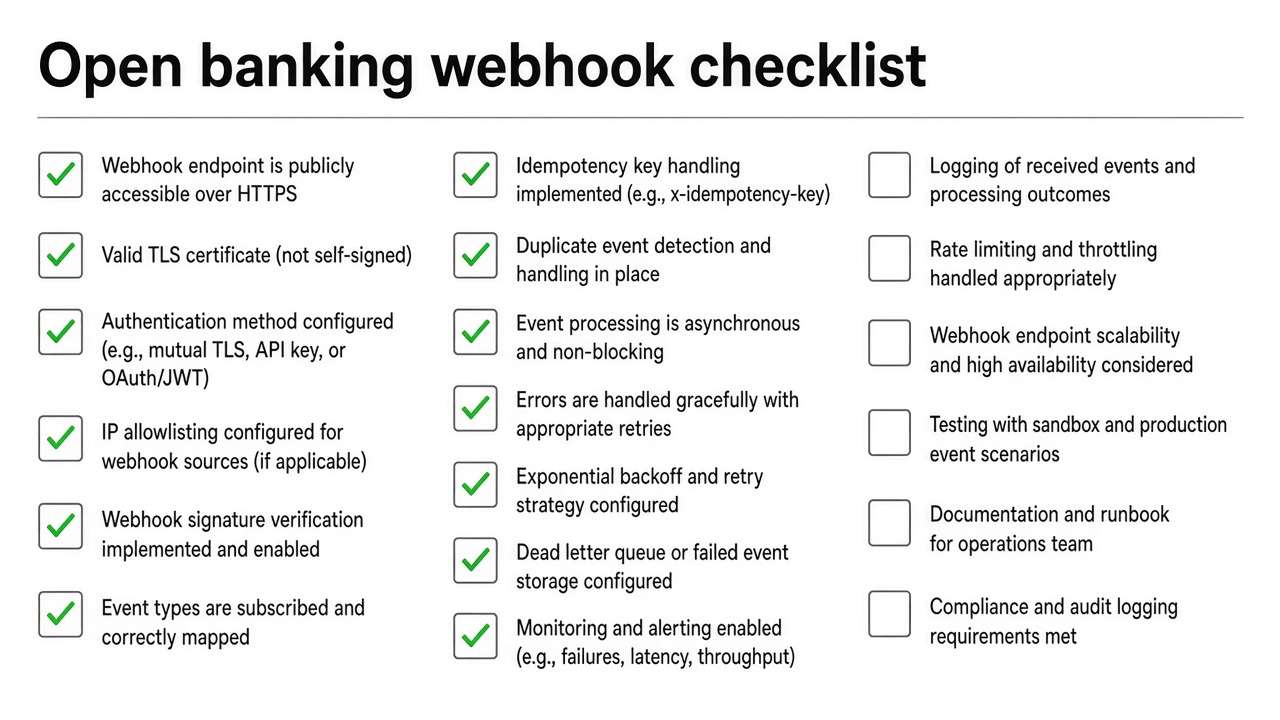
Verify every delivery before you mutate ledger state — treat webhooks like untrusted input from the public internet. Providers typically sign payloads with a shared secret or public-key scheme documented in their developer portal. Your handler should:
- Reject requests missing required signature headers in production
- Use constant-time comparison when checking signatures
- Parse JSON only after verification succeeds
- Return
2xxquickly after enqueueing work — do heavy ledger updates on a job queue, not inside the HTTP thread
Log raw payload IDs and timestamps for support, not full PAN or unnecessary personal data. If verification fails, alert engineering — spoofing attempts and misconfigured secrets look similar in logs until you compare environment keys.
For a full integration sequence (sandbox, architecture, rollout), use open banking API integration as the parent playbook; this article stays on event handling depth.
How do idempotency and deduplication prevent duplicate charges?
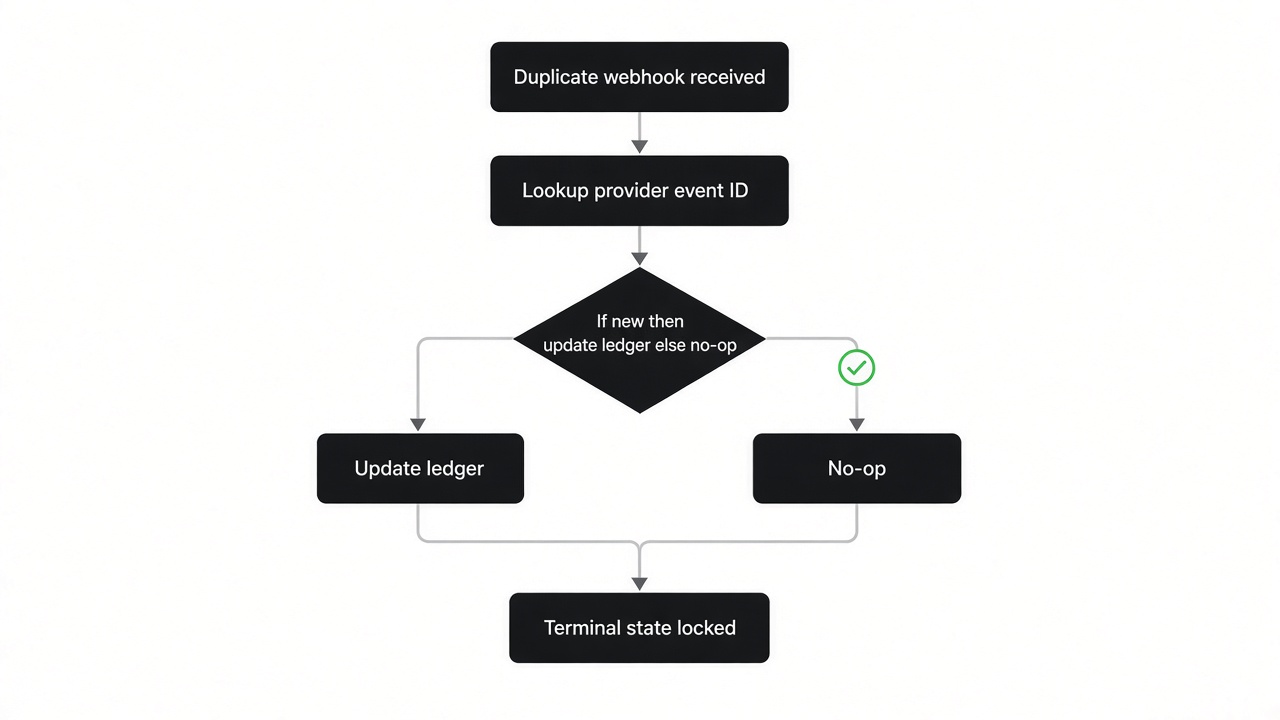
Idempotency belongs on both outbound API calls and inbound webhook processing. Network retries are normal: your server may POST the same create-payment twice; the provider may deliver the same payment.succeeded event twice after a timeout.
Production pattern:
| Layer | Rule |
|---|---|
| Outbound | Send an idempotency key on create-payment and create-mandate requests so retries do not spawn duplicate bank instructions |
| Inbound | Store provider event IDs uniquely; second delivery updates status on the same internal payment row |
| Ledger | Define terminal states (SETTLED, FAILED, CANCELLED, REFUNDED) so late events cannot reopen closed accounting periods |
| Fulfilment | Trigger shipment, licence unlock, or invoice closure only from webhook-driven state transitions you have tested |
Duplicate fulfilment is more expensive than duplicate API rows — idempotency keys protect revenue and ops. Recurring flows add mandate and consent events; map those to subscription IDs the same way as one-off payments. Dunning in open banking recurring dunning depends on reliable failure webhooks, not batch CSV exports.
Which webhook events should you handle for pay by bank and VRP?
Scope handlers to the events your finance team needs to close books — not every experimental beta event in the provider changelog. Minimum set for most EU B2B checkout and recurring products:
- Payment authorised or accepted — customer completed bank step; you may show pending state
- Payment settled or completed — funds movement your finance team treats as cash-in
- Payment failed — insufficient funds, user cancel, timeout, or bank decline with reason code
- Mandate or consent created / revoked — recurring and data products; stops collections when consent ends
- Refund or payout status — if you promise bank-account refunds in pay by bank refunds
Map each event to one internal status enum shared by checkout, billing, and support tools. Ad-hoc string matching in three codebases is how teams ship contradictory order pages.
UK commercial variable recurring payments under the UK Payments Initiative scheme add scheme-specific timing; validate with your provider which events fire for Wave 1 sector products versus generic SEPA or open-banking rails in EU corridors.
What should you test in sandbox before go-live?
Engineering should schedule failure-path tests, not only happy-path demos. Minimum matrix before production:
| Scenario | Expected webhook behaviour |
|---|---|
| Successful payment | Single terminal success event; idempotent replay does not double ledger |
| User cancels at bank | Failure event; checkout recoverable |
| Insufficient funds | Failure with reason; dunning rules can trigger |
| Slow authorisation | Success arrives after redirect timeout; order still completes |
| Revoked mandate | Recurring collections stop; no silent retries |
| Refund initiated | Outbound refund events match support portal status |
Capture timestamps and event IDs in an evidence pack — the same artefacts you would attach during open banking vendor due diligence. If sandbox webhooks differ structurally from production, treat that as a launch blocker.
How do you compare providers on webhook quality?
Shortlist on delivery guarantees and observability, not just API feature lists. Questions payments and engineering should ask finalists:
- Are webhook signatures documented with worked examples in your stack’s language?
- Is there a replay or dead-letter tool when your endpoint returns errors?
- What is the maximum retry window before the provider marks delivery failed?
- Do event schemas version with migration notices?
- Can you subscribe to separate URLs for sandbox and production?
- Are latency SLAs or status pages published for the webhook infrastructure?
When requirements are documented, use the provider-matching form to filter on markets and use cases, then score webhook maturity in technical review — we do not rank a single “best” vendor for every stack.
Frequently Asked Questions
What are open banking webhooks?
Open banking webhooks are HTTPS notifications sent from your regulated provider to your servers when a payment, mandate, or consent changes state after the customer interacts with their bank. They let you confirm success, failure, or revocation without relying on the customer returning to your website.
Are open banking webhooks required for pay by bank checkout?
They are strongly recommended for production checkout. Redirect-only fulfilment misses successful payments when the browser session breaks and inflates false abandonment rates. Webhooks give finance and ops a single source of truth for settled payments.
How is webhook verification different from API authentication?
API authentication proves your outbound calls to the provider. Webhook verification proves inbound events genuinely came from the provider. Both are required; using only API keys on inbound traffic without signature checks exposes your ledger to spoofed events.
What is idempotency in open banking webhook handling?
Idempotency means processing the same provider event ID more than once does not create duplicate ledger entries or duplicate fulfilment. You store unique event IDs and update existing payment rows when duplicates arrive.
Which open banking webhook events matter for recurring billing?
At minimum: mandate or consent created, payment succeeded, payment failed, and consent or mandate revoked. Failure and revocation events drive dunning and stop collections; success events confirm cash application to subscriptions or invoices.
How do open banking webhooks relate to API integration?
API integration covers the full journey — user UX, provider APIs, sandbox rollout, and multi-market launch. Webhooks are the asynchronous notification layer inside that stack. Teams often implement webhooks in the same sprint as create-payment APIs but should treat verification and deduplication as launch blockers, not follow-ups.
Webhook-verified fulfilment is the difference between pay by bank as a demo and pay by bank as a reconciled rail. Sign payloads, dedupe by event ID, define terminal states, and run sandbox failure tests before peak season or UKPI-scale recurring go-lives. Document your event map and compare providers on delivery tooling — not just redirect UX.
Related articles
- Cross Border Open Banking Integration: EU Multi-Country Data Playbook
Cross border open banking integration is how EU lenders, BNPL operators, and credit platforms pull consented bank data from more than one country without rebui…
- Open Banking Redirect vs Embedded: Which Flow Fits Your Product?
Open banking redirect vs embedded is the first UX decision most EU B2B teams face when they add pay by bank — and it shapes conversion, engineering scope, and…
- PSD2 Open Banking: Present-Tense EU Framework
If your roadmap includes collecting from bank accounts, verifying IBANs before payouts, or reading transaction history without manual uploads, PSD2 open bankin…