Cross Border Open Banking Integration: EU Multi-Country Data Playbook
Cross border open banking integration is how EU lenders, BNPL operators, and credit platforms pull consented bank data from more than one country without rebuilding a connector every time a customer moves. When a borrower has income in Estonia and a bureau file in Germany, your decision engine needs one normalised view — not three incompatible JSON shapes from three sandboxes. This playbook covers scoping corridors, consent and re-auth per market, merging enriched transaction feeds with bureau data, and what to test before production.
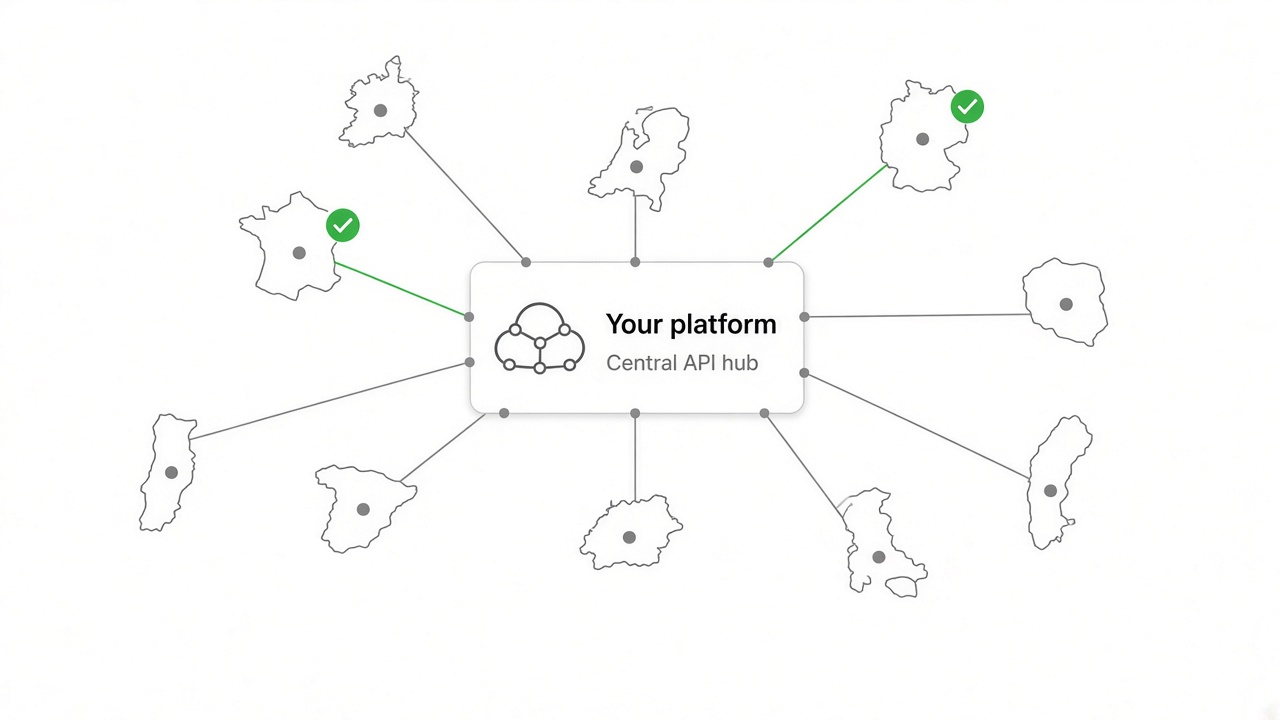
Cross border open banking integration: Connecting your product to licensed open banking providers so customers in multiple EU/EEA markets can share account data with explicit consent — and your backend receives categorised, comparable payloads for credit, affordability, or onboarding decisions. You integrate once at the provider layer; the provider maintains bank connectivity and scheme updates per country.
What business problem does cross border open banking integration solve?
You stop treating every country as a separate science project. Pan-European credit and lending products fail operationally when each market ships its own AIS connector, its own consent copy, and its own categorisation rules. Finance and risk teams then reconcile decisions manually when a customer’s financial life spans borders — common for contractors, expats, and SMEs trading across the Single Market.
A working integration delivers:
- One decision pipeline — bureau history plus bank-derived income and behaviour in a single case file
- Faster onboarding — customers authenticate in their home banking app instead of uploading statements
- Lower ops load — fewer document fraud reviews when data is bank-sourced and consent-bound
Recent industry moves underline the demand: in September 2026, credit data platform Mifundo and open banking infrastructure provider Yapily announced a partnership to combine Yapily’s categorised account data with Mifundo’s cross-border bureau network across more than 20 European markets (BeBeez International). The integration lesson generalises beyond that deal — enriched AIS must land ready for rules engines, not as raw feeds your data team re-labels nightly.
When you are ready to compare providers on multi-country AIS coverage, use the provider-matching form to filter on markets, data products, and corporate account support before deep technical review.
How should you scope countries and use cases for v1?
Pick two to three priority corridors where your application volume already concentrates, not every EU member state on day one. Cross border open banking integration scope should read like a product brief:
| Scope element | v1 decision |
|---|---|
| Countries | Where applicants live and where their accounts sit |
| Account types | Retail salary accounts vs SME operating accounts |
| Data depth | Balances only vs 90-day categorised transactions |
| Decision use | Origination vs line increase vs collections |
| Languages | Customer-facing consent and error strings |
Link single-market verification patterns in open banking account verification when onboarding is part of the same journey — cross-border credit often pairs verification with ongoing AIS refresh.
Avoid launching “all EU AIS” without a mandatory-bank list per country. Sandbox labels like “2000+ banks” do not tell you whether your applicants’ top three institutions return stable categorisation in production.
What does the integration architecture look like?
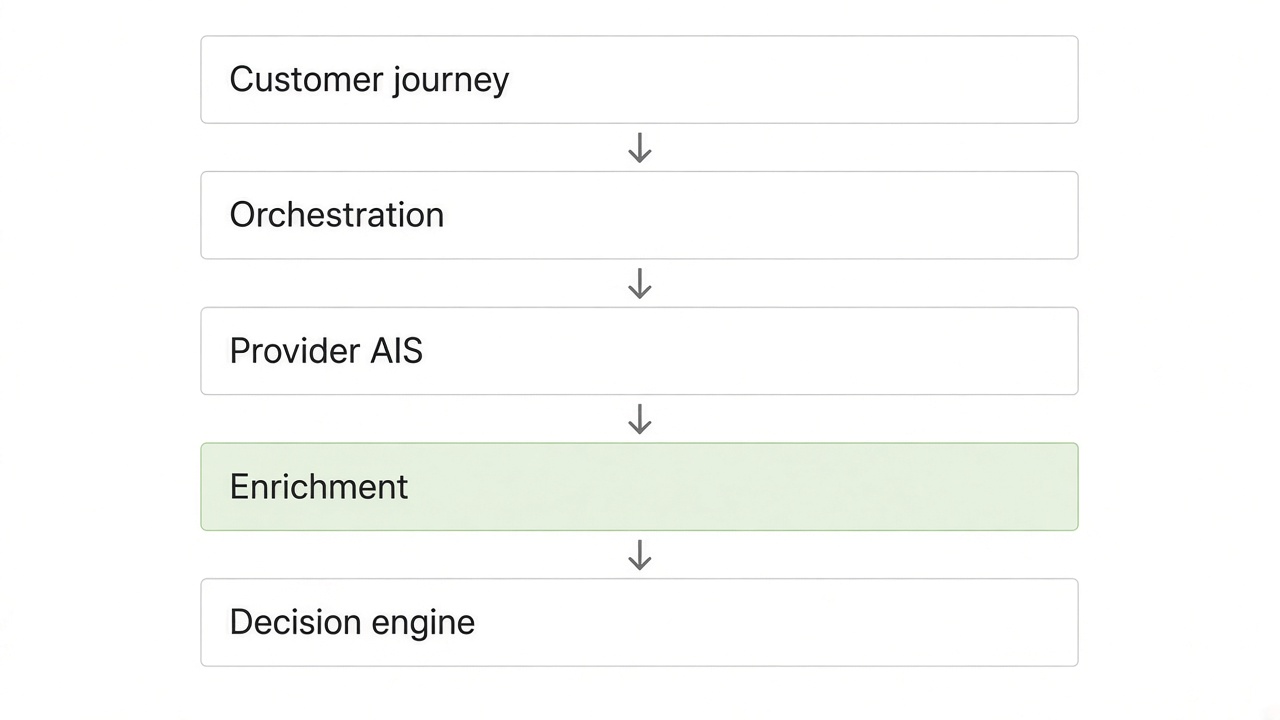
Your application owns the case ID, consent registry, and decision model; providers own bank pipes. A typical cross-border stack has five layers:
- Customer journey — country-aware bank picker and consent screen
- Your orchestration — routes the user to the correct provider entity and stores consent metadata (country, ASPSP, timestamp)
- Provider AIS APIs — returns normalised accounts and transactions (ideally pre-categorised)
- Enrichment / feature store — maps provider categories to your internal income and expense taxonomy
- Decision + audit — merges open banking features with bureau or registry inputs; logs consent evidence
Some teams add a credit data hub (like Mifundo’s model) that aggregates bureau files and open banking feeds before your core underwriting engine runs. Others call provider APIs directly and merge in-house. The build-vs-buy choice is whether that hub is your platform or a partner — see build vs buy open banking before committing engineering quarters.
Enterprise programmes sometimes run two providers for geographic redundancy. That only pays off if you invest in a single internal schema — otherwise finance and risk inherit duplicate mapping work. Open banking multiple providers covers routing logic; this article focuses on data normalisation once events arrive.
How do consent and re-authentication work across borders?
Consent is always market- and customer-specific; there is no EU-wide “connect once, read everywhere” button. Customers approve access in their banking app under local strong authentication. Ongoing access depends on refresh rules and product design — typically you plan for periodic re-authentication rather than assuming perpetual feeds.
Operational rules:
- Store consent scope — accounts, transaction history depth, and purpose text shown to the customer
- Separate consent records per country when the same user links accounts in two jurisdictions
- Handle revocation webhooks — disable decision paths that rely on stale AIS immediately
- Align copy with purpose — affordability, creditworthiness, and identity verification may need different consent wording; legal review per launch market
Regulated access to account data sits in the EU payment services framework; your licensed provider packages compliance — you still own fair processing and retention in your privacy policy and model governance docs. Do not treat cross-border integration as a loophole to bypass local consumer credit rules.
How do you merge bank data with bureau and registry inputs?
Define a single “applicant financial view” schema before you connect APIs. Cross border open banking integration fails when bureau JSON and AIS JSON land in different silos and analysts merge them in spreadsheets.
Practical merge pattern:
- Identity anchor — verified name, date of birth, national identifier where permitted
- Bureau segment — tradelines and scores from the relevant national or pan-European bureau feed
- AIS segment — categorised inflows (salary, benefits, gig), recurring obligations, and balance trends
- Conflict rules — e.g. when stated income exceeds categorised inflows by a threshold, route to manual review
- Audit trail — which source powered each feature at decision time
Partnerships like Mifundo and Yapily’s September 2026 arrangement aim to deliver bureau and enriched bank data in one standardised report rather than forcing lenders to stitch sources (FintechNewsCH). Whether you buy that hub or build merge logic internally, the outcome is the same: underwriters see one timeline, not three tabs.
For income-specific decisioning, cross-read income verification open banking for customer UX patterns — this article emphasises multi-country plumbing behind that UX.
What should you test in sandbox before production?
Run per-country matrices on mandatory banks, not generic demo institutions. Cross-border programmes need repeatable evidence that categorisation and balances match expectations for each corridor you sell into.
Minimum test matrix:
| Scenario | Pass criteria |
|---|---|
| Retail salary account (Country A) | Categorised salary tag present; 90-day history complete |
| SME operating account (Country B) | Corporate account accessible if product requires it |
| Joint account | Holder names handled without breaking identity match |
| Insufficient history | Graceful decline with customer-readable next step |
| Consent expiry | Re-auth flow tested; stale data excluded from auto-decline rules |
| Webhook / polling | Account status updates propagate to your case record |
Schedule joint tests with provider solutions engineers — slideware coverage maps rarely survive contact with your top five ASPSPs. Developers should still read open banking API integration for webhook and idempotency hygiene; those patterns apply unchanged to multi-country AIS.
How do you evaluate providers for cross-border AIS?
Score mandatory countries, account types, and payload shape — not logo count. Use a weighted checklist:
| Dimension | Why it matters |
|---|---|
| Country coverage | Live AIS in every v1 launch market |
| Corporate / SME accounts | Critical for B2B lending; often thinner than retail |
| Categorisation quality | Provider-native labels vs raw MCC-only feeds |
| Latency | Same-day decision products need sub-minute returns |
| Data residency & DPA | Entity per region if your compliance team requires it |
| Sandbox parity | Institution behaviour matches production for your list |
Do not rank vendors in prose — freeze mandatory banks and account types first, then run the same comparison dimensions as in open banking provider comparison.
FAQ
What is cross border open banking integration?
Cross border open banking integration connects your platform to licensed providers so customers in multiple European markets can share consented bank account data through secure bank authentication. Your backend receives normalised account and transaction information for credit, affordability, or onboarding — without maintaining separate bank adapters in each country.
Is cross border open banking integration the same as SEPA payments?
No. Payment initiation moves money; account information services read consented data. Many credit products need AIS integration across borders even when disbursement stays in one country. You may need both rails, but they are separate API products with separate consent flows.
Do customers need to connect accounts in every country manually?
Yes for v1. Each account link requires customer action in the relevant banking app. Your UX can guide them through multiple links in one session, but you cannot silently pull foreign accounts without consent and authentication.
How does cross border integration relate to credit bureaus?
Bureau files summarise credit history; open banking adds verified cash-flow behaviour. Cross border programmes often merge both so underwriters see tradelines and recent account activity together — especially when applicants have moved between member states.
What breaks most cross border open banking integrations?
Three common failures: assuming sandbox bank lists match production mandatory institutions, skipping SME account tests, and letting each country write its own category mapping without a central schema. Fix those before scaling marketing spend.
Can one provider cover all EU countries?
Some providers cover wide geographies; none replaces your obligation to validate your corridors and account types in sandbox. Use coverage tables as a starting point, then proof on named banks.
How long does a cross border open banking integration take?
A focused two-country AIS pilot often takes eight to twelve weeks with one provider — journey design, sandbox proof, legal sign-off, and decision model hooks. Adding countries is faster only if you already built normalisation and consent registry correctly in v1.
Conclusion
Cross border open banking integration turns fragmented national bank connections into one decision-ready data layer — when you scope corridors tightly, normalise enriched AIS before rules run, and test mandatory banks per country. September 2026’s Mifundo–Yapily partnership is one signal that lenders want bank data standardised at the border, not reprocessed in spreadsheets. Start with two markets, prove categorisation on real institutions, merge bureau and AIS in one schema, then expand. Compare infrastructure partners on coverage and payload shape once your mandatory-bank list is frozen — the same shortlist criteria apply whether you integrate directly or through a credit data hub.
Related articles
- Open Banking Redirect vs Embedded: Which Flow Fits Your Product?
Open banking redirect vs embedded is the first UX decision most EU B2B teams face when they add pay by bank — and it shapes conversion, engineering scope, and…
- PSD2 Open Banking: Present-Tense EU Framework
If your roadmap includes collecting from bank accounts, verifying IBANs before payouts, or reading transaction history without manual uploads, PSD2 open bankin…
- Agentic Payments Open Banking: What B2B Teams Need Now
Agentic payments open banking is the shift from human checkout forms to AI agents that search, compare, and pay on a customer's behalf — using bank rails that…