Open Banking Provider Migration: Cutover Without Checkout Downtime
Open banking provider migration is the controlled move from one licensed provider’s APIs to another’s without losing live payments, breaking consent records, or doubling charges in finance’s ledger. Teams trigger it when coverage gaps show up in production, commercials reprice after M&A, or a new market needs banks your incumbent never connected. This guide explains when migration beats patching, how to run a parallel cutover, and what to verify with finalists before you flip traffic — distinct from pre-sign open banking vendor due diligence and from day-one how to shortlist open banking providers.
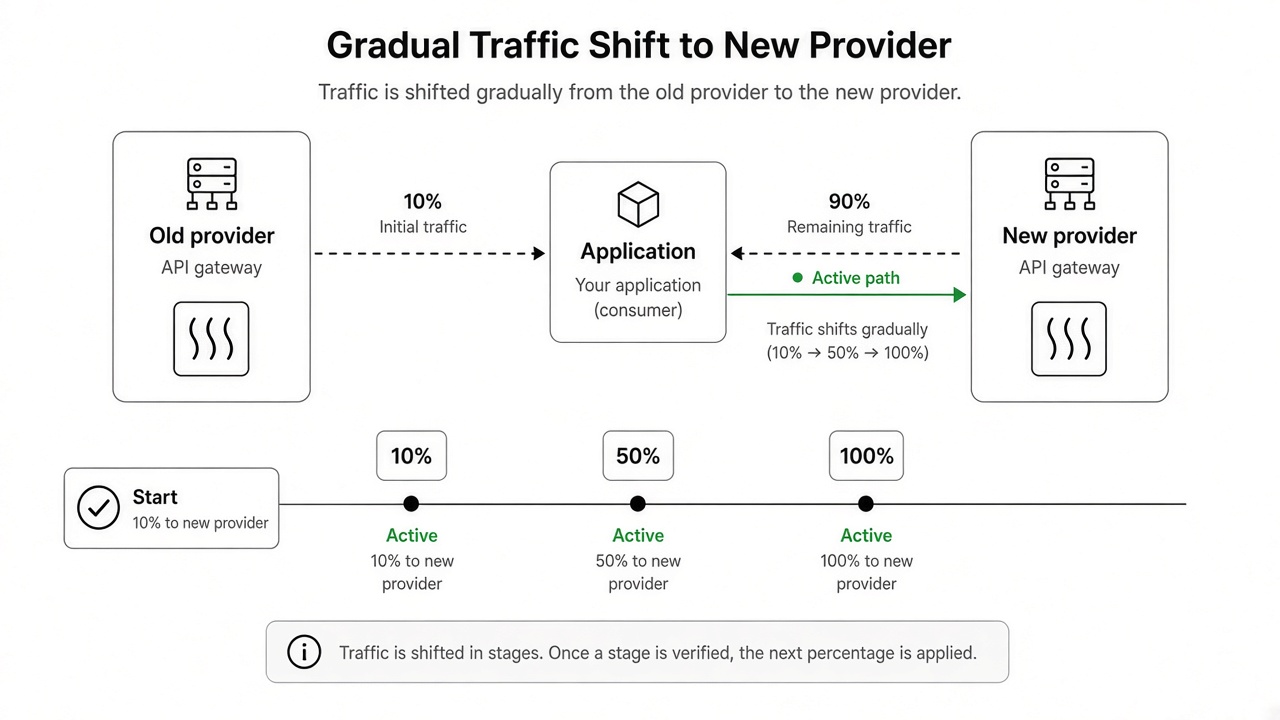
Open banking provider migration: Moving pay-by-bank, verification, or account-data flows from one regulated open banking partner to another using a planned cutover — usually with parallel routing, new customer consent where required, and reconciliation rules so finance can match every payment once.
When should you migrate instead of negotiating with your current provider?
Migrate when structural gaps block revenue — missing banks on your live list, repeated webhook outages, or contract terms that worsen after ownership change — not when a single sandbox bug needs a ticket. Negotiation fixes pricing disputes and roadmap promises; migration fixes architecture and coverage you have already proved missing in production.
Common triggers in 2026:
| Trigger | Business signal | Why negotiation often fails |
|---|---|---|
| Post-acquisition roadmap shift | Features you bought are deprioritised or bundled into another product | Roadmap is no longer independent — see Mollie GoCardless acquisition buyer actions |
| Mandatory bank gap | >5% of checkout attempts fail on institutions your customers use | Coverage is contractual but institution-level matrices hide gaps until live |
| Commercial reprice | Failed-payment fees or platform minimums exceed model | You need a market alternative, not a discount letter |
| Multi-market expansion | New country needs ASPSPs your vendor lacks | One global MSA does not create local bank pipes |
| Security or ops incident | SLA breaches or certificate rotation failures | Trust repair rarely restores engineering confidence |
If you only need failover during incidents, read open banking multiple providers first — migration is a permanent switch, not hot standby.
How do you plan migration without stopping live payments?
Run old and new providers in parallel on a defined traffic slice, with idempotent payment references and a single source of truth in your ledger. Product sets a cutover calendar; engineering maps endpoints; finance defines which provider owns each settlement day.
A practical sequence:
- Inventory live flows — checkout, invoice links, verification, recurring, webhooks; note which use hosted widgets vs your API integration (open banking API integration)
- Freeze scope — no new bank markets during migration unless the new vendor is the only path to that country
- Mint new references — payment and consent IDs must not collide across providers; store
provider_idon every row - Parallel run — route 5–10% of new sessions to the new vendor by country or cohort; compare authorisation rate and webhook latency
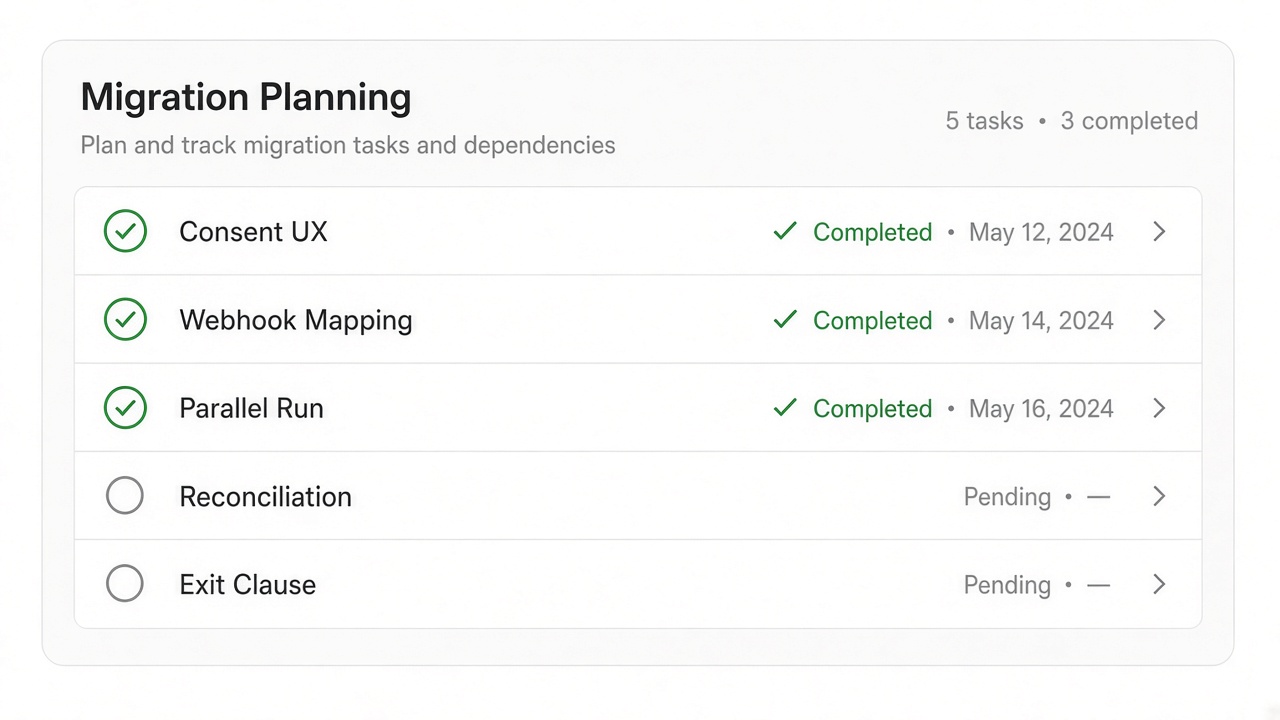
- Customer consent — new provider usually requires fresh bank consent; plan UX copy and support macros before you switch returning users
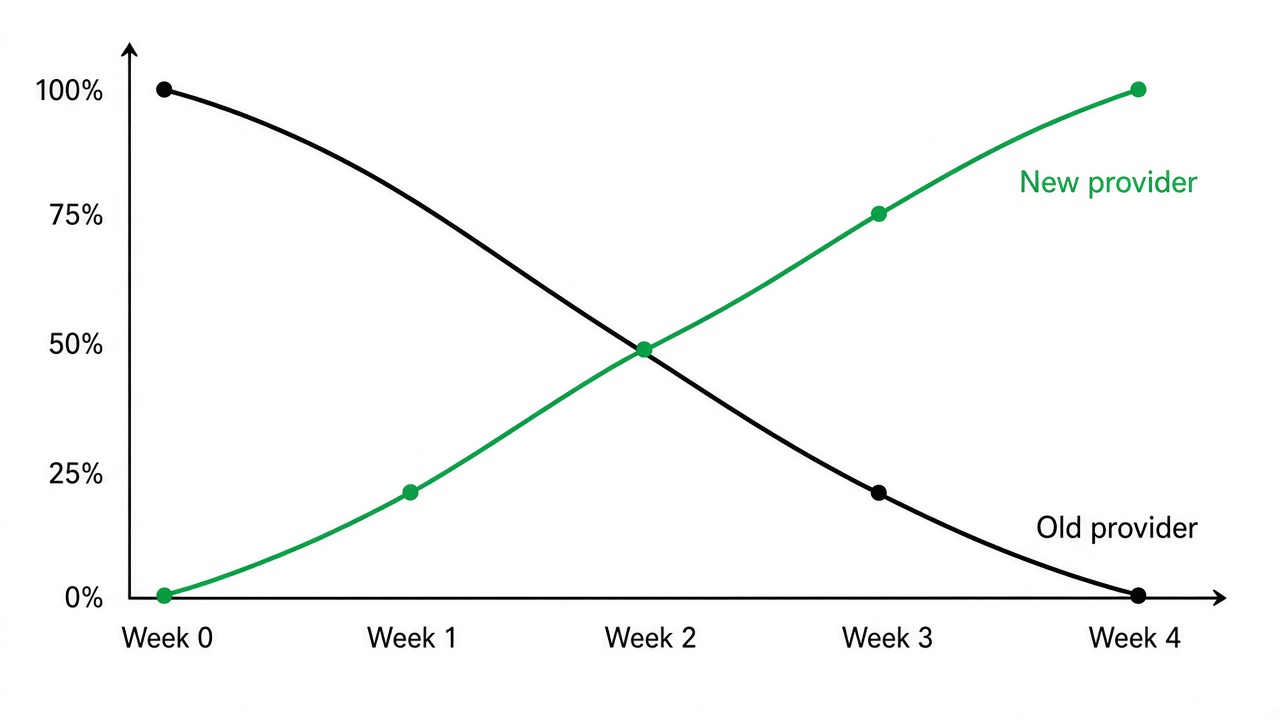
- Ramp — 25% → 50% → 100% over two to four weeks if metrics hold; keep rollback switch for one sprint
- Decommission — turn off old webhooks, close API keys, export audit logs, and terminate per contract notice
Payments leaders should assign one migration owner with authority to pause rollouts when reconciliation drifts — not a part-time thread across three Slack channels.
What breaks customer journeys during a TPP switch?
Customers often must re-link their bank when consent tokens do not transfer between providers — expect a short conversion dip on returning users even when rails are identical. Mobile deep links and bank-app authentication paths also differ per vendor.
Design mitigations up front:
- Segment messaging — email or in-app banner before cutover: “Re-link your bank for faster checkout” with a single CTA
- Grace period — keep old provider read-only for status polling until in-flight payments reach terminal state
- Returning vs new — new users only on new provider; returning users get prompted on next payment, not on login
- VRP and recurring — migrating sweeping or subscription flows needs cap and mandate alignment; see VRP consent renewal and recurring pay by bank before moving mandates
- Verification-only flows — account checks may re-run; underwriting teams should expect a short spike in manual reviews
Anthropic’s November 2026 Claude personal finance beta — bank and card linking through Plaid for US users (Finextra) — is a reminder that data-access products must document which AIS partner holds consent. EU teams shipping AI features should map migration impact on read-only scopes separately from payment initiation; security framing lives in open banking AI agent access, but your cutover plan still needs distinct AIS credentials.
How do webhooks and reconciliation stay idempotent across two providers?
Every payment row carries a stable merchant_reference your ledger owns — provider A and provider B may use different external IDs, but finance posts once per reference. Webhook handlers must key idempotency on that reference, not on the provider’s event ID alone.
Engineering checklist:
| Control | Purpose |
|---|---|
| Unique merchant reference per attempt | Prevents double-settlement when both providers fire for a retry |
provider column on payment fact table |
Supports mixed-rail reporting during parallel run |
| Terminal-state enum shared across adapters | Ops sees one vocabulary in dashboards |
| Dead-letter queue for unknown events | Parallel run surfaces schema differences early |
| Nightly reconcile job | Compares provider settlement files to internal ledger by reference |
Align webhook retry rules with open banking webhooks guidance — migration week is when duplicate delivery hurts most. Treasury should receive daily migration reports showing volume per provider until cutover completes.
What contract and commercial clauses matter before you start cutover?
Exit assistance and data return should already be in your old contract — if they are not, negotiate before you announce migration internally. Standard MSAs often cap transition support at 30 days; complex recurring or marketplace flows need longer.
Request in writing before kickoff:
- Notice period and fees for early termination
- API key validity through the parallel window
- Webhook delivery obligation until terminal payments clear
- Consent export — whether customer consent metadata can be shared (often it cannot; plan for re-consent)
- Settlement tail — who settles payments initiated on old rails after cutover date
- Subprocessor change notification on the new vendor
If consolidation drove the move, cross-check themes from open banking vendor due diligence against both vendors — the acquirer’s bundle may change pricing on the replacement as well.
How do you evaluate the replacement provider for migration success?
Score the finalist on institutions your production data already names — not a generic EU map. Run the same sandbox failure tests you would at first purchase, plus migration-specific cases: duplicate reference handling, refund on old rail after cutover, and AIS re-link for verification products.
Use our provider matching form to compare finalists against your bank list, use cases, and markets — migration is the wrong moment to discover a missing ASPSP on your top three institutions.
Evaluation weighting skewed for migration:
| Dimension | Weight | Migration-specific question |
|---|---|---|
| Coverage on live bank list | High | Institution-level matrix dated within 90 days |
| Cutover support | High | Named engineer, runbook, rollback assistance |
| Hosted vs API parity | Medium | Can you mirror current UX without rewrite? |
| Commercial stability | Medium | Price hold through ramp; no new platform fee at go-live |
| Certificate ops | Medium | Alignment with open banking mTLS certificates if you own TPP certs |
Teams still deciding whether to build orchestration in-house should read build vs buy open banking before migration — switching twice is expensive.
Frequently Asked Questions
What is open banking provider migration?
Open banking provider migration is the planned switch from one licensed payment or data partner to another while keeping payments reconcileable and customers able to complete bank authorisation. It usually involves parallel routing, new consent where tokens cannot transfer, and a defined decommission date for the old API keys.
How long does switching open banking providers take?
Most B2B products need six to twelve weeks from signed contract to full cutover: two weeks for technical mapping and sandbox, two to four weeks parallel run, and one to two weeks tail for in-flight payments. Recurring or VRP-heavy products often need longer because mandates must be re-established with customers.
Can customer bank consent move to the new provider automatically?
Usually no — consent is tied to the regulated entity that obtained it. Customers typically re-authenticate in their banking app with the new partner. Plan messaging and support volume for returning users; do not assume silent migration of tokens.
Should you migrate payment and AIS to the same new vendor?
Often yes for simpler ops and one contract, but not mandatory. Verification-only teams might migrate AIS first while payments stay on the incumbent until checkout tests pass. Split vendors increase reconciliation work — document which provider owns each event type.
When is parallel run better than a hard cutover?
Parallel run is better when you process meaningful daily volume, sell in multiple EU countries, or use recurring flows. Hard cutover suits low-volume pilots. Parallel run costs two sets of fees briefly but buys rollback if authorisation rates drop.
What is the difference between migration and using multiple providers?
Migration ends on one primary provider (sometimes with a cold standby). Multiple providers implies ongoing dual routing for resilience or market coverage. Migration may use two providers temporarily; multi-provider architecture keeps both active by design.
Related articles
- Open Banking Credit Bureau Data: How Lenders Merge Both
Open banking credit bureau planning is what credit, BNPL, and embedded-finance teams do when a bureau score alone misses cash-flow reality — but raw transactio…
- Open Banking Vendor Due Diligence: What to Verify Before You Sign
Open banking vendor due diligence is the evidence pass you run after a promising demo and before legal sends the MSA. It turns marketing claims into test resul…
- Mollie GoCardless Acquisition: What Pay by Bank Buyers Should Do Now
If you run recurring billing, invoice collection, or checkout on GoCardless or Mollie, the Mollie GoCardless acquisition completed on 1 September 2026 changes…