Open Banking AI Agent Access: Consent Without Password Sharing
Retail banks are telling customers not to hand banking usernames and passwords to AI shopping agents — while still allowing read-only account data through approved open banking paths. Open banking AI agent access is the architecture your product team needs when a copilot, assistant, or embedded AI layer wants to reason over balances and transactions: customer consent in the banking app, scoped data pulls via a licensed provider, and no screen-scraper credentials stored in the agent. This guide explains what changed in October 2026, how that differs from agentic payments open banking, and how verification and lending teams design flows that banks and regulators will tolerate.
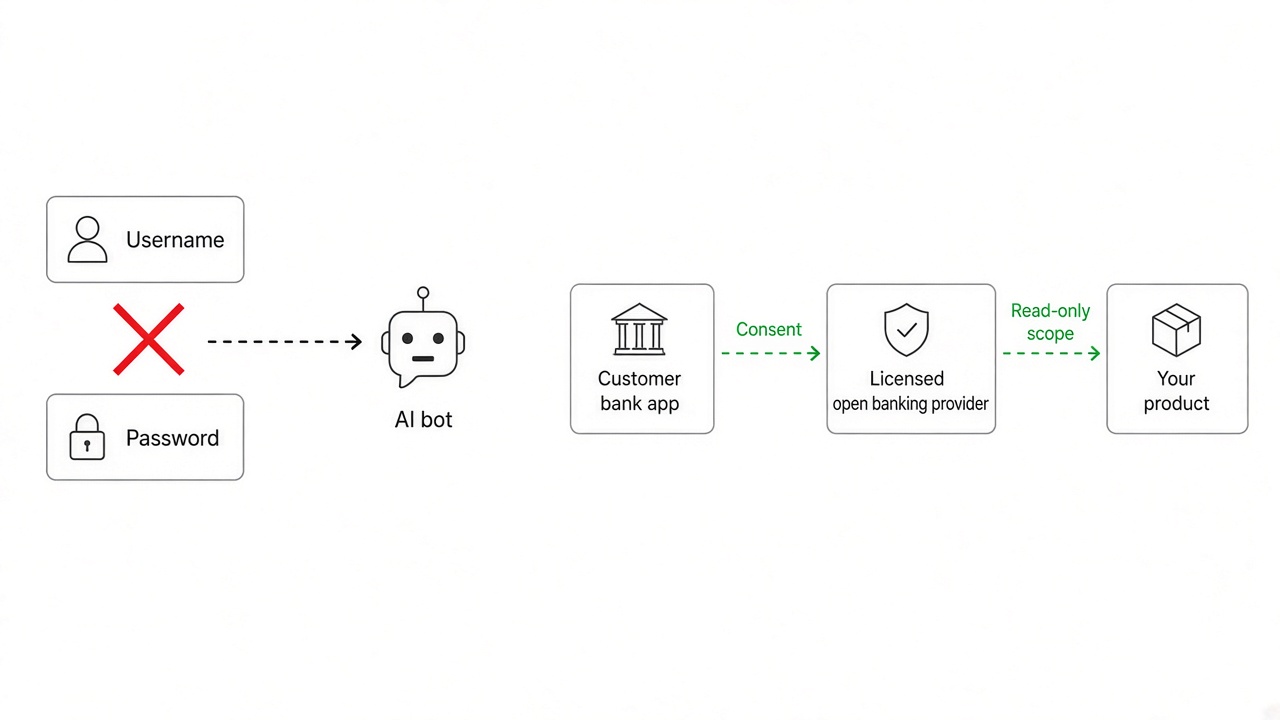
Open banking AI agent access: Letting an AI layer use customer bank account information only after the customer authenticates in their banking app and grants a defined, revocable data scope through a licensed open banking provider — instead of typing login credentials into the agent or a third-party screen scraper.
Why are banks blocking AI agents from logging into customer accounts?
Banks are cutting off credential-based agent logins because shared passwords bypass strong customer authentication, blur liability, and expose accounts to automated actions the customer never clearly approved. In October 2026, major institutions publicly warned retail clients against giving banking usernames, PINs, or card details to AI assistants, and several confirmed they block third-party agents from signing into digital banking on a customer's behalf (Finextra, 22 October 2026). RBC's chief executive told Bloomberg the bank was weighing restrictions on Meta's Muse agent accessing client account information; JPMorgan Chase, Citi, Bank of America, and Charles Schwab issued similar limits, with Citi stating customers may still authorise limited, read-only access through Citi-approved open banking providers.
For your roadmap, the signal is not "never use AI near banking." It is never route AI through retail login surfaces. Underwriting copilots, support assistants, and onboarding wizards should consume API-delivered account data under consent records your compliance team can audit — the same pattern as open banking account verification and income verification open banking, with tighter scope documentation when an automated layer sits between the customer and your UI.
How should product teams use open banking instead of password sharing?
Replace "link your bank" text fields in the agent with a redirect or embedded open banking journey where the customer picks their bank and approves a data scope in the official app. Your licensed provider returns structured account and transaction payloads; the agent reads those JSON fields — not a live scraping session inside the bank's website.
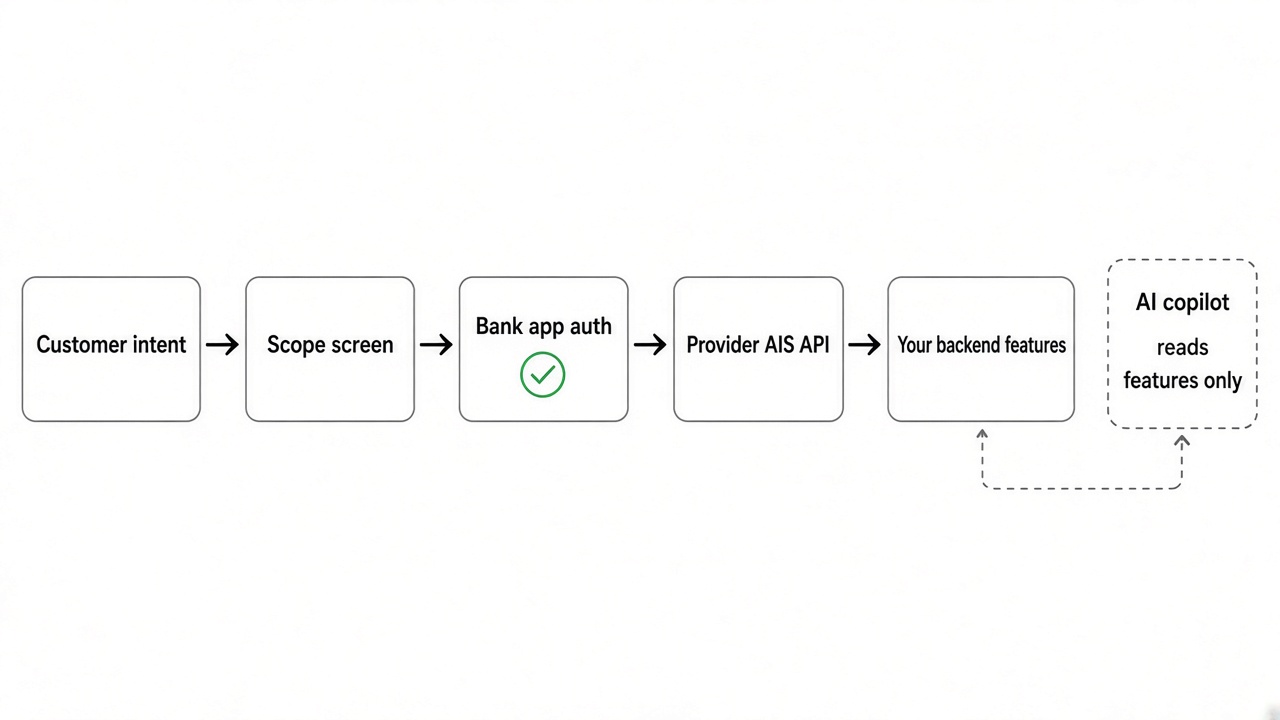
A production-safe pattern:
- Intent capture — the customer states what the agent may do (e.g. "verify my account for this loan application" or "summarise last 90 days of income")
- Scope presentation — your UI lists accounts, lookback window, and read vs payment permissions before any bank redirect
- Bank authentication — customer completes authentication in the banking app (app-to-app or redirect)
- Tokenised access — provider stores consent and refresh rules; your backend fetches data, not the LLM calling arbitrary URLs
- Agent consumption — the copilot receives derived features (verified holder name, categorised income, affordability flags) from your server, not raw credentials
- Revocation path — customer can disconnect in your settings and in the bank's consent dashboard
Payment initiation for agent-led checkout belongs on a separate rail — see agentic payments open banking — with human-in-the-loop or mandate limits where banks require it. Data access for verification and lending should stay read-only until policy explicitly allows payment scopes.
What data scopes matter for verification and lending use cases?
Match the narrowest scope that still answers the business question — account verification needs holder name and IBAN; affordability needs categorised transactions over a defined window, not indefinite full history. Over-scoping triggers drop-off and gives legal teams a reason to block the agent feature entirely.
| Use case | Typical scope | Agent should receive |
|---|---|---|
| Payout / seller verification | Account details + holder name | Match result, masked account identifier |
| Income verification | 3–12 months transactions, salary tags | Normalised income series, employer hints |
| Affordability / thin file | Transactions + balances | Policy features, not raw PDF statements |
| Support copilot "balance check" | Balance + recent credits | Aggregated answer text, not full export |
Re-use the same categorisation logic you already document for open banking affordability check and open banking credit invisible flows — agents amplify mistakes if they see unfiltered transaction dumps. Server-side feature extraction keeps prompts smaller and reduces accidental leakage into model logs.
What breaks when you ignore bank and regulator signals?
Credential sharing creates fraud exposure, unbounded automation, and vendor relationships banks are now explicitly closing. Finextra reported that US banks have discussed agent access with Federal Reserve officials, who privately supported blocking unsupervised agent logins (Finextra, 22 October 2026). EU teams face parallel scrutiny on consent evidence and third-party access under existing open banking rules — your provider's audit trail becomes the proof that the customer — not the agent — authorised each pull.
Common failure modes:
- Storing passwords or session cookies — instant conflict with bank acceptable-use policies and PCI/PSD expectations
- Letting the LLM call bank URLs directly — no stable consent artefact, impossible to revoke cleanly
- Mixing payment and data scopes in one agent prompt — customers think they only shared "read" access
- Skipping re-consent when lookback windows expire — silent stale data in automated decisions
- Logging full AIS payloads into chat transcripts — GDPR and vendor DPAs rarely permit it
Treat open banking webhooks and consent-expiry events as first-class: when access ends, the agent must stop answering balance questions until the customer re-authenticates.
How do you evaluate open banking providers for AI-adjacent access?
Shortlist providers that document consent objects, sandbox expiry behaviour, and business-account coverage for your markets — then prove revocation and re-consent in a test harness before the copilot ships. You are not choosing "the best" aggregator; you are matching AIS depth, webhook quality, and operational transparency to how aggressively your product exposes agent features.
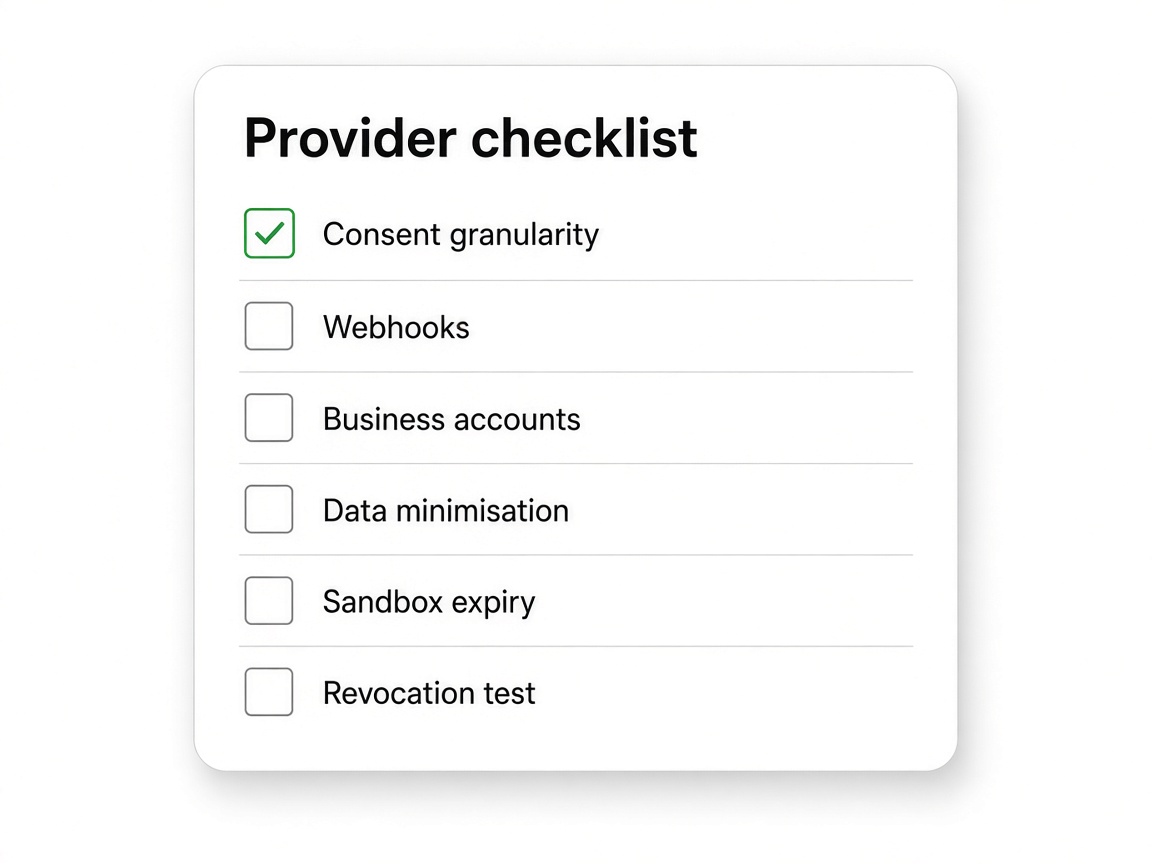
Use this checklist in vendor calls:
- Consent granularity — can you request read-only AIS without payment initiation enabled?
- Redirect vs embedded — which pattern fits your agent UI without training users to paste credentials (open banking redirect vs embedded)
- Data minimisation — filters for account types, transaction categories, and retention on provider side
- Webhook coverage — consent revoked, connection broken, institution downtime
- Business vs retail accounts — critical for B2B lending and open banking merchant onboarding
- Agent-ready documentation — clear IDs for accounts and transactions your backend can map to features without sending PANs or passwords to models
- Incident comms — status page and institution-level degradation when banks change agent policies
When your use case spans countries, align with open banking UK vs EU coverage expectations before marketing an agent that "works everywhere."
Find a provider → if you want a neutral shortlist matched to verification-heavy or lending-heavy AIS requirements — include whether an AI layer sits in front of your UX.
Frequently asked questions
What is open banking AI agent access?
Open banking AI agent access means an AI copilot or automated assistant uses customer bank data only through regulated open banking APIs after the customer consents in their banking app. The agent never receives the customer's banking password; your backend fetches scoped account or transaction data from a licensed provider and passes derived results to the model.
Is sharing my password with an AI agent the same as open banking?
No. Open banking uses bank-hosted authentication and revocable consent tokens. Sharing usernames and passwords with an AI agent is credential sharing; major banks stated in October 2026 that they block or discourage that pattern and may restrict agents from logging into retail banking (Finextra).
Can AI agents initiate payments through open banking?
Payment initiation is a separate permission from read-only account data. Many banks require a human in the loop before money leaves an account. Product teams typically split AIS for verification from PIS for agentic checkout, documented in agentic payments open banking.
How is this different from open banking account verification?
Account verification confirms ownership during onboarding — often a one-time AIS pull. AI agent access adds an ongoing consumer of data (the copilot), so you need stricter server-side feature boundaries, logging policy, and re-consent when scopes expire.
Do EU companies need a banking licence for AIS agent features?
No for typical integration: you use a licensed open banking provider that holds the regulatory permissions to access account information with customer consent. You still need GDPR-compliant processing, clear privacy notices, and contracts that cover automated decisioning if the agent influences credit outcomes.
What should we log when an AI agent uses open banking data?
Log consent IDs, timestamps, scope, and feature outputs used in a decision — not full transaction exports in chat logs. Align retention with your DPA and give customers a disconnect path that stops both API access and agent answers.
Related articles
- Open Banking Credit Invisible: Underwriting Thin Files in the EU
Stable employment and a bank account still fail bureau checks when someone has never borrowed, moved countries recently, or recovered from a single missed paym…
- Open Banking Account Verification: How It Works in 2026
Wrong-IBAN payouts, stalled onboarding, and manual statement reviews drain ops time long before a customer makes their first payment. Open banking account veri…
- Open Banking Merchant Onboarding: Verify Accounts Faster
Every merchant you approve without verifying their payout account is a future support ticket — misdirected transfers, delayed first settlement, and sellers who…