Open Banking Credit Invisible: Underwriting Thin Files in the EU
Stable employment and a bank account still fail bureau checks when someone has never borrowed, moved countries recently, or recovered from a single missed payment years ago. Open banking credit invisible underwriting uses consented transaction history to score what actually flows through the account — income rhythm, fixed outgoings, and repayment behaviour — so credit, rental, and subscription teams can approve fairly where a thin or missing credit file would auto-decline. This guide explains who credit invisible borrowers are, how open banking fits your policy stack, which signals matter in production, and how to evaluate providers without duplicating every EU bank integration.
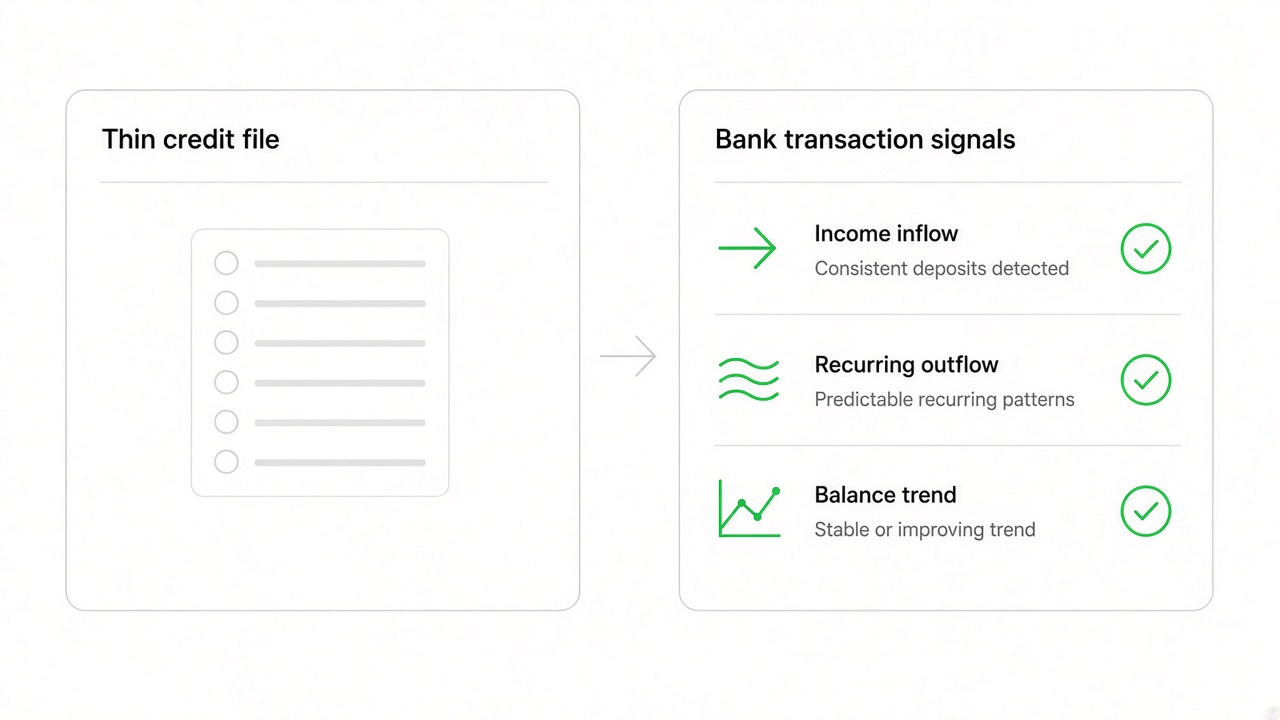
Open banking credit invisible: Serving borrowers with little or no usable credit bureau history by combining consented bank transaction data — income, obligations, and spending patterns — with your credit policy, so approval decisions reflect current affordability instead of an empty or outdated score alone.
Who are credit invisible borrowers and why do teams miss them?
Credit invisible borrowers are people mainstream bureau scores cannot describe reliably — often employed, banked, and able to repay, but declined because the file is thin, stale, or absent. Community lenders and trade press have highlighted the gap: traditional scoring excludes workers with stable jobs when records show no prior loan or a low score driven by historical events rather than present cash flow (Finextra, 5 October 2026). UK-focused lenders such as Salad report serving this segment by decisioning on open banking transaction data instead of bureau-only paths (Salad Money).
Your product team usually encounters credit invisible applicants in:
- First-time borrowers — young adults, new residents, or anyone who pays rent and bills from a current account but never held credit
- Post-crisis rebuilders — one historical default suppresses the score while day-to-day finances recovered
- Gig and multi-income households — payroll plus platform payouts that bureau models under-weight
- Thin-file professionals — NHS, public sector, or cross-border workers with strong inflows but sparse credit history
The business cost of ignoring them is not only lost revenue — it pushes applicants toward high-cost alternatives and increases support load when manual document review becomes your fallback. Open banking does not replace your licence obligations or fraud stack; it gives source-verified cash-flow evidence where the bureau line is blank.
How does open banking underwriting work for credit invisible applicants?
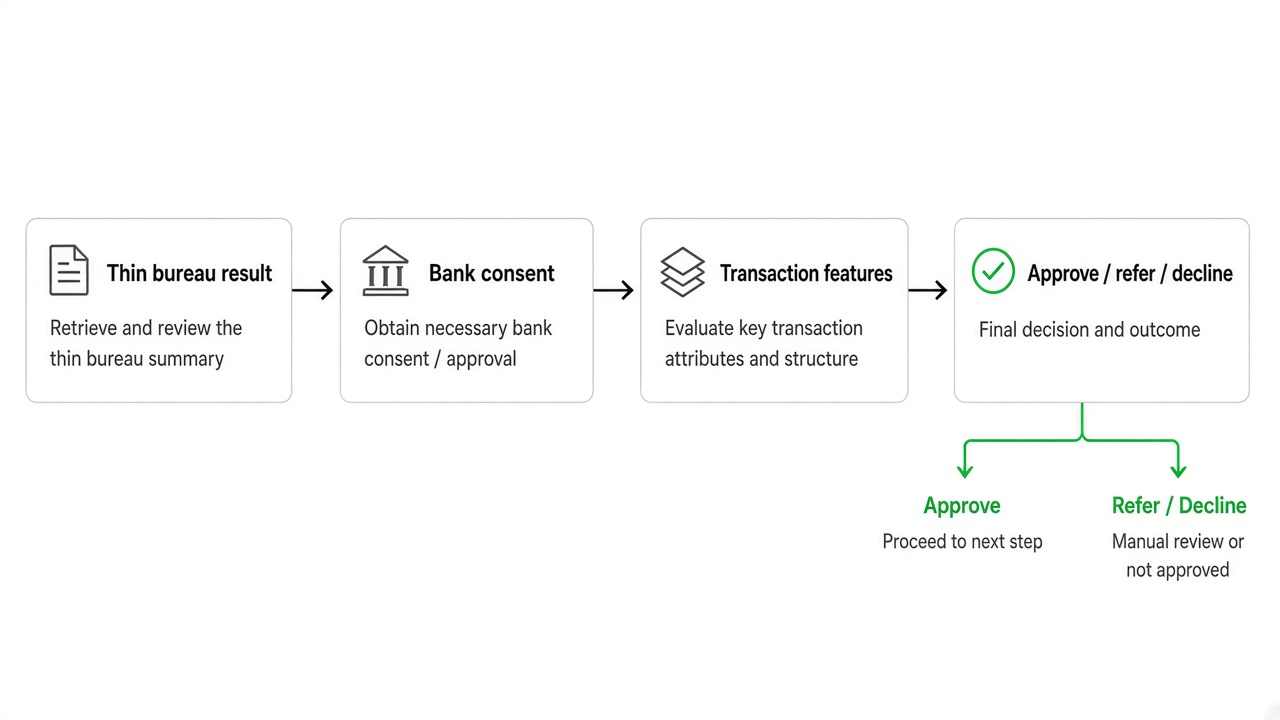
The applicant authenticates in their banking app, consents to a scoped data pull, and your policy scores categorised transactions against your limits — the same rail pattern as income verification open banking and open banking affordability check flows, tuned for thin-file decision rules.
A production path typically runs:
- Segment routing — bureau decline or thin-file flag triggers an open banking path instead of a hard stop
- Bank selection — applicant picks an institution from your provider’s coverage matrix
- Consent and authentication — mobile or web banking approval with strong customer authentication
- Data fetch — accounts and history within the agreed lookback window
- Feature extraction — income stability, recurring obligations, gambling or high-risk merchant patterns, balance volatility
- Policy outcome — approve, refer for manual review, or decline with reason codes your CRM can explain
Engineering effort sits in routing logic and explainability, not in maintaining hundreds of bank APIs — you integrate one licensed open banking provider. For a wider lending stack map, see open banking for lending.
Which transaction signals matter when the credit file is empty?
Teams weight signals that prove sustained capacity to pay — not a single balance snapshot — and that flag first-party abuse before you fund.
| Signal category | What it tells you | Thin-file nuance |
|---|---|---|
| Payroll-like inflows | Employer or regular credits | Confirms employment narrative when bureau is silent |
| Recurring obligations | Rent, loans, BNPL, utilities | Feeds obligation mapping like an affordability check |
| Balance runway | End-of-month lows | Catches overdraft reliance before you add instalments |
| Velocity and mule patterns | Inbound churn, rapid outbound | Early fraud refer even when income looks fine |
| Account tenure | History length | Brand-new account with high limit request → refer |
Salad’s public materials describe analysing open banking transactions for affordability rather than relying on credit reference data alone — an example of cash-flow-first policy for inclusion segments (Salad bond offer release). Your policy should still define minimum data quality: insufficient history, joint accounts you cannot interpret, or cash-heavy lifestyles may require hybrid paths (payslip upload, employer verification, lower initial limit).
Acknowledge trade-offs openly. Open banking sees account activity, not cash under the mattress — and consented data is only as good as the lookback window and categorisation model your provider supplies.
How should fraud and compliance controls differ for credit invisible flows?
Thin-file approval without bureau anchors raises fraud exposure — so step-up verification and account ownership checks run in parallel with cash-flow scoring, not after funding.
Practical controls EU teams deploy:
- Account verification — confirm name and IBAN match before first disbursement; see open banking account verification
- Device and identity continuity — same applicant across bank login and ID check; do not treat AIS alone as full KYC
- Limit staging — smaller initial facility, performance-based increases after successful repayments
- Refer queues — fuzzy income patterns, gambling spikes, or inconsistent employment narrative
- Audit trails — store consent timestamps, raw feature inputs, and model version for committee review
Regulated lending still requires your legal framework — open banking is evidence, not a licence shortcut. Document how transaction-derived features map to your credit policy so regulators and partners can replay decisions.
What should you ask open banking providers before launching thin-file underwriting?
Shortlist providers on coverage for your borrower banks, categorisation quality for payroll and obligations, webhook reliability, and contractual acceptance for lending workflows — not on marketing claims about inclusion alone.
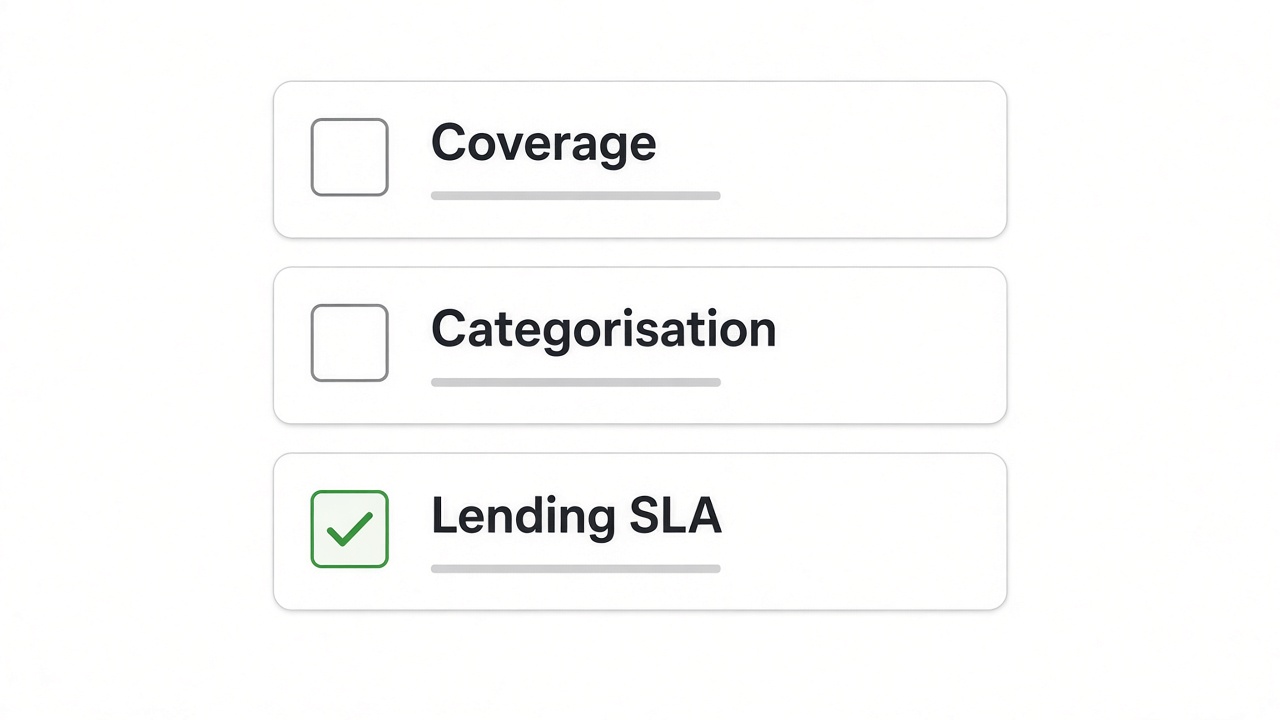
Use this checklist in procurement:
| Dimension | Question to ask |
|---|---|
| Coverage | Which EU/UK banks support AIS for your target segments? |
| Lookback | Maximum transaction history per bank; handling of partial fetches |
| Categorisation | Payroll vs transfer vs P2P accuracy; BNPL and rent detection |
| Decisioning | Raw data only vs packaged affordability features; export to your engine |
| Latency | Time from consent to scored features at p95 |
| Ops | Sandbox parity, status pages, and support SLAs for production incidents |
| Data | EU residency, retention limits, and sub-processor list |
When you need side-by-side capability mapping across vendors, use the provider-matching form on the site — we do not rank a single “winning” API; your borrower geography and policy shape the fit.
Frequently Asked Questions
What does open banking credit invisible mean?
It means using consented bank transaction data to underwrite people whose credit bureau files are missing, thin, or misleading — scoring current income and obligations instead of relying only on a traditional credit score.
How is credit invisible different from a thin credit file?
Credit invisible usually implies no usable bureau record at all; thin file means some history but not enough for mainstream models. Open banking helps both by adding cash-flow evidence, though your policy may treat them as separate segments.
Does open banking replace credit bureaus?
No. Most EU lenders combine bureau data where available with open banking for obligation mapping, income confirmation, or override paths when the bureau declines. Open banking complements — does not automatically replace — identity checks and sanctions screening.
Is open banking credit invisible lending only a UK use case?
The pattern is strongest where open banking adoption and lender innovation are mature — UK community finance is a visible example in 2026 press — but EU PSD2 AIS supports the same cash-flow underwriting model anywhere your provider covers borrower banks. Adapt policy to local consumer credit rules.
How does this relate to an open banking affordability check?
An open banking affordability check focuses on mapping obligations and disposable income. Credit invisible underwriting is the segment and routing strategy that sends thin-file applicants into that style of analysis instead of an automatic bureau decline.
Can open banking reduce bias in lending decisions?
Transaction data can surface ability to pay when historical scores lag real finances — but models can still embed bias if training data or features proxy protected characteristics. Governance, manual review queues, and periodic fairness testing remain your responsibility; open banking is not a fairness guarantee by itself.
How long does a thin-file open banking decision take?
Many flows return categorised features within minutes after bank consent, though bank latency and refer rules add time. Set UX expectations for “instant” vs “review within 24 hours” paths.
Credit invisible segments will keep growing as employment patterns diversify and bureau files lag real finances. Teams that wire open banking credit invisible paths early — with staged limits, verification, and clear refer rules — approve more good borrowers without relaxing fraud standards. When you are ready to compare infrastructure partners for your markets and policy, run through the provider-matching flow with your coverage list in hand.
Related articles
- Open Banking Account Verification: How It Works in 2026
Wrong-IBAN payouts, stalled onboarding, and manual statement reviews drain ops time long before a customer makes their first payment. Open banking account veri…
- Open Banking Merchant Onboarding: Verify Accounts Faster
Every merchant you approve without verifying their payout account is a future support ticket — misdirected transfers, delayed first settlement, and sellers who…
- Verification of Payee Open Banking: Stop Wrong Payouts Before They Leave
Wrong IBANs, invoice fraud, and authorised push payment scams cost finance teams hours of recovery work — and sometimes the money never comes back. Verificatio…