Open Banking Credit Bureau Data: How Lenders Merge Both
Open banking credit bureau planning is what credit, BNPL, and embedded-finance teams do when a bureau score alone misses cash-flow reality — but raw transaction feeds alone miss tradeline history regulators still expect. You need one decision view: tradelines and scores from the credit file, plus consented bank signals for income, obligations, and recent behaviour. In October 2026, Equifax announced expanded consumer-permissioned insights via Mastercard Open Finance so lenders can pair bureau data with open finance feeds through one relationship (Finextra). This guide explains when to merge bureau and bank data, how consent and retention differ, how to design a merge layer, and how to evaluate vendors without assuming one bundled stack fits every product.
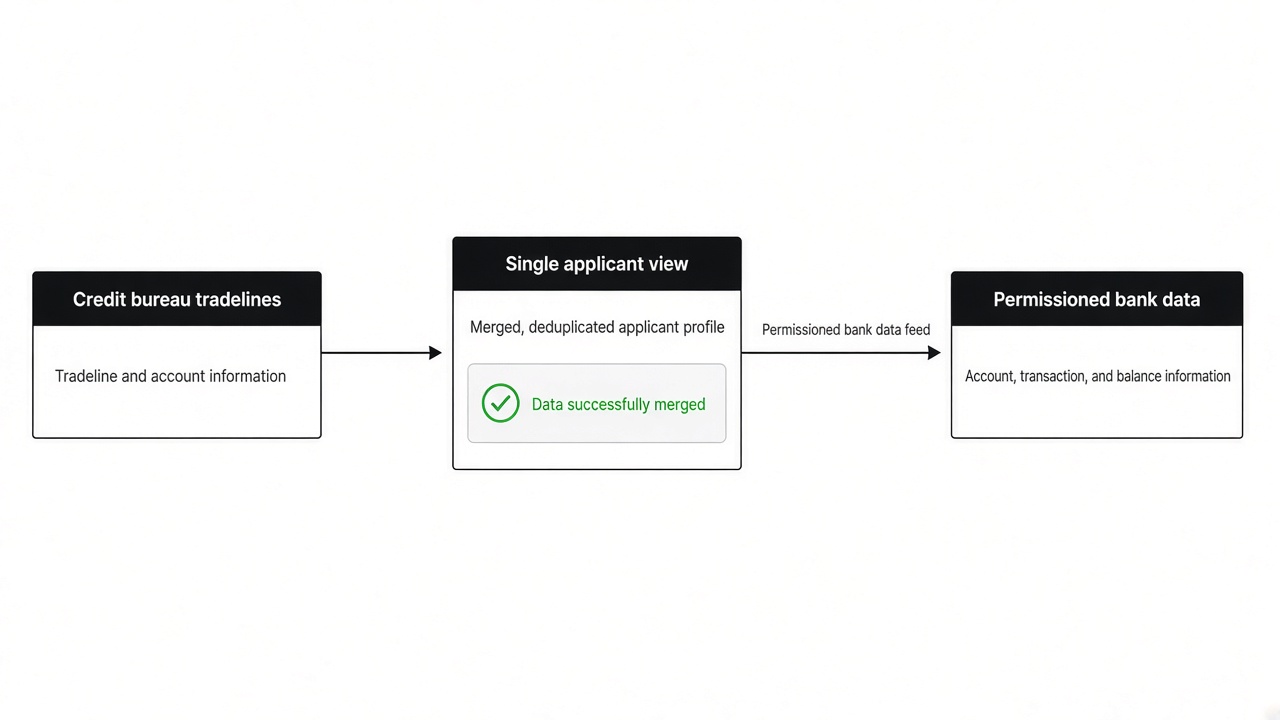
Open banking credit bureau integration: Combining a consumer’s credit bureau file with consented bank transaction and account data in one underwriting or monitoring workflow — so decisions reflect both repayment history on record and verified current cash flow.
When should lenders combine open banking with credit bureau data?
Combine bureau and open banking when your policy needs both repayment history and verified cash flow in the same decision — not when one source alone satisfies the product rules.
Typical cases:
- Near-prime and thin-file routing — bureau decline or low score triggers a bank-data path instead of a hard stop; see open banking credit invisible for segment design
- Affordability and obligation mapping — recurring debits and disposable income after fixed costs; see open banking affordability check
- Income confirmation — payroll-like inflows when payslips are slow or disputed; see income verification with open banking
- SME and micro-business — filed accounts lag; bank behaviour shows trading reality alongside any bureau commercial file
Keep them separate when regulation or product design requires bureau-only paths (some consumer products), or when bank connection rates are too low in your channel without unacceptable manual fallback cost.
| Signal need | Bureau alone | Open banking alone | Combined |
|---|---|---|---|
| Tradeline history | Strong | Weak | Strong |
| Current income | Weak | Strong | Strong |
| Recent obligation changes | Lagging | Strong | Strong |
| Fraud / identity | Strong with bureau tools | Needs step-up verification | Strongest with layered checks |
| Customer friction | Low | Higher (consent + redirect) | Medium — stage the bank step |
How does consent differ between bureau pulls and open banking?
Bureau inquiries and bank data access run on different consent and purpose rules — your UX and audit trail must show both, not one blanket checkbox.
Credit bureau access usually relies on permissible purpose under national credit reporting law and contract with the bureau — often a single click at application with logged purpose codes. Open banking requires explicit customer consent to the account servicing bank (via a licensed provider), scoped to accounts, data categories, and duration, with re-authentication when access expires.
Operational differences that break integrations if ignored:
- Timing — bureau can run at application start; bank connection may happen only after a bureau decline or at a dedicated step
- Retention — bureau tradelines have long reporting horizons; AIS payloads are point-in-time unless you refresh with valid consent
- Revocation — customers can withdraw bank consent mid-journey; bureau data already pulled may still be usable per your bureau agreement — policies must define what happens to in-flight cases
Document two consent artefacts in your case file: bureau pull reference and open banking consent ID with timestamp. That separation matters for audits and for open banking vendor due diligence when you compare data vendors.
What should a merged “applicant financial view” include?
Define one schema before you buy APIs — otherwise analysts merge bureau PDFs and JSON bank feeds in spreadsheets.
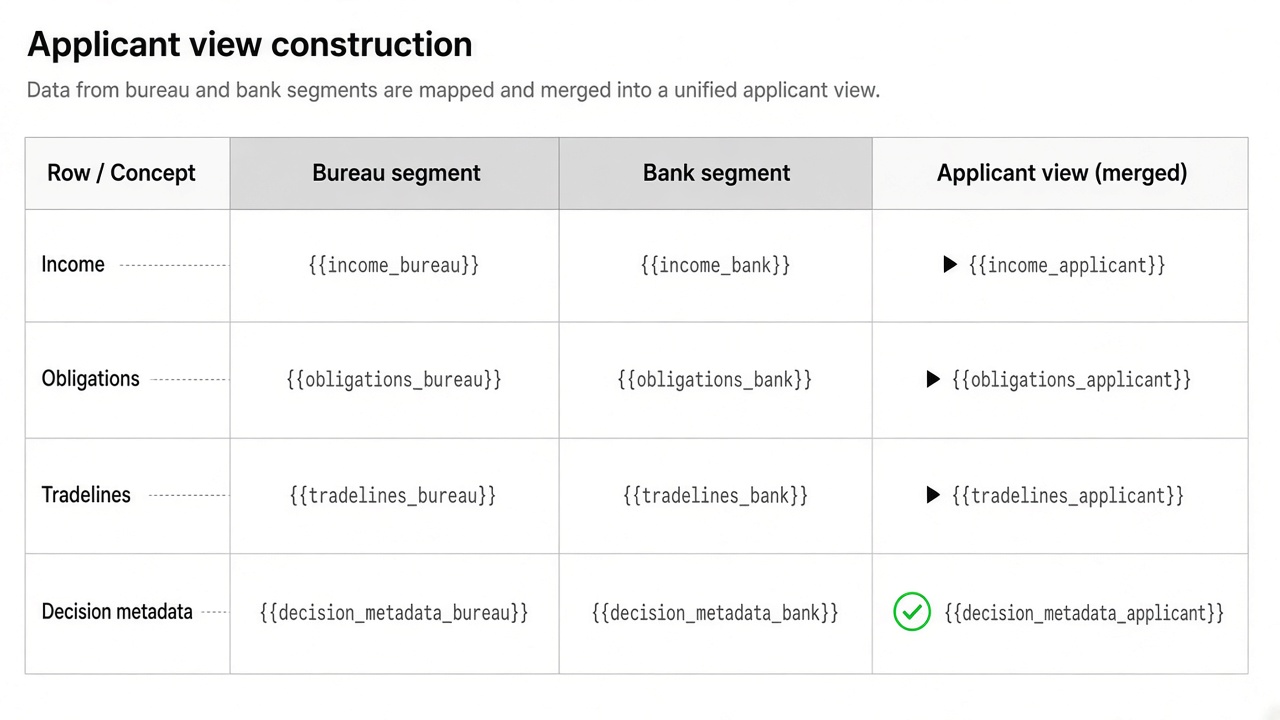
A practical merged view for EU consumer lending:
- Bureau segment — score, reason codes, tradeline summary (secured vs unsecured, delinquencies), inquiry count
- Bank segment — categorised income, fixed obligations, discretionary spend bands, balance trend, gambling or crypto merchant flags per policy
- Derived features — debt-service ratio using bureau minimum payments plus bank-detected subscriptions, net disposable income, income stability index
- Decision metadata — which path ran (bureau-only, bank-only, hybrid), consent IDs, model version
Partnership announcements such as Equifax plus Mastercard Open Finance aim to deliver permissioned bank insights alongside the bureau file so lenders need fewer manual stitches (Finextra). Whether you buy that bundle or integrate a TSP and bureau separately, the engineering outcome is identical: one timeline in your rules engine, not three tabs in ops.
Cross-border programmes add a corridor dimension — merge logic must tag which country’s bureau file pairs with which bank consent. See cross border open banking integration when applicants bank in one member state and bureau history sits in another.
How do you evaluate vendors for bureau plus open banking?
Score vendors on merge readiness and evidence, not slide-deck “partnerships”. Split the market into three roles you may buy separately or as a bundle:
| Role | What they deliver | What to test |
|---|---|---|
| Credit bureau | Tradelines, scores, attributes | Hit rate on your population, reason-code coverage, latency |
| Open banking / AIS TSP | Consent UI, account coverage, categorisation | Mandatory bank list in sandbox, refresh behaviour, webhook completeness |
| Merge / decision hub | Normalised applicant view, feature store | Schema docs, replay of sample cases, audit export |
Run the same two-week shortlist discipline as open banking aggregator comparison 2026: freeze mandatory banks, replay ten anonymised decline cases, and measure how often enriched bank data changes the decision versus bureau-only.
Questions procurement should get in writing:
- Who is controller for bank data vs bureau data in the subprocessors list?
- Can you export merged features if you switch TSP or bureau in year two?
- How are failed bank connections priced vs successful pulls?
- Does categorisation match your affordability rules out of the box or require a data science project?
If two stacks pass technical gates, use the provider-matching form to stress-test fit against your countries, products, and connection rates before you lock a multi-year data contract.
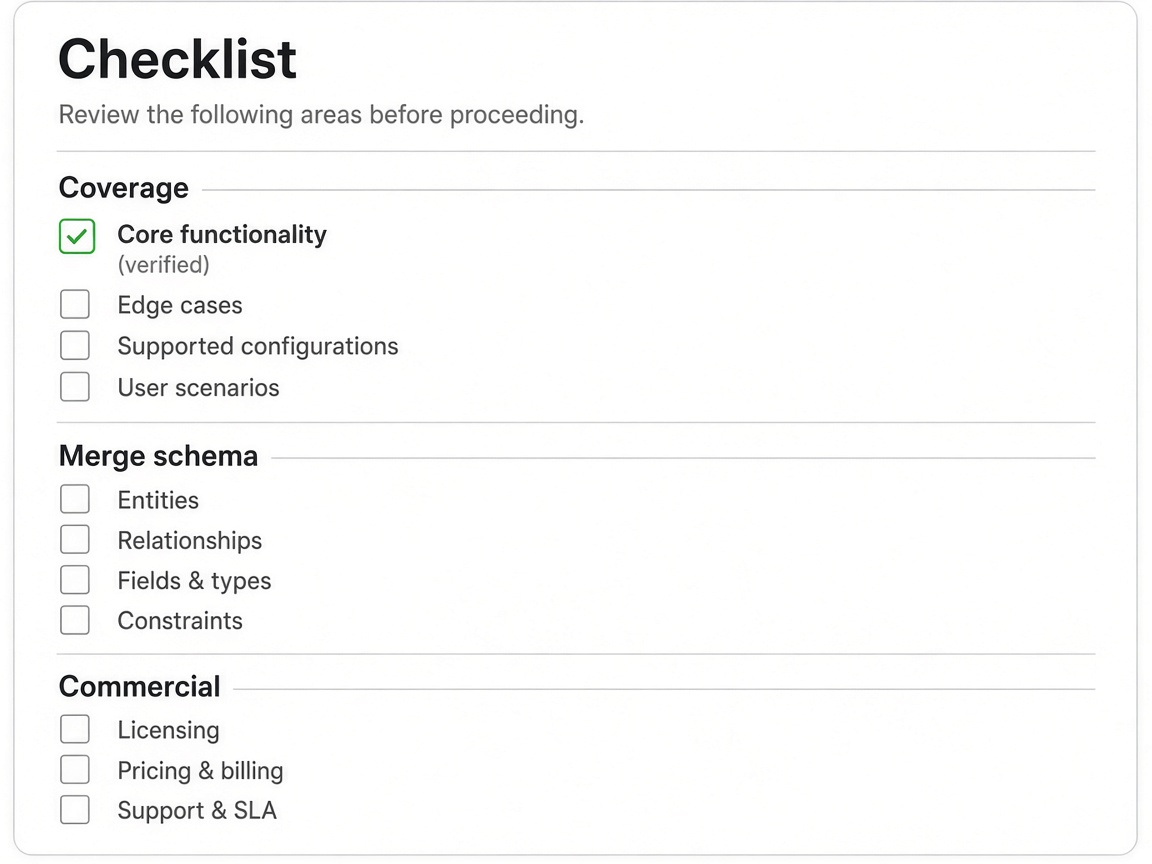
Bundled bureau-plus-open-finance offers reduce integration time when their schema matches your models. Separate TSP plus bureau contracts preserve negotiating leverage and let you swap one rail without re-platforming the other — the trade-off is engineering ownership of the merge layer, similar to themes in build vs buy open banking.
Frequently Asked Questions
What is open banking credit bureau integration?
It means using consented bank transaction and account data together with a traditional credit bureau file in the same lending or BNPL decision — so underwriters see both recorded repayment history and verified current cash flow instead of relying on either source alone.
Does open banking replace credit bureau checks?
No for most regulated consumer credit in the EU. Bureau data remains central to many products; open banking augments with income, obligations, and behaviour signals bureaus do not see in real time. Product rules and national law define when each source is required.
How is this different from open banking for credit invisible borrowers?
Credit invisible routing is a segment strategy for thin or missing bureau files. Open banking credit bureau integration is the data architecture question — how to merge bureau and bank feeds for any segment, including prime files that still benefit from cash-flow verification.
Why did Equifax and Mastercard Open Finance matter for buyers?
The October 2026 announcement signals that major bureau and open finance networks expect lenders to consume permissioned bank insights alongside traditional files — pushing procurement teams to compare bundled vs separate vendors on merge quality, not just headline partnerships (Finextra).
Can one open banking provider supply bureau data?
Open banking TSPs focus on bank connections; bureaus focus on tradelines. Some partnerships or resellers package both, but roles and contracts stay distinct. Validate who holds consent, who is liable for data quality, and whether your licence covers each use.
What should we test in sandbox before go-live?
Replay real decline reasons from production: run bureau-only, then add bank data for the same synthetic profiles on your mandatory bank list. Confirm categorisation changes features your rules engine reads, consent expiry behaves as expected, and merged exports match your audit template.
Conclusion
Open banking credit bureau integration is a buyer decision about architecture and vendors, not a single API feature. Bureau files answer “what happened on record”; permissioned bank data answers “what is happening in the account now”. Equifax’s expanded Mastercard Open Finance path is one signal that bundled delivery is maturing — yet separate TSP and bureau contracts still win when you need swap-out rights or custom merge logic. Define your applicant financial view schema first, stage consent steps honestly, and test mandatory banks before you sign. When finalists look equivalent on paper, compare them against your real decline cases and connection rates — the same evidence standard you would use for any open banking for lending rollout.
Related articles
- Open Banking Vendor Due Diligence: What to Verify Before You Sign
Open banking vendor due diligence is the evidence pass you run after a promising demo and before legal sends the MSA. It turns marketing claims into test resul…
- Mollie GoCardless Acquisition: What Pay by Bank Buyers Should Do Now
If you run recurring billing, invoice collection, or checkout on GoCardless or Mollie, the Mollie GoCardless acquisition completed on 1 September 2026 changes…
- Open Banking Multiple Providers: Dual-TSP Setup Guide
Open banking multiple providers is how platform and payments teams keep checkout and verification live when one aggregator hits a bank outage, a country gap, o…