Open Banking mTLS Certificates: EU Production Readiness
Pay-by-bank launches stall when production API calls fail with TLS or certificate errors that never appeared in demo sandboxes. Open banking mTLS certificates are the mutual-authentication credentials that prove your software (or your provider on your behalf) is allowed to call regulated bank APIs — and they expire, rotate, and must match between outbound calls and inbound webhooks. This guide helps EU B2B engineering and payments leads choose the right certificate path, build rotation runbooks, and shortlist providers without treating security setup as a launch-week surprise.
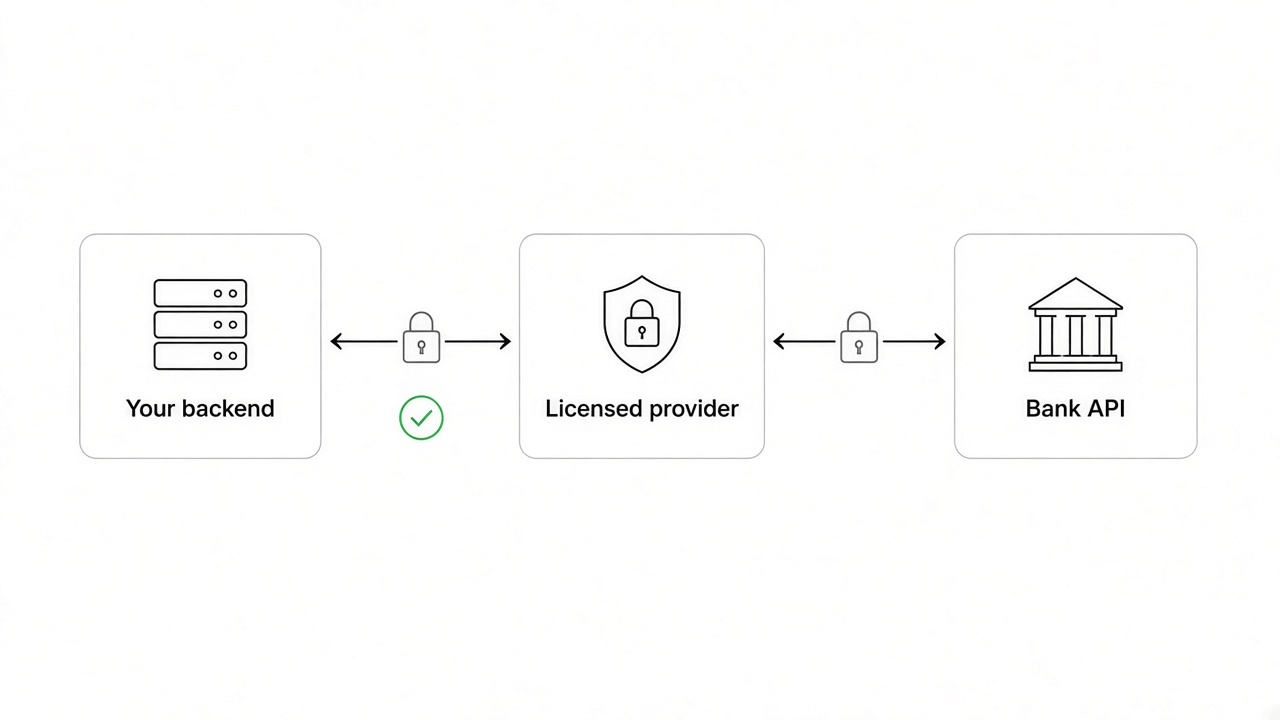
Open banking mTLS certificates: Qualified website authentication certificates (QWACs) and related eIDAS credentials used for mutual TLS between a licensed third-party provider (TPP) and bank APIs — proving both sides of the connection are who they claim to be. Merchants integrating through a hosted provider often skip holding their own QWAC; regulated TPPs and some enterprise stacks manage certificate lifecycle in-house.
Why do open banking mTLS certificates block go-live?
Certificate misconfiguration stops money moving before UX or conversion ever gets tested. Banks and schemes require mutual TLS on production PSD2 interfaces so only licensed, identifiable software can initiate payments or pull account data. When a QWAC expires, points at the wrong environment, or is missing from a webhook endpoint, calls fail with errors that look like "integration bugs" but are purely trust-chain failures.
For payments leads, the business impact is familiar: checkout stuck in pending, verification jobs never complete, recurring collections silently fail. Engineering sees HTTP 401/403 or TLS handshake failures in logs. Finance sees unmatched bank statements because initiation never settled. Industry maintenance of UK standards — including ongoing Open Banking Limited specification releases — keeps security expectations visible; EU teams face the same discipline through national supervisors and the European Banking Authority's payment services framework.
Certificate work belongs in the integration critical path, parallel with webhooks and reconciliation — not as a post-launch ticket. Parent playbook: open banking API integration; this article stays on trust material lifecycle.
When do you need your own QWAC versus a hosted provider?
Most B2B products integrate through a licensed provider and never install a QWAC in their own data centres. The provider terminates mTLS to banks using its regulatory permissions and passes you API keys or OAuth client credentials scoped to your application.
| Path | Who holds mTLS certs | Typical buyer |
|---|---|---|
| Hosted / Connect model | Provider | SaaS, marketplaces, merchants, most fintechs without PI licence |
| Direct TPP / PI | Your entity (or infrastructure partner) | Licensed payment institutions, banks, large orchestration layers |
| Hybrid | Provider + your apps for specific bank links | Enterprise failover across two regulated entities |
If you are still deciding whether to become a regulated TPP, read build vs buy open banking before budgeting certificate operations. Holding your own QWAC adds procurement lead time (qualified trust service providers), HSM or secure storage decisions, and on-call rotation when certificates approach expiry — often weeks, not days.
Unregulated teams should confirm contractually that production traffic rides on the provider's licence, not a sandbox-only arrangement. Developer-oriented comparisons in best open banking API providers for developers (2026) list onboarding friction including certificate setup — use that for shortlisting, not as a substitute for your own expiry calendar.
How should you separate sandbox and production certificate material?
Never promote the same trust stores or keystore files from sandbox to production without a documented promotion checklist. Sandboxes often accept test QWACs, relaxed trust anchors, or provider-supplied dummy credentials. Production ASPSPs enforce qualified certificate chains and stricter cipher policies.
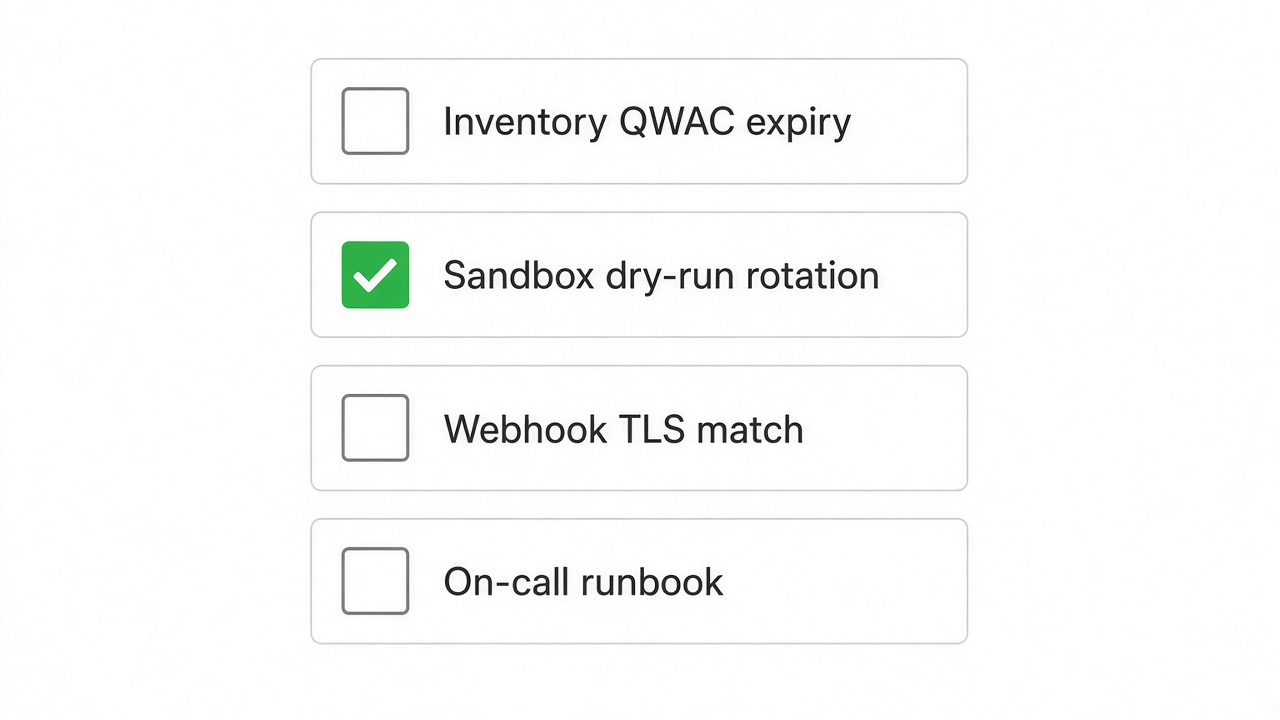
Run these gates before flipping a market live:
- Distinct client IDs and redirect URIs per environment — reduces risk of sandbox callbacks hitting production ledgers
- Separate webhook URLs and TLS certificates on inbound endpoints; load balancers must present valid chains for provider verification callbacks
- Inventory document listing QWAC serial, expiry, responsible team, and renewal ticket owner — stored where security and payments both have read access
- Dry-run rotation in sandbox thirty days before production expiry — not on expiry morning
When sandbox omits mTLS entirely (API-key-only test beds), treat successful sandbox tests as functional only; schedule a production certification window with the provider where real trust material is exercised.
What rotation and expiry runbooks do payments and engineering need?
Certificate expiry is a predictable incident unless someone owns a calendar. Qualified certificates typically run one to two years. Renewal is not always automatic: trust service provider validation, organisational details, and secure key generation can slip schedules.
Minimum runbook sections:
| Section | Owner | Content |
|---|---|---|
| Detection | Engineering | Monitoring on cert expiry (load balancer, app keystore, outbound HTTP client) with 60/30/7-day alerts |
| Renewal | Security / Eng | TSP order, new CSR, HSM import, provider registration of new public material |
| Cutover | Eng + Provider | Maintenance window, dual-cert overlap if supported, rollback if error rate spikes |
| Verification | Payments | Smoke test: create payment, receive webhook, reconcile one live €/£ transaction |
| Communication | Support | Status page macro if bank-side trust store lags your rotation |
Align webhook certificate handling with open banking webhooks: inbound TLS and signature verification are different controls — both must pass in production. During vendor review, attach redacted expiry evidence in open banking vendor due diligence packs so procurement sees operational maturity, not only ISO PDFs.
How do mTLS certificates interact with webhooks and redirects?
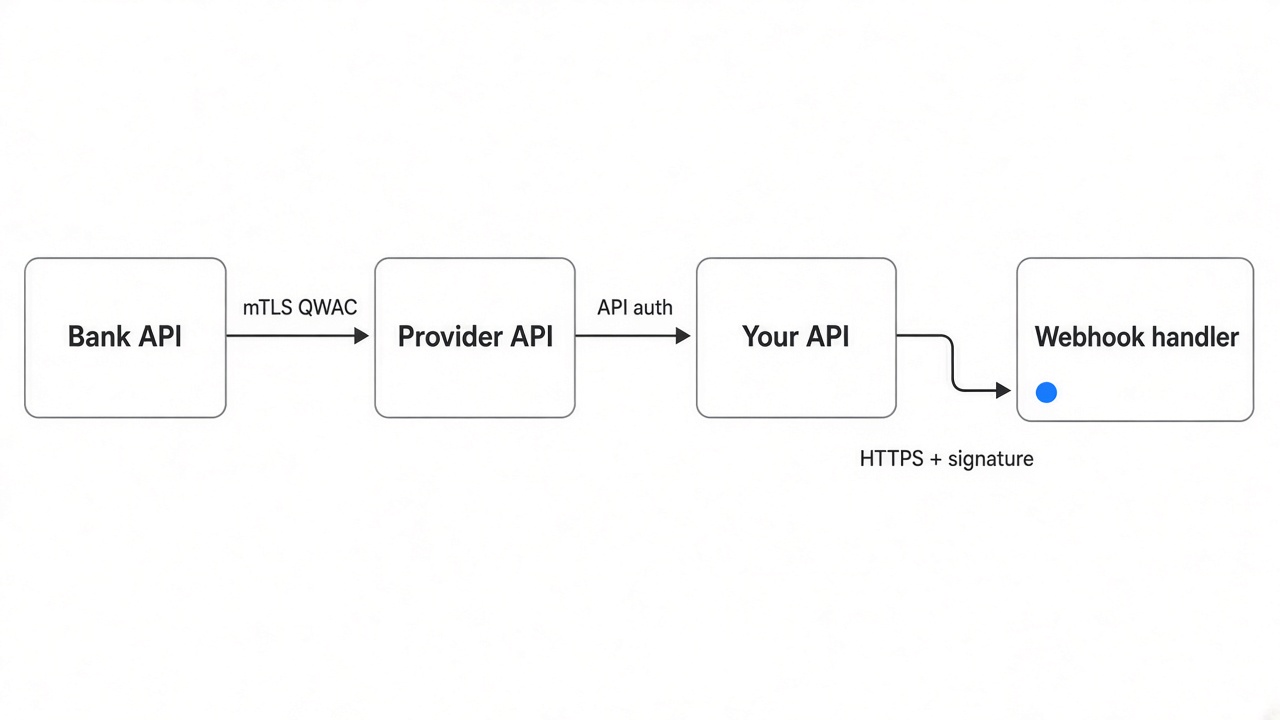
Outbound mTLS authenticates your provider to the bank; inbound HTTPS authenticates webhooks to your servers. Customers still complete authorisation in banking apps via redirects or embedded flows — certificate errors there usually surface as "cannot connect" messages unrelated to your checkout copy.
Production checklist:
- Outbound: Provider (or your TPP) presents valid QWAC on payment and data API calls
- Inbound: Your webhook endpoint uses publicly trusted TLS on a stable URL; some providers additionally pin certificates or require mTLS on callbacks — confirm in integration docs
- Idempotency and trust: Certificate rotation must not reset webhook signing secrets without coordinated key roll
Redirect UX issues from open banking redirect vs embedded are separate from mTLS, but teams often debug them in the same sprint. Split responsibilities in status meetings so TLS cutovers do not collide with marketing-led checkout experiments.
How do you compare providers on certificate and security onboarding?
Ask finalists how many days production certificate registration takes and who owns failure support. Useful questions for engineering and payments:
- Can unregulated merchants go live without ordering their own QWAC?
- Where are trust materials stored — provider cloud, your VPC, or hybrid HSM?
- Is sandbox mTLS representative of production cipher and chain requirements?
- What is the published process when a major ASPSP updates root CAs?
- Do webhook and API environments rotate independently?
When markets and use cases are documented, use the provider-matching form to filter coverage and integration depth — then score certificate operational fit in technical review. We do not label one vendor as the default for every stack.
Frequently Asked Questions
What are open banking mTLS certificates?
Open banking mTLS certificates are qualified trust credentials — typically QWACs under the EU eIDAS framework — used in mutual TLS between licensed providers and bank APIs. They prove the calling software is an authorised participant before payments or account data requests are processed.
Do merchants need their own QWAC to accept pay by bank?
Usually no. Most merchants integrate through a licensed provider that holds regulatory permissions and manages bank-side mTLS. You secure your own application with API credentials, webhook verification, and standard HTTPS — not a personal QWAC — unless you operate as a licensed TPP yourself.
What happens when an open banking certificate expires?
Bank API calls and sometimes provider-to-bank routes fail TLS handshake or return authorisation errors until a valid replacement certificate is registered. Payments already authorised may still complete, but new initiations and data pulls stop until trust material is restored — which is why expiry monitoring belongs on the same dashboard as payment success rate.
How is mTLS different from webhook API keys?
mTLS establishes transport-layer identity between regulated infrastructure endpoints. Webhook API keys or signatures prove a specific HTTP payload came from your provider. Production stacks need both where applicable: valid TLS on the channel and verified signatures on the payload.
What is the difference between QWAC and QSeal?
QWAC (qualified website authentication certificate) is commonly used for TLS identification in open banking API traffic. QSeal (qualified electronic seal certificate) can sign payloads or assertions depending on scheme rules. Your provider documentation states which credentials they manage for PSD2 interfaces versus application-level signing — ask rather than assume.
How long does certificate onboarding take with a new provider?
Sandboxes can open in hours with test credentials; production QWAC registration and ASPSP trust-store updates often take days to weeks depending on your licence status, TSP queue, and how many banks you must register with. Plan certificate lead time in the same Gantt row as reconciliation design, not only front-end checkout work.
Where do UK open banking standards fit?
The UK ecosystem maintains industry-led API standards through Open Banking Limited, including security expectations that interact with how providers manage transport and identity in practice. EU PSD2 corridors use eIDAS-qualified material through national implementations. Multi-market products should track per-environment certificate inventory, not a single global file.
Certificate-ready integrations keep pay-by-bank and verification flows alive after the first successful demo. Inventory expiry dates, separate sandbox and production trust material, run rotation drills before deadlines, and align webhook TLS with outbound mTLS policies. Compare providers on onboarding realism — then match markets and use cases through structured evaluation when requirements are clear.
Related articles
- Open Banking Webhooks: Verification, Idempotency, and Ops
Checkout teams that rely on browser redirects alone still ship orders late, double-fulfil when customers refresh, and argue with finance about which payments a…
- Cross Border Open Banking Integration: EU Multi-Country Data Playbook
Cross border open banking integration is how EU lenders, BNPL operators, and credit platforms pull consented bank data from more than one country without rebui…
- Open Banking Redirect vs Embedded: Which Flow Fits Your Product?
Open banking redirect vs embedded is the first UX decision most EU B2B teams face when they add pay by bank — and it shapes conversion, engineering scope, and…