Open Banking in Italy: Coverage and Provider Fit
Italy is where many EU payment roadmaps add Southern Europe — large retail banks, strong mobile banking, and heavy use of bank transfers for B2B invoices — yet open banking Italy on a provider slide rarely matches what your customers experience in production. Coverage gaps, corporate account quirks, and local scheme habits all show up in conversion and reconciliation metrics, not in marketing maps. This guide explains what Italian open banking delivers for B2B teams, how it relates to Bancomat and wider European scheme consolidation, and which provider evaluation questions matter before you commit budget.
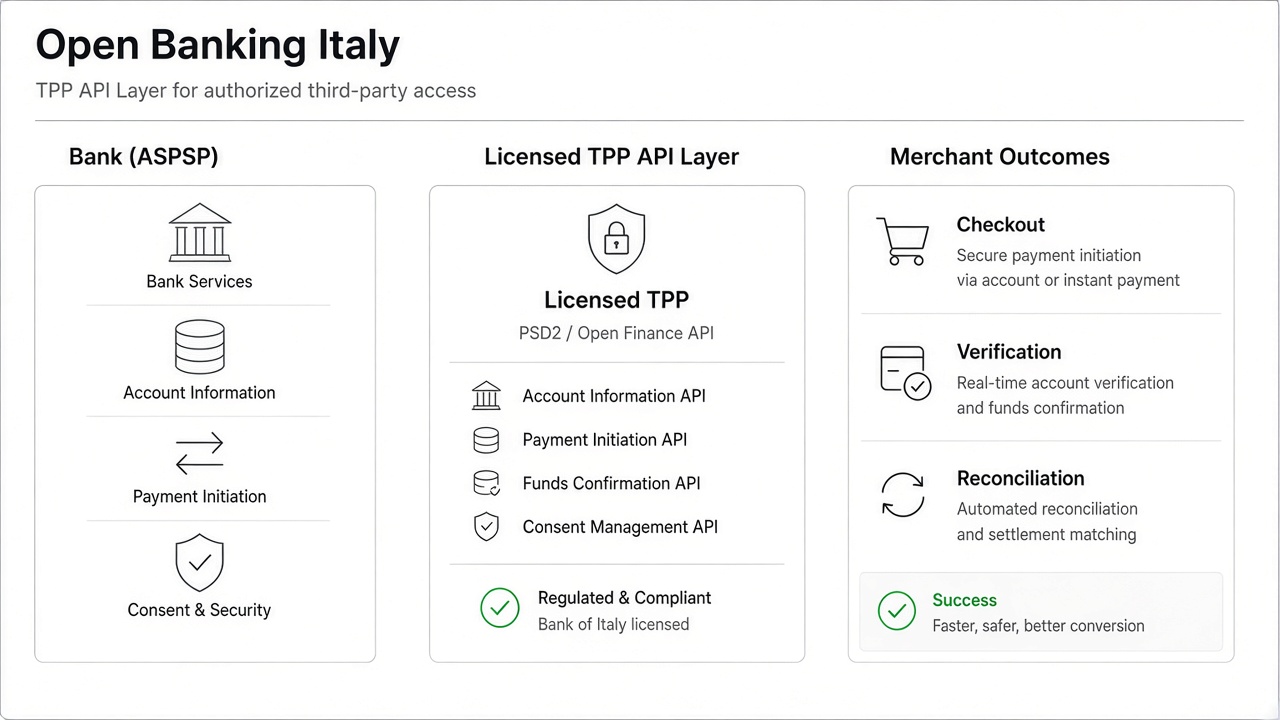
Open banking in Italy: Connecting to Italian banks through regulated EU payment APIs so your business can verify accounts, initiate customer payments, read consented transaction data, and reconcile cash — with customers approving access in their banking app.
For pay-by-bank investment context after TrueLayer’s October 2026 Milan expansion, see TrueLayer Pay by Bank funding guide. For Bancomat inside the new European Network for Payments hub, read European Network for Payments explained.
Why Italy is a priority market — and a distinct one
Italian buyers and businesses already settle invoices, rent, and supplier payments by bank transfer. Open banking productises that behaviour: instant confirmation at checkout, verified IBANs at onboarding, and structured feeds for finance instead of PDF uploads.
What makes Italy distinct for integrators:
- Concentrated retail banking — Intesa Sanpaolo, UniCredit, BNL, Banco BPM, Fineco, and digital banks such as Hype drive most consumer volume; winning them matters more than long-tail checkboxes
- Strong mobile banking — authentication often completes in the banking app, which helps Pay by Bank UX when flows are mobile-first
- B2B bonifico culture — business accounts and structured payment references differ from consumer salary accounts; verify corporate coverage explicitly
- Bancomat as local scheme context — Italy’s domestic ATM and mobile payment habits sit alongside PSD2 APIs; ENP ties Bancomat into cross-border European wallet ambitions without replacing merchant API integration today
- SEPA Instant growth — instant settlement helps marketplace payouts and treasury when bank pairs support it, but participation still varies by institution
Italy-strong is not EU-strong. Treat France, Germany, or Spain as separate acceptance tests even if your contract says “Europe.” Cross-read open banking France, open banking Germany, and open banking Spain when planning multi-market rollouts.
Open banking vs Bancomat — what B2B teams need to know
Open banking pay by bank uses PSD2 APIs through licensed providers; Bancomat is Italy’s domestic payments brand and an ENP founder — related consumer rails, different merchant integration paths.
The European Payments Initiative launched the European Network for Payments in September 2026 with Bancomat among the founding schemes. That structure aims to route cross-border wallet traffic between national schemes over time. For B2B product and payments leads today, the practical split is:
| Dimension | PSD2 open banking (Pay by Bank) | Bancomat / scheme wallets |
|---|---|---|
| Integration | Licensed TPP API — you control checkout UX and reconciliation | Scheme or bank-app flows — often consumer-facing, less merchant API control |
| Use cases | Checkout, verification, lending data, B2B invoice collection | Domestic mobile and ATM habits, future ENP cross-border wallet traffic |
| Coverage test | Named Italian ASPSPs via provider sandbox | Whether your customers expect local wallet brands vs generic bank redirect |
| Reconciliation | Webhooks and references you design | Scheme-specific settlement reporting as features roll out |
Most EU platforms serving Italy run dual awareness: merchant-initiated open banking for controlled checkout and verification, plus a roadmap view on ENP/Bancomat where consumer habits demand it. Do not assume one press release replaces PSD2 sandbox work on your bank list.
What Italian open banking is used for in B2B
Teams operating in Italy typically prioritise these outcomes:
| Use case | Business outcome |
|---|---|
| Pay by Bank checkout | Lower cost per payment and immediate confirmation on eligible flows |
| Account verification | Fewer wrong-IBAN payouts and onboarding fraud |
| Invoice and B2B collection | Match incoming bonifici to invoice IDs faster |
| Lending and onboarding | Bank-verified income and affordability — see open banking for lending |
| Marketplace payouts | Seller disbursement over SEPA with verified accounts |
| Recurring collection | First payment via bank app, renewals via SEPA Direct Debit where supported |
Retail-framed guides like open banking for e-commerce and pay by bank apply rail mechanics; Italian B2B teams add codice fiscale/partita IVA checks, ERP reconciliation, and corporate payer workflows on top.
Coverage: how to read provider claims honestly
Marketing materials cite thousands of banks across Europe. For Italy, ask narrower questions:
- Which Italian institutions cover >80% of your user base? — list Intesa Sanpaolo, UniCredit, BNL, Banco BPM, Fineco, and the neobanks your data shows, not percentage alone
- Retail vs business accounts — does verification and payment initiation work on the conto types you onboard?
- Redirect vs embedded UX — what does the customer see on mobile for each major bank?
- Downtime history — incident transparency for the groups you actually see in production data
- Instant vs standard SEPA — when SCT Inst fails, what fallback timing do you communicate to treasury?
Run sandbox tests with real internal accounts at your top ten customer or borrower banks before shortlisting vendors. A provider optimised for UK open banking will not automatically feel native in Italy.
Regulatory context in plain terms
Italian open banking sits on EU payment rules implemented nationally — customers must consent, strong authentication applies for access and payments, and regulated providers hold the licences to call bank APIs on your behalf. The European Banking Authority sets the EU-wide payment-services framework; Banca d’Italia supervises payment institutions and financial stability in Italy.
For B2B buyers this means:
- You usually integrate a licensed partner rather than becoming a payment institution on day one
- Purpose and consent copy must match what you do (checkout vs lending vs verification)
- Data residency expectations are stricter in enterprise procurement — confirm EU hosting and subprocessors
This is context for procurement, not a substitute for legal review.
Provider evaluation questions for the Italian market
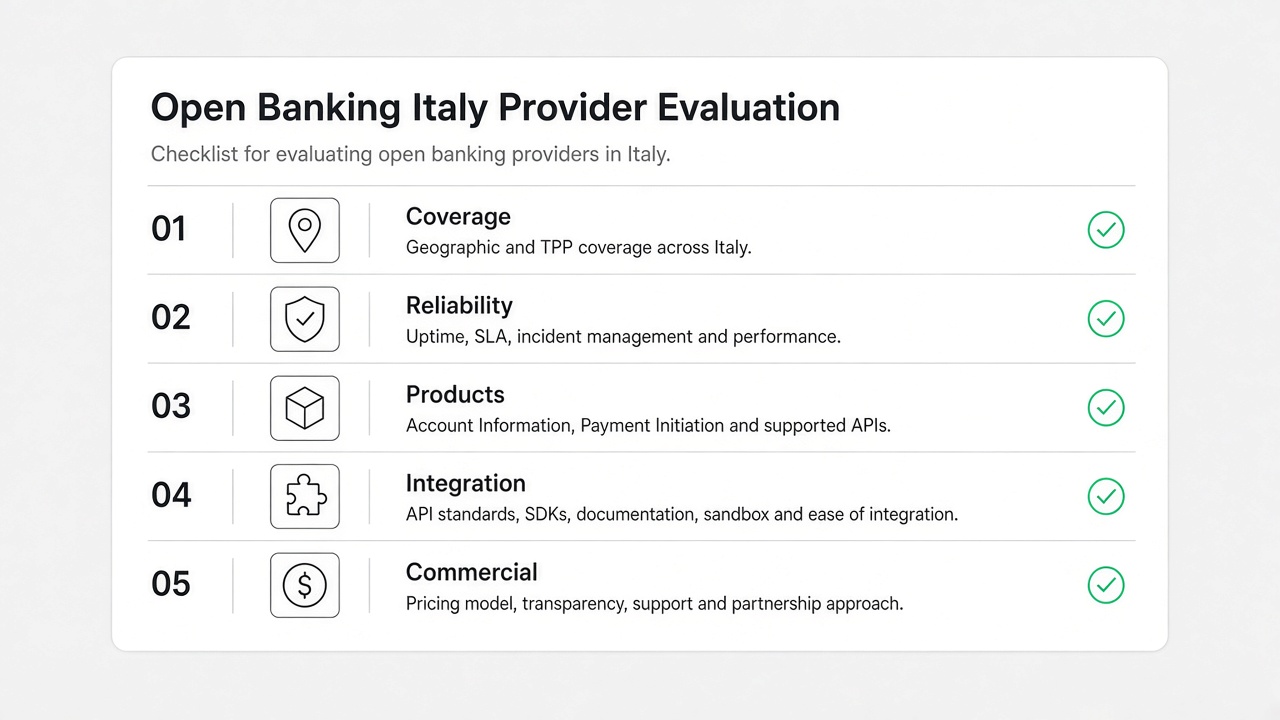
Use this checklist in RFPs and technical diligence — score answers with evidence, not slides. If you need a structured shortlist across markets, use our provider matching form to compare coverage for your bank list and use case.
Coverage and reliability
- Name the top 15 Italian ASPSPs you support in production, with go-live dates
- What is your measured success rate for payment initiation on those banks (last 90 days)?
- How do you handle bank maintenance windows and degraded modes?
Products your roadmap needs
- Pay by Bank: mobile deep links, QR, desktop redirect behaviour per major bank
- Account verification: name–IBAN match rates on retail and business accounts
- AIS depth: transaction history length, categorisation for lending or reconciliation
- Payouts: outbound SEPA and Instant coverage for marketplace or lender disbursement
- Recurring: SEPA Direct Debit mandate support after first authenticated payment
Integration and ops
- Sandbox parity — do Italian banks in sandbox match production behaviour?
- Webhook delivery guarantees, retries, and signing for finance automation
- Reference field rules compatible with Italian invoice numbers and ERP imports
- Support SLAs in CET business hours for production incidents
Commercial and risk
- Pricing model for successful vs failed initiation attempts
- EU data residency, ISO 27001 / SOC 2, and subprocessors list
- Sector acceptance: marketplaces, lenders, insurers, SaaS — named in contract
- Exit terms and portability if you change provider after go-live
No single vendor fits every Italian use case; matching depends on whether you optimise checkout conversion, lending data depth, or B2B payout reliability. See how to choose an open banking provider for a cross-market framework.
Common Italian deployment patterns
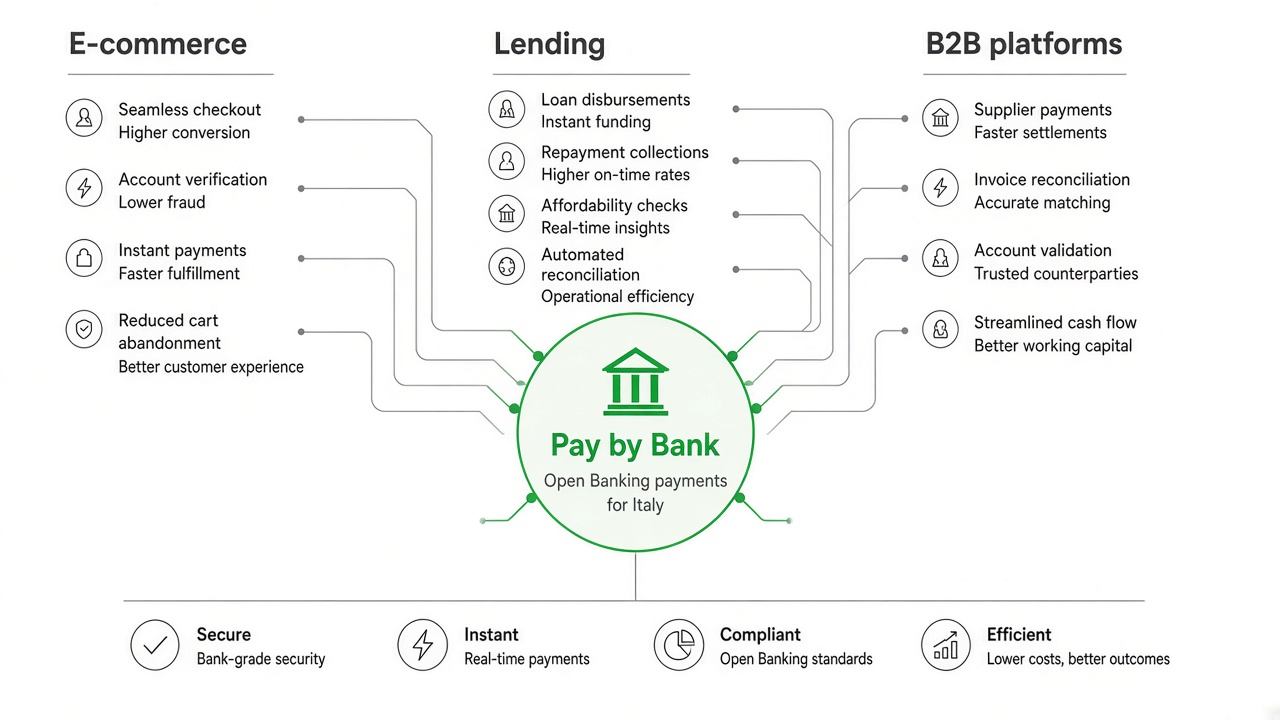
E-commerce and marketplaces — Pilot Pay by Bank on high-AOV IT baskets with card fallback; add seller verification before scaling weekly payouts. Cross-read open banking for marketplaces.
SaaS and B2B platforms — Verify the conto on annual invoice setup; collect first payment via bank app; move renewals to direct debit where mandates are supported. See open banking for SaaS platforms.
Lenders — Income verification on supported banks first; expand affordability and collections once consent renewal is automated. See income verification open banking.
Multi-market EU expansion — If Italy follows France or Germany in your rollout, treat each country as a separate acceptance test. Open banking UK vs EU explains why UK and EU stacks diverge post-Brexit.
Frequently Asked Questions
What is open banking in Italy?
Open banking in Italy is regulated API access to Italian bank accounts so businesses can verify accounts, initiate customer payments, and read consented transaction data — with customers approving in their banking app, usually via a licensed provider that connects to major Italian ASPSPs.
Is open banking widely used in Italy?
Adoption is growing for Pay by Bank and account verification, but cards and long-standing bonifico habits still shape many payment flows. Pilot on your customer bank mix rather than assuming Italy behaves like the Netherlands or the UK.
What is the difference between open banking and Bancomat in Italy?
Open banking uses PSD2 APIs through licensed providers for merchant-controlled checkout, verification, and data access. Bancomat is Italy’s domestic payments brand and an ENP founder scheme — strong for local mobile and ATM habits and future cross-border wallet routing, but not a drop-in replacement for merchant API integration today.
Do I need an Italian licence to use open banking?
Most non-bank businesses integrate a licensed open banking provider that holds the required EU authorisations. Your legal team confirms whether your specific model needs additional licensing beyond that partnership.
How is Italian open banking different from France or Germany?
All three operate under EU payment rules, but Italy combines concentrated banking groups, heavy B2B bank transfers, and Bancomat/ENP scheme dynamics — different from France’s caisse networks or Germany’s Sparkassen invoice culture. Test each market independently.
Which Italian banks matter most for coverage?
Depends on your segment — consumer lenders care about retail neobanks and major high-street groups; B2B invoice platforms care about professional account support. List the banks your users actually hold and test those in sandbox, prioritising Intesa Sanpaolo, UniCredit, and BNL unless your data says otherwise.
Can open banking replace cards in Italy?
For many flows it supplements rather than replaces cards — especially where customers expect card habits or international buyers use non-Italian banks. Most teams run dual rails with data-driven routing.
How do I evaluate open banking providers for Italy?
Demand named bank coverage, sandbox proof on your top institutions, success-rate data, business-account support, Instant payout honesty, EU hosting, and sector fit in contract. Weight criteria by your primary use case — checkout vs lending vs payouts.
Closing thought
Open banking Italy rewards specificity: name the banks your customers use, understand Bancomat and ENP as parallel consumer context, and separate marketing coverage from production success rates. Once Italian flows work, expand to the next EU country with the same discipline — not the assumption that one “EU” integration behaves identically everywhere.
Related articles
- European Network for Payments: What ENP Means for Merchants
Cross-border checkout still fragments when every country ships its own bank-app wallet — Spanish shoppers live in Bizum, Nordics in Vipps MobilePay, and Wero k…
- Open Banking in Spain: Coverage and Provider Fit
Spain combines one of Europe's strongest account-to-account payment cultures with an open banking stack that looks nothing like the UK's single-standard model.…
- Open Banking in France: Coverage and Provider Fit
France sits on many EU payment roadmaps — large banked population, strong mobile banking apps, and heavy B2B invoice volume — yet open banking France on a prov…