European Network for Payments: What ENP Means for Merchants
Cross-border checkout still fragments when every country ships its own bank-app wallet — Spanish shoppers live in Bizum, Nordics in Vipps MobilePay, and Wero keeps expanding bill pay and in-store use cases. The European Network for Payments (ENP) is the new joint company five of those schemes formed to connect their rails through one Madrid-based interoperability hub, starting with person-to-person transfers and later adding e-commerce and point-of-sale. If you sell across EU markets, ENP matters because it signals where account-to-account volume may consolidate — even while each brand keeps its local UX. This guide explains what ENP is, who founded it, how rollout phases affect merchants, and what to validate with your pay by bank or open-banking provider before you replan checkout.
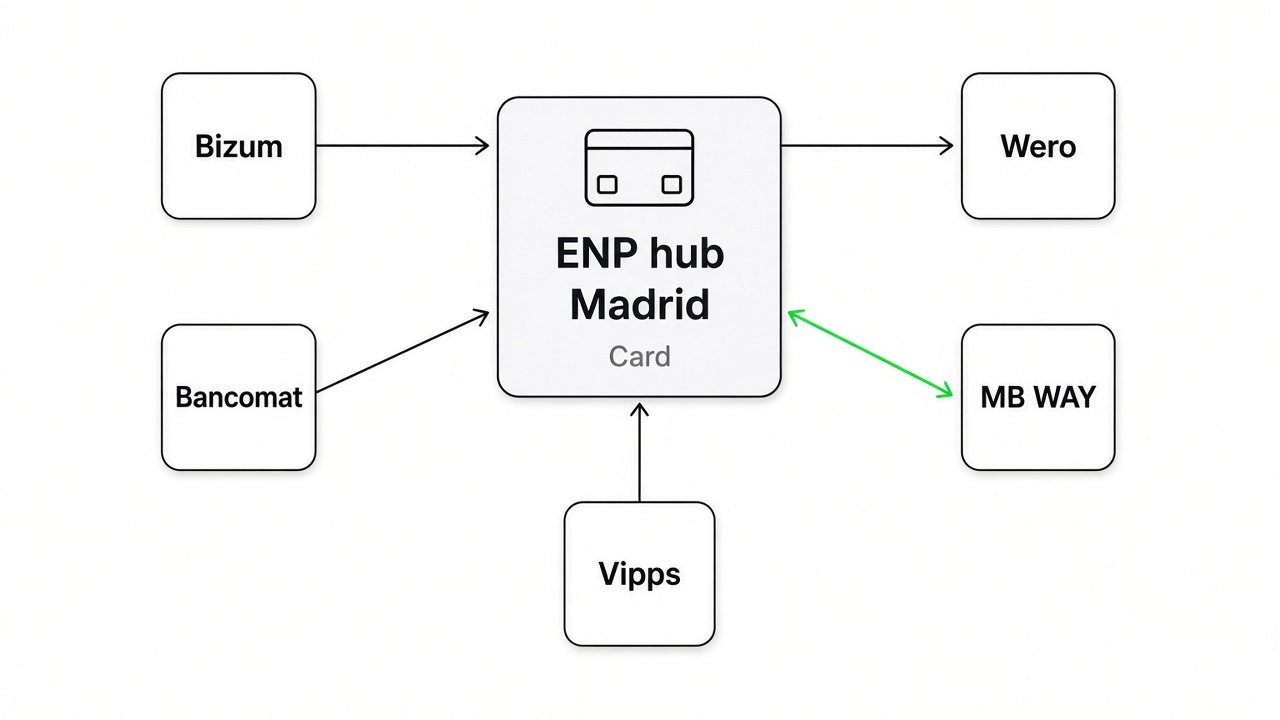
European Network for Payments (ENP): A joint entity founded by Bancomat, Bizum, EPI Company/Wero, SIBS–MB WAY and Vipps MobilePay to operate a shared interoperability hub — so customers can use familiar national payment apps across borders while merchants eventually accept more European account-to-account payers through connected schemes rather than only local ones.
What is the European Network for Payments?
ENP is a jointly owned company, headquartered in Madrid, that will run the technical and operational hub agreed when five European payment schemes signed a memorandum of understanding in February 2026. On 30 September 2026 the founders announced the legal entity and equal shareholding structure. The hub connects existing national solutions through European standards, including instant account-to-account payments, without forcing consumers to download a single replacement app on day one.
According to the EPI company press release, participating solutions together serve roughly 130 million users across 13 European countries — a large share of EU and Norwegian retail payment habit. ENP may admit other established European payment schemes later, subject to partner agreement and technical requirements.
ENP is not the same as plugging one open-banking API and instantly accepting every EU bank. Scheme interoperability sits above — or alongside — the PSD2 initiation contracts your TPP already holds. Treat ENP as a market-structure shift you monitor in roadmap planning, not a feature flag you flip this quarter unless your provider publishes concrete acceptance timelines.
Which payment schemes founded ENP and what do they cover today?
The five founders are Italy’s Bancomat, Spain’s Bizum, EPI Company/Wero, Portugal’s SIBS–MB WAY, and Nordic provider Vipps MobilePay — each keeps its brand while the hub handles cross-border routing.
| Scheme | Home markets (typical) | Merchant-relevant context |
|---|---|---|
| Bizum | Spain | Strong P2P; in-store expansion tied to Spanish bank apps — see open banking Spain |
| Wero (EPI) | BE, DE, FR, LU and expanding | Bill pay and retail pilots — see Wero bill payments France |
| Bancomat | Italy | Domestic ATM and mobile payment habits |
| MB WAY (SIBS) | Portugal | Mobile P2P and growing merchant use |
| Vipps MobilePay | Nordics | Cross-Nordic wallet with high consumer trust |
Trade press summarised the launch as a sovereignty play against US card networks (Finextra, 1 October 2026). For your product team the operational headline is simpler: European shoppers may soon pay merchants in another country using the app they already trust, once ENP moves beyond P2P into retail phases.
How will ENP roll out and when should merchants care?
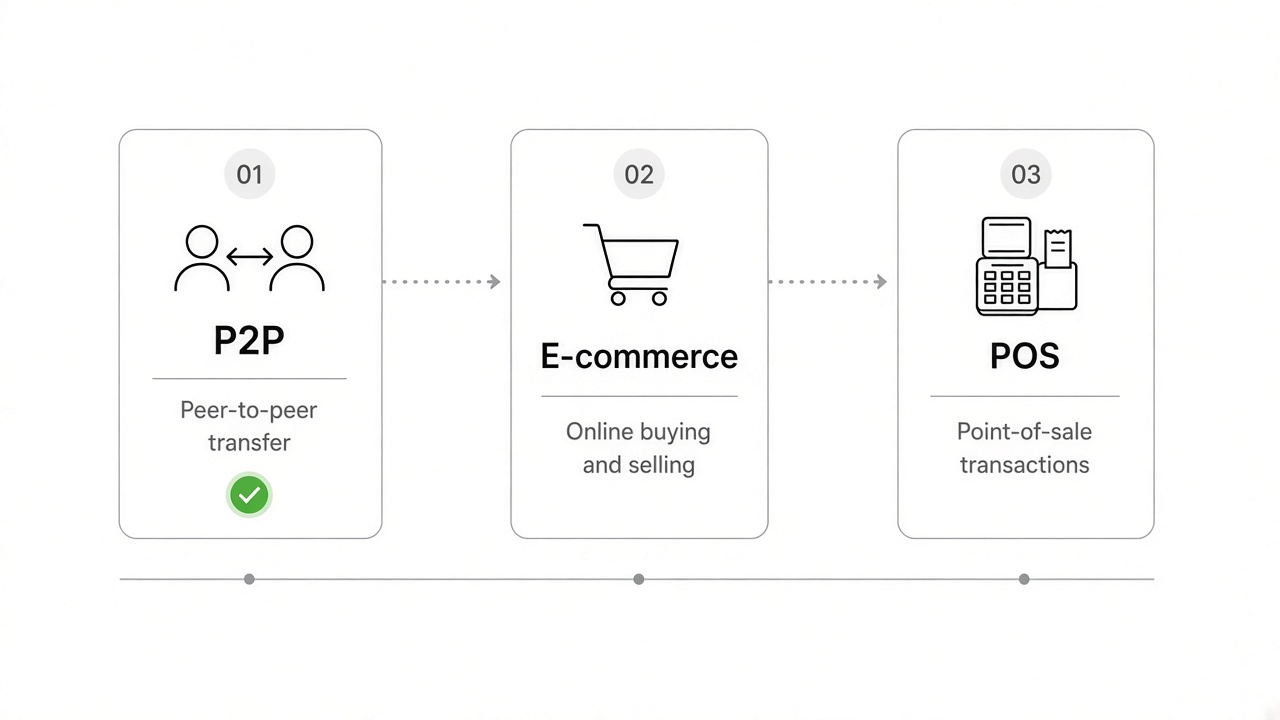
Rollout is phased: cross-border peer-to-peer payments first, then e-commerce, then point-of-sale — with no public hard dates for merchant acceptance at announcement time.
The founding announcement states that technical implementation of the target setup is in preparation (KBC newsroom summary). That sequencing matters for planning:
Phase 1 — Cross-border P2P
Consumers send money across borders using existing apps. Merchant impact is indirect — brand awareness and trust in bank-app payments rise, but checkout SKUs may not change yet.
Phase 2 — E-commerce
Remote checkout could accept payers arriving through connected schemes. Impact is direct — conversion, settlement, and reconciliation rules must map ENP status codes to your order management system. Compare readiness work to pay by bank marketplace multi-country rollouts: coverage matrices beat marketing claims.
Phase 3 — Point-of-sale
In-store QR or app-to-app patterns may mirror what Wero and Bizum already pilot nationally. Impact is direct for retail — hardware-light flows depend on mobile handoff quality, the same constraint as pay by bank payment links at QR.
Until your provider documents ENP acceptance in sandbox, keep cards and local pay-by-bank methods in production. ENP does not remove the need for per-country testing.
How does ENP relate to open banking pay by bank and PSD2 APIs?
Open-banking pay by bank uses licensed TPP APIs to initiate payments bank by bank; ENP connects national scheme wallets so a Bizum user might pay a Wero-enabled merchant without both sides rebuilding every bilateral link.
Many EU merchants already collect through:
- Scheme wallets (Wero, Bizum, iDEAL migration toward Wero in the Netherlands — see pay by bank Netherlands)
- TPP-hosted pay by bank (redirect or embedded checkout)
- Legacy rails (SEPA Credit Transfer, Direct Debit) for recurring — see open banking subscription billing
ENP adds a network layer between schemes, not a replacement for your provider contract. You still need:
- Clear webhook semantics for accepted, pending, and failed states
- Reference fields that survive cross-border routing
- Settlement currency and timing assumptions documented for finance
UK teams should not assume ENP covers Britain — open banking UK vs EU divergence continues on regulation and commercial VRP. ENP news is an EU/Nordic scheme story unless UK schemes join later.
What should payments and product teams do now?
Document your cross-border payer mix, ask providers for ENP roadmap statements in writing, and avoid rebuilding checkout until sandbox evidence exists — but start designing reconciliation keys that can absorb new scheme identifiers.
Short-term (0–6 months)
- Segment customers by home country and payment app — Spain-heavy funnels differ from Nordics-heavy ones.
- Request provider ENP FAQ — which scheme IDs, webhooks, and settlement files they expect when e-commerce phases go live.
- Stress-test existing pay by bank in top corridors — ENP will not fix broken bank coverage in your current TPP contract.
- Align finance on instant A2A settlement vs card capture timing — treasury models may need updating when cross-border A2A share grows.
Medium-term (6–18 months)
- Pilot one cross-border corridor where ENP P2P already proves demand (tourism, digital goods, marketplaces).
- Unify status codes in your payment abstraction layer so Wero, Bizum, and API-initiated pay by bank share dunning and refund playbooks — see pay by bank refunds.
- Revisit recurring strategy separately — ENP retail phases focus on acceptance; variable recurring payments and SEPA mandates still follow their own consent rules.
EPI leadership quoted in trade coverage emphasised that linking platforms should let merchants serve European customers without major new investment once retail phases arrive (Finextra). Treat that as a design goal to validate in RFPs, not a guarantee in your integration backlog.
Which provider questions belong on your ENP readiness checklist?
Ask about scheme-acceptance roadmaps, cross-border reference support, webhook parity, and sandbox banks — not logo slides about “European payments unity.”
| Criterion | Question for your TPP or scheme aggregator |
|---|---|
| ENP timeline | Written statement on e-commerce and POS phases per country |
| Scheme coverage | Which ENP founder apps your checkout can accept at go-live |
| Initiation path | Dedicated scheme APIs vs generic PIS when payer uses Bizum/Wero |
| Cross-border references | Will remittance data display correctly for foreign payers? |
| Webhooks | Final status events decoupled from browser return URLs |
| Reconciliation | Settlement files identify scheme + corridor for ERP matching |
| Refunds / reversals | Process when payer bank sits in another ENP country |
| Fallback rails | Card or local pay-by-bank when hub routes unavailable |
Run sandbox tests on the three banks your analytics say drive most drop-off in each target country before you commit marketing spend to a new wallet button.
When you need coverage mapped to your corridors and volume assumptions, use the provider-matching form — or start from how to choose an open banking provider in the EU for baseline dimensions.
Frequently Asked Questions
What is the European Network for Payments (ENP)?
ENP is a joint company founded by Bancomat, Bizum, EPI Company/Wero, SIBS–MB WAY and Vipps MobilePay to operate a shared interoperability hub headquartered in Madrid. It connects their national payment solutions through European standards, including instant account-to-account payments, while each brand keeps its local customer experience.
When was ENP announced?
The founding partners announced ENP on 30 September 2026, implementing the interoperability framework from their February 2026 memorandum of understanding. Trade press including Finextra reported the launch on 1 October 2026.
Does ENP replace open banking APIs for merchants?
No. ENP connects scheme-level wallets and national apps. Merchants still integrate through payment service providers, scheme acceptance contracts, or open-banking initiation APIs depending on the payer journey. ENP reduces bilateral fragmentation between major schemes; it does not remove PSD2 licensing and bank coverage work.
What rollout order did ENP founders announce?
Cross-border peer-to-peer payments come first, followed by e-commerce and then point-of-sale payments. Technical implementation was described as in preparation at announcement, without public merchant go-live dates for retail phases.
Will UK pay by bank be part of ENP?
The September 2026 announcement lists EU and Nordic scheme founders. UK open banking operates under a separate industry model and commercial VRP schemes. UK merchants should follow UK open banking regulatory framework updates rather than assuming ENP coverage.
How should merchants prepare for ENP e-commerce phases?
Segment cross-border demand, request written ENP roadmaps from providers, keep existing rails live until sandbox acceptance is proven, and design reconciliation to handle new scheme identifiers. Pilot one corridor before marketing a unified “pay anywhere in Europe” message.
Conclusion
The European Network for Payments turns a February 2026 interoperability promise into a Madrid-based operating company linking Bizum, Wero, Bancomat, MB WAY and Vipps MobilePay — with phased rollout from P2P to e-commerce and POS. Merchants win when cross-border bank-app payers convert without forcing everyone onto one wallet, but only if your provider integration, webhooks, and finance reconciliation keep pace. Monitor ENP milestones, test pay by bank in your top corridors today, and treat retail phases as a validated roadmap item — not an automatic upgrade to every checkout.
Related articles
- Open Banking in Spain: Coverage and Provider Fit
Spain combines one of Europe's strongest account-to-account payment cultures with an open banking stack that looks nothing like the UK's single-standard model.…
- Open Banking in France: Coverage and Provider Fit
France sits on many EU payment roadmaps — large banked population, strong mobile banking apps, and heavy B2B invoice volume — yet open banking France on a prov…
- Pay by Bank Netherlands: iDEAL to Wero Migration Guide
If you sell into the Netherlands, most of your online revenue probably arrives through iDEAL — bank-account checkout that Dutch shoppers treat as the default.…