Open Banking for Local Government: Council Tax and Fee Collection
Council billing teams spend too much time chasing failed direct debits, matching card settlements to citizen references, and explaining why payment dates cannot move when residents' pay cycles change. Open banking for local government adds bank-rail collection alongside existing channels: residents authorise in their banking app, you receive deterministic references for finance, and — in the UK where schemes allow — variable recurring payments can flex within agreed limits instead of fixed monthly direct debit dates. This playbook maps the flows worth piloting first, how they differ between the UK and EU, and what to validate before you change citizen-facing payment pages.
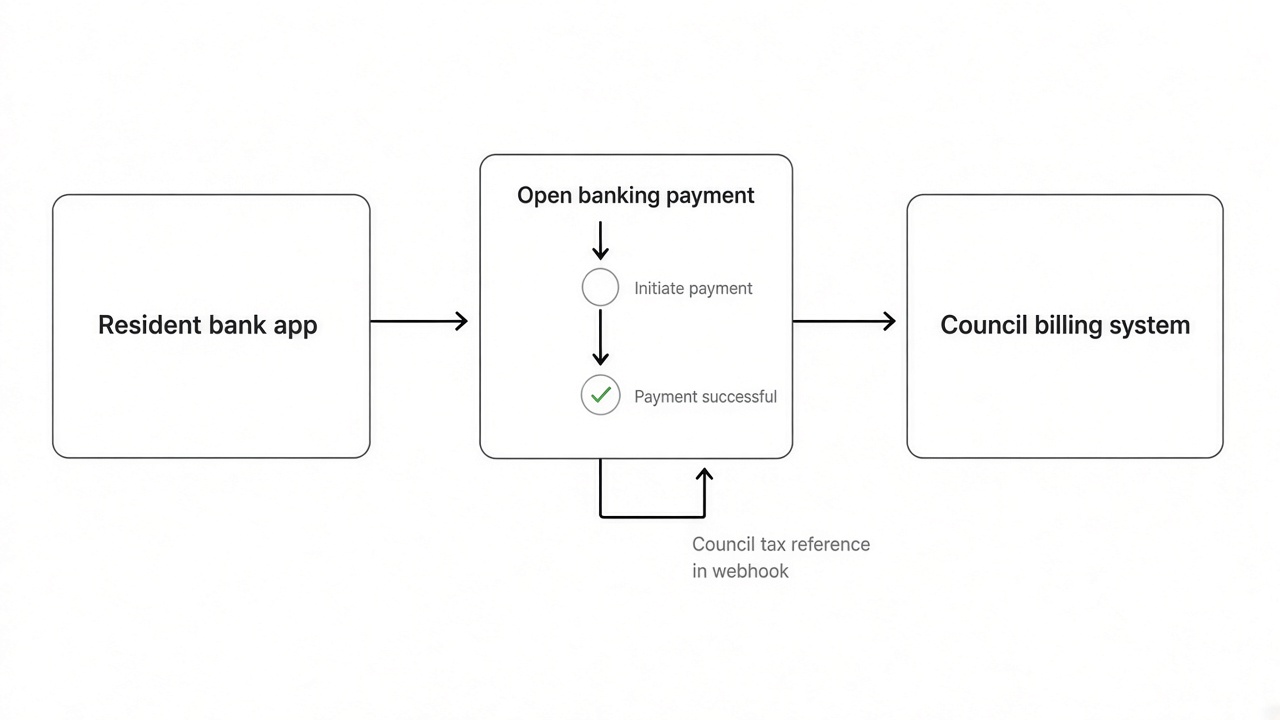
Open banking for local government: Using regulated bank APIs — typically payment initiation and, in the UK, commercial variable recurring payments where eligible — so councils and municipal billing agents collect taxes, fees, and housing payments with customer consent in the banking app, faster reconciliation, and lower cost per successful inbound payment than many card routes.
Why are councils and municipal billing teams evaluating open banking?
Local authorities evaluate open banking because inbound payment volume is high, references must be exact, and rigid direct debit calendars clash with how residents actually get paid. Card acceptance adds interchange on every bill; manual bank transfers flood reconciliation queues when references are wrong. Pay by bank gives instant confirmation with a structured creditor reference, and account-to-account settlement avoids card dispute mechanics on routine tax and fee collection.
Industry discussion at Open Banking Expo UK & Europe 2026 highlighted council tax as a case where traditional direct debit can lock residents to payment dates that do not match variable salaries — and where commercial variable recurring payments (cVRP) could offer more flexible scheduling within agreed caps. That is a citizen-experience argument as much as a cost argument.
The UK government’s Payments Forward Plan frames open banking and cVRP as part of making account-to-account payments more common for businesses and consumers — with FCA oversight of future commercial schemes. EU municipalities typically combine pay-by-bank initiation with SEPA Direct Debit and local digital-wallet programmes; the job-to-be-done is the same: fewer failed collections and cleaner ledger matching.
Which local-government payment flows fit open banking first?
Start with high-volume, reference-heavy inbound flows where citizens already use online self-service: council tax balances, business rates, parking and permit fees, and catch-up payments after a failed schedule. Deferred prosecution fines and complex court-ordered payment plans need legal and policy review before you change rails — treat them as phase two.
| Flow | Typical rail mix today | Open banking fit |
|---|---|---|
| Council tax annual / instalment plan | Direct debit, card, post office | Pay by bank for one-off and plan setup; UK cVRP where sector rules allow variable pulls |
| Business rates | BACS, direct debit, card | Pay by bank with fixed business reference; B2B bank coverage matters |
| Parking, permits, garden waste | Card-heavy self-service | Pay by bank lowers cost per transaction on repeat buyers |
| Social housing rent (council landlord) | Direct debit, housing benefit offsets | Overlaps open banking for property management patterns; verify tenant IBAN at sign-up |
| Refunds and small credits | Manual BACS files | Outbound initiation where supported; pair with account verification |
UKPI Wave 1 lists central and local government among sectors eligible for commercial variable recurring payments alongside utilities and telecoms — see recurring pay by bank for sector framing. Confirm your billing entity’s eligibility with your payment partner before marketing cVRP to residents; November 2026 merchant-category expansions focus on other sectors, not a replacement for government eligibility rules.
How does pay by bank work for council tax and business rates?
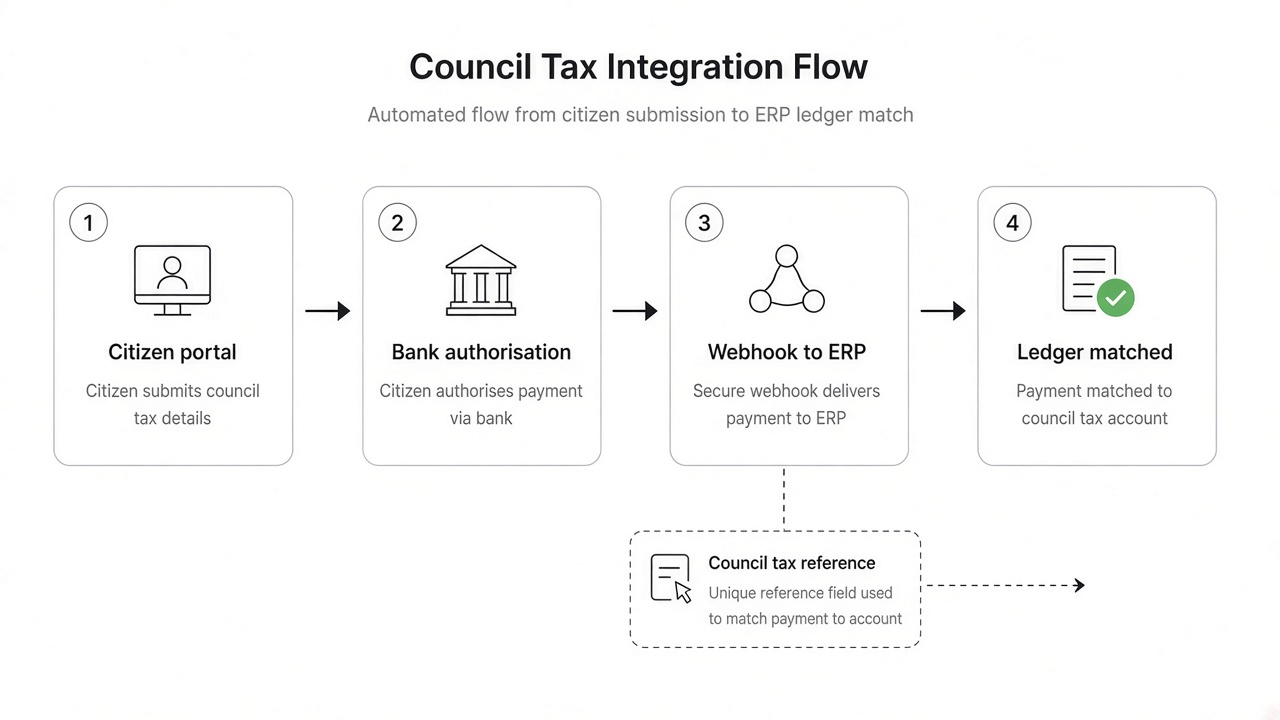
Residents choose pay by bank in your portal, approve the amount in their banking app, and funds settle account-to-account with a reference your ERP can ingest automatically. That pattern suits arrears payments, end-of-year balances, and new-account first payments where setting up direct debit feels heavy.
A practical sequence:
- Citizen sees amount due and reference (account number, invoice ID, or UPRN-backed token your CRM maps)
- Your provider launches bank redirect or mobile deep link with amount and reference embedded
- Citizen approves in the banking app; success webhook returns payment ID and reference fields
- Billing marks the instalment paid and stores verified IBAN if you plan a follow-on recurring consent
Trade-offs: every one-off payment needs citizen action unless you already hold a separate mandate or cVRP consent. For residents who prefer “set and forget”, direct debit or cVRP remains relevant; pay by bank wins on conversion for one-off and cost per success on the pay by bank rail. Business rates payers often use business banking apps — shortlist providers on B2B account coverage, not retail-only bank lists.
Can variable recurring payments improve council tax instalments in the UK?
Where UKPI rules cover your authority, cVRP lets residents approve limits once while you request each instalment within those caps — including amounts that change when discounts or exemptions adjust mid-year. Fixed direct debit dates frustrate residents paid weekly or on irregular schedules; flexible pulls within consent limits address that operational complaint without abandoning automation.
cVRP differs from classic direct debit because the regulated payment initiation provider holds consent and initiates each pull; the citizen’s bank enforces caps. Open Banking Limited and UK Payments Initiative materials describe the commercial scheme layered on open banking initiation. Implementation work sits with your PSP and finance: consent UX copy, webhook-driven ledger posting, and audit trails for exemptions.
What cVRP does not solve alone: policy on who may enrol, how partial benefits interact with instalments, and comms when a pull fails. Pair bank-rail dunning with SMS pay-by-bank links — patterns from open banking recurring dunning apply when a scheduled pull fails.
How should finance and digital teams reconcile open banking payments?
Reconciliation succeeds when creditor references, webhook payloads, and citizen account identifiers share one deterministic mapping — before you go live on marketing pages. Councils process millions of rows; “payment received” without a matchable reference recreates the manual transfer problem.
Checklist billing leads should sign off:
| Check | Why it matters |
|---|---|
| Reference format in API vs citizen UI | Citizens truncate or mistype if shown raw internal IDs |
| Webhook retries and idempotency | Duplicate posts break trust with auditors |
| Multi-rail reporting | Direct debit, card, pay by bank, and cVRP in one daily cash report |
| Failed-payment citizen journey | Clear next step — retry link, phone, or office visit |
| Data retention on verified IBAN | Align with privacy policy; only store what the next rail needs |
EU authorities often run the same discipline on SEPA credit transfers initiated via pay by bank. If you also operate open banking utility payments style shared service centres, reuse webhook schemas and finance runbooks across directorates to avoid N duplicate integrations.
What should local government teams ask open banking providers?
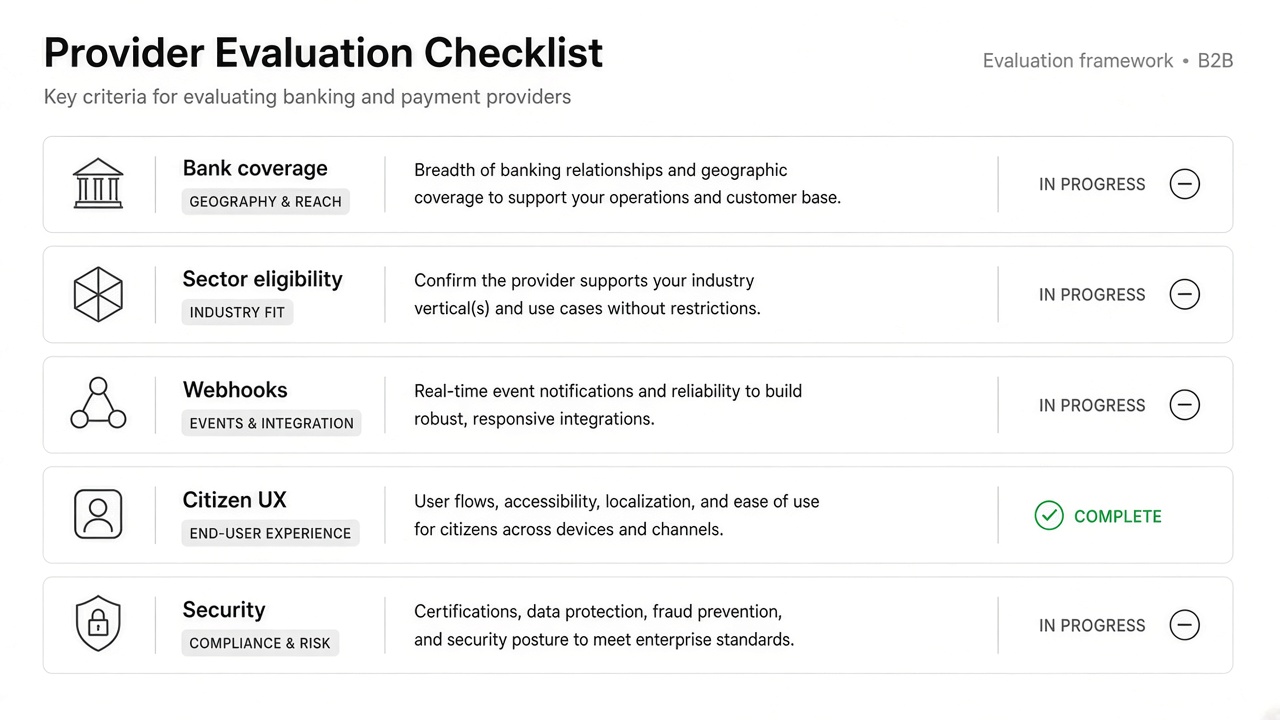
Shortlist on bank coverage in your catchment, government-sector eligibility for UK cVRP, reference fields in webhooks, and accessibility of citizen UX — not API feature lists alone. A gap on one high-street bank shows up as residents abandoning at the final step.
Validation before procurement:
- Citizen bank coverage — Retail and business accounts for your county’s top ASPSPs
- Sector eligibility — Written confirmation for council tax / rates entities under UKPI or your EU licence path
- Consent and recurring — Support for one-off initiation plus variable recurring where policy allows
- Reconciliation contract — Sample webhook payloads with your reference format
- Security and hosting — DPA, sub-processor list, incident notification aligned with public-sector procurement
- Fallback — Card and direct debit remain when a bank or scheme is unavailable
Compare candidates through the same lenses as how to choose an open banking provider in the EU — coverage and ops outweigh headline fees for citizen billing.
Frequently Asked Questions
What is open banking for local government?
Open banking for local government means councils and municipal billing agents use regulated bank APIs to let residents pay taxes and fees from their banking app with structured references, faster confirmation, and often lower cost per successful payment than card. In the UK, eligible authorities may also use commercial variable recurring payments for instalment plans within citizen-approved limits.
Can UK councils use cVRP for council tax?
Many UK local-government billing entities fall under UK Payments Initiative Wave 1 sector eligibility for commercial variable recurring payments, alongside utilities and charities — but your payment partner must confirm your legal entity and use case before launch. cVRP is not a universal replacement for direct debit; it is an additional rail where policy and scheme rules align.
How is open banking different from direct debit for council tax?
Direct debit pulls on a fixed schedule with scheme-specific rules on advance notice and indemnity claims. Pay by bank requires citizen approval per payment unless you hold a separate recurring consent. UK cVRP blends automation with variable amounts within caps the citizen sets in the banking app. Most councils keep direct debit while adding bank-rail options for flexibility and cost.
Do EU municipalities use open banking for local taxes?
EU municipalities typically combine pay-by-bank initiation for digital self-service with SEPA Direct Debit for recurring local taxes and fees. National wallet schemes and instant payment regulation vary by country; the operational goal matches the UK — deterministic references and fewer manual transfer mismatches.
Does open banking reduce card fees on citizen payments?
Card interchange applies to every successful card payment; account-to-account pay by bank usually carries a different fee shape negotiated with your provider. Savings depend on volume, card mix, and whether citizens actually choose the bank option — citizen UX and communications determine adoption more than treasury policy alone.
How do councils handle failed bank-rail payments?
Failed pulls or abandoned bank sessions should trigger the same dunning discipline as direct debit: retry rules, pay-by-bank deep links for the exact arrears amount, and clear status in the citizen portal. Measure recovery rate and cost per successful collection, not only first-attempt authorisation.
What should we pilot before a full public launch?
Run sandbox tests with real reference formats on the top five banks in your area, reconcile webhooks into a test ledger, and pilot with one payment type — often arrears pay by bank — before retargeting instalment plans. Involve finance, revenue, and customer services in failure scripts before marketing.
Conclusion
Open banking for local government is less about new regulation than about giving billing teams bank-rail options citizens already recognise: pay by bank for balances and arrears, structured reconciliation, and — in the UK where confirmed — cVRP for instalments that respect variable incomes. The councils that benefit first treat references, webhooks, and multi-rail reporting as one programme, then layer citizen choice on top of direct debit rather than replacing it overnight.
Related articles
- Open Banking for Education: Tuition and Fee Playbook
Finance teams at universities and edtech platforms still lose weeks each intake season matching anonymous bank transfers to student IDs, chasing card expiry on…
- Open Banking for Sports Clubs: Membership Fee Playbook
Grassroots treasurers lose evenings to chasing match fees in group chats, re-keying bank details after every new squad signup, and reconciling transfers that a…
- Open Banking for Property Management: Rent Collection Playbook
Lettings and build-to-rent ops teams bleed margin when rent collection depends on cards with interchange, slow bank-transfer reconciliation, or direct debits t…