Open Banking for Education: Tuition and Fee Playbook
Finance teams at universities and edtech platforms still lose weeks each intake season matching anonymous bank transfers to student IDs, chasing card expiry on instalment plans, and manually verifying IBANs for bursary payouts. Open banking for education connects regulated bank APIs to enrolment, billing, and disbursement workflows so tuition, accommodation, and course fees arrive with deterministic references and fewer failed renewals. This playbook maps six flows education operators can pilot first, how UK and EU recurring schemes apply, and what to validate before you change student-facing payment copy.
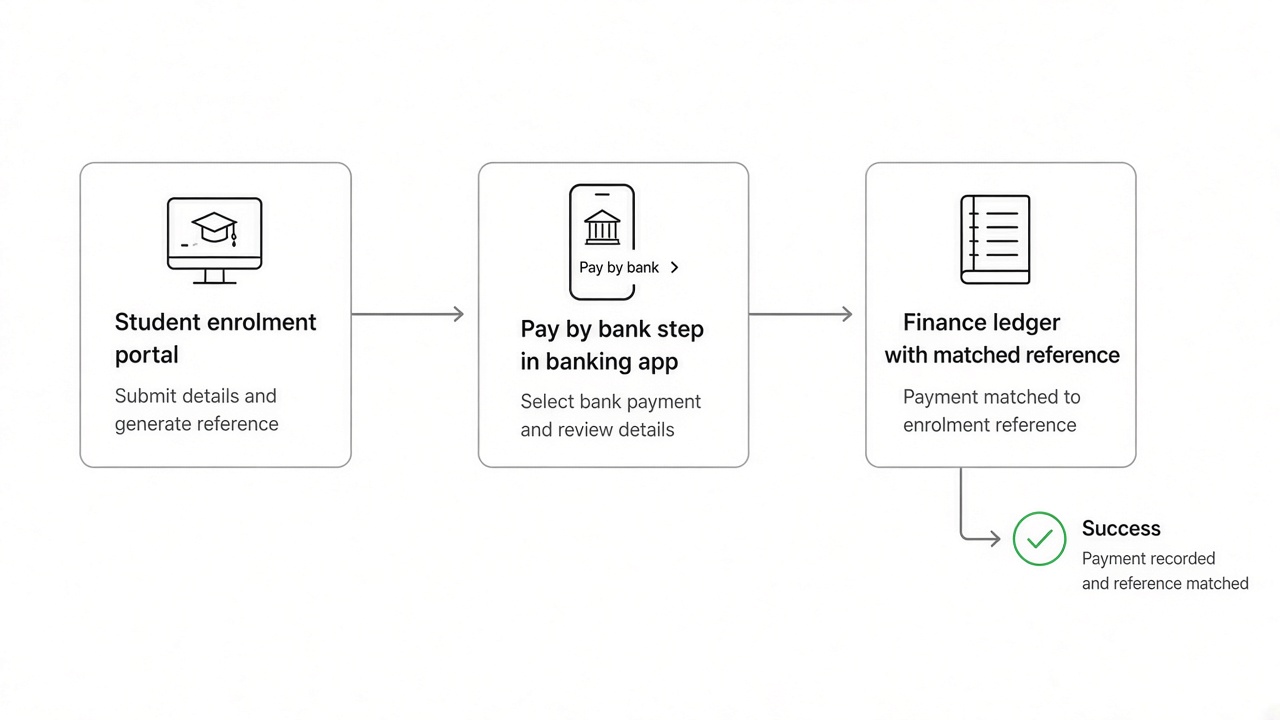
Open banking for education: Using regulated bank APIs — payment initiation, account verification, and recurring bank authorisations — so schools, universities, and edtech platforms collect tuition and fees, verify payer accounts at enrolment, and reconcile instalments through account-to-account transfers with explicit consent in the banking app.
Why are universities and edtech platforms adopting open banking?
Education finance teams adopt open banking because manual transfer matching and card-on-file churn do not scale across intake peaks, international cohorts, and instalment plans. A single autumn registration window can mean tens of thousands of payers — parents paying on behalf of minors, international students wiring from non-UK accounts, and employers sponsoring professional courses.
The pain differs from charity or sports-club playbooks in open banking for charities and open banking for sports clubs:
- Fee complexity — tuition, accommodation, lab levies, and exam resits often bill on different schedules in one academic year
- Payer mix — students, guardians, sponsors, and employers may pay the same invoice from different account types
- Cross-border intake — international students expect local bank pay where cards fail or FX fees bite; EU–Canada real-time payment linkage discussions (reported by Finextra in November 2026) signal wider instant-rail connectivity over time, not a turnkey tuition product today
- Regulated disbursements — bursaries, refunds, and hardship grants need verified outbound accounts, not just inbound checkout
Open banking does not replace every rail. SEPA Direct Debit and Bacs remain common for flat monthly instalments. Cards still dominate impulse course purchases. The operational win is embedding bank pay inside enrolment and student portals so finance stops re-keying references after every clearing file.
How does tuition and instalment collection work with bank rails?
Tuition collection with open banking links course registration to a pay-by-bank or mandate step so each student ID carries a payment reference from day one. When a student or guardian completes enrolment, payment authorisation should happen in the same session — not in a follow-up email that arrives after the place offer expires.
A practical flow:
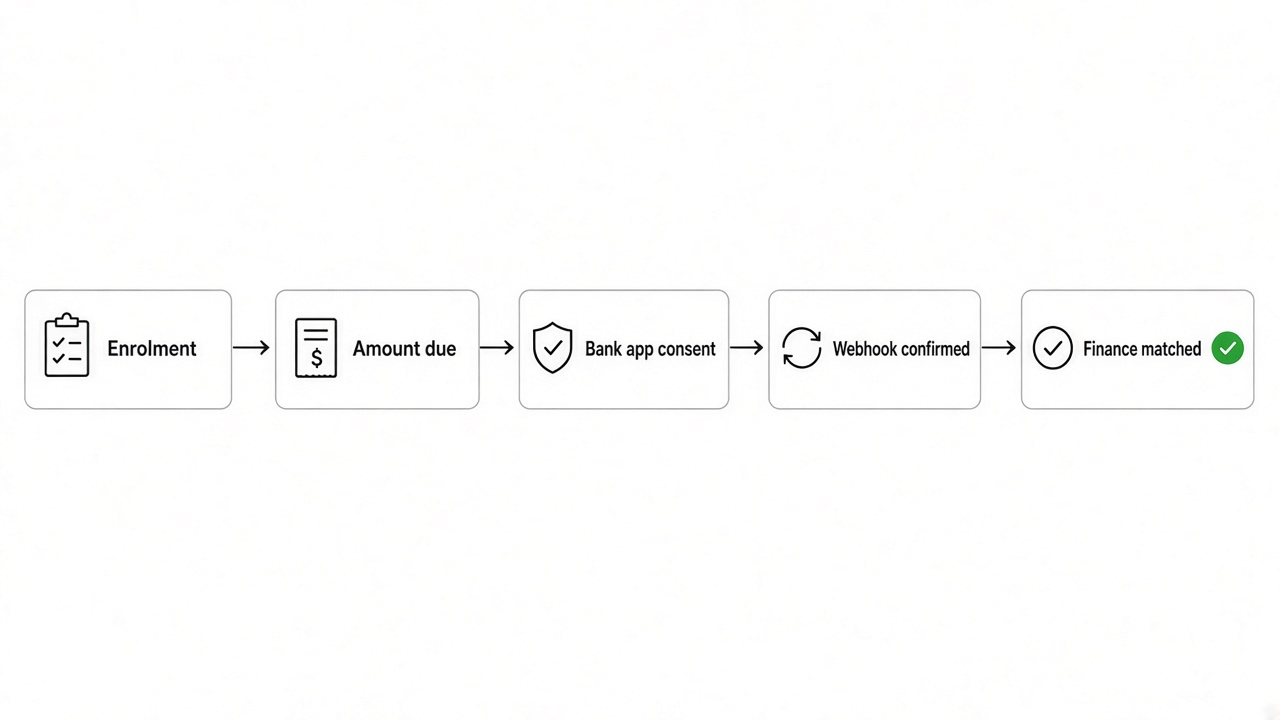
- Student selects modules, accommodation, or course bundle in the SIS or edtech checkout
- The platform presents total due — deposit plus instalment schedule if applicable
- Payer consents via pay by bank (one-off) or sets up a recurring bank mandate where amounts are predictable
- Webhooks confirm success; the student record moves to "paid" or "deposit received" without manual ledger entry
- Failed attempts trigger automated retry or a recovery link before the registrar marks the place at risk
Patterns mirror B2B invoice collection in pay by bank invoice payment, but education adds academic-year seasonality and guardian payer flows similar to youth sport — display student name and course code on every payment screen and confirmation.
Which bank rails fit term billing and recurring campus fees?
Term billing needs rails that handle deposit payments, fixed monthly instalments, and mid-year top-ups without forcing students to re-enter bank details each time.
| Rail | Best for education use | Main trade-off |
|---|---|---|
| Pay by bank (one-off) | Deposits, exam fees, short courses, arrears catch-up | Payer action each time without a mandate |
| SEPA Direct Debit / Bacs | Flat monthly tuition instalments in EU/UK | Mandate setup; chargeback windows differ by scheme |
| UK recurring pay by bank / cVRP | UK institutions with variable fees within caps | Sector eligibility under UKPI waves — see below |
| Card on file | Micro-credentials and low-value add-ons | Interchange; expiry before multi-year programmes complete |
In the UK, Open Banking Limited describes the UK Payments Initiative (UKPI) as the commercial open banking payment scheme launched in 2026. Wave 1 focused on regulated sectors; broader retail-style recurring billing for general e-commerce and subscriptions sits in expected Wave 2 scope — see UKPI Wave 2 recurring payments for timing and pricing context, not as a go-live checklist for every university today.
EU campuses should map instalment needs to bank on file vs card on file and evaluate providers on multi-country student bank coverage before marketing bank pay to international cohorts.
How can open banking support international student payments?
International student checkout fails when you assume every payer holds a local retail account or accepts card FX markups — open banking improves conversion where your provider covers the student's home-country banks and surfaces clear FX/settlement messaging. Cross-border instant payment connectivity is evolving (EU–Canada linkage is a recent policy signal, not a live tuition rail), so treat marketing claims as roadmap items until your provider names supported corridors in contract.
Design choices that reduce support load:
- Offer pay-by-bank alongside cards and traditional wire instructions during migration
- Show currency, settlement timing, and who pays FX before redirect to the banking app
- Store guardian or sponsor contact separately from student record for dunning
- Use per-student payment links with deterministic references — avoid one shared faculty URL
Account verification at first payment helps bursary teams confirm the account holder matches the student or guardian on file — patterns from open banking account verification adapted for enrolment, not corporate KYB alone.
How do bursary, refund, and hardship payouts fit?
Outbound education payments need verified beneficiary accounts and audit trails — open banking verification reduces wrong-IBAN grants and manual re-work when students change banks mid-year. Refunds for accommodation deposits and course withdrawals still compete with card refund expectations; bank-account refunds need clear timelines when you verify IBAN at enrolment.
Operational patterns:
- Verify account at grant application or refund request — not only at first inbound payment
- Separate workflows for inbound tuition vs outbound bursary to simplify permissions and reporting
- Log consent and verification timestamps for audit — especially where public funding rules apply
- Keep card or manual transfer fallback for edge cases until bank coverage is proven on your cohort
What should education platforms evaluate in an open banking provider?
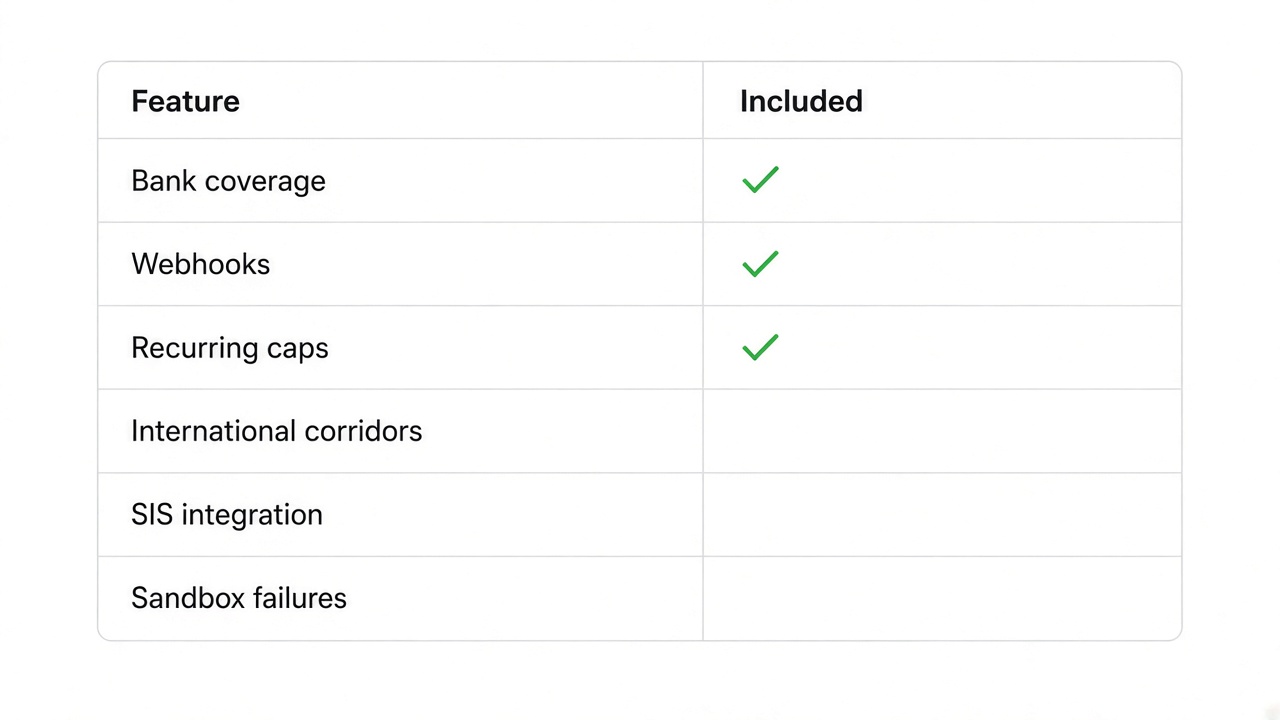
Shortlist providers on retail and student-bank coverage in your intake markets, recurring consent support, webhook reliability, and integration with your student information or edtech stack — not API marketing alone. A gap in one national champion bank shows up as abandoned checkout during clearing week.
Validation checklist before production:
| Criterion | Why it matters for education |
|---|---|
| Retail account coverage | Students and parents pay from personal current accounts across many banks |
| Reference in webhook payload | Finance matches thousands of student rows; references must be deterministic |
| Variable amount within caps | Lab fees, resits, and accommodation adjustments change mid-year |
| Guardian and sponsor flows | Payer is often not the named student |
| Sandbox with failure paths | Test insufficient funds and retry before autumn intake peak |
Run sandbox tests with your fee shapes — a £9,250 annual tuition with three instalments behaves differently from a €299 micro-credential bundle on some bank rails. For a neutral comparison framework, see how to choose an open banking provider in the EU. When requirements are documented, use the provider-matching form to compare bank coverage, recurring support, and SIS integration against your intake markets.
Frequently Asked Questions
What is open banking for education?
Open banking for education uses regulated bank APIs so universities, colleges, and edtech platforms collect tuition and fees, verify payer accounts at enrolment, and reconcile instalments through account-to-account transfers with explicit consent — typically in the banking app — instead of relying only on unstructured transfers or cards that expire before multi-year programmes finish.
Can universities use pay by bank for tuition fees?
Yes, where your open banking provider supports payment initiation on the banks your students and guardians use. Pilot on one faculty or course type first, keep card and direct-debit fallbacks live, and measure completion rate and cost per successful collection before campus-wide rollout.
Does open banking work for international students?
It can when your provider covers the home-country banks your cohort actually uses and you communicate FX and settlement timing clearly. Cross-border instant payment initiatives are evolving; validate named corridors in sandbox rather than assuming every international wire replaces bank redirect.
How is education billing different from SaaS subscription billing?
Both use instalments and dunning, but education adds intake seasonality, guardian payers, regulated bursaries, and academic-year fee changes. See open banking for SaaS platforms for renewal mechanics; education needs stronger reference discipline and sponsor workflows on top.
Can open banking reduce failed instalment payments?
Failed pulls usually trace to insufficient balance on due dates, closed student accounts, or mandates set against the wrong account. Open banking improves recovery with instant pay links, clearer failure webhooks, and verified account setup at enrolment — patterns covered in open banking recurring dunning.
Do UK universities need UKPI Wave 2 for recurring tuition?
Commercial variable recurring payments under UKPI Wave 1 targeted specific regulated sectors. General university retail-style recurring billing is expected in Wave 2 discussions — confirm eligibility with your provider before marketing bank-pay instalments UK-wide.
How do I evaluate open banking providers for an edtech platform?
Demand named bank coverage in your student markets, sandbox proof on your top institutions, webhook fields for student references, recurring support for instalments, and integration paths with your LMS or billing stack. Weight criteria by whether you optimise checkout conversion, bursary payouts, or both.
Closing thought
Open banking for education rewards treating each intake market as its own acceptance test: name the banks your students hold, separate inbound tuition from outbound bursaries, and pilot before clearing week — not after finance is already drowning in unmatched transfers. Once core flows work, extend the same discipline to the next campus or country rather than assuming one EU contract covers every cohort.
Related articles
- Open Banking for Sports Clubs: Membership Fee Playbook
Grassroots treasurers lose evenings to chasing match fees in group chats, re-keying bank details after every new squad signup, and reconciling transfers that a…
- Open Banking for Property Management: Rent Collection Playbook
Lettings and build-to-rent ops teams bleed margin when rent collection depends on cards with interchange, slow bank-transfer reconciliation, or direct debits t…
- Open Banking for Charities: Donation Collection Playbook
Charity finance and fundraising teams lose donor goodwill when collection friction shows up as failed monthly gifts, manual bank-transfer reconciliation, or ca…