Open Banking for Sports Clubs: Membership Fee Playbook
Grassroots treasurers lose evenings to chasing match fees in group chats, re-keying bank details after every new squad signup, and reconciling transfers that arrive without a player reference. Open banking for sports clubs gives club committees and the platforms that serve them bank-rail tools — pay by bank, account verification, and recurring bank authorisations — so membership and match-fee income lands with deterministic references and less card expiry churn on repeat payers. This playbook maps six flows amateur and semi-pro organisations can pilot first, how UK recurring schemes apply, and what to validate before you change parent-facing payment copy.
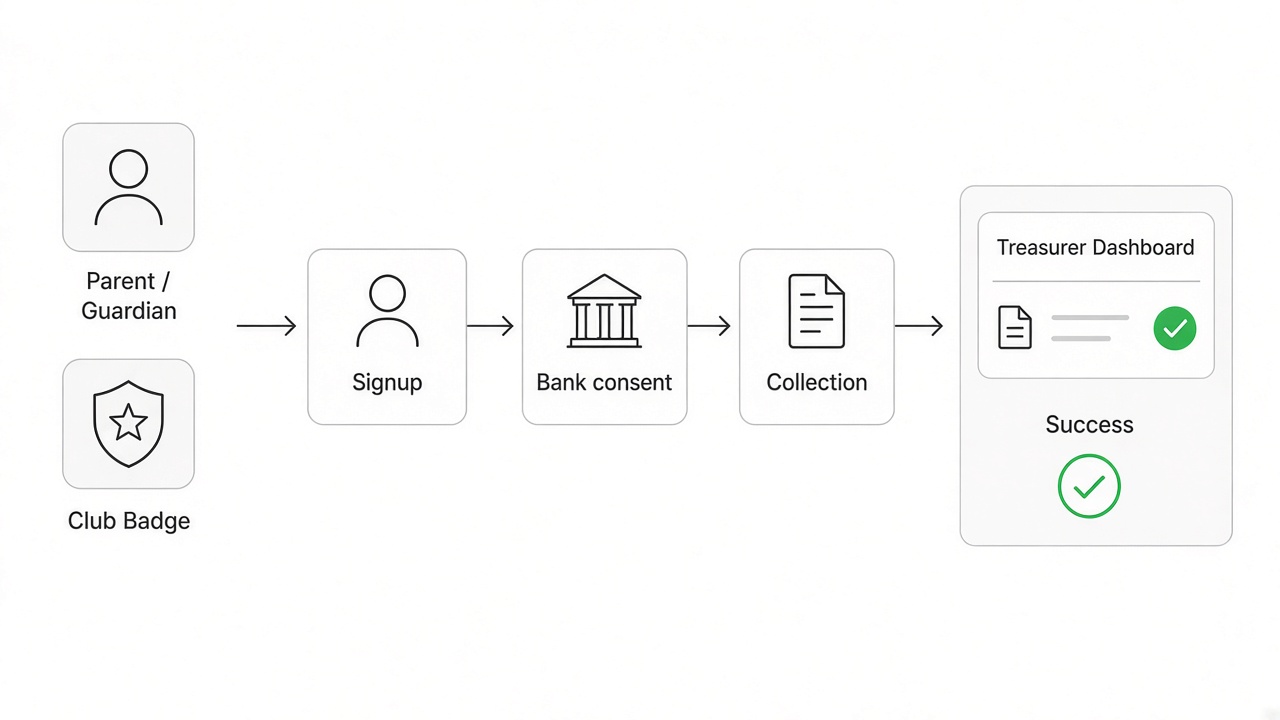
Open banking for sports clubs: Using regulated bank APIs — payment initiation, account verification, and recurring bank mandates — so amateur and semi-pro clubs collect membership dues, match fees, and season passes through account-to-account transfers with explicit payer consent in their banking app, instead of relying solely on cash, manual transfers, or card-on-file.
Why are sports clubs and membership organisations adopting open banking?
Clubs adopt open banking because volunteer treasurers cannot scale manual collection as squads and seasons grow. A county youth football programme may register hundreds of players each autumn; each signup traditionally triggers a separate payment chase — bank transfer with missing references, card forms that expire mid-season, or cash handed to coaches without audit trail.
The pain differs from charity fundraising in open banking for charities:
- Payer mix — parents and guardians paying on behalf of minors, often from personal current accounts
- Fee types — annual membership, per-match levies, kit deposits, and tournament surcharges in the same season
- Governance — community amateur sports clubs (CASCs) and member-run committees need transparent books, not donor CRM workflows
- Platform layer — many clubs run on league or club-management software; payments must embed there, not in a standalone portal treasurers forget to check
Open banking does not replace every rail. Bacs Direct Debit remains the workhorse for flat monthly subs at many clubs. Cash still appears at the touchline. The operational win is embedding bank pay inside signup and renewal so treasurers stop matching anonymous transfers to player IDs.
How does membership and match-fee collection work with bank rails?
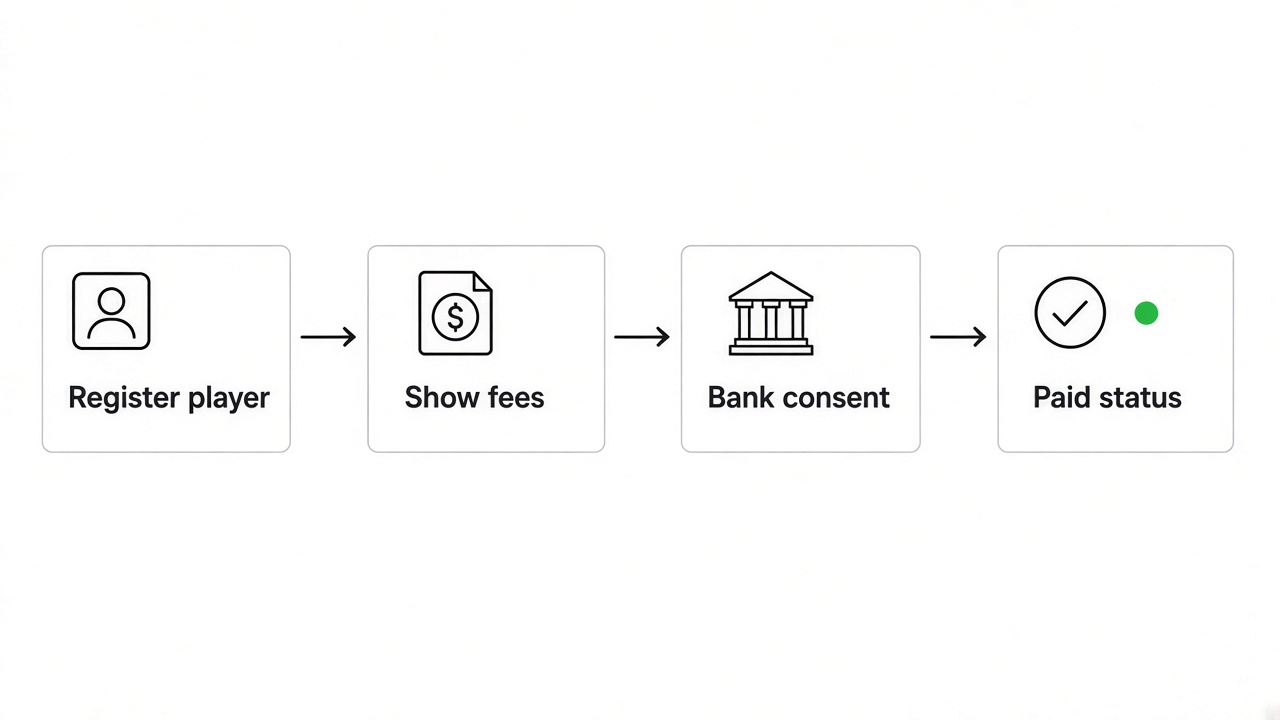
Membership and match-fee collection with open banking links electronic signup to a pay-by-bank or mandate step so each player ID carries a payment reference from day one. When a parent completes registration in your club app or league platform, the payment authorisation should happen in the same session — not in a follow-up email three days later.
A practical flow:
- Parent or player completes registration with squad, age group, and contact details
- The platform presents total due — membership plus any match-fee bundle or kit levy
- Payer consents via pay by bank (one-off) or sets up a recurring bank mandate where amounts are predictable
- Webhooks confirm success; the player record moves to "paid" without treasurer manual entry
- Failed attempts trigger automated retry or a recovery link before the registrar marks the slot unpaid
Industry vendors have pushed this pattern into grassroots sport — for example, GoCardless partnered with County FAs across England to help clubs automate membership collection. The architecture lesson is vendor-agnostic: payments belong inside the club or league platform, not as a spreadsheet side process.
Trade-offs: embedded flows require your platform to expose webhooks and idempotent payment APIs. Legacy clubs on email plus PDF invoices should pilot one age group before migrating the whole club.
Which bank rails fit seasonal and variable club billing?
Seasonal club billing needs rails that handle one-off signup payments, fixed monthly subs, and occasional top-ups without forcing treasurers to re-collect bank details each time.
| Rail | Best for club use | Main trade-off |
|---|---|---|
| Pay by bank (one-off) | Registration fees, tournament entries, arrears catch-up | Payer action each time without a mandate |
| Bacs Direct Debit | Flat monthly training subs | Setup friction; chargeback windows |
| SEPA Direct Debit | EU affiliate clubs and tours | Mandate rules vary by country |
| UK recurring pay by bank / cVRP | UK clubs with variable fees within caps | Sector eligibility rules apply — see below |
| Card on file | Parents unfamiliar with bank redirect | Interchange; expiry before end of season |
In the UK, Open Banking Limited describes the UK Payments Initiative (UKPI) as the first commercial open banking payment scheme, with FCA and PSR statements supporting the June 2026 launch; Wave 1 focused on regulated sectors. Broader membership clubs and retail-style recurring billing sit in the expected Wave 2 scope outlined in industry commentary — see UKPI Wave 2 recurring payments for timing and pricing context, not as a go-live checklist for every amateur club today.
EU clubs should map recurring needs to bank on file vs card on file and evaluate providers on multi-country coverage before marketing bank pay to touring squads.
How can open banking reduce failed payments for club treasurers?
Failed payments usually trace to insufficient balance on collection day, closed junior accounts, or mandates set up against the wrong account — open banking improves recovery with instant pay links and clearer failure signals. Treasurers spending Saturday mornings texting parents about unpaid subs are doing work that automated retry and pre-filled recovery links can shrink.
Patterns that work for membership organisations:
- Scheduled retry — retry failed pulls on defined days before marking a player ineligible for selection
- Recovery link — SMS or email with pay-by-bank for the exact arrears amount and embedded player reference
- Verified account at signup — reduce wrong-IBAN mandates by confirming account details when the parent first pays
- Dual rail fallback — keep Direct Debit or card live for one season while piloting bank pay on new registrations
Measure cost per successful collection and treasurer hours saved, not just authorization rate on the first attempt. A rail that fails often on certain retail banks increases volunteer burnout.
How do parent and guardian pay flows differ from adult membership?
Parent and guardian pay flows must assume the payer is not the named member — consent copy, receipts, and references should tie to the player ID while charging an adult's account. Youth sport dominates grassroots volumes; checkout UX that assumes the account holder is the athlete creates confusion and charge disputes.
Design choices that reduce support load:
- Display member name and squad on every payment screen and confirmation email
- Store guardian contact separately from player record for dunning messages
- Avoid sharing one club-wide payment link — use per-player or per-invoice links with deterministic references
- Offer pay-by-bank alongside existing methods during migration; forcing a single rail spikes dropout at signup
Account verification at first payment helps treasurers confirm the payer name matches the guardian on file — similar patterns to open banking account verification in B2B onboarding, adapted for volunteer-led governance.
What should club platforms evaluate in an open banking provider?
Shortlist providers on retail bank coverage in your league's regions, recurring consent support, webhook reliability, and integration with your club-management or league platform — not API marketing alone. A gap in one major high-street bank shows up as parents abandoning signup at the final step.
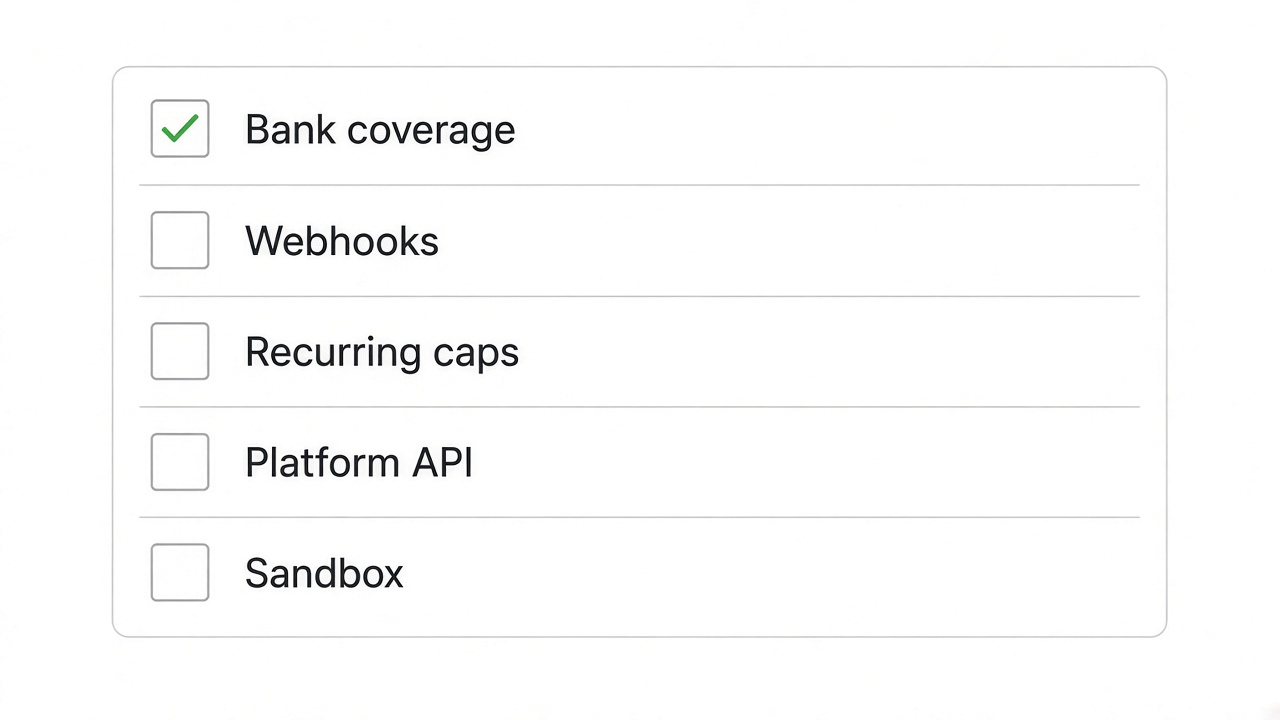
Validation checklist before production:
| Criterion | Why it matters for sports clubs |
|---|---|
| Retail account coverage | Parents pay from personal current accounts, not corporate IBANs |
| Reference in webhook payload | Treasurers match thousands of player rows; references must be deterministic |
| Variable amount within caps | Match fees and kit levies change mid-season |
| Platform integration | Signup, roster, and finance modules should share one payment state |
| Sandbox with failure paths | Test insufficient funds and retry before autumn registration peak |
Run sandbox tests with your fee shapes — £40 annual membership plus £5 match levy behaves differently from a £200 season ticket. For a neutral comparison framework, see how to choose an open banking provider in the EU. When requirements are documented, use the provider-matching form to compare bank coverage, recurring support, and platform integration against your league markets.
Frequently Asked Questions
What is open banking for sports clubs?
Open banking for sports clubs uses regulated bank APIs so amateur and semi-pro organisations collect membership dues, match fees, and season payments through account-to-account transfers with explicit payer consent — typically in the banking app — instead of relying only on cash, unstructured bank transfers, or cards that expire before the season ends.
Can grassroots football clubs use open banking for membership fees?
Yes. Grassroots and youth clubs can offer pay by bank at registration and for arrears, and can use Direct Debit or recurring bank mandates where amounts and consent rules fit the product. Many clubs integrate through league or club-management platforms; confirm live bank coverage and fee types with your payment partner before replacing existing collection methods.
How is open banking for sports clubs different from charity donations?
Sports club flows centre on membership ledgers, player IDs, and parent payers — not donor programmes, Gift Aid, or appeal campaigns. Charities may qualify for UKPI Wave 1 cVRP under registered-charity rules described in open banking for charities. Amateur sports clubs should treat UKPI eligibility as a separate check with their provider rather than assuming charity rules apply.
Does open banking work for variable match fees and one-off tournaments?
Yes. Pay by bank handles one-off and variable amounts when the payer authorises each payment, or when a recurring mandate allows changes within agreed caps. Tournament entries and kit surcharges often fit one-off pay by bank; flat training subs fit Direct Debit or recurring bank products where supported.
Will UKPI Wave 2 matter for membership clubs?
Industry expects UKPI Wave 2 to extend commercial variable recurring payments to broader retail and membership-style billing after Wave 1 sector limits. Wave 2 was not live for general membership clubs at the time of writing; treat it as planning context — confirm dates and eligibility with your provider rather than changing parent-facing copy on expectations alone.
How should a club treasurer choose an open banking provider?
Start from parent bank coverage in your region, integration with your club or league software, webhook quality, support for both one-off and recurring fees, and sandbox parity with production. Pilot on one squad or age group, keep legacy rails live for a season, and measure failed-payment recovery before club-wide rollout.
Club committees that pilot bank pay on one registration cohort — while keeping existing Direct Debit or card flows — can measure treasurer time, failed-payment recovery, and parent completion rates before autumn peak. Document fee types, payer mix, and platform integration needs first; then compare providers on coverage and ops fit rather than headline pricing alone.
Related articles
- Open Banking for Property Management: Rent Collection Playbook
Lettings and build-to-rent ops teams bleed margin when rent collection depends on cards with interchange, slow bank-transfer reconciliation, or direct debits t…
- Open Banking for Charities: Donation Collection Playbook
Charity finance and fundraising teams lose donor goodwill when collection friction shows up as failed monthly gifts, manual bank-transfer reconciliation, or ca…
- Open Banking for Telcos: Billing and Collection Playbook
Telecom resellers and managed service providers (MSPs) bleed margin on billing ops long before a network fault hits: manual mandate re-keying after contract si…