Commercial VRP Economics: When UK Bank Recurring Pays
Commercial VRP economics decide whether UK variable recurring payments are a margin play or an experiment — not whether your engineering team can hit the API. After UKPI Wave 1 went live in 2026, regulated access fees replaced free sweeping APIs and cVRP became a billable rail for utilities, insurers, councils, charities, and regulated finance. This guide maps the cost stack (scheme fees, TPP pricing, ops, and failed pulls), compares unit economics to Direct Debit and card-on-file, and gives billing leaders a checklist before they shift volume.
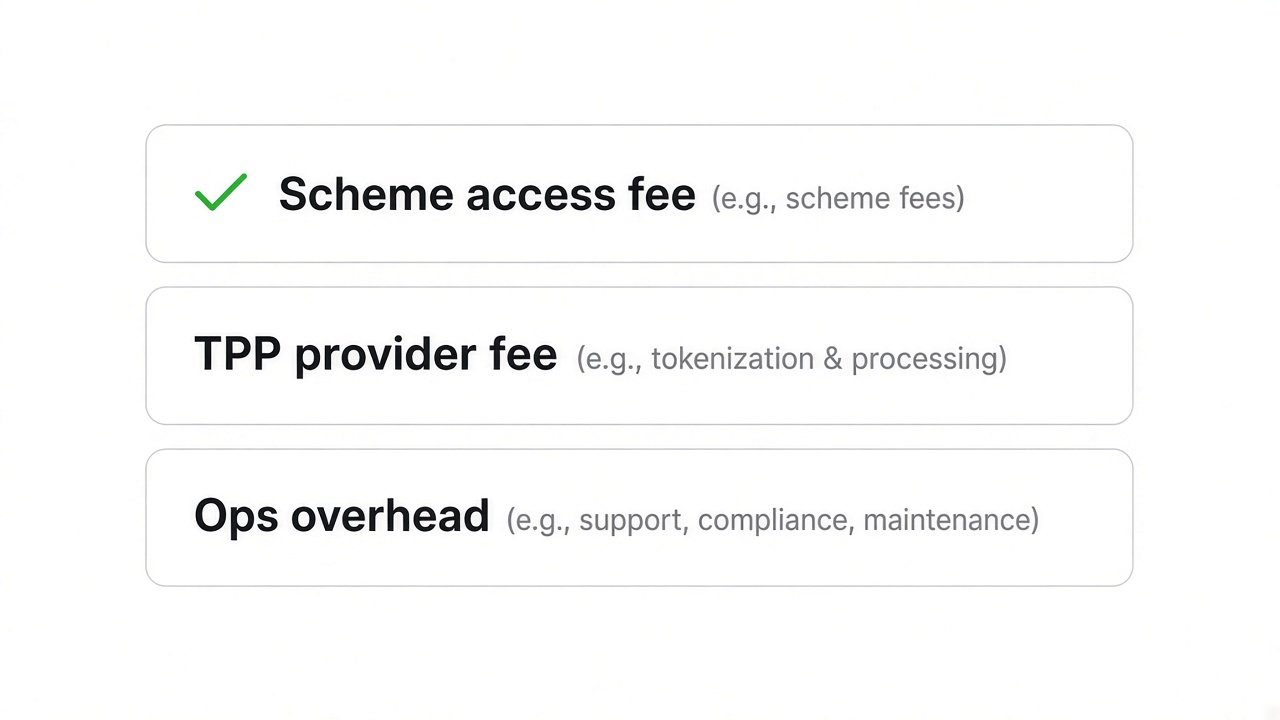
Commercial VRP economics: The full unit cost of collecting repeat payments via UK commercial variable recurring payments — UKPI access fees paid to banks, TPP or aggregator pricing, collections ops, and downside costs from insufficient funds, disputes, and coverage gaps — compared to Direct Debit and card-on-file alternatives.
For product mechanics see cVRP and variable recurring payments explained. For generic provider pricing shapes see open banking pricing models.
What makes commercial VRP economics different from sweeping?
Sweeping moved money between a customer's own accounts for free under CMA rules; commercial VRP collects to your business and carries regulated access fees plus provider margin.
That shift is why Finextra industry commentary in November 2026 framed cVRP as the end of open banking's compliance-only era — recurring merchant billing must justify its line on the P&L. Open Banking Limited's VRP overview describes mandate caps and customer control in the banking app; the economics question is whether Faster Payments settlement and lower dispute patterns offset new scheme and TPP costs.
Do not mix the two products in spreadsheets. VRP sweeping remains me-to-me with different pricing psychology; commercial VRP belongs next to Direct Debit and cards in your recurring stack model.
How do UKPI access fees stack under your TPP quote?
UKPI Wave 1 sets bank access fees through an FCA and PSR overseen pricing committee — your TPP passes them through, often with markup, minimums, or bundled tiers.
The FCA and PSR prioritisation statement on UKPI commercial VRP describes Phase 1 scope and interim commercial arrangements. Industry analysis published on Finextra in November 2026 notes that regulated per-transaction access fees break the earlier free API model for sweeping and give banks incentive to run reliable initiation paths for retail-scale collection windows.
When modelling:
| Layer | What to ask finance |
|---|---|
| Scheme access fee | Is it passed at cost or marked up? Does it change by ASPSP? |
| TPP success fee | Per successful pull only, or initiation attempts too? |
| Platform minimum | Does monthly minimum dominate at your pilot volume? |
| Failed pulls | Insufficient funds, cancelled consent — billable events? |
Stack access fees under provider quotes using the TCO framing in open banking pricing models — cVRP adds a scheme line that one-off pay-by-bank may not carry at the same intensity.
When does commercial VRP beat Direct Debit on cash and cost?
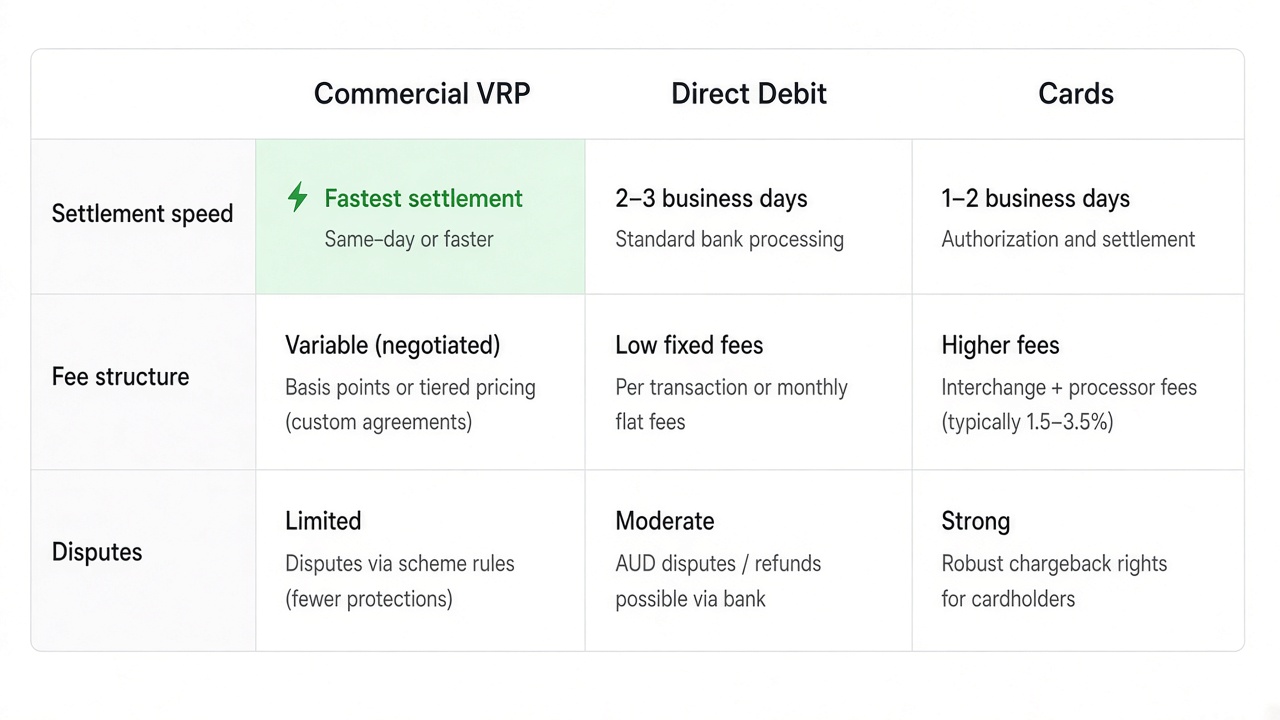
Commercial VRP wins on settlement speed and visibility into mandate status; Direct Debit still wins on universal UK reach and mature retry rails until cVRP coverage crosses your customer bank mix.
Faster Payments settlement means working capital arrives in hours, not the multi-day Bacs cycle Direct Debit uses. That matters for utilities with tight cash positions and for insurers tying collections to policy events. The trade-off is coverage: commentary in the Finextra piece cites roughly 75% current-account coverage as the threshold merchants treat cVRP as a core rail — below that, hybrid stacks dominate.
| Factor | Commercial VRP (cVRP) | Bacs Direct Debit |
|---|---|---|
| Settlement | Near real-time on success | Typically multi-day |
| Mandate visibility | Customer sees caps in banking app | Customer sees DD instruction |
| Failed payment insight | Often faster webhook on decline | Bacs return codes later |
| Retry maturity | Developing; provider-dependent | Decades of Bacs retriers |
| Scheme fee | UKPI access fee + TPP | Bacs sponsor fees (different shape) |
Most Wave 1 billers run cVRP plus Direct Debit fallback rather than a hard cutover — see operational patterns in open banking recurring dunning. Economics improve when a high share of payers bank with participating ASPSPs and success rates stay stable through peak windows.
How do commercial VRP economics compare to card-on-file?
Cards charge interchange and carry expiry and chargeback ops; cVRP anchors to bank accounts but lacks mature retry tooling and familiar dispute muscle for many customers.
Card-on-file still wins when payers demand chargeback protection habits or when interchange is subsidised by your acquirer deal. Commercial VRP economics improve when:
- Average ticket size is high enough that interchange hurts margin
- involuntary churn from expired cards is measurable in your cohort
- you need same-day cash more than chargeback mediation speed
Cards lose ground on authorization visibility — continuous authorities hide behind statements while cVRP caps sit in the banking channel, which can reduce silent churn from customers who forgot they opted in. You pay for that transparency with consent renewal work — budget it in ops, not only in API fees (VRP consent renewal).
Pair rail choice with bank on file vs card on file and recurring pay by bank implementation notes before you reprice products.
Which hidden costs blow up commercial VRP unit economics?
Insufficient funds without card-style retries, refund and dispute handling, fraud monitoring under APP reimbursement rules, and consent renewal campaigns all belong in the same unit-cost model as API fees.
Industry commentary flags three execution costs as cVRP scales beyond Wave 1: API resilience during peak collection windows, standardized refund and dispute rails, and inbound fraud calibration so legitimate variable pulls are not blocked as false positives. Those are not line items on a pricing PDF — they are FTE and vendor tooling.
Coverage and partial adoption
Pilot economics look cheap; national rollouts fail when 30% of payers bank with non-participating ASPSPs. Finance should model blend rates — cVRP success share times cVRP unit cost, plus fallback rail cost on the remainder — not headline cVRP-only cost.
Refunds and customer trust
Card networks trained consumers to expect frictionless refunds. cVRP reverse flows depend on provider and bank timeliness. Slow refunds show up as support tickets and NPS drag, not payment gateway fees. Ask providers about reverse payment APIs before you promise parity with card dispute SLAs.
Consent lifecycle
Expiry and cap increases trigger re-authentication — cheap if automated, expensive if your team re-onboards payers manually. Treat renewal conversion rate as a collections KPI tied to economics.
How should UK billers build a commercial VRP business case?
Start with three billing segments, model blended rail cost at real bank mix, and pilot one peak collection window before you commit headline savings.
Step 1 — Segment payers by bank concentration
Export the top five ASPSPs by payer count. Compare against your provider's published cVRP participation list. If concentration is low, economics start as a niche rail, not a DD replacement.
Step 2 — Model success and failure rates in sandbox
Run pulls that include insufficient funds and revoked consents. If your contract bills failed initiations, effective cost doubles quickly — the same discipline as sandboxing pay-by-bank checkout failures.
Step 3 — Time cash, not only fees
Finance should compare days to cash on cVRP versus DD on your dunning calendar. A slightly higher per-pull fee that lands same-day can beat a cheap Bacs pull that funds after working-capital stress.
Step 4 — Price Wave 2 ambitions separately
E-commerce and SaaS outside Wave 1 need UKPI Wave 2 recurring payments eligibility — do not assume today's economics for tomorrow's sectors.
Step 5 — Shortlist providers on economics enablers
| Criterion | Why it hits margin |
|---|---|
| Published UK bank list | Coverage drives blend rate |
| Webhooks for consent and payment | Lowers ops cost per failure |
| DD or pay-by-link fallback | Avoids stranded payers |
| Transparent access-fee passthrough | Prevents finance surprises |
| Sandbox for peak load | Proves API cost is not retry tax |
Use the provider-matching form with your top three segments, monthly pull volume, and current DD versus card mix — or compare criteria in best open banking providers for recurring transactions.
Frequently Asked Questions
What are commercial VRP economics?
Commercial VRP economics are the full unit costs and margin effects of collecting repeat payments via UK commercial variable recurring payments — including UKPI access fees, TPP pricing, ops for consent renewal and failures, and fallback rails — compared with Direct Debit and card-on-file.
How is commercial VRP pricing different from open banking checkout pricing?
Checkout pay-by-bank is usually one-off initiation with different volume curves and often lighter scheme fee exposure. Commercial VRP adds recurring UKPI access fees, consent lifecycle ops, and peak-window API reliability requirements. Model them on a per-successful-pull basis with your actual retry and failure mix.
Do commercial VRP economics include bank access fees?
Yes. Under UKPI Wave 1, payment initiation providers pay banks regulated access fees set under FCA and PSR oversight. Your contract may show them as passthrough, bundled, or marked up — finance needs the explicit line, not only the TPP's all-in pence rate.
When is commercial VRP cheaper than cards for recurring bills?
When interchange on your average ticket is material, expired cards drive involuntary churn, and a high share of payers bank with participating ASPSPs so success rates stay high. When chargeback mediation and consumer familiarity dominate, cards may still win on total cost of ownership.
When should billers keep Direct Debit alongside cVRP?
When payer banks are outside cVRP coverage, when Bacs retry partners already optimize your return rates, or when regulators and customers expect DD as the default mandate. Hybrid economics often beat forced 100% cVRP migration in Wave 1 sectors.
How does Wave 2 change commercial VRP economics for merchants?
Wave 2 extends commercial VRP toward broader e-commerce and subscription sectors with its own eligibility and pricing evolution. Today's Wave 1 unit-cost model does not automatically apply to SaaS or general retail — plan a separate business case when Wave 2 opens your category (UKPI Wave 2 recurring payments).
Commercial VRP economics are a margin discipline: scheme fees are visible for the first time, settlement is faster, and ops must own consent, refunds, and coverage blend rates. Billers who model all three rails on the same spreadsheet — and pilot peak collection before they cut card share — are the ones who know whether cVRP is strategic or a side rail. Start with your bank concentration export, then match providers that publish coverage and fee passthrough clearly.
Related articles
- VRP Consent Renewal: Keep UK Recurring Bank Pulls Live
Recurring revenue on bank rails fails quietly when consent expires — not with a declined card, but with a pull your billing engine was never allowed to fire. V…
- Open Banking Dunning: Bank-Rail Failed Payment Recovery
Involuntary churn on bank-rail renewals looks different from card dunning: there is no expired PAN to refresh, but consent can vanish overnight and insufficien…
- UKPI Wave 2 Recurring Payments: E-commerce Prep Guide
If you run a UK subscription business — SaaS, streaming, membership clubs, or general e-commerce with renewals — you have watched UKPI Wave 1 launch without yo…