FiDA Open Finance: What EU Teams Should Plan After 2026
FiDA open finance was meant to give EU firms a regulated route to customer-approved savings, insurance, investment, and pension data — the same way payment-account access works today. In early November 2026 the European Commission placed the Financial Data Access Regulation (FiDA) on the withdrawal list for its 2027 work programme, which stalls that EU-wide mandate. Payment teams still get a clearer path for bank accounts through the Payment Services Regulation (PSR), but product roadmaps that assumed uniform open finance across sectors need a new plan: commercial contracts, national schemes, and payment-only APIs.
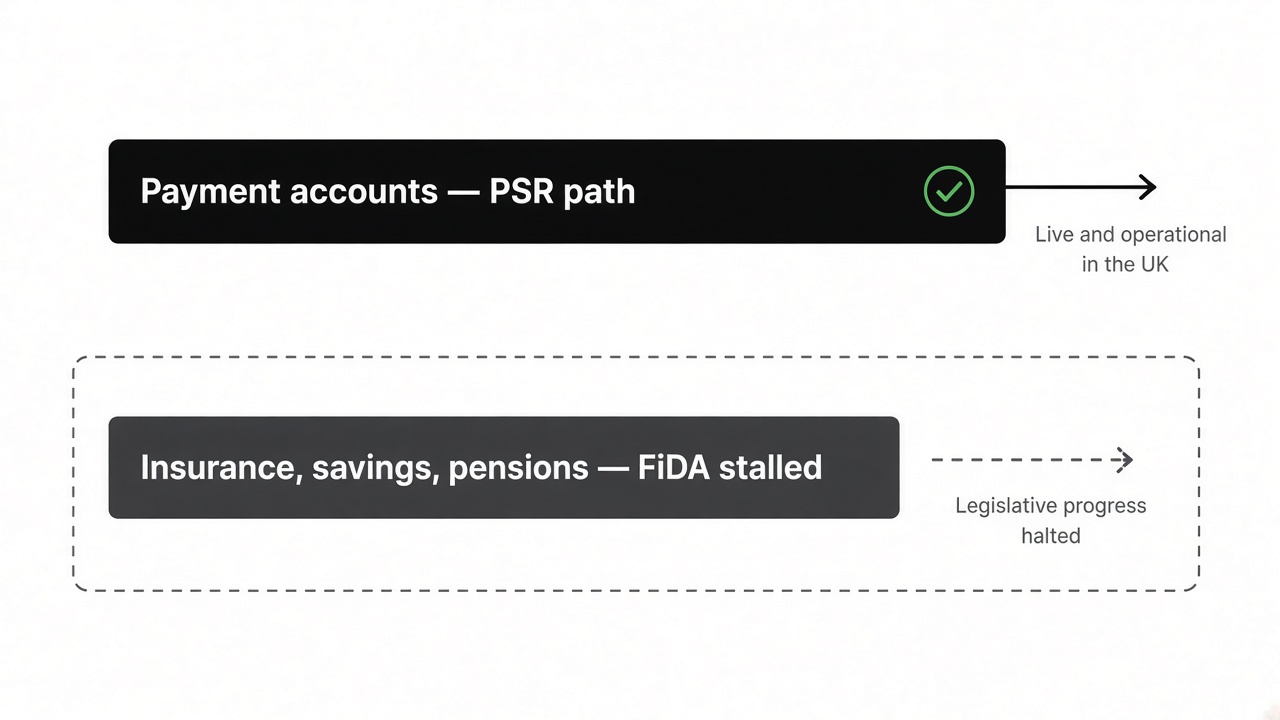
FiDA open finance: The EU proposal to extend customer-permissioned data sharing beyond payment accounts to savings, investments, pensions, and insurance — under harmonised access rules, dashboards, and fees. With FiDA on the Commission’s 2026 withdrawal list, that cross-sector mandate is paused; payment-account access continues to evolve separately through PSD3 and the PSR.
For payment-initiation and account-information mechanics today, see AIS vs PIS in open banking. For PSD3 timing and API quality rules, see PSD3 open banking.
What happened to FiDA open finance in November 2026?
The Commission signalled withdrawal before adoption, not a repeal of an existing law. FiDA was proposed in June 2023 to build an EU-wide open finance framework next to payment services. On 4 November 2026 the Commission included it on the withdrawal list annexed to its 2027 work programme — meaning the executive does not intend to pursue adoption in the current cycle unless Parliament or Council objections change that trajectory. Withdrawal still requires formal procedure; teams should treat FiDA as on hold, not dead.
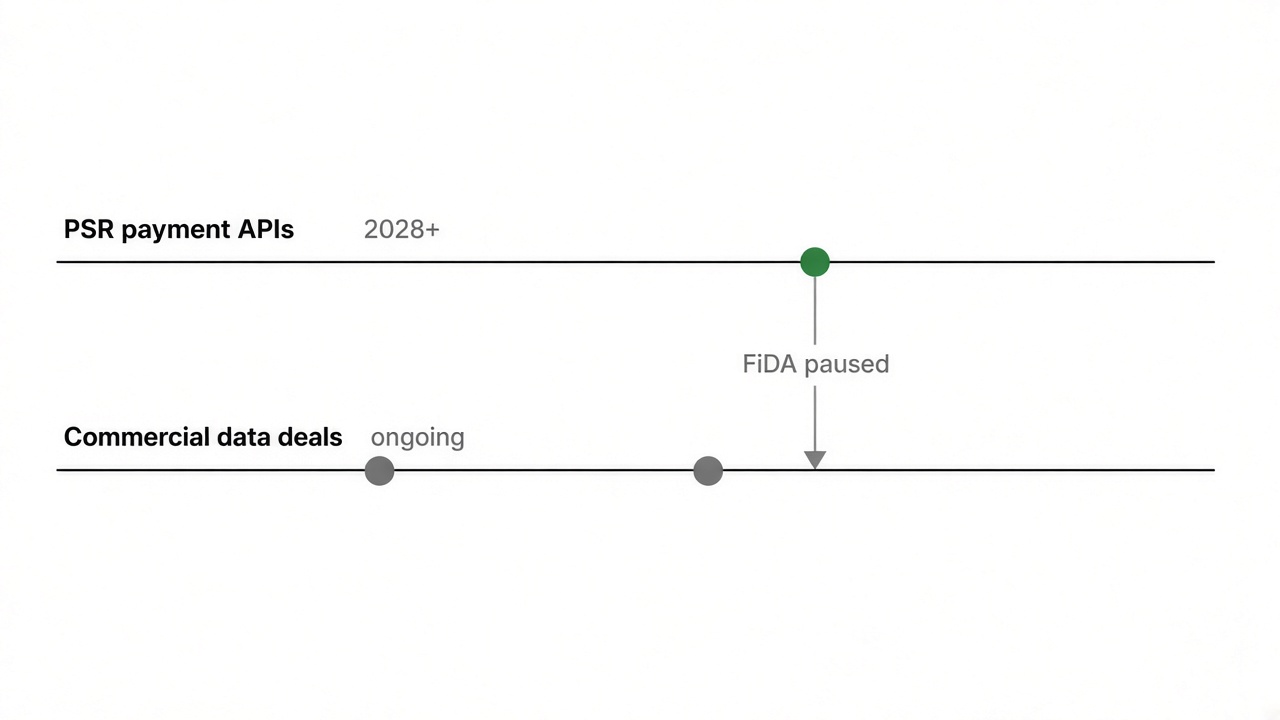
Parallel payments reform moved forward on a different track. The EU Council adopted its first-reading positions on PSD3 and the PSR on 29 October 2026, with the Commission accepting those texts on 3 November 2026. Industry trackers report Parliament referred the package to ECON for second reading on 12 November 2026, with plenary adoption still pending. That split — payments regulation advancing, open finance mandate paused — is the headline for EU roadmaps this quarter.
How does FiDA differ from PSD3 open banking for your product?
PSD3 and the PSR govern who may access payment accounts and how bank APIs must perform; FiDA would have governed every other retail financial product you might want to read or port.
| Topic | PSR / PSD3 (payments track) | FiDA (open finance track — stalled) |
|---|---|---|
| Data scope | Payment accounts, initiation, account information | Savings, investments, pensions, insurance, other financial data |
| Legal status (Nov 2026) | Council first reading adopted; Parliament second reading | On Commission withdrawal list |
| Typical buyer | Billing, collections, onboarding, lending on bank data | Wealth, insurance, holistic finance apps |
| Access model | Dedicated AIS/PIS interfaces, consent dashboards planned | Would have mirrored access rights plus data-holder controls |
If your roadmap only needs pay by bank, verification, or transaction history from current accounts, the PSR track is the one to model. If you pitched investors on one EU API for insurance plus banking plus investments, FiDA’s stall pushes you back to bilateral data deals, national initiatives, or screen-based access outside payments — each with different risk and cost profiles.
What does FiDA’s stall mean for data beyond payment accounts?
You keep GDPR portability and contracts, not a harmonised EU right to pull pension or policy data on demand.
Without FiDA:
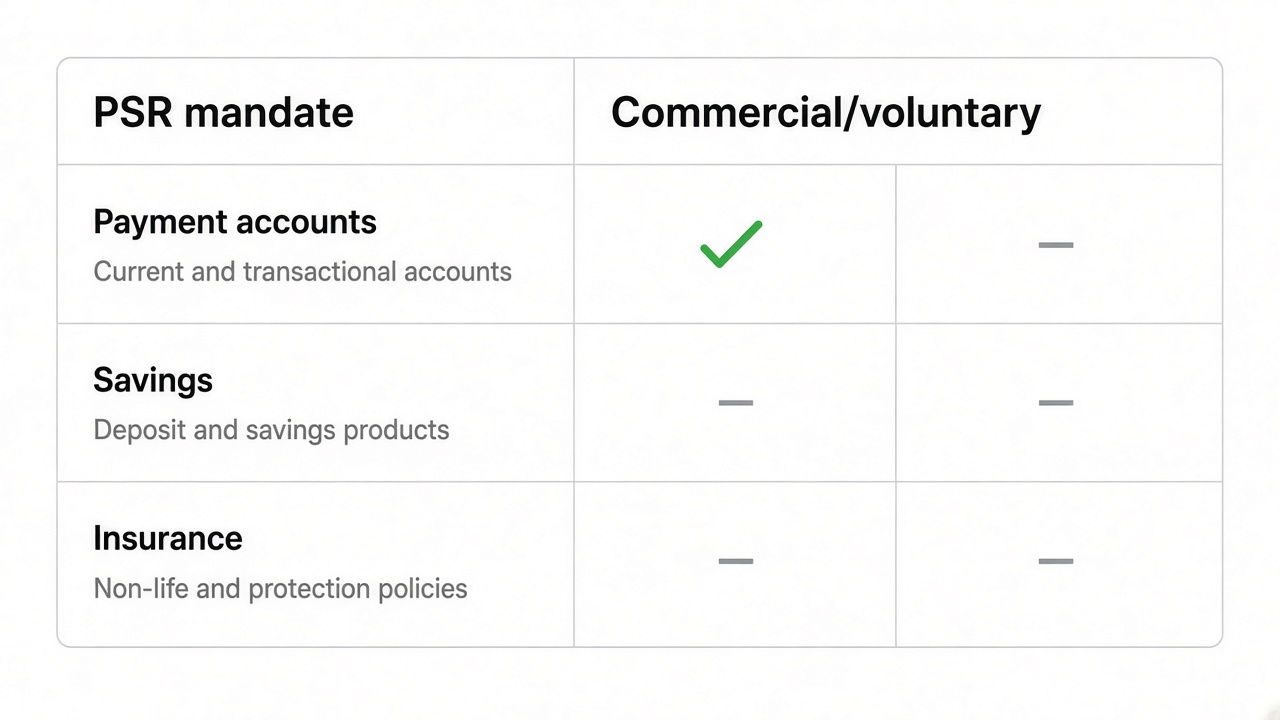
- Payment accounts remain the only sector with an EU-wide access mandate in flight — carried into the PSR with tighter interface rules, fraud obligations, and permission dashboards once the package applies (roughly 21 months after Official Journal publication, per Council-approved texts).
- Savings, credit, pensions, and insurance fall back to national law, voluntary industry schemes, and commercial API programmes. There is no single technical standard obligation comparable to PSD2 for those products in 2026.
- Screen scraping and credential sharing for non-payment data were FiDA’s intended replacement target. Pausing FiDA leaves those practices governed mainly by contract terms and GDPR — higher operational and conduct risk for teams that hoped regulation would standardise access.
For insurance-specific jobs-to-be-done that still rely on bank rails today, cross-read open banking insurance use cases — bank transaction data remains available through licensed providers even when policy data does not.
How should product and payments leads replan their 2027 roadmaps?
Sequence payment-account launches on PSR timing, and quarantine non-payment data bets until you have signed data-holder agreements.
A practical replan:
- Confirm your data categories — List each dataset (current account AIS, investment holdings, pension pots, policy details). Mark which are covered by payment regulation vs commercial only.
- Align payment engineering to PSR milestones — Interface KPIs, consent refresh, and payee verification requirements will land on the PSR clock, not FiDA. Budget provider upgrades on that timeline (see PSD3 open banking).
- Replace FiDA assumptions in business cases — Revenue models that relied on mandatory access fees or standard dashboards for insurers need new counterparties and pricing discipline.
- Evaluate voluntary schemes — Payment-account access schemes such as SPAA remain industry-led; participation and pricing vary by bank. Treat them as optional accelerators, not guaranteed coverage.
- Document conduct risk — Teams exploring non-payment aggregation without FiDA should record legal review of credential sharing and customer disclosures.
When you are ready to compare providers that still cover your payment-account scope across EU markets, use the provider-matching form to filter on countries, use cases, and webhook quality before deep contract review.
What should you ask providers and data holders now?
Procurement should separate “PSR-ready payment coverage” from “optional non-payment feeds” and get written roadmaps for each.
Questions for TPPs and aggregators:
- Which datasets beyond payment accounts are contractual today, and which banks actually produce them in production?
- How will you report per-bank API performance when PSR interface KPIs apply?
- What is your plan if a data holder revokes commercial access — do you have customer communication templates?
- Do you still rely on non-regulated access paths for savings or investment views, and how is that disclosed to our compliance team?
- How does consent management differ between AIS payments data and any voluntary insurance or wealth feeds?
Questions for insurers, wealth platforms, or pension administrators as counterparties:
- Do you offer a premium API with audit trails, or only batch files?
- Who owns customer permission UX — you, us, or a joint portal?
- What are renewal, pricing, and termination terms if FiDA never returns?
Developers should still benchmark payment APIs using best open banking API providers for developers (2026); this article adds market-structure context, not a vendor ranking.
How does FiDA open finance compare with the UK direction?
The UK continues open banking and wider smart-data work domestically while the EU pauses FiDA — cross-border products need two regulatory stories.
The UK’s open banking framework and emerging smart-data schemes pursue wider data use cases through national policy, separate from FiDA. EU entities serving UK customers still follow UK rules locally; EU-only products lose the promised single-market open finance layer FiDA represented. For a side-by-side regulatory map, see open banking UK vs EU.
FAQ
What is FiDA open finance?
FiDA open finance refers to the EU’s proposed Financial Data Access Regulation, which would have required financial firms to share customer-permissioned data across savings, investments, pensions, insurance, and other products under harmonised EU rules. It sits beside payment-account access under PSD2 and the PSR. In November 2026 the European Commission placed FiDA on its withdrawal list for the 2027 work programme, pausing adoption.
Is FiDA already law in the EU?
No. FiDA was proposed in 2023 but not adopted. The Commission’s November 2026 withdrawal list signals it does not intend to complete the legislative process in the current cycle unless institutional objections alter that course. Until formal withdrawal completes, monitor Commission, Parliament, and Council statements rather than planning product launches on FiDA rights.
Does FiDA’s stall stop PSD3 and the PSR?
No. PSD3 and the PSR are a separate legislative package focused on payment services and payment-account access. The Council adopted first-reading positions in October 2026, and Parliament’s second reading was underway in November 2026. Payment-account open banking rules should still apply on the PSR timeline after Official Journal publication, independent of FiDA.
Can we still access insurance or pension data in the EU?
Yes, but mostly through commercial agreements, national schemes, or customer-authorized channels rather than a uniform FiDA mandate. Payment-account transaction data remains available through licensed open banking providers. Policy, pension, and investment datasets require direct contracts with data holders or providers that have negotiated access — validate production coverage before you ship.
What replaces FiDA for cross-sector finance apps?
There is no single EU replacement in late 2026. Teams combine payment-account APIs (regulated), voluntary industry schemes, bilateral APIs, and — where legally permitted — credential-based aggregation with heightened compliance review. Agentic payment experiments add demand for structured data; card networks are publishing agent rules faster than open finance outside payments.
How should we choose providers while FiDA is on hold?
Prioritize payment-account coverage, PSR readiness communication, webhook reliability, and transparent reporting on non-payment datasets that are contractual only. Compare options through structured evaluation — how to choose an open banking provider in the EU — rather than assuming a future FiDA mandate will standardize access.
Related articles
- Open Banking in Poland: Coverage and Provider Fit
Poland is where many EU payment roadmaps add Central Europe — a large banked population, fast mobile adoption, and heavy use of bank transfers for B2B invoices…
- Open Banking in Italy: Coverage and Provider Fit
Italy is where many EU payment roadmaps add Southern Europe — large retail banks, strong mobile banking, and heavy use of bank transfers for B2B invoices — yet…
- European Network for Payments: What ENP Means for Merchants
Cross-border checkout still fragments when every country ships its own bank-app wallet — Spanish shoppers live in Bizum, Nordics in Vipps MobilePay, and Wero k…