UK Open Banking Adoption: What 1 Billion Payments Means for B2B
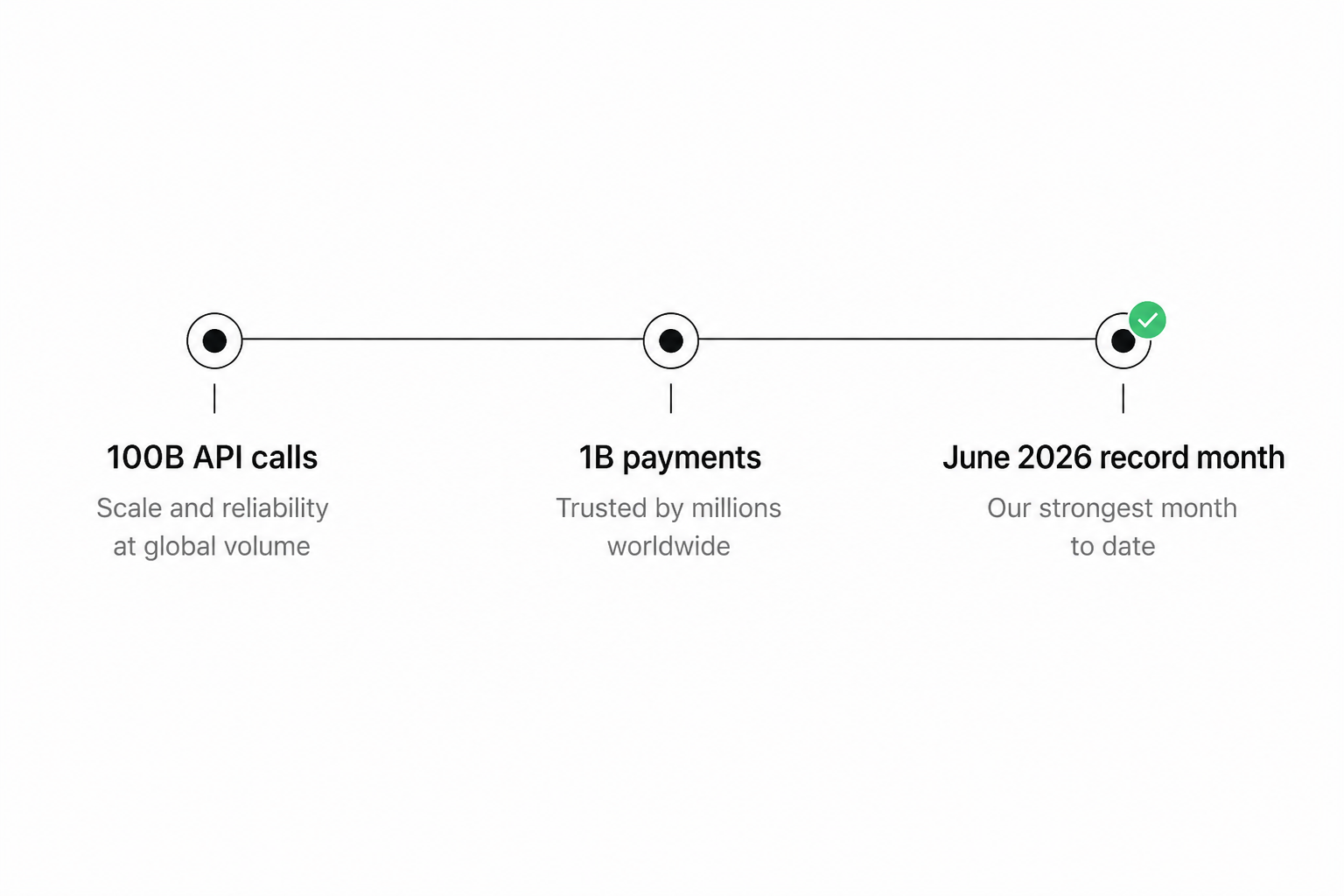
If you sell into the UK and still treat pay-by-bank as a pilot, the scale numbers just moved again. On 30 July 2026, Open Banking Limited reported that the UK ecosystem has passed one billion cumulative open banking payments and 100 billion API calls since launch — with June 2026 setting a record 2.81 billion API calls in a single month. For payments and product leads, UK open banking adoption is no longer an early-adopter story: it is live infrastructure with measurable volume, improving response times, and recurring flows growing faster than one-off checkout.
UK open banking adoption: The sustained growth in UK consumers and businesses using bank-initiated payments and account-data services — measured by payment volumes, active connections, and API traffic across participating banks — indicating that pay-by-bank and recurring bank collections are mainstream infrastructure rather than experimental rails.
What do the July 2026 UK open banking adoption numbers show?
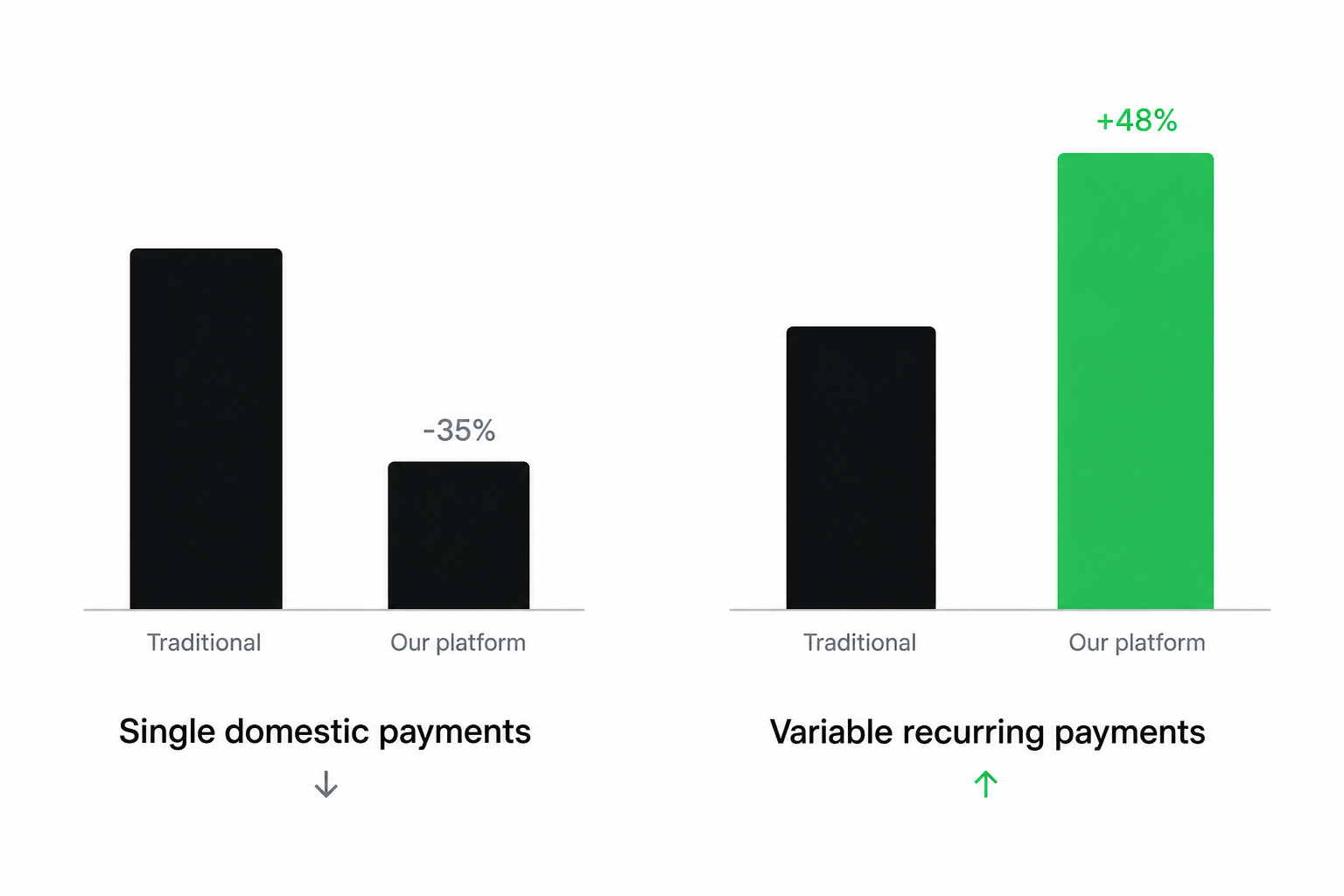
The UK crossed one billion cumulative open banking payments and 100 billion API calls, with June 2026 recording the highest monthly API volume to date at 2.81 billion calls (+4.4% month on month) and 40.16 million payments — while variable recurring payments (VRP) grew 6.7% even as single domestic payments dipped 1.2%.
According to Open Banking Limited's 30 July 2026 announcement, the milestones cover activity across the CMA9 banks since open banking launched more than eight years ago. The June snapshot is what matters for 2026 roadmaps:
| Metric (June 2026) | Value | Month-on-month change |
|---|---|---|
| API calls | 2.81 billion | +4.4% (record month) |
| Open banking payments | 40.16 million | Resilient overall |
| Single domestic payments | — | −1.2% |
| Variable recurring payments | — | +6.7% |
| Average payment response time | 349 ms | 50 ms faster than prior period |
Two signals stand out for B2B teams. First, API traffic keeps accelerating — a proxy for data, verification, and payment services embedded in apps rather than one-off checkout experiments. Second, VRP is the growth pocket inside payment volumes, which aligns with UKPI Wave 1 commercial recurring launches and the recurring billing content your finance team already tracks under recurring pay by bank.
Why does UK open banking adoption matter for pay-by-bank checkout?
Higher adoption reduces customer friction at checkout: more UK bank apps already support account-to-account initiation, so pay-by-bank stops feeling unfamiliar and failure rates from "unsupported bank" drop for well-integrated providers.
Checkout teams usually worry about three things — conversion, cost per successful payment, and ops load when a method fails silently. Scale data does not replace your A/B tests, but it changes the prior:
- Consumer familiarity — When millions of users already authorise bank connections for money management and payments, checkout copy can lead with speed and security instead of explaining the concept from zero
- Provider reliability — Record API volumes paired with 349 ms average response times suggest ecosystem participants are optimising latency; that directly affects drop-off between "Pay from bank" and confirmation
- Competitive positioning — Merchants adding pay by bank alongside cards are aligning with rails that moved 40 million payments in one month, not a niche beta
Adoption is UK-specific. If you operate across regions, pair this milestone read with open banking UK vs EU so EU checkout teams do not assume identical bank coverage or consent UX.
What adoption does not guarantee
Volume does not mean every bank or account type supports every flow on day one. Commercial VRP still follows UKPI sector gates; one-off PIS coverage remains ahead of recurring for many merchants. Treat adoption as permission to prioritise, not proof that your exact use case is fully live.
How is VRP growth changing recurring billing plans?
VRP rising 6.7% month on month while single domestic payments fell 1.2% suggests UK teams evaluating subscriptions, invoices, and membership billing should weight recurring bank rails more heavily in 2026 provider shortlists.
Recurring collections fail for predictable reasons: expired cards, soft declines, and reconciliation gaps. Bank-on-file style VRP addresses the first two by keeping authorisation inside the customer's bank app with agreed limits. The June split — flat to slightly down on one-off domestic, up on VRP — mirrors what providers have marketed since UKPI Wave 1 went live.
Practical planning steps:
- Segment your churn — If involuntary churn from card expiry dominates, model VRP for eligible UK sectors (utilities, charities, financial services, parts of the public sector in Wave 1)
- Pilot with fallback — Run variable recurring payments in sandbox with Direct Debit or card backup until your bank coverage hits your threshold
- Track scheme economics — Commercial VRP carries scheme fees; stack them under provider quotes using open banking pricing models before you commit margin assumptions
Statutory VRP access and the wider UK open banking regulatory framework will extend coverage over 2027 — but June's VRP growth shows demand is already building inside today's voluntary and Wave 1 commercial rails.
What should B2B teams ask providers after the milestone?
Use the milestone to pressure-test coverage, latency SLAs, and recurring readiness — not to re-litigate whether open banking "works" in the UK.
| Question | Why it matters now |
|---|---|
| Which CMA9 banks do you support for PIS and VRP in production? | Adoption is national; your conversion is bank-specific |
| What p95 initiation latency do you see in UK sandbox vs production? | OBL reports ecosystem average 349 ms — your provider should beat or explain gaps |
| How do you handle VRP limit changes and failed re-presentations? | VRP growth implies more billing teams will hit edge cases |
| What UKPI Wave 1 sectors are live for your merchants today? | Sector gates still separate checkout-scale from recurring-scale |
| How do API call volumes translate to your commercial pricing? | Rising API traffic may affect aggregator unit economics |
When you shortlist open banking providers, weight UK production references and June-era performance claims — generic "global open banking" decks understates how concentrated UK volume is across nine banking groups.
How should you act on UK open banking adoption in Q3 2026?
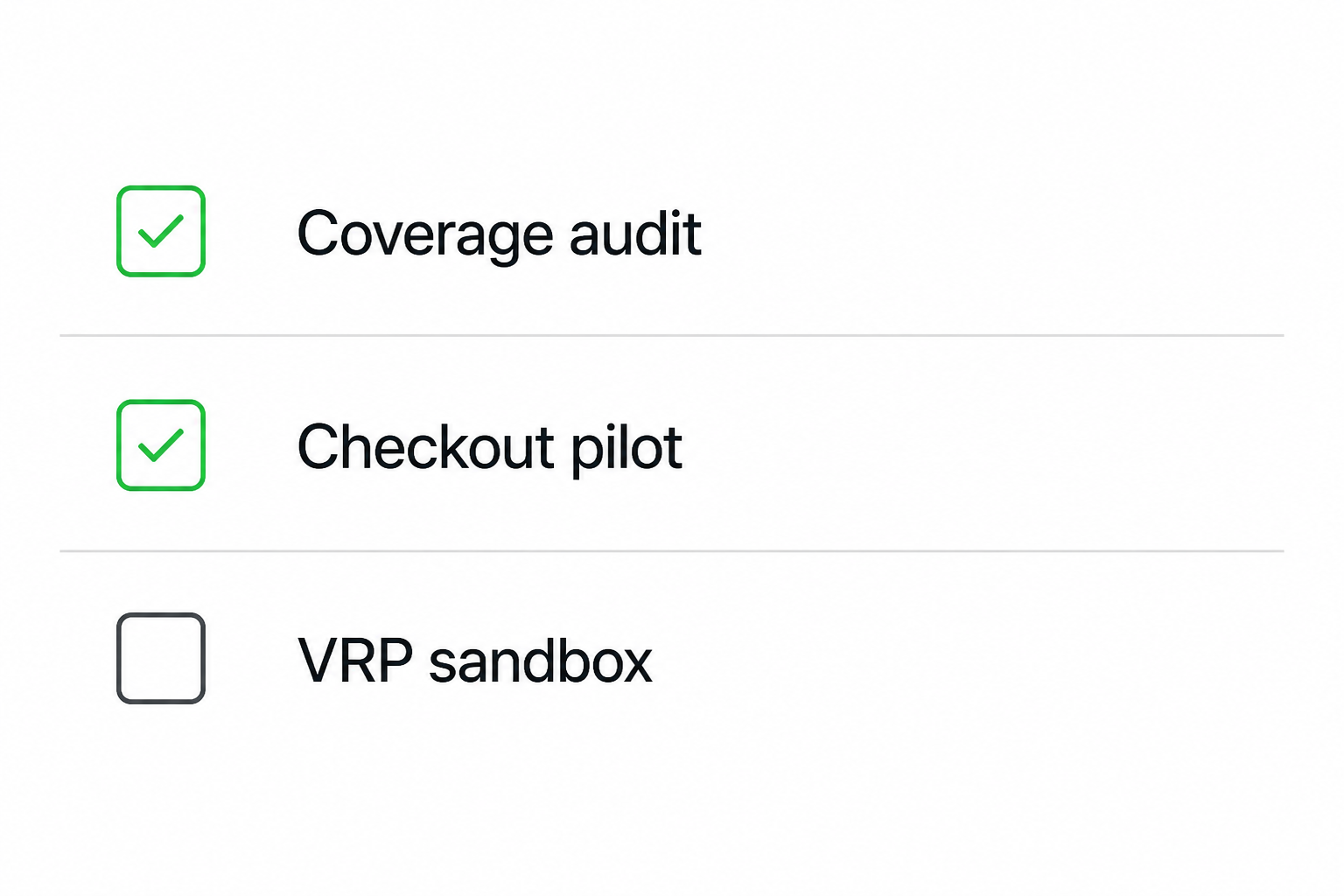
Run a 30-day UK coverage audit, launch or expand pay-by-bank checkout where PIS already clears your top banks, and open a VRP sandbox if recurring churn hurts margin — without waiting for every 2027 regulatory final.
Suggested sequence:
Week 1–2: Coverage and latency baseline. Pull your top ten customer banks by GMV or invoice value. Match them against your provider's live PIS and VRP lists. Log sandbox initiation times against the 349 ms ecosystem benchmark.
Week 3–4: Checkout experiment. If three or more major banks clear, add pay-by-bank to one high-intent funnel (renewals, balance due, guest checkout). Measure authorisation rate and time-to-confirm versus cards — not just headline conversion.
Parallel track: Recurring economics. If VRP applies to your sector, model one SKU on bank-on-file with explicit fallback. Compare all-in cost to card-on-file including chargeback and retry ops.
Do not defer UK checkout because "adoption is still early" — the billion-payment threshold says otherwise. Do defer enterprise-wide recurring migration until sector gates, fallback rails, and finance sign-off on scheme fees are documented.
When you need providers with proven UK pay-by-bank and recurring coverage, use the provider-matching form to narrow the field before a full RFP.
Frequently Asked Questions
What is UK open banking adoption?
UK open banking adoption is the rate at which consumers and businesses connect bank accounts and use open banking-powered services — including pay-by-bank checkout, account verification, and variable recurring payments — across participating UK banks. Open Banking Limited tracks adoption through metrics such as API call volumes, payment counts, and active user connections.
How many open banking payments has the UK processed?
Open Banking Limited reported in July 2026 that the UK ecosystem surpassed one billion cumulative open banking payments since launch, with 40.16 million payments recorded in June 2026 alone across CMA9 banks.
How fast is UK open banking growing in 2026?
In June 2026, the UK recorded 2.81 billion API calls, up 4.4% month on month and the highest monthly volume reported to date. Variable recurring payments grew 6.7% month on month in the same period, while single domestic payments declined 1.2%.
Does UK open banking adoption mean VRP is available for every merchant?
No. Adoption growth includes both one-off pay-by-bank and recurring VRP, but commercial VRP still follows UKPI sector and bank participation rules. E-commerce at national scale may need to wait for later UKPI waves even while aggregate VRP volumes rise.
Why did average payment response times improve to 349 ms?
Open Banking Limited's June 2026 performance data cites ecosystem-wide optimisation by participating banks and providers, with average response times 50 ms faster than the previous reporting period. Lower latency typically reduces checkout abandonment between bank authorisation and merchant confirmation.
How should EU businesses interpret UK adoption statistics?
UK adoption reflects CMA9 bank participation and UK-specific schemes such as UKPI. EU merchants should treat the milestone as evidence that pay-by-bank can reach mainstream scale in a single market, then validate their own country coverage separately — UK volume does not automatically transfer to PSD2 markets.
When should we add pay-by-bank to our UK checkout?
Add pay-by-bank when your provider supports PIS for banks covering a meaningful share of your UK customers and sandbox latency is acceptable. The July 2026 billion-payment milestone supports prioritisation; your go-live timing still depends on bank coverage, UX design, and fallback when initiation fails.
Conclusion
UK open banking adoption crossed two symbolic thresholds in July 2026 — one billion payments and 100 billion API calls — with June data showing record API traffic and VRP growing faster than one-off domestic payments. For B2B teams, the takeaway is operational: pay-by-bank is mainstream infrastructure, recurring bank collections are accelerating, and provider evaluation should focus on bank coverage, latency, and UKPI readiness rather than whether the market is "ready." Run the coverage audit, pilot checkout where banks align, and model VRP where sector rules allow.
Related articles
- Open Banking in France: Coverage and Provider Fit
France sits on many EU payment roadmaps — large banked population, strong mobile banking apps, and heavy B2B invoice volume — yet open banking France on a prov…
- Pay by Bank Netherlands: iDEAL to Wero Migration Guide
If you sell into the Netherlands, most of your online revenue probably arrives through iDEAL — bank-account checkout that Dutch shoppers treat as the default.…
- UK Open Banking Regulatory Framework: What Changed in July 2026
UK pay-by-bank and recurring billing roadmaps just got a fixed destination date. On 14 July 2026, HM Treasury opened its Modernising Payment Services Regulatio…