Pay by Bank UK Small Business: Multi-Rail Checkout That Wins Sales
UK sole traders and sub-£2m businesses lose revenue when checkout only supports one rail — especially when a buyer wants to pay from a banking app instead of typing card details on a phone. Pay by bank UK small business programmes add account-to-account checkout alongside cards and newer in-person contactless options, so you can close the sale without extra terminals or heavy finance admin. This guide maps when bank-rail pay fits UK SMB flows, how it sits next to Tap to Pay, what UK Payments Initiative (UKPI) sector rules still mean in 2026, and which provider questions matter before you switch on a second payment method.
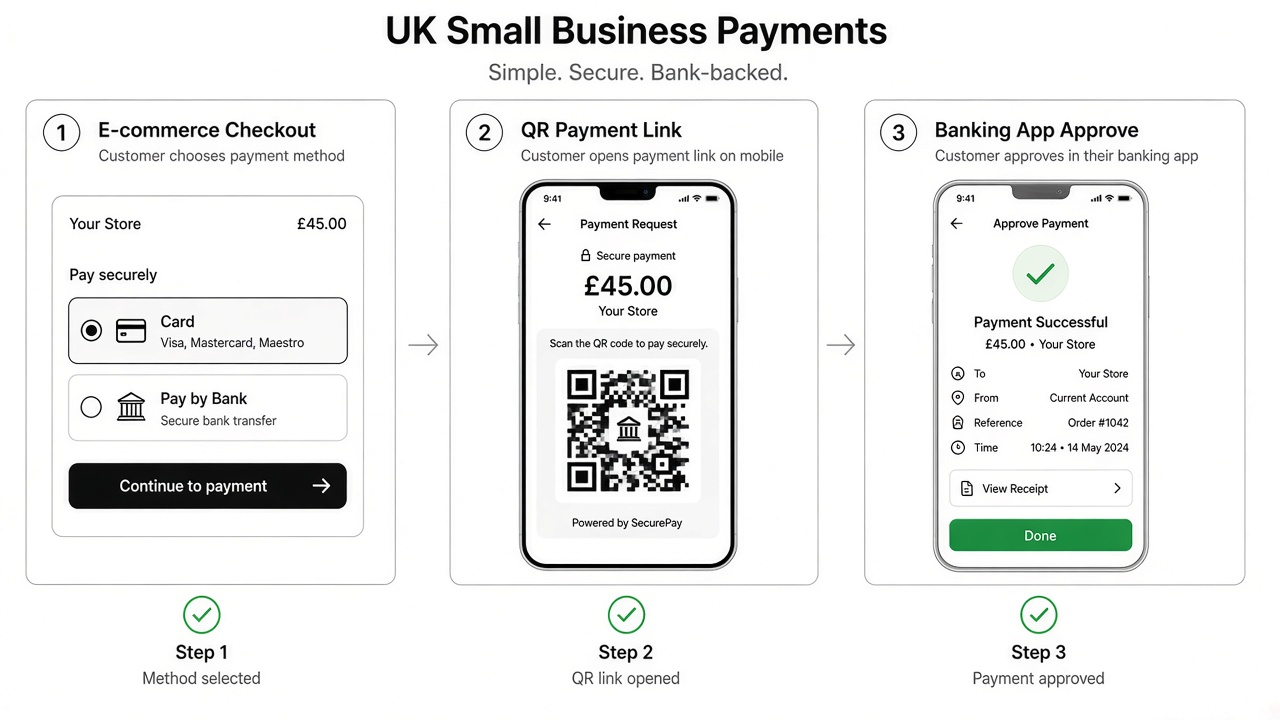
Pay by bank UK small business: Letting UK customers approve a one-off or recurring bank transfer from their banking app at checkout, on an invoice link, or via QR — so sole traders and small firms collect with lower variable cost than many card flows and clearer references for finance, without replacing every in-person card terminal.
For the core rail definition, see pay by bank explained. For conversion UX detail, see pay by bank checkout conversion.
Why are UK small businesses adding pay by bank now?
One in three UK small business owners surveyed report losing a sale when they could not accept the customer's preferred payment method — and bank-app pay closes part of that gap for online and invoice-led revenue without new hardware.
Finextra reported in November 2026 that HSBC UK and Stripe launched Tap to Pay for eligible business-banking customers after Censuswide research among 594 UK firms with turnover below £2 million. 33% had lost a sale for that reason; 52% called contactless acceptance essential; 78% spent at least an hour a week on payment administration.
Tap to Pay solves in-person contactless on a phone. Pay by bank solves a different slice: buyers who prefer bank approval for larger baskets, B2B-style invoices, or lower-fee domestic transfers on your website. Most UK SMBs need both — not a swap.
According to Open Banking Limited, cumulative UK open banking payments passed one billion in 2026 — growth is still weighted to one-off initiation, which matches how small firms start: one checkout segment or payment-link flow before expanding.
Which pay-by-bank use cases fit UK sole traders and micro-businesses?
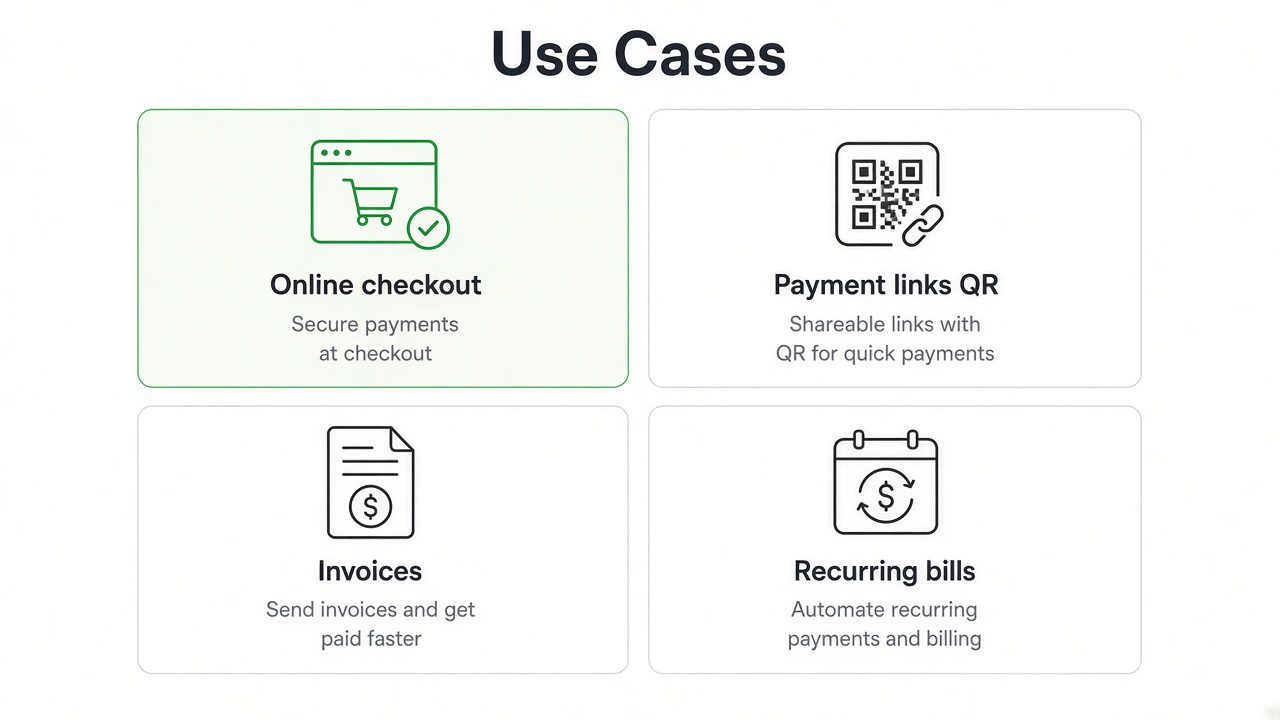
Start where you already send customers a payment request — e-commerce checkout, emailed quotes, and recurring bills in UKPI Wave 1 sectors — not every in-person queue.
Online shop and booking checkout
Add pay by bank next to cards on mobile-heavy flows. Domestic UK buyers often complete bank-app authorisation quickly when your bank list matches their institution — apply the same placement rules as pay by bank checkout conversion: visible at payment step, fee and settlement copy before redirect.
Payment links and QR (no card terminal)
Hosted pay by bank payment links suit market stalls, trades, consultants, and training businesses: SMS, email, or printed QR with amount and reference locked. No Stripe terminal required — validate mobile handoff on iOS and Android before you retire manual IBAN instructions.
Invoices and professional services
For B2B-light workflows — accountants, agencies, installers — bank pay on pay by bank invoice payment patterns beats chasing card numbers on email. Reference fields must match what your buyer's bank displays.
Recurring where UKPI allows
Recurring bank pay under UKPI Wave 1 covers named sectors (utilities, energy, financial services, government, charities, and related billers). General e-commerce subscriptions wait on Wave 2 timing discussed in recurring pay by bank. Do not market cVRP-style collection outside your sector gate.
What stays on cards or Tap to Pay
Tourist-heavy card spend, amex-heavy corporates, and counter contactless under £100 remain card territory. Finextra's HSBC/Stripe story targets phone-as-terminal for card wallets — complementary to, not a substitute for, open-banking checkout on your site.
How does UKPI affect what a small business can offer?
UKPI sets which sectors can charge recurring bank pay today and how fees are framed — your marketing promise must match your sector eligibility, not generic "open banking subscription" slogans.
UKPI commercial models and Wave 1 sector lists are published through industry bodies including UK Finance and Open Banking Limited. For a sole trader selling physical goods online only, one-off pay by bank is the realistic 2026 starting point unless you qualify for Wave 1 recurring sectors.
| Topic | Practical SMB takeaway |
|---|---|
| One-off checkout | Widest eligibility via licensed payment-initiation providers |
| Recurring / cVRP | Sector-gated; confirm your SIC and use case before copy promises |
| Pricing vs cards | When card fees dominate headlines, model effective cost per success — see pay by bank UK card fees |
| Consumer protection | Bank-rail disputes differ from card chargebacks — staff scripts matter |
This is not legal advice; validate sector wording with your provider and compliance adviser before public campaigns.
What admin and ops workload should owners expect?
Bank-rail checkout reduces some card disputes but adds webhook monitoring and bank-list maintenance — budget time up front so the "one hour a week" payment admin problem does not shift to reconciliation exceptions.
The HSBC/Stripe research cited on Finextra found 69% of SMBs believe customers wait no longer than five minutes when payment fails; 34% cap patience at two minutes. Pay-by-bank journeys fail differently from card auth declines — stuck redirects, wrong bank selected, or awaiting settlement — so surface retry paths and support numbers on the payment page.
Operational checklist:
- Webhook-first posting — never mark an order paid on browser return alone (same rule as payment links).
- Reference discipline — order ID on the bank confirmation screen reduces finance matching time.
- Settlement messaging — Faster Payments is often same day but not instant on every bank pair; under-promise on product pages.
- Outage fallback — keep cards live when banks maintenance-window during month-end; see pay by bank bank outage playbooks.
- Admin consolidation — if you already use Stripe for Tap to Pay, still compare whether open-banking initiation sits on the same contract or needs a UK TSP — reconciliation keys should align.
Which provider criteria matter for UK small business pay by bank?
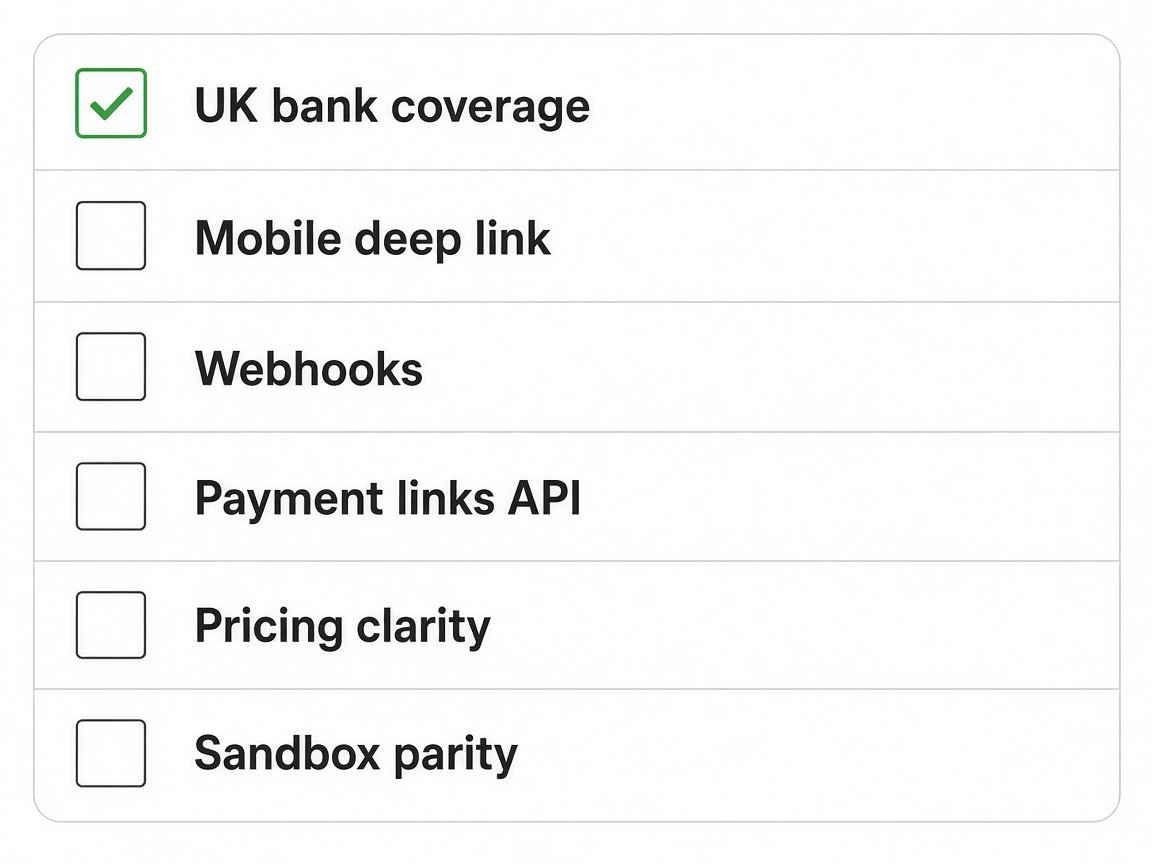
Shortlist on UK retail-bank coverage, mobile deep links, payment-link APIs, transparent per-success pricing, and sandbox tests with your top three customer banks.
| Criterion | Question for UK SMB buyers |
|---|---|
| UK coverage | Do your customers' high-street banks appear and rank correctly on mobile? |
| Hosted vs API | Can you launch payment links without a developer sprint? |
| Webhooks | Final status without manual bank-statement checks? |
| Wave 2 readiness | Will one contract cover recurring when your sector qualifies? |
| Support hours | Who answers when a payer abandons at 9pm Saturday? |
| Pricing shape | Per-success fee vs monthly minimum — model at your average order value |
Run a two-week pilot on one channel (e.g. invoice links) with funnel metrics: link open → bank selected → webhook accepted. Compare support tickets against card-only weeks.
When you want coverage mapped to your UK banks and order mix, use the provider-matching form — or start from how to choose an open banking provider in the EU for baseline evaluation dimensions.
How do you roll out pay by bank without hurting in-person sales?
Pilot online or invoice-led bank pay first; add Tap to Pay or card terminals for face-to-face separately — forcing one rail everywhere recreates the "lost sale" problem in reverse.
Suggested sequence:
- Measure lost sales — survey or tag checkout abandonment reasons; align with the Finextra stat pattern if you lack your own data.
- Turn on bank pay for one SKU band or service type — measure completion vs cards on the same traffic.
- Train front-of-house on rails — "You can pay by card, contactless, or bank transfer from your phone" only if each path actually works.
- Expand links and QR after web checkout metrics stabilize — each channel adds support load.
- Revisit recurring when UKPI Wave 2 matches your sector — keep Direct Debit or cards until then if needed.
Frequently Asked Questions
What is pay by bank for UK small businesses?
Pay by bank for UK small businesses lets customers approve account-to-account payments from their banking app at online checkout, on a hosted payment link, or via QR — without entering card details. Sole traders and micro-businesses use it to lower variable fees on eligible sales and improve payment reference data for bookkeeping.
Is pay by bank the same as HSBC Tap to Pay with Stripe?
No. Tap to Pay accepts contactless cards and digital wallets on a compatible phone through Stripe onboarding with HSBC UK, as described in Finextra's November 2026 coverage. Pay by bank moves money bank-to-merchant via open-banking initiation — different UX, economics, and chargeback patterns. Many firms offer both.
Do UK sole traders need a payment terminal for pay by bank?
No for online checkout and payment links — the customer authorises in the banking app. For in-person collection without a card reader, QR payment links are common; for contactless card wallets at the counter, you still need a card-capable path such as Tap to Pay or a traditional terminal.
Can every UK small business offer recurring pay by bank?
Not yet for all sectors. UKPI Wave 1 recurring rules cover named industries; general retail subscriptions typically wait for later UKPI waves. One-off pay by bank is the usual starting point for e-commerce micro-businesses in 2026.
How long do pay-by-bank settlements take for UK SMBs?
Many domestic payments settle via Faster Payments the same banking day when initiation succeeds, but timing depends on bank, amount, and fraud checks. Treat provider webhooks as confirmation for fulfilment, not the browser return screen alone.
Will pay by bank remove card fees entirely?
Unlikely. Cards and contactless remain essential for many buyers and in-person spend. Pay by bank shifts the mix on eligible domestic orders — model effective fee per successful payment including failed attempts and admin time, especially when card fee litigation dominates headlines.
Conclusion
Pay by bank UK small business adoption is about closing the payment-method gap Finextra and HSBC highlighted for UK SMBs — not ripping out cards. Start online or on invoice links, respect UKPI sector gates for recurring, and run bank coverage and webhook pilots before you promise bank pay in every channel. Pair in-person contactless where counter sales matter; measure completion rates and support load per rail. When your UK bank list and use cases are clear, compare providers on coverage, links, and pricing shape rather than slogans.
Related articles
- Pay by Bank UK Card Fees: Rail Mix When Interchange Is in Court
When UK card interchange returns to the headlines, finance teams ask the same operational question: does pay by bank UK card fees math change enough this quart…
- Pay by Bank Bank Outage: Checkout When Bank Apps Fail
When a payer's bank app stops loading, pay by bank bank outage handling decides whether you lose one transaction or an hour of checkout revenue. Bank-side inci…
- TrueLayer Pay by Bank Funding: What the $27M Round Means for Buyers
If you are shortlisting pay-by-bank providers for EU checkout, the TrueLayer Pay by Bank funding round on 8 October 2026 is a signal about where capital is flo…